
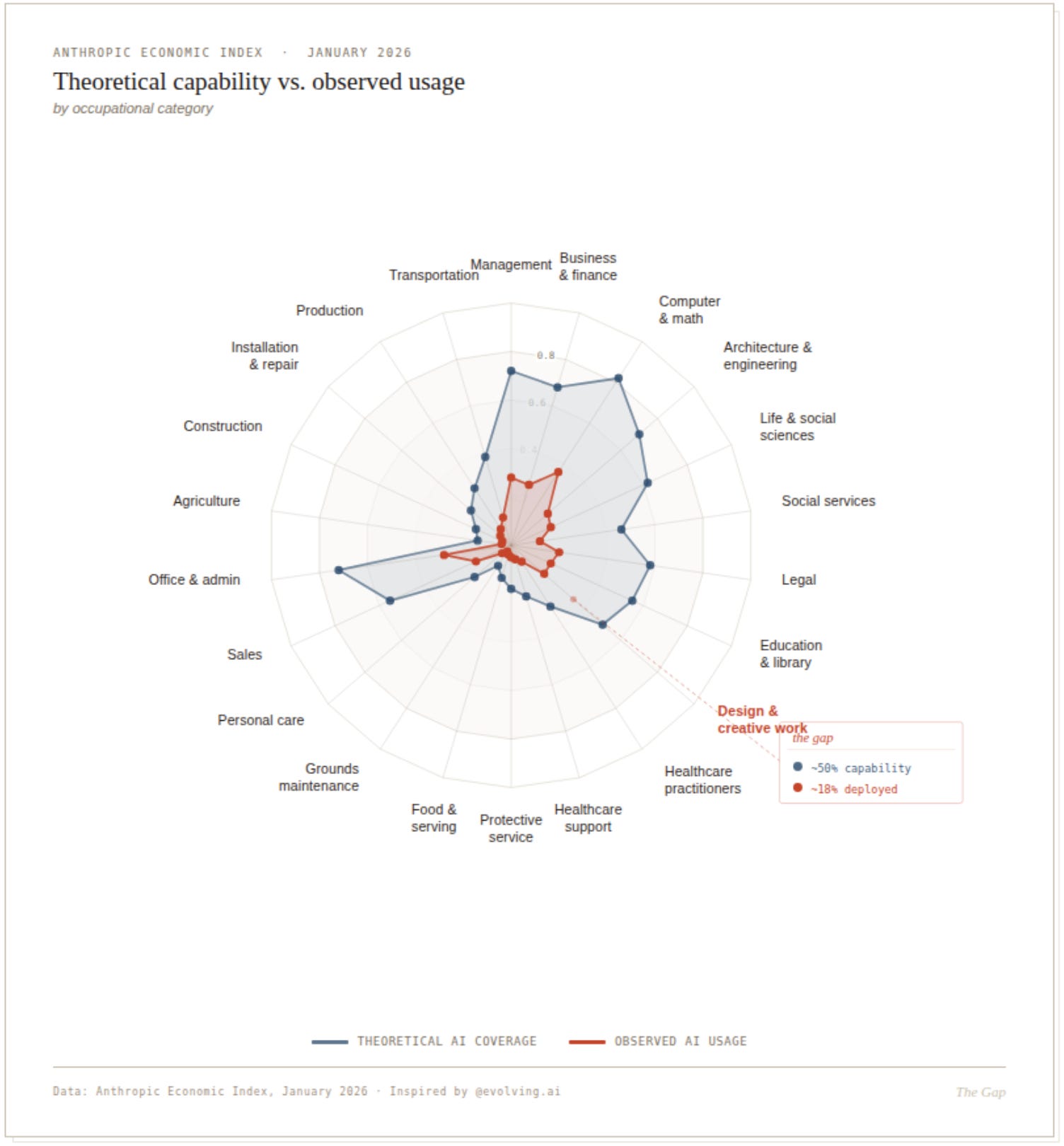
The report dropped earlier last month. It made the rounds. Arts, design, entertainment, and media — the second most AI-exposed occupational category in the economy. 10.3% of all Claude queries. Right behind computer and math work.
People read that and started concluding. Most of them wrong. Some are right.
The report describes what’s happening to production. It says nothing useful about judgment — what to build, why, and for whom. Those aren’t the same work. They never were. One is getting cheaper. The other is the only thing that decides whether cheaper execution actually matters.
That’s what this is about. The cost of that confusion just went up.
Anthropic’s economists introduced a metric called “observed exposure,” the gap between what AI can theoretically do and what organizations are actually deploying it for. For computer and math occupations, large language models could theoretically handle 94% of tasks. Actual deployment: about 33%. Design and creative work follow the same pattern. The capability exists. The adoption is still a fraction of what’s coming.
We are at the beginning of this curve.
Not the end.
What’s already in motion is real. Wireframes, UI variations, copy, prototypes — the production layer is compressing fast. In 2025, senior designers were regularly producing the output previously associated with teams of three. Entry-level roles built around artifacts — the handoff, the mockup, the redline — contracted hard. That’s not projection. It’s what the market did.
Most organizations read that as design losing value. It’s the opposite.
The work that got cheaper was always the least defensible part. AI can surface patterns in your retention data. What it cannot do is tell you what those patterns mean for the actual person behind them. The research, the hypothesis, and the judgment call about what a customer needs versus what they said they wanted. That’s still human work. It’s where the decisions that matter actually get made.
The Figma file was never the design.
It was the receipt.
You built the practice. Research capability. Designers are involved when product decisions get made. Processes that connect what customers say to what ships.
Your job right now is not to protect what you built. It’s to move it.
Companies that stand still turn this into a budget conversation before it becomes a strategy one. Leadership sees AI doing in an afternoon what took a week. The instinct is to cut. That instinct is understandable. It’s also the kind of decision that looks smart in Q2 and shows up as a competitive problem by Q4.
The answer is upstream. Before engineering picks up a ticket. Before a product decision gets made without customer context. Before a feature gets built around an assumption nobody thought to test. That’s where the investment belongs. In validating hypotheses early, in de-risking the roadmap before it becomes a sunk cost, in building knowledge about your customers that doesn’t live in a prompt and can’t be replicated by a competitor who skipped that work.
Your PM knows the roadmap. Your researchers know the method. Your designers know what the customer actually experiences when those two things collide. Separately, each is useful. Together — pointed at the same problem before anyone writes a line of code. They’re the most reliable way a product organization has to avoid building the wrong thing with total confidence. AI compressing execution doesn’t make that obsolete. It creates space for it. When nobody’s buried in production, you can work on the right problem instead.
Not fewer people.
Better work, earlier.
Nielsen Norman Group’s State of UX 2026 is direct about what’s happening in the market: the roles recovering and growing fastest treat design as strategic problem solving, not artifact production. The organizations moving design upstream are pulling ahead. The ones treating this as a cost reduction are falling behind. They just don’t know it yet.
Design at your company has mostly meant visual execution. Research happens after launch. Customer feedback lives in a support queue. You know who you are.
The old argument against investing in design was speed and cost. Research takes too long. Designers are expensive. We move faster by shipping and iterating. It was never a good argument. It was at least an honest one.
That argument is gone. Execution is cheap regardless of how you staff for it. AI commoditized the part of the process that was easiest to point at and hardest to justify. What’s left — what’s genuinely scarce — is judgment. Which hypothesis deserves your engineers’ time? What the customer actually needs versus what your roadmap assumes they need. Designlab’s 2026 survey of product designers across startups and enterprises found that as AI lowers the barrier to execution, strategic thinking becomes the skill that compounds. The execution gap between you and your competitor is closing. The judgment gap is widening.
Speed without judgment doesn’t make you competitive. It makes you precise about going the wrong direction.
Test assumptions before they become roadmap commitments. Treat a customer insight like a business asset. Get product, design, and research into the same conversation before a decision gets made. Not after. Execution is solved. The scarce thing is knowing what’s worth executing on. That’s what separates your product from one built by a team with identical tools, a similar budget, and no real idea who their customers are.
Every tools revolution in this industry produces two kinds of organizations: the ones that understand what changed, and the ones that mistake the tool for the work. Desktop publishing handed a generation of people a copy of PageMaker and the conviction that they were now, in fact, graphic designers. The internet convinced a generation of companies that having a website was a strategy. The second group always moved fast. They just moved fast in the wrong direction.
This is that moment.
Cheaper production has never built a better product. It builds more of them. The Anthropic data makes this concrete: AI usage in design and creative roles is at 10.3% of observed queries, and theoretical capability is multiple times higher than actual deployment. The gap between what AI can do and what organizations are actually using it for is still enormous. That gap will close. When it does, the organizations that redirected their people toward judgment — research, hypothesis, validation — will have already built something their competitors can’t replicate with a better prompt.
The ones that didn’t will have more output and the same problems.
Treat design like decoration, fund it like overhead, cut it when budgets tighten — then wonder why the product isn’t sticking. The tools got good enough to generate interfaces before most organizations figured out what an interface was actually for. That’s not a new story. It’s the same one, running faster.
The gap between what gets built and what people actually need hasn’t closed. It just got more expensive to ignore.
No posts
Comments
Nothing yet. Say the first thing.
Sign in to join the conversation.