
Let me tell you about the conversation I have at least once a week.
An author messages me. They’ve been on Substack for anywhere from three months to a year. They’re posting. They have subscribers, sometimes a few hundred, occasionally more. They’re doing what everyone told them to do: show up consistently, write about your book, build your platform.
And their book sales have barely moved.

They want to know what they’re doing wrong.
The honest answer is usually: nothing obvious. And that’s precisely the problem.

The gap for authors on Substack
There’s a version of Substack that functions as a holding pen. You write posts. A small number of people read them. The subscriber count ticks up slowly. You feel like you’re doing something, because technically you are. You’re publishing. You’re present. You’re building.
Except the readers who would actually buy your book have no idea you exist, because everything you’re doing is visible only to the people who already found you. Substack has a discovery layer, a genuinely powerful one, and many authors never give it the attention it deserves. They set up their publication, write their posts, and wait for readers to arrive through some mechanism they haven’t quite identified yet.
That mechanism is Notes. And the way most authors use it, or don’t use it, is where the whole strategy falls apart.
Notes is not a place to announce your posts. It’s not a place to share your Amazon link or tell people your book launched today. Somewhere I read that notes with links get less engagement than those without.
Notes is the part of Substack that functions like a public square, where people who have never heard of you can stumble across your thinking, decide you’re worth following, and eventually become the kind of subscriber who buys your book because they’ve been reading you long enough to trust you.
The authors who understand that distinction are playing a different game entirely.
has written non-fiction and is now writing a fiction series about women in later life. She’s doing some of the best work I’m seeing on Notes in terms of building a world and getting buy-in for the characters in her books:
What “building an audience” actually means
I’ve been running The Substack Bookstore for a year now. In that time I’ve watched authors use Substack every way imaginable, and the ones who see real traction share a few things in common that have nothing to do with how often they post or how good their writing is.
They treat their publication and their Notes as two separate jobs. The publication is for the people already in their world. Notes is for everyone else. If you’re writing Notes the same way you write your newsletter posts, you’re doing the equivalent of sending a direct mail piece to people who didn’t ask for it and then wondering why they’re not buying.
They also have a very clear answer to the question: what do I want a reader to do after they find me? Not “subscribe,” which is obvious. But after that. What’s the path from “I just found this person on Substack” to “I bought their book and left a review”? That path needs to be deliberate, not accidental. Most authors haven’t designed it at all.
And the ones who are actually converting subscribers to book sales have usually figured out how to talk about their book without talking about their book. They write about the ideas in it, the questions it raises, the world it’s set in, the research that surprised them, the reason they couldn’t not write it. The book itself becomes something readers feel like they already know before they’ve bought it.
The Substack problem specific to authors
Here’s something the general Substack growth advice doesn’t account for: your goal isn’t trying to build a media business. The goal is selling books. Those are related goals but they’re not the same goal, and the strategy that gets someone to 1,000 newsletter subscribers is rarely the strategy that gets them to 1,000 book sales.
Authors who treat their Substack like a general interest publication, posting about their life, their writing process, their thoughts on the industry, without a clear through-line to their actual work, end up with an audience that’s interested in them but not primed to buy. That’s a nice problem to have, but it’s still a problem if book sales are the point.
The through-line matters. Every piece of content you put out, whether it’s a full post or a thirty-word Note, should be doing one of two things: bringing new people into your world, or deepening the relationship with the people already in it. If it’s doing neither, it’s just noise you’re adding to your own feed.
I say this honestly and with all the kindness I can muster, even though it sounds harsh, because I’ve watched authors pour real time and energy into Substack and walk away thinking the platform doesn’t work for them, when actually the platform was fine and the strategy just needed adjusting.
What actually makes a difference
A few things I’ve seen make a genuine difference, based on a year of watching authors use this platform:
Posting Notes at low-competition times. The data on this is surprisingly clear. Early morning posts, especially on weekends, perform significantly better than the midday weekday window that most people default to, because there’s less content competing for the same reader attention. Scheduling four Notes a day at strategic times, rather than posting whenever you remember to, is a small change that compounds quickly.
Writing Notes in the 33 to 64 word range as a default. This comes from an analysis of nearly 19 million Notes and it tracks with what I’ve observed on my own account. Long enough to make a real point, short enough to read in one breath. The medium-length note, 80 to 200 words, is where engagement tends to drop off despite feeling like a reasonable middle ground.
Engaging genuinely in other people’s comment sections, not to promote your own work, but because Substack surfaces active participants and that activity translates to profile views that turn into subscribers.
And being patient with the compounding effect. The growth that looks sudden from the outside is almost always a year of consistent effort becoming visible. The authors who give up after three months of slow growth are usually three months away from the point where it starts to accelerate.
If you want to shortcut the learning curve
Everything I’ve just described, I learned mostly through trial and error over the past year. Some of it through my own account. Some of it through watching what worked for the authors I’ve worked with. Some of it through the kind of mistakes that are obvious in retrospect and expensive in real time.
learned it by building one of Substack’s most-followed author publications from scratch. Her approach to the platform, the mechanics of growth, the Notes strategy, the way to structure a publication so it actually converts, is different from mine in some ways and complementary in others.
From August 4-6, the two of us are running the Substack for Authors Bootcamp, three days of practical guidance for authors who want Substack to actually work for their books.
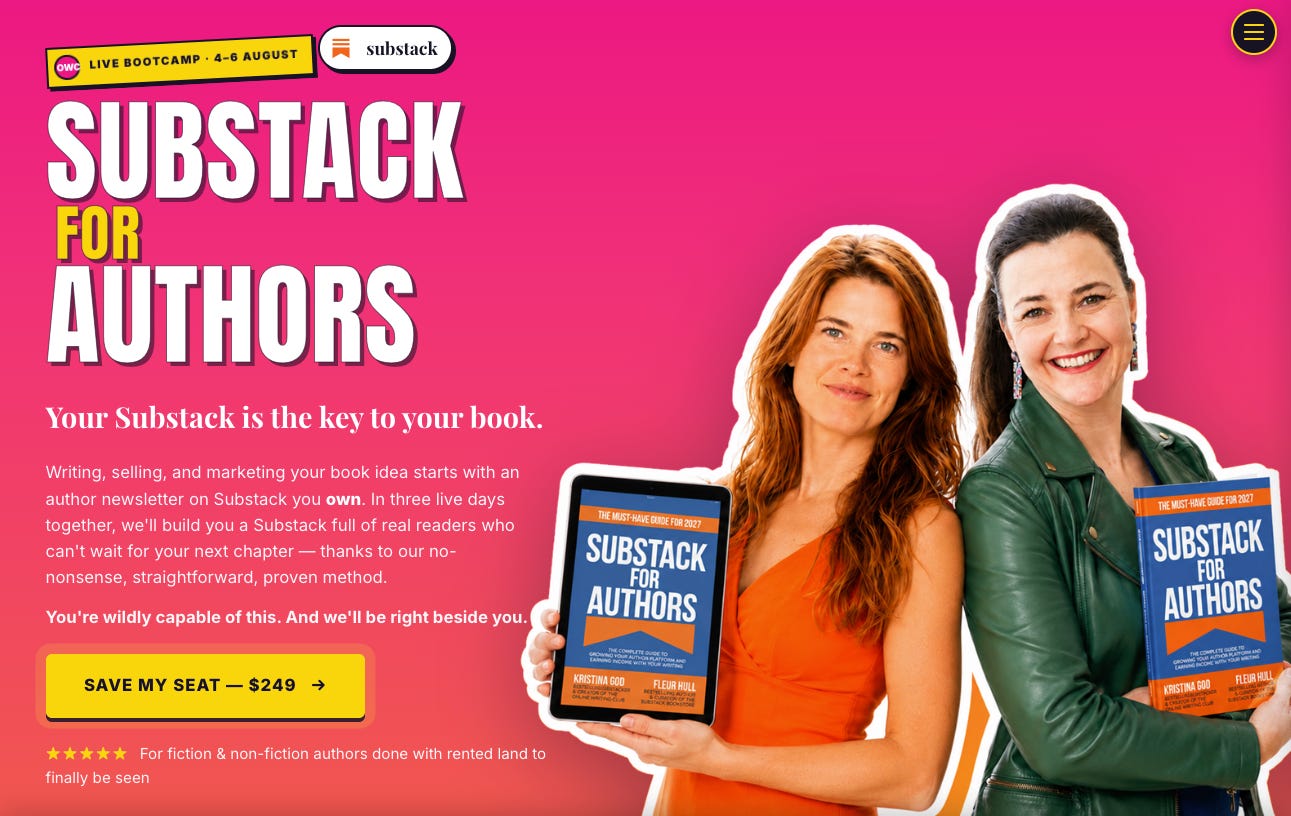
The specific decisions, the actual structure, the real strategy behind building a Substack that functions as a reader pipeline rather than just a newsletter that goes out into the void.
If you’ve been on Substack and wondering why it isn’t moving your books, or you’re about to start and want to do it right from the beginning, this is the place to start.
The Bootcamp runs 4 to 6 August. Details and registration are at substackauthor.com, and if you’re a Substack Bookstore subscriber, use code CELEBRATION for a significant discount off the standard price.
The platform works. The strategy just has to match what you’re actually trying to do.
The algorithm was never going to find these indie books for you. Subscribe free to read, or list your book with 3.5k+ readers who are ready to discover it.
Comments
Nothing yet. Say the first thing.
Sign in to join the conversation.