
Living for Two: Twin Loss Stories is a 2023 book written by journalist and triplet Pia Rockström. It explores the profound and unique grief experienced by surviving twins, reflecting the feeling of some, of having to live both for oneself and one's lost sibling. I connected with Pia after we met through the Lone Twin Network and read her book including 20 stories of twin loss at birth, in childhood and in adulthood from around the world. All of the stories are beautiful and touching, and I asked Pia to share the story of her sister Maria, and of writing her book. When I read Pia’s story I was struck by how long Pia had held that grief, before even she ‘found’ it inside her. Almost half a century…
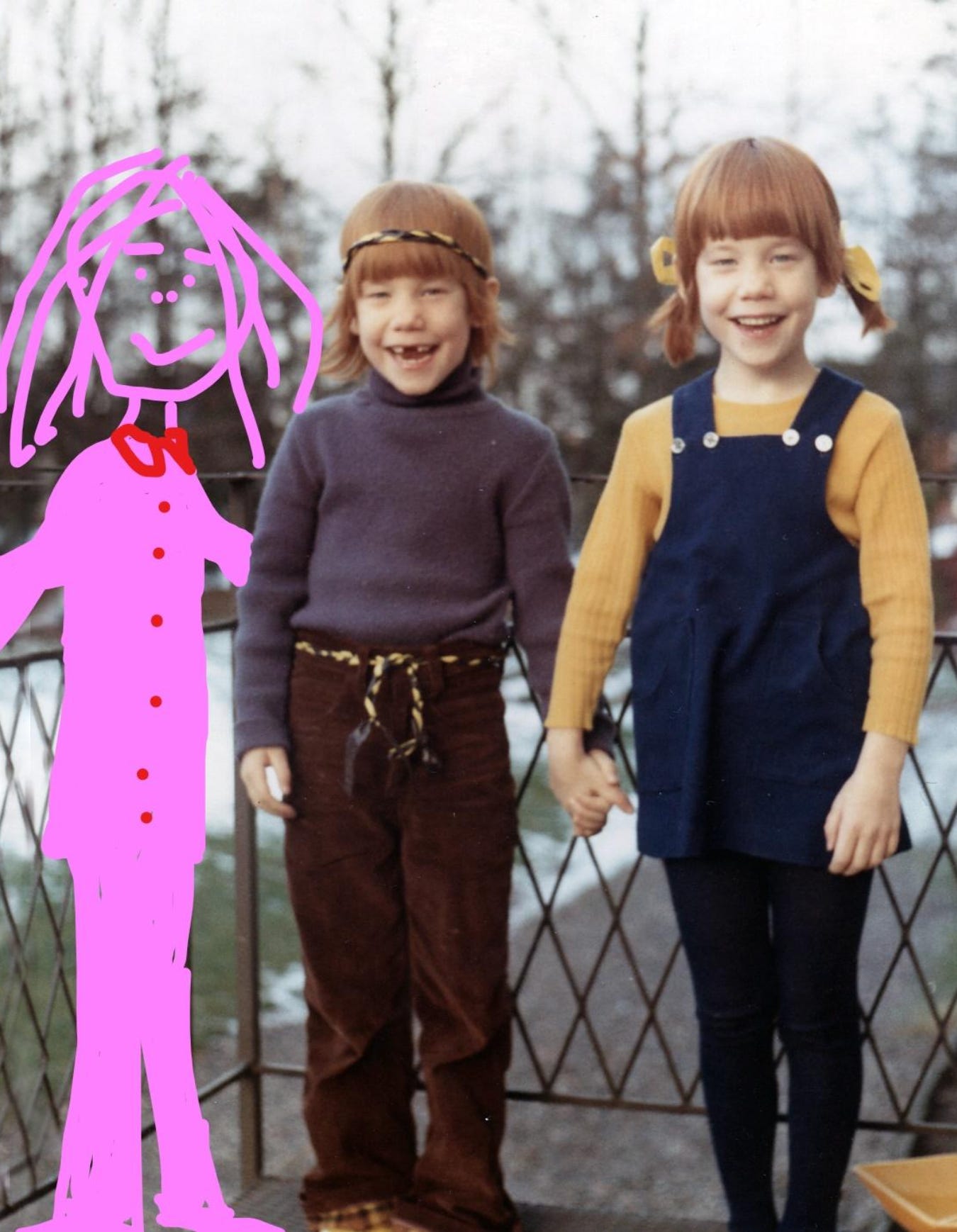
Sara and Pia, twins but also triplets
In memory of my sister Maria and all the twin souls who have gone first
When I was 54 years old, I was given access to my mother’s birth record. I saw in black and white the exact sequence of events, the October day in 1970 when my sisters and I were born. Ultrasounds did not become common in maternity care in Sweden until ten years later. Therefore, as a 23-year-old first-time mother, my mother came to the maternity ward in Lund with the belief that she was expecting one baby. It was only when she came in with contractions at week 35 that the staff discovered that there were three fetuses. That year, only seven of all births in Sweden were triplets. All three of us came into the world nine minutes apart. I, as number one, with my head first, just like my sister Sara who comes out number three. Between us, Maria is born breech. Maria is operated on for a left-sided diaphragmatic hernia and dies during the procedure.
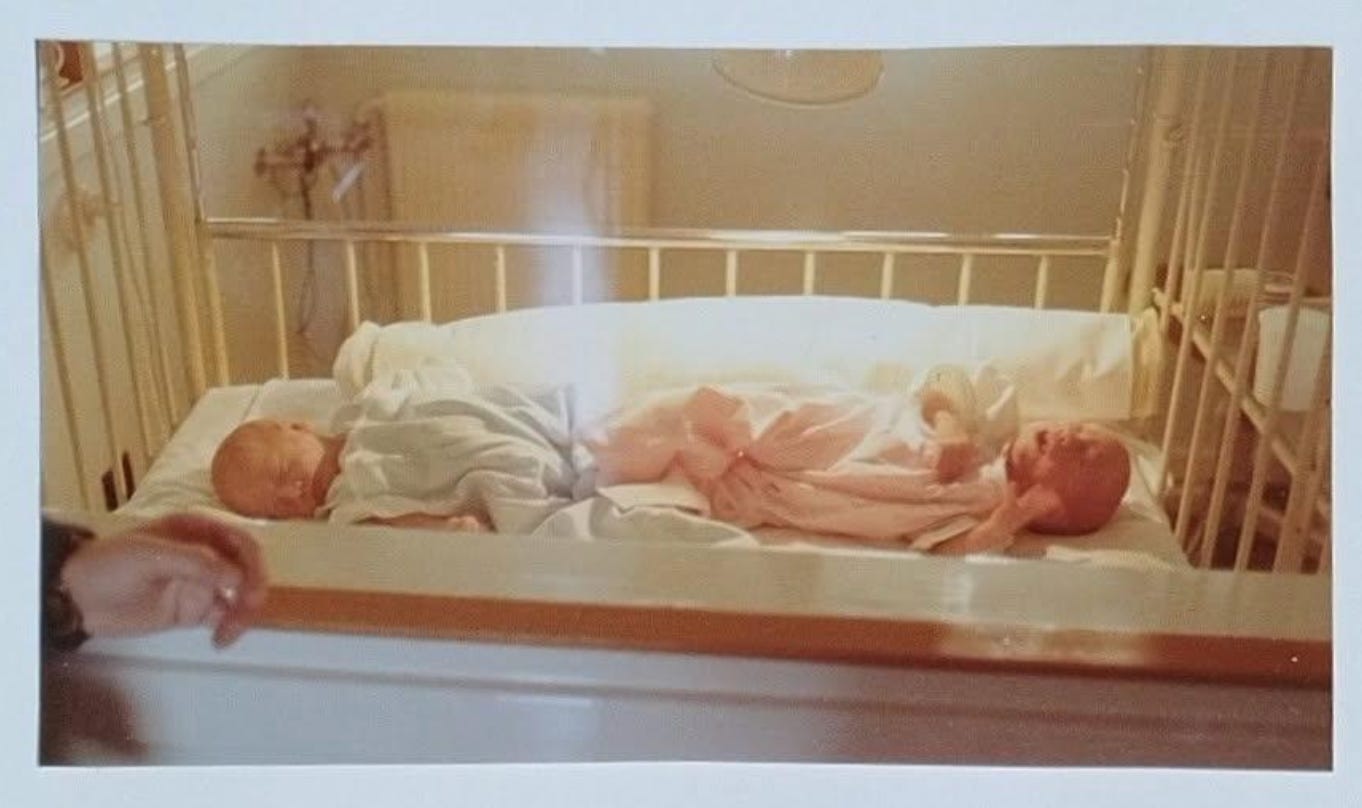
Pia and Sara the first month at Lunds hospital
We rarely talked about Maria in the family. When she is mentioned at some point, it is more practical, like me celebrating my name day on her day, Maria Day, when my name is not in the calendar. We two surviving sisters are tight and do most things together. I therefore did not think of myself as someone who carried grief.
It was only when I was over forty that the longing catches up with me during a yoga session. We travel through time, when we count down from our achieved age, with five-year intervals and feel what our body is telling us. I do not feel anything special in the exercise until the end when we have come down to the nine months that precede life. Then I burst into tears that couldn’t be stopped.
I cry loudly in the room, it is many years of grief over my sister that comes up. The incident made me want to know more about the twin relationship and how other lone twins have experienced twin loss. As a journalist, I see my opportunity to spread information about a subject that is barely covered in my home country of Sweden. I take a leave of absence from work and spend a year interviewing around twenty twins from Sweden, the USA, the UK and Norway who have lost their twin at some point in their lives.
if we had talked more about Maria at home, I would never have had to write a book
Sometimes I have thought that if we had talked more about Maria at home, I would never have had to write a book. Now the book is my way of facing my feelings. And I have really healed by hearing other people’s stories. I have understood that I am not alone in the experience of walking with unconscious grief that has arisen in the middle of life. I met another set of triplets who lost their brother when they were two years old. When Jan, who came from the same egg as Alf, did a stomach massage at the age of 25, the grief over his brother came up.
The parents were not told where the children who died went
I was also deeply moved by Ingrid, an lone twin who lost her sister at birth in 1950s Sweden. At that time, it was common for stillborn children to be buried in already open graves. The parents were not told where the children who died went. They were spoken of in silence, all pregnancies would end happily, it was seen as best that the parents had no relationship with the child.
That interview made me search for Maria on a page of Swedish graves. For the first time, I saw her name in text, Maria Holmberg, Lund pastorate, which states the day of our birth but also the day she was buried. But the most healing thing is knowing that since the 1970s in Sweden, parents have been given the option to hold a funeral for children who die at birth. My parents got to say goodbye with a funeral where my sister lay in a small white coffin. Before that, she was also baptized and given her name, Maria.
Grief can hide deep inside a twin who has lost their twin at birth, and it feels important to share that fact.
It is so easy for those around them to only see twins who have lost their twin in their teenage years or as adults. But grief for someone with whom you shared the time of conception can leave deep traces. The bond is already created in the womb and is permanent. Important research that can explain the depth of such grief has been done by Italian psychotherapist Alessandra Piontelli. Through ultrasound, she has followed twins’ relationship with each other in the fetal stage. She has categorized their behavior in the womb as “the playing pair”, “the hostile pair” and “the hugging pair”. She has then shown that the relationship patterns they have with each other in the womb tend to continue even after birth.
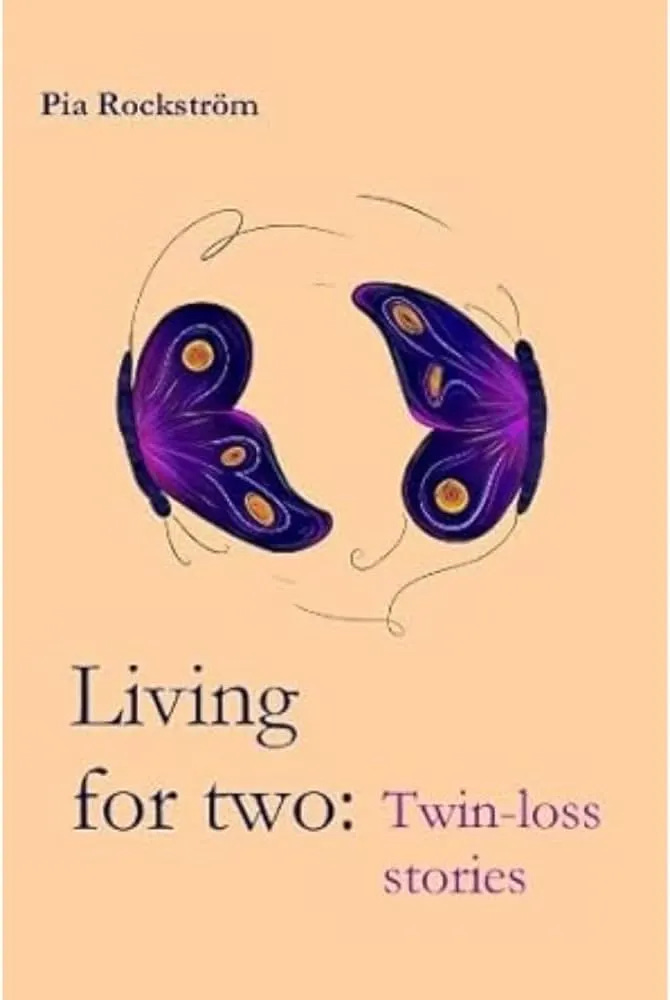
My interviews eventually became the Swedish book Leva för två, which was translated into the English book Living for two, published by Free Association Books in London. It was only after the book was finished that I got to see my mother’s birth record. Thanks to that, I had the opportunity to meet the midwife who took me and my sisters in. I found her name in the birth record and learned from a mutual acquaintance that she was now over eighty years old. Even though she, Anita, did not remember our birth, it was nice to meet her with my sister Sara and share all her experience. She had only been a practicing midwife for three years when she had her first triplets, and then worked in the profession for almost fifty more years.
The more I open up and let Maria be a part of my world, the more powerful and strong I feel
I can recommend that parents of lone twins allow the surviving twin to see the birth record when they are old enough. The record clearly showed me that my sister was in such a bad condition that life on earth was not preferable. I could read how the medical staff made several attempts to keep her alive, how she was met with professionalism, which has helped me accept that I did not get to share life here on earth with her. I also hope that my book Living for two will provide comfort in that I and other twins often feel a kind of connection with our twin siblings after a loss. It’s as if the bond is so strong that not even death can break it. I’ll tell you more about my experiences of meeting other lone twins in a future post.
Until I became an attending neonatologist, I would never have imagined this situation existed; that there may have been a triplet pregnancy but where only two babies survived. It’s possible that as a resident or fellow I met families like this; I don’t know or remember. I had always been aware that we struggled to know what to do, or say, on the NICU when there were twins, where only one baby survived, and that led to the Butterfly Project. Triplets are much less common, and the challenges faced when there are only two survivors are unique. Not better or worse than singleton loss, or twin loss. But unique and different. I have now met several triplet families like Pia, and their stories are profound and deeply moving.
I don’t know what the “take home” message from Pia’s story is. There are probably many. But every time I listen to parents or siblings speak or write like this it continues to strike me what a privileged life I have led.
Pia carried her grief for Maria for almost half-a-century before she realised it was there. I never thought that could happen. Of course, it’s possible to suppress ‘trauma’ for years, but Pia’s grief was and is different.
I have heard health professionals caring for bereaved families say, or heard from the parents direct that they’ve been told, “you’ll get over it”. If there’s an important take away for health professionals from Pia, it is that the grief of baby loss lives with you forever.
We never know what someone else is going through. We will never know what it feels like to be Pia, or Dani or the other siblings and parents who will write here in the Butterfly project. I hope it makes all of us behave and act with more kindness, compassion and gratitude.
Have a nice day :)
No posts
Comments
Nothing yet. Say the first thing.
Sign in to join the conversation.