
“The need to know was at odds with a desire to close down the senses.”
- W.G. Sebald, On the Natural History of Destruction
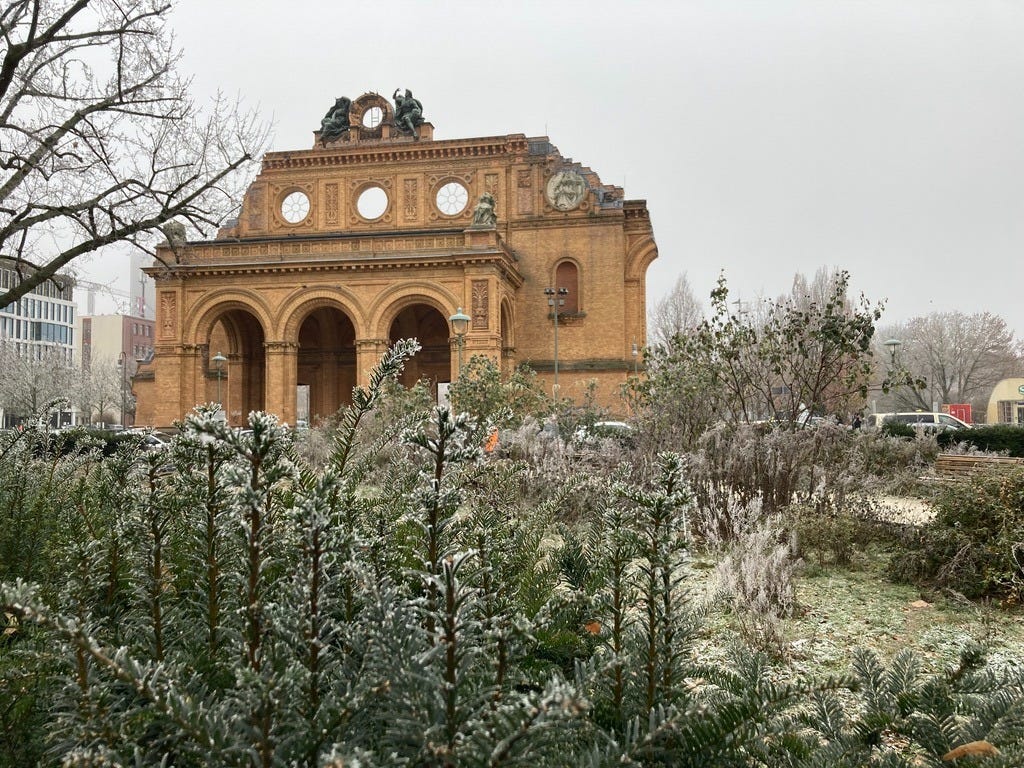
Half a mile southeast of Potsdamer Patz along Stresemannstrasse sits the remains of Anhalter Bahnhof, previously one of the busiest and most important train stations in Berlin. Largely destroyed during World War II, the station was briefly brought back to service after the war before being closed permanently in 1952 as relations between allied occupying powers deteriorated: the train station was in West Berlin but the tracks primarily served Soviet-controlled East German locations.
I have thought about Anhalter Bahnhof a lot in the past few weeks, or more precisely, I have thought about a plaque in front of it, which reads (emphasis mine):
In early June 1942 the Nazis began deporting Berlin’s aged Jewish citizens to the ghetto camp of Theresienstadt. The ‘old people’s transports’ started here at Anhalter Bahnhof and continued almost until the end of the war. By March 1945 over 15,000 Jews had been deported from Berlin’s railway stations to Theresienstadt, which is now in the Czech Republic. Anhalter Bahnhof was a busy central passenger station. A total of 116 ‘Theresienstadt convoys’ left from here, normally consisting of 50 or 100 persons. In all, over 9,600 people were deported from this station.
The deportations took place amid the normal station traffic.
For the Theresienstadt convoys, two special 3rd class coaches were usually coupled to the regular passenger train to Dresden or Prague that departed from Platform 1 at 6:07 a.m.
The deportees, mostly elderly men and women, had been brought to the station from an assembly point by tram or truck in the early morning. Their clothing and baggage hardly marked them out from the other passengers on the platform. But unlike them, the deportees wore the yellow star for Jews and were surrounded by guards. This was clear for all to see.
The Nazis described Theresienstadt as a ghetto for the aged, but it was actually a transit camp, a stopover. Those who survived dying of disease or exhaustion there were sent further eastwards, mainly to Auschwitz.
Three Berlin railway stations were used for deportations during the Nazi dictatorship: Bahnhof Grunewald, Moabit Goods Depot and Anhalter Bahnhof. From October 1941 to March 1945, over 50,000 Jews were deported from Berlin. Their destinations: the ghettos and extermination camps in the German-occupied territories of Eastern Europe. Only a few survived.
Anhalter Bahnhof was unique among Berlin deportation sites in that, rather than using freight wagons, Jewish residents of Berlin were loaded into ordinary train carriages that were connected to ordinary trains which ran according to a published timetable. The plaque’s emphasis on the ways in which genocide was carried out in close proximity to public life casts an inconvenient doubt on the stories (fantasties?) that we tell ourselves about how we might act if our neighbors were being taken away in front of our eyes.
In the US, ICE is the latest in an unbroken chain of semi-secret police organizations that have been mandated to carry out state violence since this country was founded. So while on some level there’s nothing new to see here, there is a quality of brazenness and impunity that is jarring: driving through Phoenix this year, there’s a notable increase in traffic stops carried out by armed men driving unmarked SUVs, the trucks usually parked diagonally up on the curb in a performative act of urgency, doors left open and sirens blaring.
These traffic stops are the most visible sign of an infrastructure that is deeply entrenched in my community. The ICE Phoenix Field Office (2.5 stars on Google Maps) is down the street from my kid’s school. The so-called agents who deploy from the field office go on to take detained/kidnapped individuals to one of four Arizona detention centers easily searchable and filterable on the ICE website. From there, individuals who are sent out of Arizona are processed at the Arizona Removal Operations Coordination Center (AROCC) which isn’t on the ICE website because it’s subleased from a companay called Strategic Equity Investors. AROCC is located at the Phoenix-Mesa Gateway Airport next to a private jet facility and down the street from a CrossFit gym. While AROCC is intended as a short-term transit facility, the Arizona Mirror reports that this isn’t always the case: a Venezuelan man with no felonies against him was recently held at the facility for 42 days before being deported to Mexico.
The “ICE Air” fleet that operates out of Mesa includes planes owned by the government, including the Boeing 737 that previously served as JD Vance’s campaign jet, as well as chartered flights often brokered through opaque government contracts with third party logistics companies. Avelo Airlines, a commercial airline that will fly your family down to Florida for spring break also carried out nearly 2,000 flights on behalf of ICE between May and December 2025 before the program was shut down this month due to “business decisions”, aka a successful public boycott of the airline.
All of this is happening in broad daylight—it’s clear for me to see. And so I’m grateful to organizing efforts like The Data Deportation Project, Global Detention Project, and ICE Flight Monitor and as well as local initiatives like PHX Rapid Response for helping me to build a more nuanced understanding of the humanitarian crisis that I live in the midst of. This decentralized act of collective observation, of keeping the receipts on authoritarianism, is an essential yet insufficient act of resistance. Change only happens when brave people act on these observations, because the Democrats aren’t going to save us, asAshley Fairbanks astutely remarked on Instagram the other day:

Thanks for reading,
– Grif
Comments
Nothing yet. Say the first thing.
Sign in to join the conversation.