
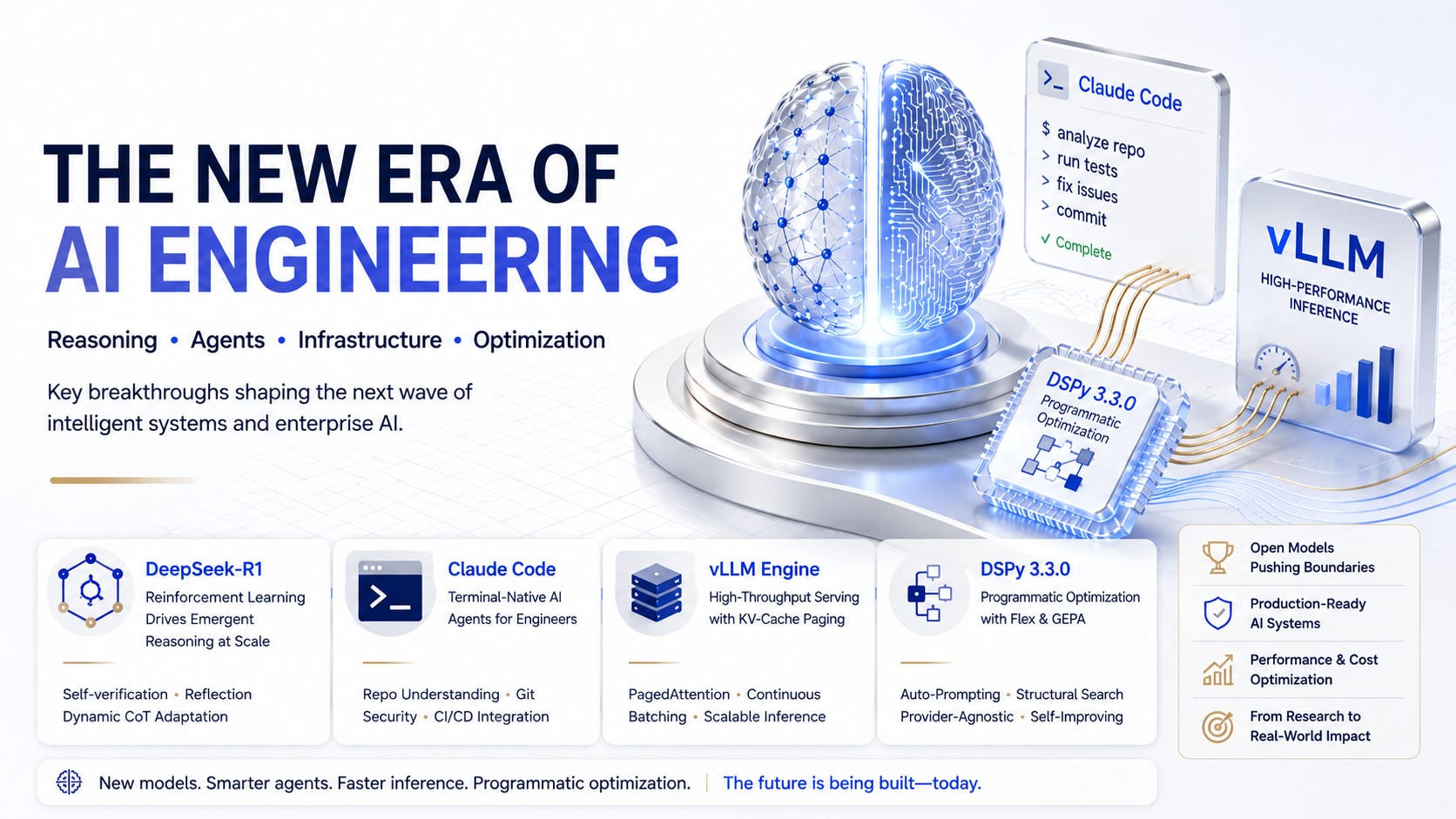
The artificial intelligence landscape is undergoing a structural paradigm shift from pure supervised fine-tuning (SFT) toward reinforcement learning-driven reasoning, paired with localized high-throughput serving architectures and terminal-native agent execution. Empirical evidence demonstrates that large-scale reinforcement learning without preliminary human demonstrations incentivizes self-reflection, verification, and dynamic chain-of-thought strategy adaptation. Concurrently, enterprise engineering workflows are shifting toward agentic development environments operating directly within command-line interfaces and continuous integration security pipelines. To meet these compute demands efficiently, model serving frameworks are maturing through dynamic memory scheduling, paged key-value attention allocation, and automatic hyperparameter optimization. This report analyzes state-of-the-art open reasoning architectures, production-grade terminal agents, and high-performance inference platforms driving current technical developments.

What Happened: DeepSeek introduced DeepSeek-R1-Zero and DeepSeek-R1, proving that advanced chain-of-thought reasoning capabilities can emerge purely through large-scale reinforcement learning (RL) without preliminary supervised fine-tuning (SFT). DeepSeek-R1-Zero applies RL directly to a 671-billion parameter Mixture-of-Experts base model (activating 37 billion parameters per token), giving rise to natural self-verification, reflection, and dynamic strategy adaptation. To resolve formatting repetition and language mixing observed in DeepSeek-R1-Zero, DeepSeek-R1 incorporates a cold-start data stage before RL, followed by secondary alignment stages. DeepSeek subsequently distilled these reasoning patterns into dense models ranging from 1.5B to 70B parameters based on Qwen2.5 and Llama3, establishing new open benchmarks where the distilled 32B model outperforms competitive closed models across mathematical and coding evaluation suites.
The Technical Primer: Traditional language models learn by mimicking human-written text patterns, which caps their performance ceiling to the quality of training demonstrations. Reinforcement learning without human demonstrations acts like a self-playing algorithm: the model explores thousands of computational pathways to solve math or code problems, receiving numerical rewards only when the final verification check passes, thereby discovering optimal internal verification strategies independently.
Why It Matters:
Architectural Significance: Validates that complex reasoning trajectories, intermediate step verification, and long chain-of-thought generation can be incentivized natively via rule-based RL without reliance on expensive human annotations.
Enterprise Implications: Distillation of 671B reasoning traces into 1.5B–70B dense checkpoints allows resource-constrained organizations to deploy state-of-the-art reasoning capabilities on standard enterprise hardware.
Downstream Research Impact: Establishes open distillation methodologies and inspires open-source reproduction pipelines across the research community.
Key Takeaway: Pure RL training incentivizes emergent reasoning capabilities that can be economically distilled into lightweight edge-deployable models.
What Happened: Anthropic introduced Claude Code, an agentic coding tool operating natively within terminal command-line interfaces, integrated with local development environments and automated GitHub workflows. Built to execute natural language commands across whole repositories, Claude Code handles refactoring tasks, git workflows, and shell commands directly. Complementing this runtime, Anthropic released the Claude Code Security Review Action for GitHub CI/CD pipelines, which performs deep semantic code analysis on pull requests rather than relying on traditional static pattern matching. The release cycle includes version 2.1.223, introducing sandboxed credential masking, cross-session state teleportation (
claude --teleport), and customizable focus views.The Technical Primer: Traditional developer tooling relies on static analysis tools that search for rigid syntax patterns, missing deeper contextual logic flaws. Terminal-native agentic environments operate like an automated developer with direct shell access, analyzing complete repository syntax trees and diff histories to identify security vulnerabilities and execute command sequences safely within sandboxed OS processes.
Why It Matters:
Architectural Significance: Shifts AI developer tools from isolated web chat interfaces into context-aware CLI execution with full filesystem and tool execution capabilities.
Enterprise Implications: Reduces false positives in security scanning by applying LLM semantic reasoning to pull request diffs, filtering low-impact noise.
Downstream Workflow Impact: Standardizes Workload Identity Federation (OIDC) between GitHub Actions and enterprise AI endpoints, eliminating hardcoded secret management.
Key Takeaway: Command-line agentic integration embeds deep semantic reasoning directly into daily version control and deployment pipelines.
What Happened: The vLLM serving framework continues to refine high-throughput inference engine standards through PagedAttention, continuous request batching, and chunked prefill mechanics. Developed out of UC Berkeley’s Sky Computing Lab and maintained across industry partners, vLLM manages key-value (KV) attention memory dynamically in virtual memory pages, dramatically reducing GPU memory fragmentation. Recent updates optimize quantization formats including FP8, NVFP4, and GPTQ, while integrating distributed execution through Tensor Parallelism (TP) and Data Parallelism (DP) across diverse accelerator backends. Complementing the engine, the release of GuideLLM offers automated benchmarking and synthetic load-generation tools for capacity planning.
The Technical Primer: Standard LLM serving reserves rigid, oversized contiguous blocks of GPU memory for every request’s context history (KV cache), leading to severe memory waste. PagedAttention operates like operating system virtual memory, breaking key-value attention tokens into dynamic, non-contiguous physical memory blocks allocated on demand, maximizing GPU compute density.
Why It Matters:
Architectural Significance: Eliminates up to 80% of KV-cache memory waste, enabling higher concurrent request capacity and continuous batching efficiency.
Enterprise Implications: Lowers deployment operational expenditure by allowing large 70B and 405B models to execute across minimal GPU topologies via optimized TP/DP configurations.
Downstream Operational Impact: GuideLLM provides realistic production trace replays and operational boundary mapping for enterprise service-level agreements.
Key Takeaway: Dynamic virtual memory allocation for key-value attention caches is essential for scaling enterprise LLM serving economics.

What Changed: Stanford NLP’s DSPy framework released version 3.3.0, introducing programmatic optimization capabilities that transform language model development from manual prompt crafting to compiled Python modules. The release features
dspy.Flex, a framework primitive that allows the structural decomposition of an AI program to be optimized automatically. Rather than fixing a model’s architectural control flow (such as hardcodedPredictorReActloops),dspy.Flexuses Generative Evolutionary Prompt Adaptation (GEPA) to search across the execution space, rewriting intermediate predictors, tool calls, and control flow structures based on user-defined metrics.Why This Matters: Manual prompt engineering is brittle and fails to adapt when switching between model providers or updating underlying weight checkpoints. DSPy abstracts prompts into declarative signatures (e.g.,
question -> answer), decoupling system logic from specific instruction strings. By compiling programs against labeled evaluation datasets, DSPy automatically synthesizes few-shot demonstrations, instruction mutations, and structural control flows that consistently outperform hand-crafted prompts.Technical Breakdown (Easy to Understand): Traditional prompt engineering is like writing code in machine language where every word must be manually adjusted for a specific chip. DSPy acts like a high-level compiler: developers write clean declarative logic in Python, and the optimizer automatically tests, tunes, and compiles the underlying prompts and execution steps to run efficiently on any target language model.
Industry Impact: Standardizes software engineering rigor within generative AI pipelines, enabling deterministic continuous integration, version control of prompt artifacts, and provider-agnostic model routing.
Opportunities Created: Engineering teams can construct self-improving retrieval-augmented generation (RAG) pipelines, multi-agent workflows, and classification systems that automatically re-compile and optimize whenever newer baseline models are deployed.
What Happens Next: Production architectures are shifting toward compiled agent runtimes where prompts are generated as version-controlled JSON artifacts, minimizing inference variability while maximizing accuracy.

What It Is: An open-source implementation of large-scale reasoning-oriented reinforcement learning training focused on simplicity, scalability, and GPU colocation. The framework utilizes a single-controller trainer design that co-locates training and generation phases on identical hardware to maximize GPU utilization.
Why It Matters: Demonstrates that reasoning RL pipelines can achieve competitive performance on AIME2024 and MATH500 benchmarks using a tenth of the training steps required by standard baseline implementations.
Potential Use Cases: Fine-tuning mathematical, scientific, and domain-specific reasoning models on single-node or enterprise GPU clusters.
Learn more: Official Website, Documentation
What It Is: A reinforcement learning framework built upon veRL for training language models to interleave chain-of-thought reasoning with real-time search engine tool calls.
Why It Matters: Extends pure RL reasoning paradigms to open retrieval environments, enabling models to verify intermediate facts dynamically via local or online search retrievers.
Potential Use Cases: Building open-source DeepResearch alternatives, automated research agents, and enterprise knowledge retrieval systems.
Learn more: Official Website, Documentation

DeepSeek-R1 Technical Paper
A comprehensive study documenting how pure reinforcement learning incentivizes reasoning capabilities in large language models without supervised fine-tuning demonstrations.Claude Code GitHub Actions Deployment Guide
Official documentation outlining Workload Identity Federation (OIDC) setups, security permission boundaries, and automated pull request workflows.High-Performance LLM Serving Architecture with vLLM
Technical breakdown of PagedAttention, continuous batching configurations, and multi-GPU tensor parallelism strategies.

1. Reinforcement learning without initial supervised demonstrations generates dynamic self-verification and chain-of-thought strategy adaptation, establishing rule-based RL as a core post-training technique.
2. Distillation transfers complex reasoning behaviors from 671B base models into lightweight 1.5B–32B dense models, enabling high-tier mathematical and coding execution on local edge devices.
3. Developer tooling is moving from browser GUIs toward terminal-native agent runtimes embedded directly within filesystems, shell execution, and continuous integration workflows.
4. Memory management techniques like PagedAttention in vLLM eliminate memory fragmentation, serving as the foundational standard for enterprise inference efficiency.
5. Declarative module systems like DSPy compile instructions and search spaces automatically against quantitative metrics, removing manual prompt fragility.

Tool: Unsloth Studio
Why It Matters: Delivers no-code local fine-tuning and local agent integration via
unsloth start, reducing VRAM consumption by 70% while supporting multi-GPU hardware setups.What Opportunity It Creates: Enables engineering teams to fine-tune specialized domain models locally without incurring cloud API usage fees or exposing internal datasets.
Explore: https://unsloth.ai/docs/new/studio
Research Paper: Reproduce DeepSeek R1 Survey & OREAL Framework
Why It Matters: Explores token-level reward assignment and imitation mechanisms to reproduce R1-style reasoning without requiring massive model distillation datasets.
What Opportunity It Creates: Offers lightweight training recipes for researchers seeking to apply reinforcement learning on domain-specific reasoning benchmarks.
Explore: https://arxiv.org/abs/2502.06781
GitHub Repository: DSPy Stanford Repository
Why It Matters: Replaces hand-written prompt templates with compiled Python pipelines that optimize instructions and few-shot examples automatically via GEPA and MIPROv2 search algorithms.
What Opportunity It Creates: Allows engineering organizations to build regression-tested AI systems that automatically re-compile and optimize when baseline models are updated.
Explore: https://github.com/stanfordnlp/dspy
Comments
Nothing yet. Say the first thing.
Sign in to join the conversation.