
Hello!
Welcome to today’s edition of Business Analytics Review!
Most production ML failures do not start with bad algorithms. They start with a silent mismatch between the data someone thinks they trained on and the data that actually reached the training script. Teams still copy folders named “final_v3_clean” into shared drives, then wonder why a model that scored 0.91 in the notebook collapses to 0.67 after a colleague re-labels two thousand images. The paradox is brutal: the more sophisticated the model, the more fragile the entire system becomes without immutable data lineage. Reproducibility is not a research luxury. It is the only way to answer the question regulators, auditors, and your own future self will ask: exactly which rows, labels, and preprocessing steps produced this artifact?
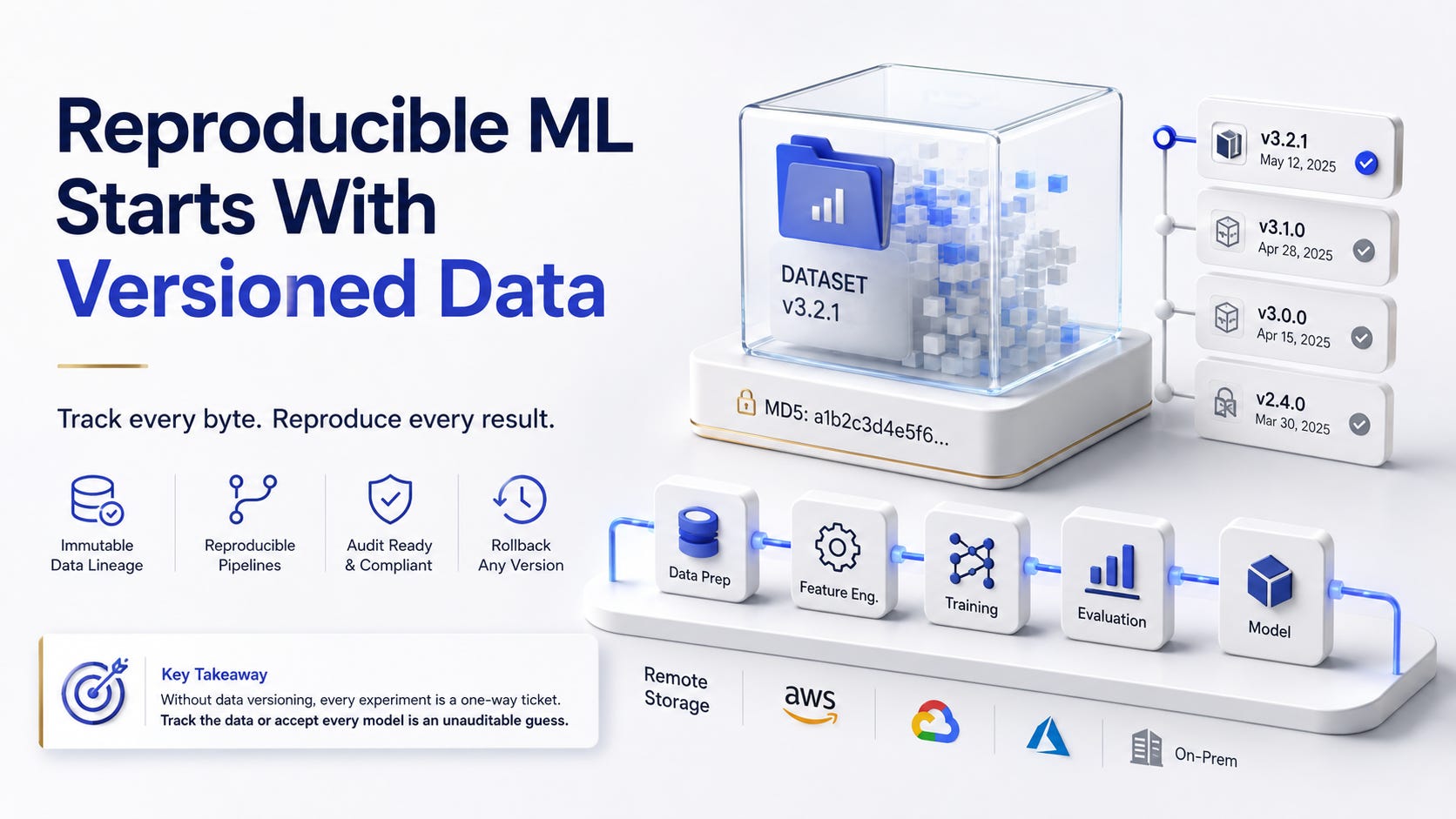
Without deliberate data versioning, every experiment is a one-way ticket. You cannot roll back, you cannot isolate the impact of a new annotation batch, and you cannot prove that the model in production matches the one that passed validation. Tools such as DVC turn that chaos into Git-style history for datasets that routinely exceed tens or hundreds of gigabytes. The result is traceability that survives team turnover, storage migrations, and compliance audits.
Legacy workflows treat data as an afterthought. Engineers commit code to Git and shove raw files into object storage or a shared network mount. The only link between the two is a hard-coded path or a comment in a README. When the dataset grows, someone adds a new CSV; when labels improve, someone overwrites the old one. Hashes are never recorded. Pipeline stages become brittle because no one can prove whether a given training run used the January snapshot or the March correction. Debugging then consumes days of detective work: re-running old notebooks, hunting for forgotten local caches, and arguing over which Slack message described the “correct” split.
The cost is both computational and organizational. Retraining from scratch after an undetected data drift wastes GPU hours. Silent label changes produce models that look better on paper yet degrade in production. Governance requirements under frameworks such as the EU AI Act demand documented lineage of training data; ad-hoc folder versioning supplies none of it. Even simple Git LFS fails at scale: repositories bloat, clone times explode, and binary diffs become unusable. The architectural flaw is fundamental. Code is text and small; data is binary and large. Treating them with the same tool creates friction that only grows with every new experiment.
Key Takeaway: Reproducibility collapses the moment data versions are not first-class citizens of the same commit history that tracks code and parameters. Track the data or accept that every model is a black box you can never fully audit.
Content-Addressed Pointers: Modern data versioning replaces the actual files in the repository with tiny metadata files that store cryptographic hashes. DVC, for example, writes a .dvc file containing the MD5 of every tracked object. Git commits that lightweight pointer while the real bytes live in a local cache or remote object store. Checking out an older Git commit followed by a single dvc checkout command restores the exact dataset that existed at that moment, without ever bloating the Git history.
Pipeline Codification and Selective Re-execution: Beyond simple file tracking, tools capture entire directed graphs of stages: data preparation, feature engineering, training, evaluation. Each stage declares its dependencies and outputs. When only a preprocessing script changes, the system re-runs only the affected downstream stages. This turns the ML workflow into a reproducible build system analogous to Make, but aware of data hashes instead of mere timestamps. Metrics and model artifacts become first-class outputs that travel with the same version history.
Remote Storage Abstraction and Branching Semantics: Data lives wherever the team already keeps it (S3, GCS, Azure, on-prem). Versioning tools push and pull only the changed objects, using hard links or copy-on-write where possible to avoid duplication. Higher-level systems such as lakeFS extend the model to full Git-like branching and merging over petabyte lakes, enabling isolated experiment sandboxes that cost almost nothing in storage. The combination gives both individual data scientists and platform teams the same mental model they already trust for code.
A computer-vision team at a mid-size logistics firm spent nine months iterating on a defect-detection model. Every sprint they pulled the latest labeled images from an annotation platform into a shared folder. When a new labeling guideline arrived, the annotation vendor updated files in place. Three months later the model’s precision on the held-out set dropped six points. No one could identify which batch of corrected labels had been used for the previous champion model. Retraining from the current folder produced a different distribution of errors, and the team lost two full weeks reconstructing the earlier state from local backups and Slack screenshots.
They introduced DVC. Every annotation export became a versioned directory. The training pipeline was declared in dvc.yaml so that any change to the data hash automatically invalidated downstream stages. Within two sprints they could switch between any historical data snapshot in under a minute. Model promotion now required a Git tag that pointed to both the code commit and the corresponding DVC data pointer. Debugging time for data-related regressions fell from days to hours. The same lineage later satisfied an internal audit that asked for the exact training set behind the model still running in production warehouses.
Your AI can reason about your marketing. It cannot remember the click.

It sounded right. It was guessing. Your export: last-click, one channel, 30 days. Your customer touched six things over four months.
Free 30-min workshop with SegMetrics founder Keith Perhac. Connect AI to full-funnel attribution data. For marketers & founders spending real money on ads. No code.
Strategic roadmaps must treat data versioning as infrastructure rather than an optional convenience. Evaluate tools by how cleanly they integrate with existing Git and object-storage workflows, by the latency of checkout operations on your typical dataset sizes, and by the storage cost of retaining multiple historical versions. Favor systems that keep large objects out of Git while still providing immutable, content-addressed references; otherwise the cost of cloning and the risk of accidental overwrites will dominate.
On the execution side, make data versioning part of the definition of done for every experiment. Require that every training run records the exact DVC or lakeFS commit hash alongside the code hash and hyperparameters. Build simple checkout-and-reproduce scripts that any new team member can run in a fresh environment. Align skills so that data engineers own the remote storage configuration and caching strategy while model developers own the pipeline declarations; the shared language of commits and hashes then becomes the coordination mechanism.
Pipeline Diagnosis Prompt: Feed an LLM your current dvc.yaml plus the output of dvc status and dvc metrics show. Ask: “List every stage whose dependencies have changed since the last successful run, explain why the hash differs, and propose the minimal set of stages that must be re-executed. Output a shell script that runs only those stages.” Use the generated script as a starting point for selective repro.
Lineage Reconstruction Prompt: Paste the .dvc files from two Git commits together with the corresponding metrics.json. Prompt: “Compare the two data versions. Identify which files changed, estimate the volume of new or modified samples, and generate a short audit paragraph suitable for a model card that describes the exact data lineage of each model.”
Governance Check Prompt: Provide a list of remote storage paths and the set of Git tags used for production models. Ask: “For each production tag, verify that the referenced DVC remote objects still exist and have matching hashes. Flag any missing or mismatched objects and produce a remediation checklist that a junior engineer can execute.”
Tutorial: Data and Model Versioning
This official DVC walkthrough takes readers from a simple image-classification notebook to a fully versioned pipeline. You learn how dvc add, dvc checkout, and dvc stage add turn large datasets and model weights into Git-trackable objects while keeping the actual bytes in remote storage. The core takeaway is that a single pair of git checkout + dvc checkout commands restores an entire experiment state. Read MoreData Versioning: ML Best Practices Checklist 2026
A practical checklist covering semantic versioning for datasets, automated tracking, TTL policies, and governance. It compares DVC, lakeFS, Git LFS and others, then spells out what to version (raw inputs, labels, features) and how to avoid common pitfalls such as overwriting labeled data in place. Readers finish with a clear decision framework for choosing tools by team size and data volume. Read MoreML Data Versioning with DVC: How to manage machine learning data
A concise operational guide that shows the exact commands for adding data, pushing to remote storage, and switching versions. It emphasizes treating models the same way as datasets and demonstrates how DVC prevents the classic “which CSV did we actually use” problem. Ideal for teams that already live in Git and want to extend the same discipline to data. Read More
Let’s catch up on some of the latest happenings in the world of AI and Data Science
Nvidia and Wall Street Assemble $500B AI Financing Engine
Nvidia is partnering with major Wall Street firms on a potential $500 billion financing package for AI infrastructure, supporting chips, power, and data centers as Big Tech spending accelerates.
SpaceX and Tesla Plan $16.8B AI Chip Factory in Texas
SpaceX and Tesla will initially invest $16.8 billion in Terafab, a massive Texas semiconductor complex designed to secure AI chip capacity for robotics, vehicles, and space-based data centers.
Microsoft Expands India AI Infrastructure
Microsoft has opened its largest Indian data-center hub in Hyderabad, expanding to four cloud regions as AI demand accelerates, backed by a $20.5 billion investment commitment and major enterprise customers.

DVC remains the most widely adopted open-source tool for bringing Git-style versioning to datasets, models, and ML pipelines. It stores only lightweight hash-based metafiles in Git while the actual large files live in any remote storage the team already uses. Operators gain the ability to switch between historical data versions in seconds, declare reproducible pipelines that re-run only changed stages, and share exact experiment states across machines without ever committing gigabytes to the repository.
Learn more.
Comments
Nothing yet. Say the first thing.
Sign in to join the conversation.