
Hello!
Welcome to today’s edition of Business Analytics Review!
Most teams treat fairness as a post-training checkbox. Train the model, check accuracy, then run a quick demographic scan and call it responsible. That sequence is exactly why high-stakes systems keep failing in production. When historical data already encodes unequal outcomes, the model learns those patterns as signal. The result is not a rare edge case. It is the default behavior.
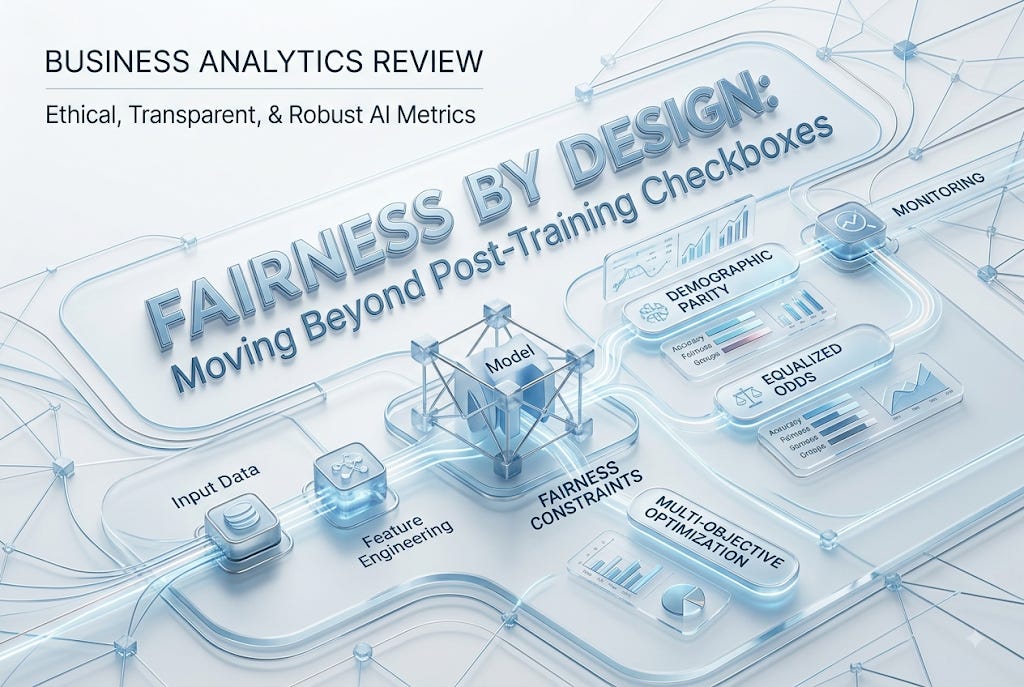
Consider lending or hiring pipelines that appear highly accurate overall yet systematically under-serve certain groups. The model is not “broken.” It is faithfully optimizing the objective it was given on the data it was given. Demographic parity and equalized odds expose the gap between overall performance and group-level reality. Without those metrics baked into the development loop, transparency claims collapse under scrutiny, and robustness evaporates the moment the population shifts.
The deeper issue is architectural. Bias enters at data collection, feature engineering, objective design, and deployment thresholds. Treating it as a single mitigation step after the fact is like trying to remove noise after the model has already fitted it. Teams that wait until the audit stage pay in rework, legal exposure, and lost trust.
Default machine-learning workflows optimize a single scalar loss, usually cross-entropy or mean squared error, on aggregate data. That objective has no term for group disparity. When protected attributes correlate with the target (even indirectly through proxies such as zip code or prior outcomes), the optimizer amplifies the correlation. The model becomes more accurate for the majority subgroup and less accurate for others. Accuracy on the full test set stays high while error rates diverge.
Fairness metrics reveal the structural flaw. Demographic parity requires that the rate of positive predictions is statistically independent of group membership. Formally, the selection rate should be roughly equal across groups. In practice this often conflicts with base-rate differences in the data. Equalized odds goes further: it demands that true-positive rates and false-positive rates are equal across groups. A model can satisfy demographic parity yet still produce unequal error structures, or satisfy equalized odds at the cost of overall accuracy. The mathematical impossibility results (Kleinberg et al. and others) show that calibration, equalized odds, and demographic parity cannot all hold simultaneously unless base rates are identical or the predictor is perfect. Legacy pipelines ignore these trade-offs, so the “best” model on accuracy is frequently the least fair.
The operational cost compounds. Retraining after an audit is expensive. Threshold adjustments or post-processing can restore one metric while degrading another. Without continuous monitoring, concept drift reintroduces bias. Teams that treat fairness as optional documentation rather than a first-class constraint end up with systems that look robust in the lab and fragile in the field.
Key Takeaway: Fairness is not a post-hoc filter. It is a multi-objective constraint that must shape data selection, loss design, and evaluation from the first experiment.
Building ethical, transparent, and robust AI requires three interlocking pillars that replace the old accuracy-first pipeline.
Data and Representation Discipline: Bias originates upstream. Teams must quantify representation gaps, proxy variables, and historical label bias before any model is trained. Techniques such as reweighting, stratified sampling, or synthetic augmentation under fairness constraints reduce the raw disparity that later metrics will measure. Documentation of data provenance and known limitations becomes part of the model card, not an afterthought. Without this step, every downstream metric is measuring a contaminated signal.
Metric-Driven Multi-Objective Training: Demographic parity and equalized odds must sit alongside accuracy in the evaluation suite and, where feasible, in the training objective. In-processing methods add fairness regularizers or adversarial debiasing so the optimizer explicitly trades off group disparity against predictive performance. Post-processing methods adjust thresholds per group after training. The choice depends on whether the use case prioritizes equal selection rates (hiring, lending) or equal error rates (medical diagnosis, risk scoring). Practitioners compute both metrics on every candidate model and surface the Pareto frontier rather than declaring a single winner.
Lifecycle Transparency and Robustness Loops: Transparency means more than publishing a model card. It requires continuous monitoring of fairness metrics in production, drift detection on both performance and disparity, and clear escalation paths when thresholds are breached. Robustness testing includes stress evaluation on under-represented subgroups and counterfactual probes that ask how predictions change when sensitive attributes are flipped. These practices turn fairness from a compliance exercise into an operational control system that keeps models aligned as data and populations evolve.
A mid-size financial services team building a credit underwriting model faced classic disparity. Overall AUC looked strong at 0.87, yet the false-positive rate for one demographic group was nearly double that of the reference group. Demographic parity difference exceeded 0.18 and equalized odds gaps were visible in both true-positive and false-positive rates. Initial attempts at simple threshold adjustment restored one metric while tanking another and reducing overall approval volume.
They shifted to a structured experiment. First they audited the training data for proxy features and reweighted samples. Then they trained with Fairlearn’s reductions approach targeting equalized odds while monitoring demographic parity as a secondary constraint. After three iteration cycles the equalized odds gap fell below 0.05, demographic parity difference dropped under 0.08, and overall AUC declined only 0.02 points. Production monitoring dashboards now track both metrics weekly. Debugging time for fairness-related tickets fell by roughly 40 percent because the team already possessed the measurement infrastructure and the trade-off documentation. The model shipped with a clear model card that listed the chosen metrics, the observed gaps, and the residual risks.
Strategic roadmap planning must treat fairness metrics as first-class requirements rather than optional add-ons. Evaluate architecture choices (pre-processing, in-processing, or post-processing) against the specific harm you aim to reduce, then quantify the accuracy-fairness and latency cost of each option. Budget for continuous monitoring infrastructure; the one-time mitigation cost is almost always lower than repeated post-deployment remediation.
On the execution side, embed fairness evaluation into every model comparison and A/B test. Maintain a short list of protected attributes and the two or three metrics that matter for your domain. Align team skills so data scientists, product owners, and compliance staff share a common language for trade-offs. Regular tabletop exercises that inject synthetic drift and measure metric response keep the process sharp.
Metric Selection Prompt: Feed your use-case description, protected attributes, and base-rate statistics into an LLM with the instruction: “List the two most relevant fairness metrics from demographic parity, equalized odds, equal opportunity, and predictive parity. For each, state the mathematical definition, the primary harm it prevents, and one concrete failure mode if the other metric is ignored. Output in a structured table.” Use the output to document the rationale before any training begins.
Bias Audit Workflow: Export prediction probabilities, true labels, and group indicators. Prompt: “Given this CSV summary of selection rates, TPR, and FPR by group, compute demographic parity difference and equalized odds gaps. Flag any group where the absolute difference exceeds 0.05. Suggest three concrete mitigation steps ranked by expected impact on the larger gap.” Iterate the prompt with updated numbers after each mitigation experiment.
Counterfactual Robustness Check: Construct a small set of near-identical feature vectors that differ only on a sensitive attribute. Prompt the model (or a surrogate) to score both versions and then ask an LLM: “Compare the score delta. If the absolute difference exceeds the decision threshold margin, explain possible proxy pathways and propose a feature ablation test.” Run this weekly on a held-out slice to catch emerging sensitivity.
Common fairness metrics (Fairlearn documentation)
This official guide walks through demographic parity, equalized odds, and related metrics with precise definitions, assumptions, and practical caveats. Readers learn when each metric is appropriate, how the metrics conflict, and how to interpret results in real assessment pipelines. Read MoreAI Fairness: Metrics, Criteria, and Best Practices
Snowflake’s overview covers group fairness concepts, demographic parity, equalized odds, and mitigation approaches (pre-, in-, and post-processing). It emphasizes choosing the criterion that fits the use case and documenting the inevitable trade-offs rather than chasing every definition at once. Read MoreA Review of Fairness and A Practical Guide to Selecting Context-Appropriate Fairness Metrics in Machine Learning
This arXiv paper provides a structured flowchart for choosing metrics based on twelve criteria that include data bias, model assessment needs, and regulatory context. Practitioners gain a decision process that links philosophical and legal considerations to concrete metric selection. Read More
Let’s catch up on some of the latest happenings in the world of AI and Data Science:
Nvidia Eyes $3B SB Energy Investment for OpenAI Project
Nvidia is reportedly negotiating a $3 billion investment in SoftBank’s SB Energy to support OpenAI’s planned Ohio data center, splitting funds between project signing and SB Energy’s upcoming IPO.
DeepSeek Unveils Flagship V4 Pro with Premium Pricing
DeepSeek officially launched its advanced V4 Pro model, priced up to 14 times higher than V4 Flash, aiming to monetize enhanced AI agent performance amid fierce domestic market competition.
Google Launches Cost-Effective Gemini 3.7 Flash for Coding and Agents
Alphabet’s Google introduced Gemini 3.7 Flash, an upgraded, low-cost AI model optimized for software development and multi-step autonomous agent workflows, while leaving the timeline for its flagship Pro model unannounced.

Fairlearn is an open-source Python package that lets teams assess fairness metrics such as demographic parity and equalized odds, then apply mitigation algorithms including reductions and threshold optimization. It integrates cleanly with scikit-learn pipelines so fairness evaluation becomes part of ordinary model comparison rather than a separate research project. Operators use it to surface group disparities early, quantify trade-offs against accuracy, and document the chosen constraints for audits and model cards.
Learn more.
Comments
Nothing yet. Say the first thing.
Sign in to join the conversation.