
I’m Polina Panasenko, a political science major and journalism minor, and I’m here to report on mental health in wildland firefighting.
While the demand for wildland firefighters in Colorado grows, their job doesn’t get easier.
Sixteen-hour work days, exposure to smoke, and the obvious dangers of fighting fire have been some of the most prominent challenges. And yet, despite some estimates showing approximately 20% of firefighters developing post-traumatic stress disorder, and at least 100 firefighters taking their own lives yearly, not a lot might be publicly said about the mental struggles that firefighters endure.
According to the National Fallen Firefighters Foundation, firefighters develop post-traumatic stress at a similar rate to military service members.
Robin Verble, a wildland firefighter occupational health worker and spouse of a wildland firefighter, conducted her own research and surveys, which found half of wildland fire dispatchers that responded said they personally knew someone who took their own life.
She outlined her findings in a recent TEDx Talk. Here’s one slide from it:
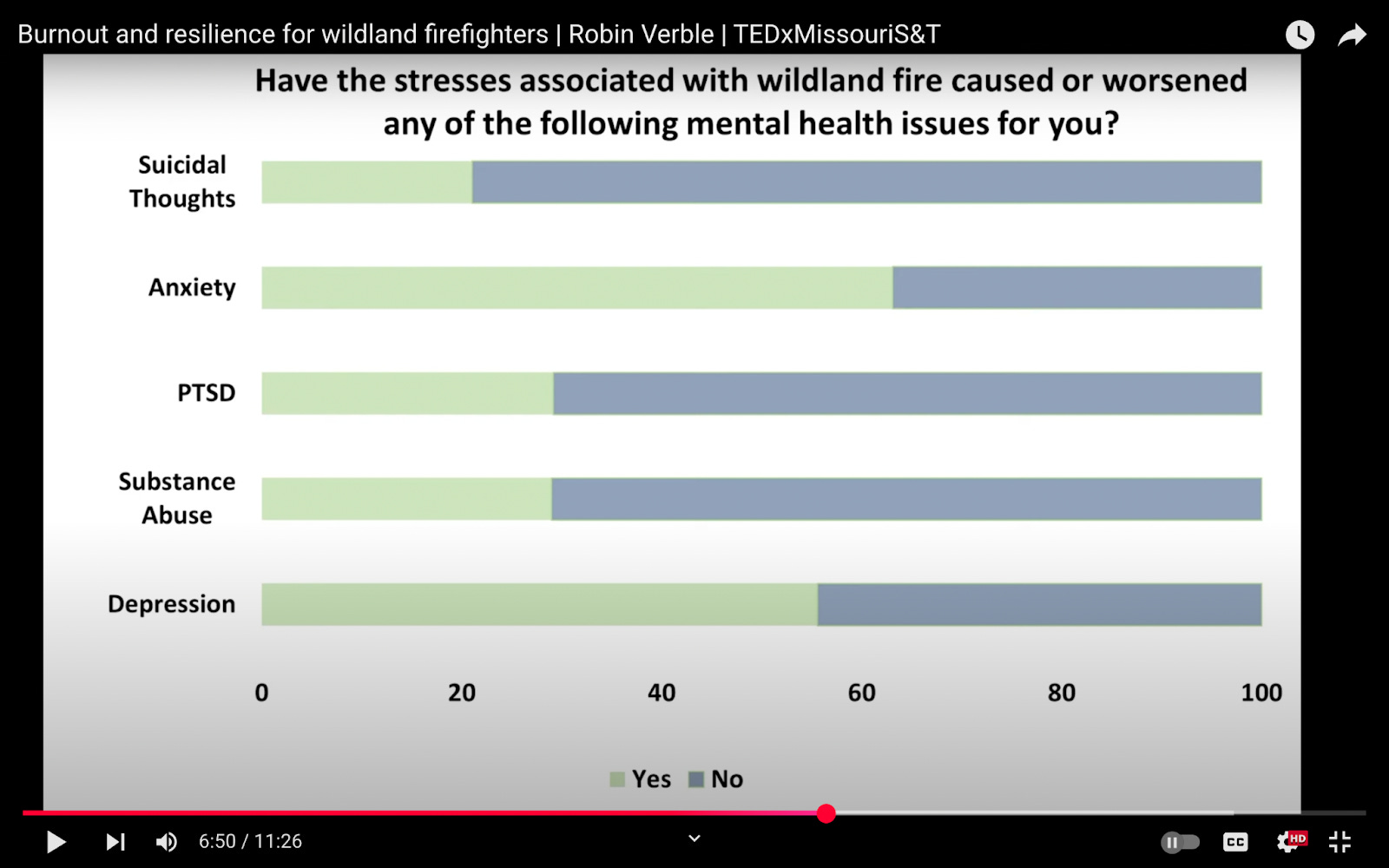
Wildland firefighters, she said, also reported increased levels of anxiety, depression, and substance abuse as a result of their jobs, something they have to deal with regardless of being on the fire line.
Verble pointed out that being a firefighter puts a strain on the entire family.
“Most wildland fire families report high levels of conflict, they report financial strain, difficulties reintegrating a partner when they return from these long deployments, and lots of anxiety and worry associated with their partner’s job,” Verble said in her TEDx talk.
Chris Mangiarelli, field operations manager and crew boss for Stone Mountain Fire Protection, reflected on his experience of working as a firefighter. His wife works as an administrator for the same agency.
“How do we not make work all of our relationship, right?” he said. “So we will have a conversation. All right, I’m done talking to my work wife, I’m gonna talk to my wife now.”
Firefighting is physically and mentally exhausting, but both Mangiarelli and Verble highlight the importance of family as a support system and encourage proactive decisions to stabilize work-life balance for wildland firefighters.
In his work, Mangiarelli manages a crew of roughly 20 firefighters.
“So, my job as a field operations manager is to oversee every one of my staff, not just to take an engine out or not just to take them on the field,” he said. “I oversee them 365 days a year for what they’re doing and what they need.”
As a person responsible for an entire crew, Mangiarelli forms a family-like environment within his team. Communication, honesty, safety, and respect are the core of his leadership style, and those are the very things forming the atmosphere where people become more than colleagues.
“It’s hard to just be a number sometimes,” Mangiarelli said. “We want them to know that we have their back out there.”
Besides resources available during the off-season, wildland firefighting crews also have counselors present on the fire site.
Joe Ortega, an engine boss for Stone Mountain Fire Protection, said some firefighters utilize the immediate help available to them, but many might refuse to talk to a professional.
In an industry defined by danger and risk, this is an understood and common sentiment. People, it turns out, are not the only resource available to first responders.
“One of the things I love is that they bring out the therapy dogs,” Mangiarelli said. For someone working a strenuous job away from family and friends, it is a small but necessary “serotonin dump,” as he described it.
In 2022, the National Wildfire Coordinating Group released a new edition of its Incident Response Pocket Guide (IRPG), with updates that included policy changes aimed at prioritizing firefighters’ personal safety.
Page 18 of the IRPG describes four situations in which firefighters have the right and obligation to report safety issues:
Violation of safe work practices
Environmental conditions make the work unsafe
The individual lacks the necessary qualifications or experience
Defective equipment is being used
These changes may seem minor, but they are a big shift from the “go, go, go” mentality of firefighting. Instead of encouraging reckless behavior, instructors during training go over the process of reporting safety issues, proposing alternative solutions, and critically evaluating the risks.
Both Magiarelli and Ortega teach certification courses at Colorado Firecamp in Salida, where they conduct group trainings to demonstrate the necessity of prioritizing personal safety. This approach is crucial for maintaining a healthy lifestyle as a firefighter, both physically and mentally.
There is still much to be done to ensure that wildland firefighters can access the resources needed to maintain their lives and jobs.
Another issues is gender bias on the fire line.
Kat Pedersen, training coordinator and forestry supervisor at Colorado Firecamp, recalls multiple situations where she was not given credit for her work or was outwardly disrespected.
“We [fire crew] were listening to the radio, and there was a conversation taking place and it was people calling in about women in firefighting, and so many people were saying how women didn't belong in fire, that they belonged more in the kitchen, that they couldn’t see how a woman could save someone out of a burning building,” Pedersen recalled.
“There are some really strenuous things, but there are ways that women can do exercises and strength training,” she said. “Firefighting is a team sport. There are rarely things that we do alone.”
Spreading awareness is one step toward directing society’s attention to wildland firefighters and taking action to make their lives easier as a form of gratitude for their work in keeping people safe in some of the most remote areas.
I’m Max McKee, a Film and Media Studies major, interested in how firefighters are able to safely, comfortably, and effectively fight fires.
Fire isn’t the only danger many firefighters face anymore.
According to the International Association of Fire Fighters, a North American firefighters union with more than 350,000 members, the leading cause of deaths for firefighters isn’t fire, it isn’t smoke, and it isn’t falling debris.
Nearly three quarters of IAFF members who died in 2023 lost their lives to occupational cancer, according to the IAFF website. A study of Canadian firefighters from 2007-2021 also reported cancer death rates as high as 84% annually.
Working around hazardous, burning material has the potential to bring firefighters in contact with cancer-causing carcinogens, but the firefighters union believes there might be another cause.
From 2022-2023, firefighters or firefighter unions filed multiple lawsuits alleging that it is the very equipment that keeps them safe that is causing the unusually high cancer rates.
What the IAFF argues is so dangerous is the coating applied to gear to make it waterproof.
Having a waterproofing layer is essential for firefighters, as it prevents their clothes from getting drenched in water or oil while working. One of the most common and effective ways to do this is to use a group of chemicals called per-and-polyfluoroalkyl substances, or PFAS. What makes them effective is that they create a barrier to moisture, a durable water repellent or DWR layer, that remains functional despite exposure to heat or extreme wear and tear.
The problem is that PFAS are part of what scientists refer to as “forever chemicals.”
Made as a byproduct of the plastics industry, and because of their unique chemical composition, they’re almost impossible to break down under any natural circumstances.
A 2024 study found that regular use and care caused structural firefighter turnout gear to shed PFAS, leaving more than double the amount of PFAS on the surface than that found in unworn gear.
If these forever chemicals get onto a firefighter’s skin, or get into their bloodstream, they can be absorbed by the body and end up staying essentially forever.
PFAS have been found in much higher concentrations than average in the blood of municipal firefighters, and scientific studies have linked PFAS in drinking water to higher risk of cancer later in life.
In response, multiple cities have implemented plans to incorporate PFAS-free equipment into their fire departments in the coming years. Vancouver is set to become the first city in North America to have a firefighting force with completely PFAS-free turnout gear, and San Francisco is set to have PFAS-free equipment by June of 2026.
This new gear will still have a moisture barrier like the old PFAS equipment, but it will be made of compounds that have not yet been linked to cancer. While development is still underway, some of the materials tested struggle with being able to repel oil as well as PFAS-coated materials, although the new equipment has been certified for use.
While municipal fire departments have taken steps to transition away from PFAS, the same can’t be said about wildland fire agencies.
“It’s tragic that, down the road, we’re seeing an increase in cancer especially in wildland firefighters,” said Kat Pedersen, a wildland firefighter for more than 40 years.
“The hardest part for us,” she said, “is we are ‘fix-it, go-to’ people that want to make things better and fight that fire.”
Studies have shown that wildland firefighters show significant levels of PFAS on their skin after just a single day’s work. Pair with this that some wildland firefighters will go weeks without a shower while fighting a fire, and that the USDA reports that “Skin becomes 400% more absorptive for every 5-degree increase in core body temperature,” and you might find a high cancer risk among wildland firefighters.
“I trust my greens and yellows, but I also know their limitations,” Pedersen said, referring to her fireproof clothing worn on the job.
In a 2024 study of 32 textiles sampled from equipment across all sorts of firefighting work, the single highest concentration of PFAS was found on a piece of wildland fire equipment.
“What tends to happen is something is used for several years, and then all of a sudden we start to see the downside of it,” Pedersen said.
Although Pedersen believes that the protective equipment needs an update, a bigger concern for her is the changing nature of how wildland firefighters do their job.
“It’s no longer just a simple wildland fire,” she said. “We’re seeing more and more urban interface fires.”
When fire spreads from forests into residential areas, it enters what firefighters refer to as the wildland urban interface, or WUI. By building homes surrounded by heavy vegetation, the WUI becomes an incredibly fire-prone and unsafe place to live, although that hasn’t stopped people from moving there in droves in recent years.
Between 1990 and 2010, the number of U.S. homes built in the WUI increased by 46% — a number that only continues to grow, according to studies by the USDA. Currently, about half of Colorado’s population lives in the WUI.
When fires burn through there, wildland firefighters are often charged with putting out house fires, despite not having the proper protective breathing equipment that structure fire teams have.
“There’s so many carcinogens that are off-gassed by a structure, or a vehicle, or even household garbage that is on fire, that our gear doesn’t protect us,” Pedersen said.
Structure firefighters have the ability to bring air tanks with them so that they can safely work around burning buildings.
Wildland firefighters don’t have that same ability, and end up breathing in anything that might be in the smoke. “There’s nothing you can do on the wildland side to protect yourself from that,” Pedersen said.
Municipal fire teams also have the benefit of groups like the IAFF that can fight for them. Wildland firefighters, on the other hand, are spread across multiple federal or state agencies, and can be independent contractors.
“We really don’t have that same collective bargaining of what a union would have for gear and health and safety and all these different things,” Pedersen said.
But there is change in the wind for wildland firefighters. The lengths that the IAFF have gone to have brought attention to the issue of firefighter cancer across the board.
“Even those agencies that aren’t union benefit from the union,” Pedersen said.
And things are changing at Colorado Firecamp, where Pedersen works as the training coordinator and forestry supervisor. The biggest take away from the multi-day basic firefighter class is safety, and how firefighters can work together to make sure everyone walks away from a fire at the end of the day.
“I think for us in wildland, still our biggest risk is cancer,” Pedersen said. “We all want to have long happy careers doing this.”
I’m Theo Tannahill, a political science and journalism student interested in how policy and law affect our ability to live with and fight wildfires.
The City of Denver passed a slate of decisive ballot measures in November, but the effect of a change to work status requirement for firefighting jobs remains to be seen.
Between establishing collective bargaining rights and a slaughterhouse construction ban, an amendment to the city charter concerning immigration status emerged as one of the tightest issues for Denver voters.
Officially called “Denver Referred Question 2T,” the bill, which removed the United States citizenship requirement for serving as a firefighter or police officer, passed by only 4,579 votes out of 331,495 cast. The ballot measure came in the midst of a presidential election riddled with debates over immigration, and a rightward national shift on the topic of immigration.
Question 2T’s narrow win removed language in the Denver city charter that stated applicants to the classified service “shall be citizens of the United States,” opening up positions in the fire and police department to green card holders and legal resident non-citizens of the United States.
Despite the removal of this barrier, no non-citizens have been hired, according to the organization overseeing the program.
On Feb. 12, 2025, the Denver Civil Service Commission, which is the commission tasked with hiring for Denver police and fire, adopted the rule change. At the time of the adoption, the DCSC’s Denver Fire job posting had expired — only two days earlier on April 10.
“CSC conducted a retrospective review of all candidates who were denied exclusively for non-US citizenship,” said DCSC’s executive director Gracie Perez. “We found 1 candidate for EMT and 18 candidates for Fire.”
Out of the 18 fire candidates DCSC reached out to and directed to an entrance exam for the Fire Department, two responded.
“Both failed,” Perez said. “There are no non-US citizens expected to be hired for Denver Fire in 2025.”
Denver City Councilwoman Jaime Torres noted that the lack of hiring was mainly because of the timing of the bill, not a lack of interest.
“We have not allowed non-citizen applicants into academy classes until this year, so we have yet to see whether they have started applying and if they qualify,” Torres said. “Members of academy classes right now had to apply and qualify last year (2024), which was before we could accept any apps from non-citizens.”
Torres said she has hope that this change will open up career pathways in Denver for non-citizens, and expects there will be increased applications during the next hiring cycle from interest she has seen on the ground.
Denver’s local policy change comes amidst aggressive federal changes in immigration policy. The administration of Republican President Donald Trump promised to deport 11 million undocumented migrants, revoked legal status for 530,000 residents, and used the 1798 Alien enemies act to deport legal residents accused of gang activity.
In some cases, the administration has deported legal residents and green card holders who have not committed a crime, but rather for speech the administration claims threatens U.S. foreign policy interests, using the Secretary of State’s broad power to order deportations as a punitive measure for otherwise protected speech.
Non-citizens who apply to or work positions at Denver Fire in the future will be city employees, which are considered government or “public” employees.
Asked if he thought this could potentially put non-citizen firefighters in Denver at risk if the federal government could access their records, Colorado Democratic Gov. Jared Polis, who has at times agreed with parts of Trump’s immigration policies when it comes to violent criminals, responded delicately.
“Generally, I think we’re trying to be in a place where we don’t necessarily have information that the federal government could demand of us, which we don’t necessarily like,” Polis said during a Q-and-A in his office with Colorado College students on April 2.
Polis said the state tries to avoid recording immigration status in employment records, or at least does not have the desire to know.
“We don’t want to know if somebody has a problem with the federal government on immigration,” he said. “We just want to know, are you here and able to be a firefighter? We would hope that we don’t have that in our files.”
All jobs in Colorado, government or not, are required to use the Social Security Administration and Department of Homeland Security’s E-Verify tool, which matches and records 1-9 and social security information to confirm work status, which is based on immigration status.
“It is unlawful to hire, recruit, or refer for a fee, for employment in the United States, an individual without verifying the employment eligibility status of the individual through completion of the Form I-9, or its successor form,” reads the Colorado Secretary of State’s website.
The same federal law that outlines this process also requires the retention of a document pertaining to work status for at least three years after the individual’s hiring or recruiting.
As for who can access that information, the act makes it “available for inspection by officers of the Service, the Special Counsel for Immigration-Related Unfair Employment Practices, or the Department of Labor.”
Councilwoman Torres sounded unconcerned for the moment about federal meddling in the status of those who are hired through 2T’s charter change.
“Federal policy changes around deportation increases should not affect immigrants who don’t have a criminal background,” Torres said. “Those who qualify for Denver police or fire still have to pass background checks, and those who apply and make it through to the Academy should not be concerned about Federal intrusion. But this remains to be seen.”
For non-citizen firefighters working under the Trump administration, however, the threat of deportation could just be another addition to the dangers of the job.
You’re reading Burning Questions, a newsletter produced out of the Colorado College Journalism Institute with support from a National Science Foundation grant. Students produced some editions in their class “Reporting on Wildfires” in the fall of 2023 and the spring of 2025. Learn more about this newsletter here. 📬 Enter your email address to subscribe and get Burning Questions delivered to your inbox each time it comes out. You can reach us with questions, feedback, or tips by emailing burningquestionscc@gmail.com.
No posts
Comments
Nothing yet. Say the first thing.
Sign in to join the conversation.