
(I have been collecting evidence—mountains of it—that I (and you, dear reader) have a brain that by default can precognize the future.
This precognition can have a duration of a few seconds or moments into the future ... or a few hours ... or days ... or weeks ... or, in fact, years.
I have gathered evidence that precognition pertains not only to dreams, but to waking. To everyday stuff that happens in the waking world. That an awful lot of what happens in my brain—and yours, dear reader—is ... there really isn’t a great way to gloss this ... from the future.
This is Part IV of a series of essays about all that.)
I’m a university professor. I think people like me should be braver and start talking about paranormal, anomalous, unexplained experience. But to be honest with you, I’m not quite sure how to start talking about being precognitive. “Being a precog.” I’m really not.
When it comes to anomalous experiences, first-person confession narratives are common and popular.
With my English professor hat on, there’s a thing I can tell you about first-person stories.
They are intrinsically unbelievable.
If you want your audience or your readers not to trust someone, just get them to report a story in the first person. It’s why The Usual Suspects works: it’s a set of first-person stories, where the big reveal is that the story-teller is the big crime boss, but appears to be the cowardly little witness. Or Frankenstein: it’s a series of nested first-person stories (Walton, Victor, the Creature), so you don’t know who to believe.
I want to tell you about that night about waking up from what I took to be a terrible nightmare about my son Simon shooting me, as I opened the back door of my house. And I would love to tell you about how some fancy footwork as I thought about this dream led to the possibility that it was about the dog barking next door. Maybe my brain had changed the bark into the sound of gunfire. But I don’t quite know how to do it.
Share Bring Me My Bow of Burning Gold
And I want to tell you about how I very often refer to my little brother Charlie as Simon--a common mistake, so I gather, and perhaps a mistake related to precognition (Eric Wargo has written about it!), but no matter ... I really don’t like it when I do it. Confusing my son with my brother feels bad. Maybe because if my brother is my son then I’m ... you do the math.
So that when I tell you that the dog next door was called Charlie, a fact I didn’t know until I texted the neighbors, everything clicked. And that when I went downstairs to see what was going on, I wasn’t surprised to find the dog I found out was Charlie barking because another dog, Buddy, a much older dog even than Charlie, was stuck in a complicated physical muddle outside in the rain.
Maybe this is just too little of a story to have much of an effect on you, dear reader, and maybe that’s actually a good thing. This was not 9/11. This was not the Titanic. This was a dog stuck in a muddle outside in the rain. I tell you what though, this story had a dramatic effect on me, because for the first time in my life, I took it seriously that I had precognized what was about to happen: a text from Clyde and Cindy about Charlie, whom they named. THAT was the precognitive part.
I mused on the possibility that I had read Charlie’s name in the future, and dreamed about Charlie, turning Charlie into my son Simon and turning the bark into a gunshot. And turning next door’s house into my own house. “Seeing” them like that because ... why wouldn’t I? I was interpreting information from the future as best as my baffled old self could do. All that.
The effect of the idea that I was precognitive was for sure like being shot.
Jeff Kripal writes about the shock and what could be the trauma-based OMFG quality very very well in a lovely little essay right here on Substack:
I still think that. Actually, what I think is that individuals who have been traumatized, split open, as we say, are much more likely (by no means certain) to know these kinds of revelatory incursions than those of us who have not been so traumatized. This is also why I think anomalous events are so often negative or scary: they are processing human suffering and injustice, which is to say: trauma. Those who have been severely and repeatedly traumatized are the most open of all. I call this the traumatic secret. It is one of the strongest comparative patterns that I have noticed over the years.
I think this is true in my case.
Buddy had been making these really strange yipping noises all night, so strange and so quiet that Treena and I had thought it was a possum. But it’s because he was very old and because he was trapped.
Now, the only thing you REALLY know about a first-person narrative is that someone is telling it to you. The ENTIRE plot of Samuel Taylor Coleridge’s The Rime of the Ancient Mariner could be TOTAL bullshit. The ONLY real thing we know for sure is that there’s this homeless-looking Mariner accosting a Wedding Guest and telling a story:
Text within this block will maintain its original spacing when published
It is an ancient Mariner,
And he stoppeth one of three.
“By thy long beard and glittering eye,
“Now wherefore stopp’st thou me?
“The Bridegroom’s doors are opened wide,
“And I am next of kin;
“The guests are met, the feast is set:
“May’st hear the merry din.”
He holds him with his skinny hand,
“There was a ship,” quoth he.
“Hold off! unhand me, grey-beard loon!”
Eftsoons his hand dropt he.
He holds him with his glittering eye—
The wedding-guest stood still,
And listens like a three years’ child:
The Mariner hath his will.
The wedding-guest sat on a stone:
He cannot chuse but hear;
And thus spake on that ancient man,
The bright-eyed mariner.
Aaaand that’s it. Pretty much. There are some parts where the Wedding Guest freaks out a little, and then there’s the end when the Mariner finishes and off he goes and the Wedding Guest walks off as if he’s been clonked with a two by four.
Everything else is first person narrative about something we have and possibly can’t ever know for ourselves.
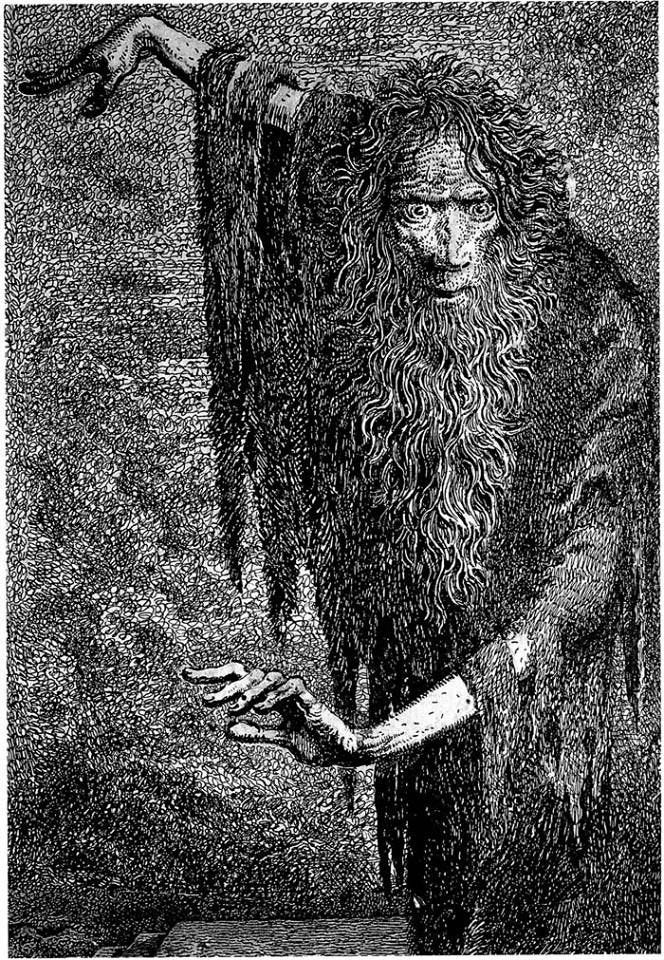
This isn’t noticed a lot, even by scholars like me! When I pointed it out on a discussion list recently, people were a bit stunned. It’s so obvious, you don’t see it.
Perhaps that’s the REAL magic of this poem: to make a first-person narrative “hold [you] with [its] glittering eye.” To put you in a trance.
If I tell you a bunch of precog stories in the first person, I’m priming you for disbelief. I’m turning you into an “outsider,” a “researcher,” a skeptic, automatically.
Which is why, when I start to tell the story of my precognitive dream, I have a sense of dread. Just look at what happened to Whitley Strieber. Without any other mediation than his own first-person narrative, readers jumped on his abduction stories and attacked them. A lot. Immediately.
So if perhaps my stories can prompt you to recall your own, dear reader, that would be good. My realizing that I precognized stuff prompted my wife Treena to note some stuff from her own experience.
And if I can refrain from wanting to add rhetoric that acts like it proves or authenticates my stories in some way, but instead adopt this somewhat casual, somewhat sidelong, look at everything, as if I was sitting next to you looking at the evidence (which I sort of am), maybe that will help too. I understand how pleading won’t work.
You know, the funny sad cool thing about having Complex PTSD is, I am my own sternest critic. I’m the most likely person not to believe ANY of my experiences are real. I’m REALLY good at thinking “this is just made up.”
I did a dissociation test for a therapist in 2021, and I got SO excited to fill out the questions, then one question jumped off the page:
Someone else has been filling out this form.
You were supposed to grade the statements from 1 (not relevant at all) to 10 (OMFG this is so true).
I wrote “15” to one side of the 10.
There’s no way to soften this, TRIGGER WARNING. I grew up adjacent to a crime syndicate. Do you know about the Kray Twins? I met one of their assassins at the age of ten. Name of Lofty. He was sitting on my dad’s living room floor. It was my dad who introduced him. He went to prison a few years later for a murder that my dad (a psychopath) described to me over and over with great relish. I was already a mega survivor so I had already seen Lofty as an assassin (don’t ask me why; he did have tiny tiny pinprick pupils, that was part of it). The Kray Twins made pdf movies and put me in them. Yeah.
It’s why I am super good at helping upset traumatized people, now that I’ve done twenty-four years of psychoanalysis and three years of EMDR and Ego State therapy.
Recent events have been ... a lot to deal with. And totally not surprising. At all. It’s been quite ... irritating watching and waiting for people to catch up with what I figured out within seconds of the golden escalator.
In the discourse of the paranormal, it seems to me as a relative newcomer that there are first-person narratives and there is research. The whole field bifurcates, exactly like the study of religion or cultural studies. Or indeed English Literature.
You can do it differently. Here at Rice we recently changed our department’s name to English and Creative Writing. I would’ve been happy with just Creative Writing. Shakespeare was a creative writer. My friend Kiese Laymon is a creative writer. Heck, my writing is pretty “creative” ... and what does “non-fiction” mean anyway? And why is it different from “criticism”? These are labels that help corporations to sell products.
As my friend Lacy Johnson (working with Kiese and me in our department here at Rice), it’s like having a drawer for socks, and a drawer for everything else called “non-socks.”
Critic and artist as Oscar Wilde puts it. Study, or create. Insider or outside. “Emic” or “etic.” “Fan” or researcher. And in the case of the paranormal, “experiencer” and “researcher.”
But what if you’re a researcher type of a person who then realizes you’re an experiencer? That’s what has happened to me.
What if you’re an “experiencer” who wants to look critically (not necessarily negatively!) at experiences?
So I’m worried about this whole thing. I want so badly to talk about it, but I realize that there’s a whole strict bifurcation between “talking about” and “being” or “doing.”
“You don’t do, you teach!” as my erstwhile landlady’s partner once told me. It was 1995 and I had just arrived in Boulder Colorado and I was a bit ... put out by this remark, which he probably meant as a joke. I was standing by the washing machine in their house, and ...
And there’s more. In the giant invisible record store of life, there are these generic aisles that make no sense, or make some sense ... or some sense to some people ... and the aisles overlap and criss cross, and you’ll find heavy metal records in the hip hop aisle, and all that.
Aisles like “History,” “Prehistory,” “Gender,” “Human.” It’s a bit seedy and creepy and sleazy.
One of the main splits in the aisles in the store is the “Subjects” aisle versus the “Objects” aisle. For example, human beings (very often and unfortunately just one or two types of them) get to fit in the Subjects aisle.
There’s a split between analyzing something, looking at it, studying it; and being it, doing it or otherwise creating it. The whole thing implies distinguishing between a “subject” (the onlooker) and an “object” (the object, precisely, of study).
But as I’ve already suggested, what happens to paranormal or anomalous or unexplained (thanks Eric!) experiences? Where do they go in the record store? Especially if those experiences involve a whole lot of “Is this really happening?” ... “What the fuck?” ... “I don’t believe it.” As a dissociated person I am for sure aware that you can be experiencing something and looking at it at the exact same time, and even that those two kinds of “thing” can be very different, as if different people were doing them!
(There’s a whole Jeff Kripal book about this.)
But as a watcher of movies you should also know this, dear reader. You’re swept up in the action, and indeed the whole thing requires you to participate, as the audience. And yet you’re not “inside” the screen. It’s like watching a play. Are you looking into a fishbowl, or are you in it? What happens when a character does an aside or looks at the camera?
It’s like the default white western culture is really dissociated. There might be person, one being, doing the experiencing and doing the analyzing. But the culture acts like these two can’t mix at all. Oscar Wilde’s dialogue “The Critic as Artist” depends on the strict separation of these roles for its effect.
And what happens when those experiences are really weird and even abject? That is to say, what happens when they undermine my idea of where my body stops and starts? Of what a subject is, or an object?
And there’s even more! What happens when an “object,” my brain, appears to be “pushing” me from the future? I thought “subjects” do the pushing and “objects” are the things that get pushed!
No posts
Comments
Nothing yet. Say the first thing.
Sign in to join the conversation.