
(I have been collecting evidence—mountains of it—that I (and you, dear reader) have a brain that by default can precognize the future.
This precognition can have a duration of a few seconds or moments into the future…or a few hours…or days…or weeks…or, in fact, years.
I have gathered evidence that precognition pertains not only to dreams, but to waking. To everyday stuff that happens in the waking world. That an awful lot of what happens in my brain—and yours, dear reader—is…there really isn’t a great way to gloss this…from the future.
This is Part II of a series of essays about all that.)
So.
What’s the MOST important thing about precognition?
LOADS of people experience it, knowingly. And that’s because, I believe, EVERYONE experiences it, knowingly or not. It’s a bodily function. Shit happens.
Maybe you’ve thought of something and a few minutes later, you read about it. Maybe an image has popped in your head, then later in the day, someone tells you about it.
A lot of stuff that people call coincidence or synchronicity might very well have another explanation. A precognitive one.
In his first study of precognition, the indomitable and fearless Eric Wargo writes about a man called John William Dunne (1875–1949). Dunne flourished in the Edwardian period, one of the most fascinating periods in history, I think, where some white English guys started to wonder whether inanimate objects were people (Winnie the Pooh) and whether nonhuman beings were people (The Wind in the Willows) and whether paranormal, “psychical,” supernatural phenomena might be a thing (Conan Doyle, Myers). Maybe it was the fact that peak empire allowed them to let their guard down a bit. I’m not sure.
John William Dunne figured out that the weird coincidences that happened to him, as if Dunne (or rather, Dunne’s brain) had predicted the future or seen something from afar or read someone’s mind, were because Dunne had somehow been able to see himself reading about or hearing about something in the future.
Someone had to figure this out eventually, I guess, but it’s interesting that pretty much no-one white did (something about ideology and psychology here!) before this guy. And this guy hadn’t made a career of psychology, though he got into philosophy.
That’s the way this stuff works, because it’s literally paranormal: by the side of (para) what is taken to be the norm. It just ... happens, like the way it happens on the X Files. There you are, in a hamburger joint, and along comes this guy who can reverse entropy so that no one who is shot dies, including the shooter. But without the music. Or the credits. Or the anything like that. You might even overlook it.
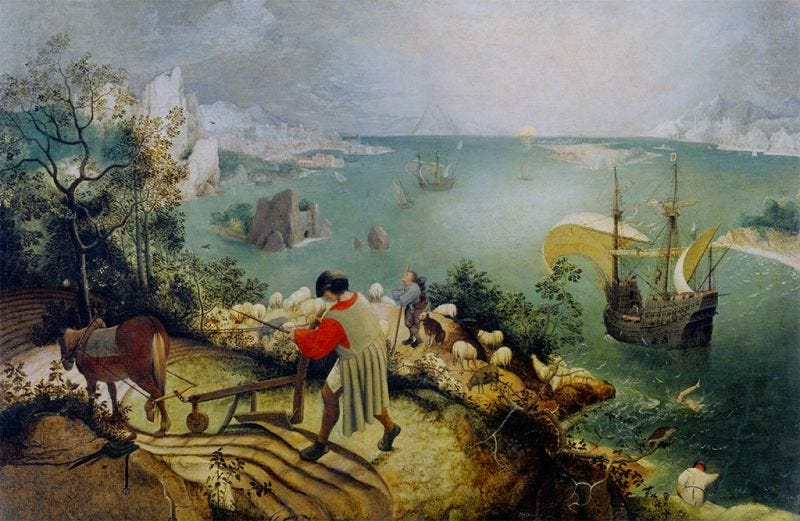
Dunne’s future brain called his present brain, kind of. Or maybe Dunne’s present brain was always-already “in” the future. Or maybe this “present” thing isn’t all it’s cracked up to be.
To be honest with you, explaining this precisely is low on my to-do list right now. This is where Eric Wargo does the most incredible, nay heroic, job. Someone has to! But honestly, just the fact that this is a thing … just let that sink in. That’s enough for now. Quite enough.
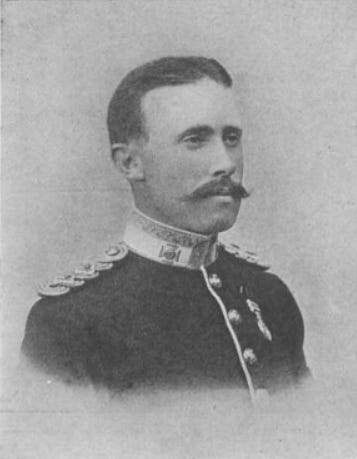
Look at this guy! That’s John William Dunne. I don’t share an awful lot with this guy. Well, I do: he’s a Brit and he’s white and he has a mustache. And I guess my grandfathers were both in the military. One was a communist, very upper middle class, father was a chemistry guy, who persuaded his whole regiment to vote Labour after the war, and other was a not-communist who designed not-good tanks and had been a steelworker in the north of England who had taken elocution lessons.
Forget that bit. I share more than I would like to with this chap.
And I share being precognitive and being aware of it.
[I’m gonna share these posts about the paranormal for free for the duration. But if you feel like subscribing, mostly to support my wife Treena’s incredible writing—which is bundled with Bring Me My Bow … we would be honored if you went ahead]
You know what I mean? Precognition can happen to anyone, just look at this Sergeant-Pepper-looking guy in his amazingly stiff imperial garb.
What I’m going to post today is about how precognition is SO shared among SO many people, yet the way culture imagines it is as individual oddities here and there, whether individuals or experiences within those individuals: experiences viewed as rare, unusual. It doesn’t hurt that precognition is intrinsically surprising. Coming across something you somehow knew already is … surprising.
Whether people imagine precognition in supportive or in hostile ways, the emphasis is on privatized, individual, quirky, pathological, different or unique, random, bizarre, fleeting.
I would like to start out by drawing a big strong line in the sand. No more of that. That’s a kind of gravity well of how this stuff is talked about. An attractor. A default. How people “live” the paranormal is as atomized, individualistic … the unpleasant default isolation of how a single, separate, skin-encapsulated, “normal” white person is lived!
Ideology slimes the paranormal. Makes it all too normal.
From an evolutionary point of view, all humans are mutants. In one book I called it X-Existence.
It’s especially weird to think of precognition as isolating, because precognition feels like telepathy, or clairvoyance, where you share the thoughts and feelings of others. It’s why I found that show Sense 8 quite moving. Or the X Men. It’s about a group dynamic. A collective. Shared experience. (Although the superhero thing sometimes doesn’t help: it’s about unique special people.)
Experience is intrinsically sharable. A whole lot of it just is sharing.
And you’re sharing stuff with your future self. Think about it. Sharing can take place over time as well as space. It’s why history is so incredibly absorbing. And important. When you open a novel you’re opening how someone felt and thought and wrote from 1890 or 1790 or …
(One day, in one of these, I’m going to write about how special remembering is, let alone “premembering.”)
But Americans don’t often think about groups, outside of learning to cooperate as small kids and harrassment training at work and sports … well also the military. Well maybe Americans think about groups a lot. But I think I’m right … maybe what I mean is “enough.” Americans don’t think about groups enough. Not feeling like you live somewhere (for example, there’s no local news), can result in some politically very not good stuff.
A sense of group dynamics is few and far between. This is a shame. Groups behave like individuals when you don’t care about them. When you neglect people and groups of people, they get narcissistic personality disorder. This disorder has to do with rigid exclusion. Groups are narcissists unless you work on them, hard. They scapegoat. They exclude.
When human beings don’t think or talk or act or otherwise care enough about groups, groups default to very not good stuff. Just look around you.
I’d like to talk about the group, community, collective of people who are aware of things such as precognition. I’d like to encourage that group to start thinking of itself in group terms.
What’s the most important thing about being what some people call an experiencer? A paranormal one? What’s the MOST important thing if you’ve had a kundalini experience of a slender string-like flame of warm, hot, weird energy rising up the center of your body (especially if it “just happened”)? Or something seemingly psychokinetic? Aliens? Seeing orbs? Being abducted? Out of body experiences? Near death?
You are not alone. Not alone!
[I’m gonna share these posts about the paranormal for free for the duration. But if you feel like subscribing, mostly to support my wife Treena’s incredible writing—which is bundled with Bring Me My Bow … we would be honored if you went ahead]
There is a gigantic sprawling group of overlapping groups of people who have experienced stuff that is invisible or shunned in regular science and regular religion (not saying “religion” versus “spirituality”), regular cultures, ideologies … regular stuff.
The group is so large, I bet, that the experiences are in fact the regular stuff!
There’s a gigantic sprawling group of people who have experienced stuff that regular explanations don’t fit. Gigantic. Colossal. I don’t want to guess how big, it’s so big. Worldwide. Regardless of belief, gender, race, class … and species. Dogs. Cats. Parrots.
Sentient beings.
I am writing this kitty corner from the Archives of the Impossible in the Woodson Rare Books and Manuscripts part of my beloved Fondren Library here at Rice University. And the Archives contain … let me find out from the wonderful Rice librarian Amanda Focke. Hang on … (emailing her).
Bless her, she’s out of the office. Amanda has an intense job. Let me text Jeffrey Kripal. Here we go:
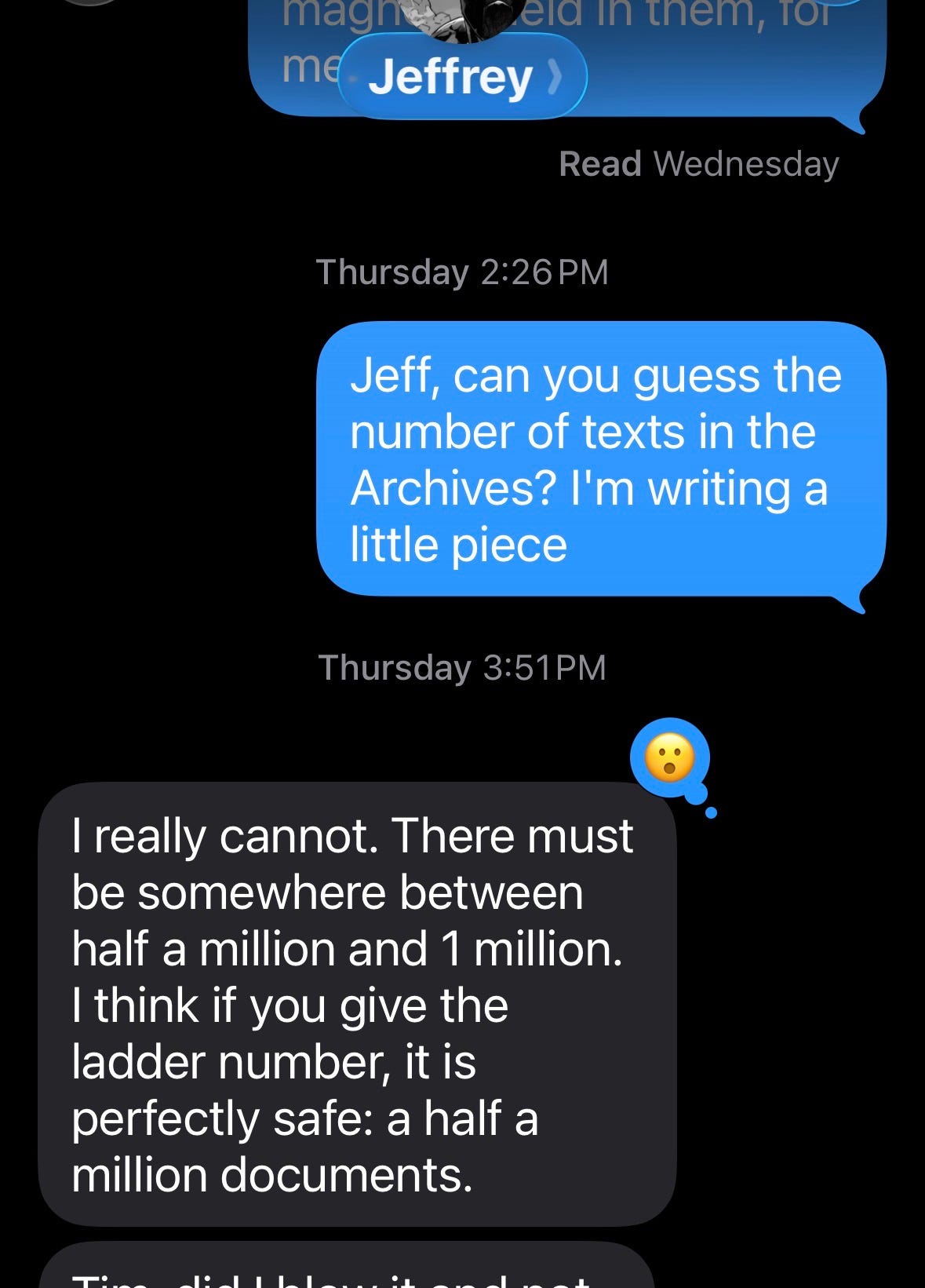
That’s half a million to a million documents about abduction, remote viewing … you name it. Archives donated by Jacques Vallée, John Mack, Whitley Strieber, Ed May … curated by Jeffrey Kripal, Karin Austin, Amanda Focke and a host of others …
You are not alone … although the experiences might be very strange. And themselves “alien.” You might feel isolated. You might isolate, cordon off those experiences within yourself.
This is a point Eric Wargo makes on page 48 of his study of artists and writers who precognize things: and there are way way more than you might think. Eric explores so many writers who demonstrably precognize. Eric brings the receipts.
Here’s Eric, discussing something precognitive that happened to Mark Twain:
Stick a pin in Twain’s phrase, “foreign to my thoughts.” A common feature of psychic experiences is that they are experienced as uncaused or alien, a phenomenological quality they share with moments of artistic or literary inspiration.
The experience itself seems so “other” because one of the alien beings in the universe is myself, in the future. It’s why this haunts me:
Torchwood (a Doctor Who spinoff), Miracle Day (penultimate episode)
In my dream (see my previous), my son Simon (17) shot me. Point blank, with a revolver, through the chest. Just came through the back door and shot me. I woke … startled doesn’t begin to cover it. It was not just a shocking image, it seemed as if the entire imagining of it had come from somewhere, something else.
I felt like that when I watched a David Lynch movie for the first time. I wished I hadn’t seen it. Blue Velvet. I was nineteen. That someone could have imagined such things … it was a lot to bear. I almost wanted a lobotomy.
I cried out, “NO!” when Simon shot me in the dream.
It takes a lot of courage, maybe a lot of therapy, to admit to unconscious desires. My dream was making something disturbing out of a note that I read three hours later, about a dog barking (hence the bang of the gun). What my dream made of this, like a deranged chef, was itself disturbing. As was the other unconscious aspect of the dream: my own brain, unknown to present-time me at three in the morning.
That in itself is a gunshot to the heart. Like glimpsing another dimension.
Look, this is how you depict the fourth dimension in a painting:
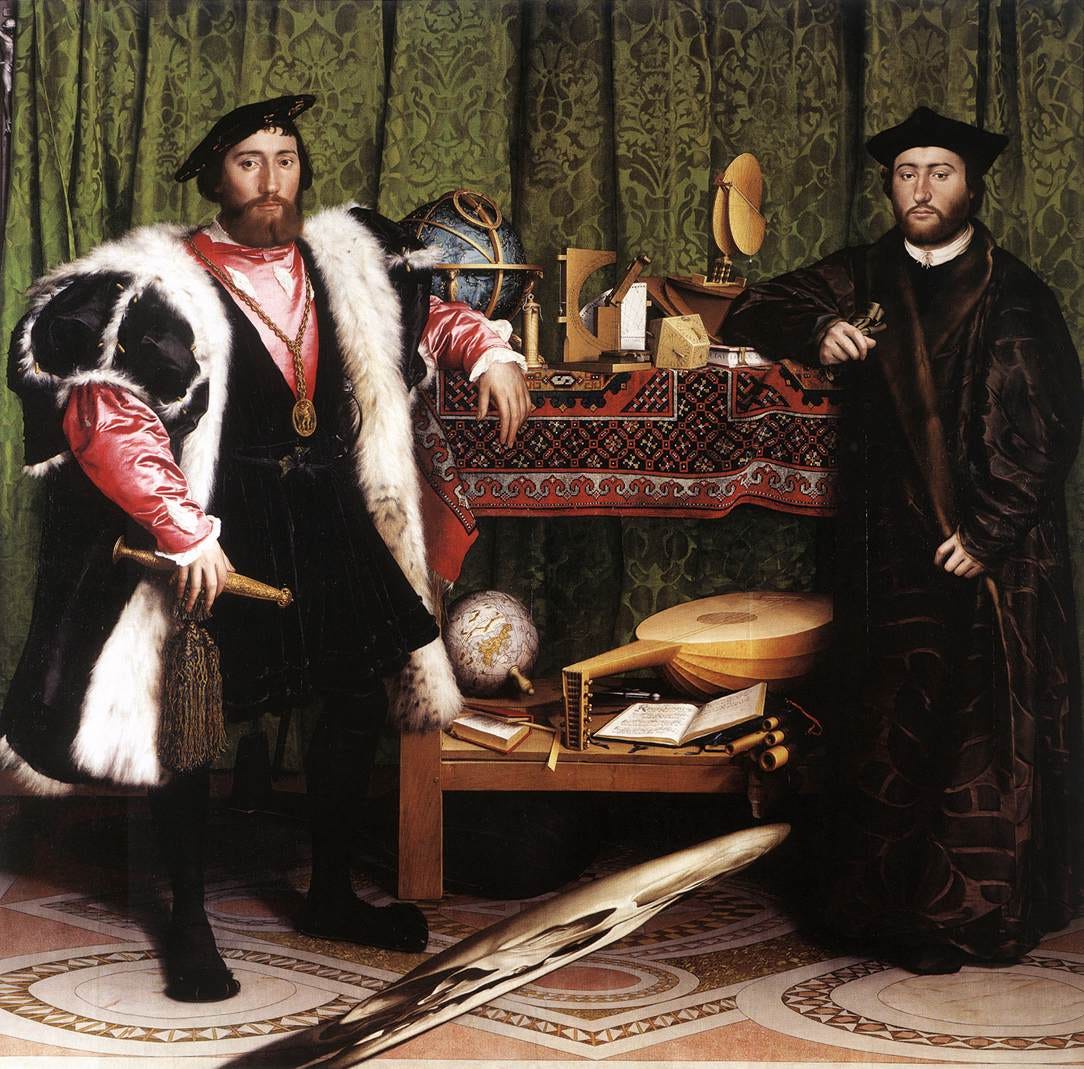
That shape in the front is a skull, rotated 45 degrees into the picture plane—at a funny angle relative to the three dimensions of the imagined space. Which itself is imagined in TWO dimensions! To make a 2D surface like a painting look 3D is to figure out how to add a dimension at 90 degrees to the up-down and left-right dimensions of that painting. Basically, you have to use 45-degree angles.
But what about a dimension that’s at 90 degrees to ALL THREE dimensions? Well you have to rotate the thing by 45 degrees “into” the surface itself: crazy, but doable. It’s why the skull is floating at that angle. You can only really see it if you look at the picture by standing to the right of it and looking across the surface … but then the rest of the picture looks as distorted as the skull looks above!
That skull, a memento mori, haunts that opulent image of wealth and art and love and power. It’s in a FOURTH dimension that is everywhere and nowhere. Like death.
It could creep up on you or it could surprise you, like a bullet. Since precognition implies that some of your brain is in a fourth dimension (I’ll shut up … it’s actually really hard to let this part in, but Matisse’s goldfish painting makes it lovely) …

So stuff like precognition can hit you like a trauma, and you go into a huddle and isolate, like with any trauma. There’s a social stigma, but it’s also literally a mark (Greek, stigma), a wound. A puncture.
And a puncture in thinking. A major pulling of the plug on various ideas about myself, and a reveal of how I carry those ideas around by default, me, seemingly thoughtful above-all-that me. Those ideas about being separated, being a command-control ego pulling the strings of a mechanical body like a charioteer pulling the reins of the horses (Plato).
Then if you talk about it people will prey on it … pick you off, as a wounded, isolated being. And this is such a shame, because like I say, this happens SO OFTEN. Paradigm-disruptingly often.
Often, being evidence that this is common. Common as muck! Which is not to put it down but to show you my love of muck. A bodily function, like sneezing.
Common, too, in another way. Your future brain has stuff in common with your present brain, like really common. Linked. The same thing. Whatever. I don’t want to get into the scientific weeds here. Just to share the raw fact of precognition with you.
This is why responses like this, to my first post (I’ve been getting a lot), mean a lot to me:
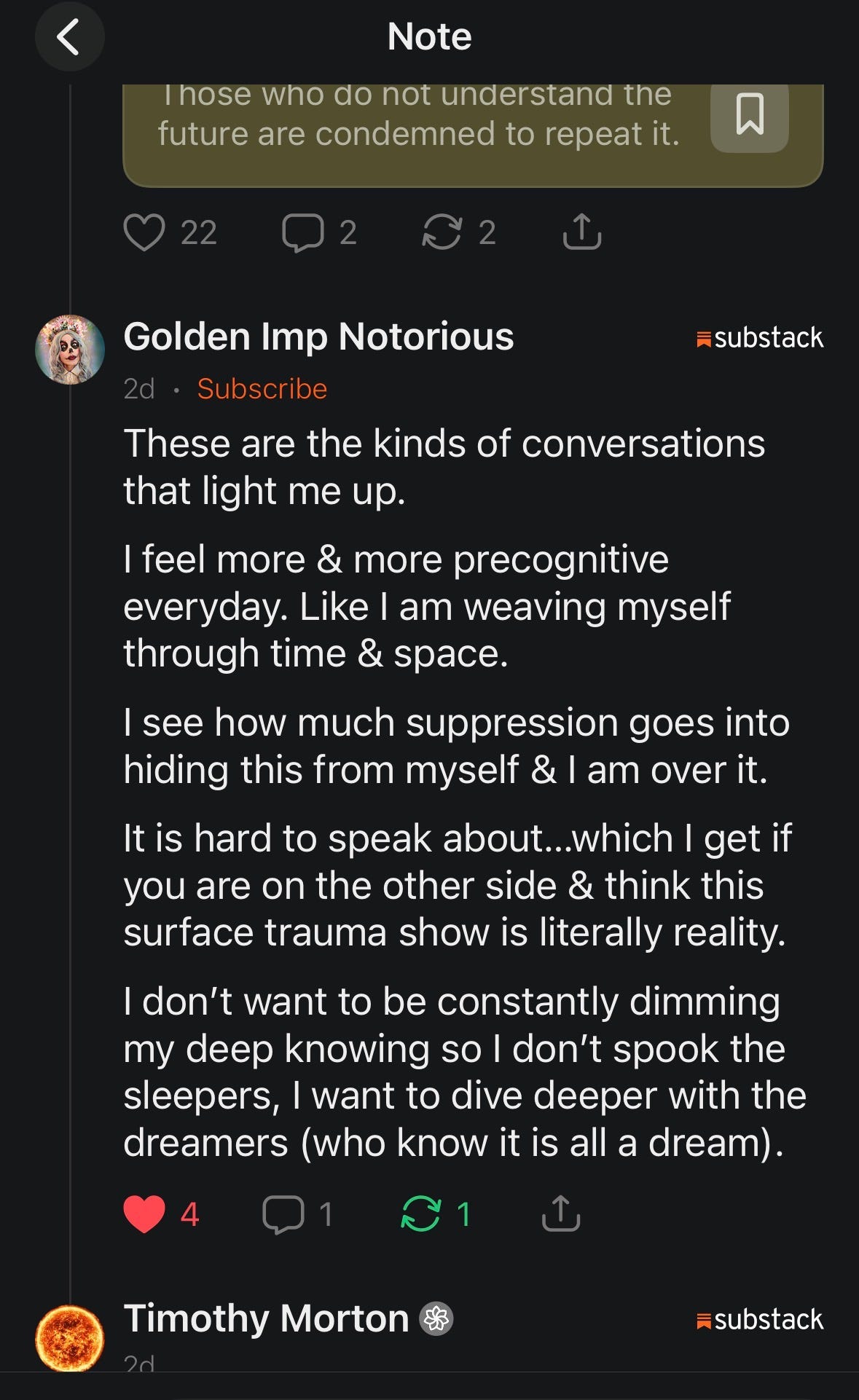
There’s so much more to say.
PS: 3:49pm 1.15.26 Treena’s mom (”Mommy”) is here for a few months from Jamaica. She can barely walk--all kinds of broken and sprained and misshapen feet, and we walk around the supermarket way way slow (she can walk with a cart, it’s the wheels).
Today, absurdly, about 8am before I left for work, the picture popped in my head of her walking up the stairs, before I left for work. Walking up the stairs for exercise.
Mommy just told me that she walked up the stairs today. For exercise.
Stuff like this is always happening...
Comments
Nothing yet. Say the first thing.
Sign in to join the conversation.