
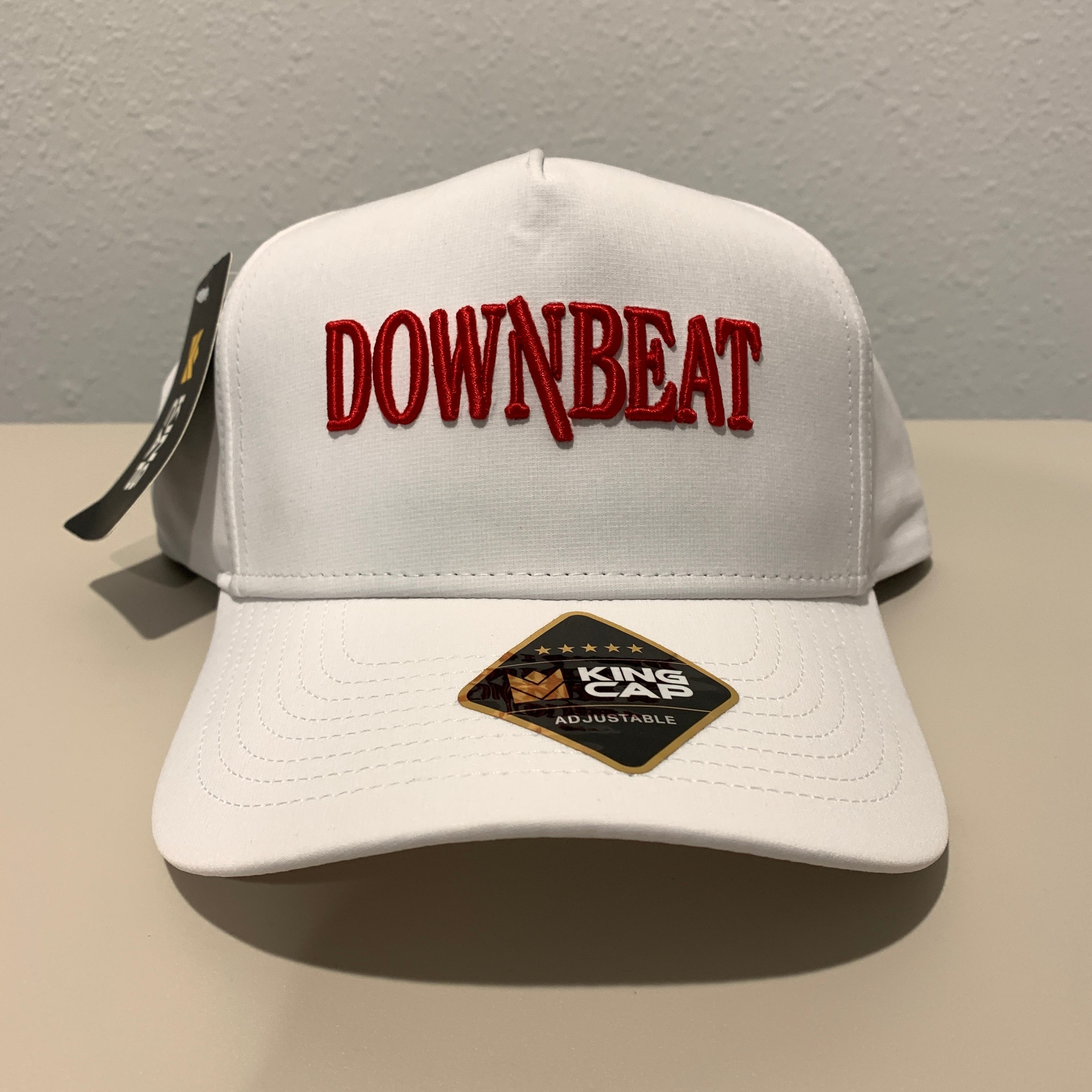
In addition to publishing this newsletter and putting out records, I write for Stereogum, The Wire, and DownBeat basically every month, and for other places (the Shfl, Everything Jazz, Jazz’n’More, We Jazz) less frequently. I also vote in a couple of critics’ polls every year, one of them being the DownBeat poll.
As a reward for participating in the DownBeat critics’ poll, I get a free subscription to the magazine. I also usually get a T-shirt. The one they sent a couple of years ago is really nice; I wear it all the time. Well, this year they sent the hat you see above.
I cannot imagine myself wearing that hat. I don’t have a yacht (or get invited out on other people’s yachts), nor do I play golf. But if you think you would like it, I will give it to you. All you have to do to be entered to win is upgrade your subscription from free to paid ($5 a month/$50 a year) and email me with the subject line GIMME THE HAT. Yes, all caps.
(Offer available to US-based subscribers only. Sorry, but international postage rates are crazy.)
I am almost out of stuff to watch! I have been watching a couple of series on Apple TV: Lucky (con show starring Anya Taylor-Joy, Timothy Olyphant, and Annette Bening) and Sugar (detective show starring Colin Farrell). I enjoyed and recommend both, but Sugar ended a week or so ago and Lucky ended this week. I’m also currently watching Reacher (big guy beats up bad guys) on Amazon, and Furious (female FBI agent stalks female serial killer) on Hulu, but other than that I’m reduced to watching old episodes of shows from the 2000s and 2010s like Elementary, Fringe, Law & Order, and The Mentalist. So I need you all to recommend stuff to me! I like crime shows and action movies, in any language; I’m particularly interested to see non-musical Indian movies; and I am also potentially interested in thoughtful dramas with no car chases, hand-to-hand combat, or explosions. Recommend shows and movies in the comments, and let me know where they can be watched (Netflix, Hulu, Apple, and Amazon are the paying options available to me, plus free sites like Tubi and Pluto).
I am also out of stuff to read! I have no unread books in my house, an intolerable situation. Recommend me SF (not fantasy); crime, especially by writers from outside the US and UK; literary fiction if it’s funny (really funny, not New Yorker cartoon funny); and/or nonfiction books about history, social issues, stuff like that. No true crime, please. Thanks in advance!
New release update! The CDs for our next two releases, Wadada Leo Smith’s Constellations And Hemispheres and Michael Sarian’s In This Desert (a 2CD set!), have arrived. We had the CDs manufactured by DiscMakers — I’ve listened to them; they sound awesome — and the jackets and inner sleeves by Stoughton Printing, who did our first two releases, Senyawa’s Alkisah and Ivo Perelman and Nate Wooley’s Polarity, when we started this whole thing back in 2020. When the jackets and sleeves arrive, we’ll assemble them here and ship them to customers and distributors. That should happen in a few weeks, which means it’s time for you to pre-order your copies!
Rapper Sensational died earlier this month at 52. His debut album, 1997’s Loaded With Power, remains one of the weirdest hip-hop records you’ll ever hear, a primitive and obscurantist document of a singular voice. Stephan Kunze explores the MC’s entire career, which continued until the end of his life. “When most hip-hop artists were still sampling James Brown drum breaks, Sensational was freestyling over Karlheinz Stockhausen tracks. The Guyana-born, New York-raised MC and producer made many rap fans feel as if they were bebop enthusiasts hearing free jazz for the first time. The elusive artist, who came up in Brooklyn alongside the Jungle Brothers, was one of the last true outsiders in hip-hop… He returned in 1997 with his solo debut, Loaded With Power, released on WordSound, an independent label run by writer, producer and activist S.H. “Skiz” Fernando Jr. alias Spectre. The album was made under extremely lo-fi conditions using subpar equipment; since Sensational didn’t even own a microphone, he’d recorded his vocals through headphones.”
Columbia House, the “12 cassettes/CDs for a penny” mail-order service, is finally closing its doors next month, 30 years after you forgot it existed. “Columbia House traces its origins to 1955, when Columbia Records, then part of CBS, launched the Columbia Record Club as an experimental mail-order service. The goal was to reach rural and suburban customers who lacked easy access to record stores while also competing with other direct-marketing efforts outside the traditional music industry. Early members received promotional offers that included free or low-cost albums in exchange for committing to purchase a set number of additional titles at regular club prices. The model proved highly successful. Within a year the club had hundreds of thousands of members and sold millions of records. Operations quickly outgrew New York and shifted to a major distribution center in Terre Haute, Indiana, a location chosen for its rail access and proximity to Columbia’s own pressing plant… Membership surpassed three million by the mid-1970s. The 1980s and 1990s brought further growth with the rise of compact discs. At its peak in the mid-1990s, Columbia House claimed roughly sixteen million members and, together with its main rival BMG Music Service, accounted for a substantial portion of all CD sales in the United States.”
At Cabinet, Thea Applebaum Licht examines the Scandinavian concept of the smörgåsbord, and how it evolved into the American smorgasbord (and eventually the Las Vegas-style all-you-can-eat buffet). “The all-you-can-eat buffet — offspring of the self-serve cafeteria and the smorgasbord — was to find its spiritual home in Las Vegas, where it became a cornerstone of the casino experience. Academic sources are sparse, but according to a contemporaneous article in a Las Vegas newspaper, the El Rancho Vegas hotel broke new ground in 1946 when it opened the Chuck Wagon buffet. Originally a late-night offering, by the 1950s, the buffet at the El Rancho was open 24-7 and cost only a dollar — a model emulated by other hotels in the city. Affordable, accessible, and indulgent, the Las Vegas buffet provided the model for the ‘smorgys’ (and their siblings, the ‘smorga, smorgee, & smorg-ette’) that proliferated through the 1950s and 1960s. Low-brow cultural diversity was one of the main draws, including at California’s Fjörds Smorg-Ette, Okie Frijole Mexican Smorgy, and Gong Lee’s Smorga.” She also considers how any of these things might survive the Age of Ozempic. “Can the sampling platter muscle its way past the raised defenses of semaglutide-assisted temperance? Studies show that all manner of experimental subjects — humans, rats, cats — eat far more when presented with a buffet-style meal than when faced with just one option. Variety thwarts satisfaction; it induces desire. The buffet, regardless of its scale and its dishes, offers the hyperpalatability of choice itself. Acting, as they seem to do, in most of the nooks and crannies of our physiological hunger and digestion pathways, drugs like Ozempic may also buffer against this so-called buffet effect. And yet, the buffet survives as a psychological antidote to the weight-loss drug dilemma: as a way to wring more pleasure from the fewer bites one can stomach.”
Comments
Nothing yet. Say the first thing.
Sign in to join the conversation.