
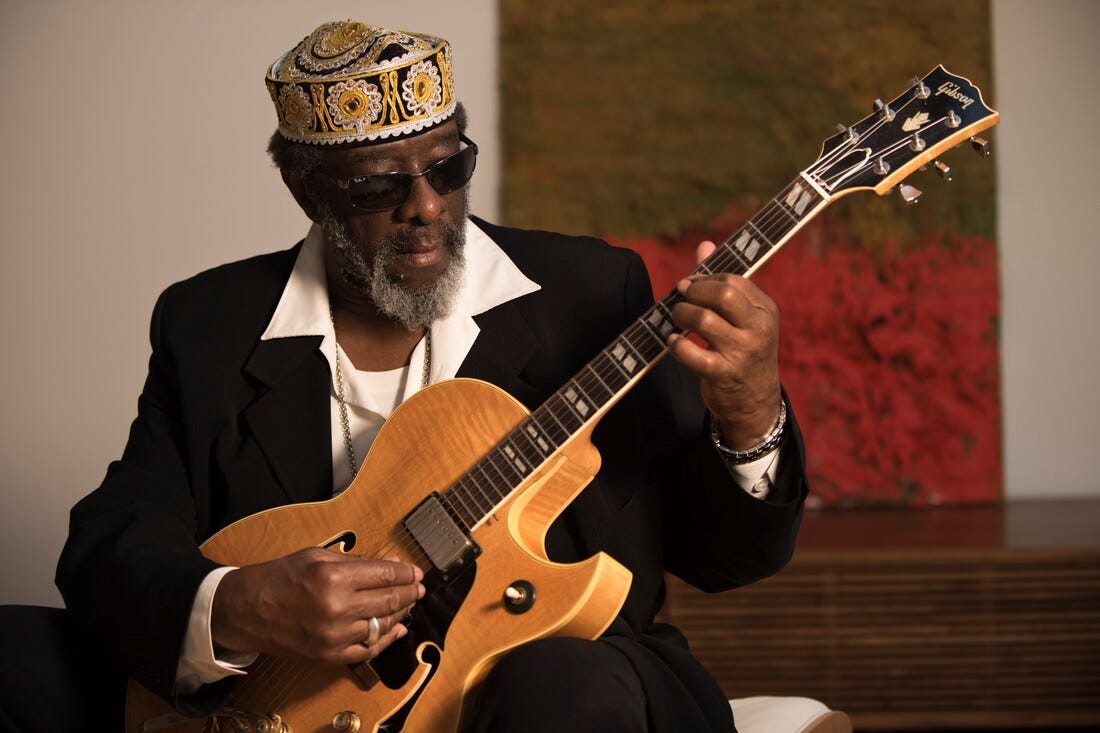
Guitarist James “Blood” Ulmer died last week at 86. He first came to prominence via his connection with Ornette Coleman: he was a member of the saxophonist’s live band in the early ’70s, and Ornette (along with bassist Jamaaladeen Tacuma and drummer Denardo Coleman) played on Ulmer’s debut album, Tales Of Captain Black, which was released on the Artists House label in 1979. Ulmer made some other interesting appearances in the late ’60s and early ’70s, too, appearing on Joe Henderson’s Multiple, Big John Patton’s Accent On The Blues and Memphis To New York Spirit, Rashied Ali’s Rashied Ali Quintet, and Larry Young’s Lawrence Of Newark. He also played with Frank Wright on a gig that was released in 2012 as Blues For Albert Ayler. And in the late ’70s, as he was beginning his career as a solo artist, he played on two of Arthur Blythe’s best albums, Lenox Avenue Breakdown and Illuminations. Those two in particular are must-hears.
Ulmer’s initial string of solo albums — Tales Of Captain Black, Are You Glad To Be In America?, Free Lancing, and Black Rock — featured collaborators like saxophonists Oliver Lake and David Murray, trumpeter Olu Dara, guitarist Ronny Drayton, bassist Amin Ali, and drummers G. Calvin Weston, Cornell Rochester, and Ronald Shannon Jackson. Together, they swirled the blues, harmolodic funk, free jazz, and Ulmer’s barbed No Wave/noise guitar into a totally unique sound that could make your head spin.
I’ll be honest, though; those records didn’t do a whole lot for me. I found Ulmer’s explosive bursts of notes and the way the bass and drums were mixed (metallic and dry/thudding, respectively) to be harsh and unforgiving, and the horn lines were often shrill. Basically, it was a whole bunch of tones and timbres I didn’t like, used to create music I found overly busy and aggressive, without the cathartic release of punk or free jazz. Everything felt simultaneously unfettered and tightly coiled. It made my eyeballs twitch, and not in a good way.
(Counterpoint: Here’s Melvin Gibbs on Ulmer, from a 2019 issue of the Oxford American.)
Some other Ulmer projects sounded great to me, though. In 1983, he took a sharp left turn, abandoning “free funk” jazz-punk and forming a new band, Odyssey, with violinist Charles Burnham and drummer Warren Benbow. That trio made two amazing albums — Odyssey and 1984’s Part Time, the latter recorded live at the Montreux Jazz Festival — and expanded to a quartet with the addition of Amin Ali for 1986’s Live At The Caravan Of Dreams. The contrast between Ulmer’s guitar and Burnham’s droning, almost psychedelic violin, with Benbow laying down a strong backbeat for them, was really beautiful, combining harmolodic blues with a kind of rural minimalism, like Tony Conrad jamming with Junior Kimbrough. Twenty years later, Ulmer reunited Odyssey for a second studio album, 2005’s Back In Time. It’s really good, too, and still in print.
Here’s an Odyssey performance from Warsaw in 1983:
(Side note: guitarist Brandon Ross joined forces with Burnham and Benbow to form the trio Breath Of Air, whose debut album was released on Burning Ambulance Music in 2022. We still have CD copies available. Get yourself one.)
The other Ulmer project I really liked was his band the Music Revelation Ensemble, which went through a few different lineups over the years. The original version, heard on 1980’s No Wave, had David Murray on tenor sax, Amin Ali on bass, and Ronald Shannon Jackson on drums. In 1988, they made a self-titled album with Jamaaladeen Tacuma replacing Ali, while on 1990’s Elec. Jazz the lineup was Ulmer, Murray, Ali, and Cornell Rochester. That version of the group stayed together for 1992’s After Dark, but on 1994’s In The Name Of…, Murray was gone, replaced by Arthur Blythe on alto sax, Sam Rivers on tenor, soprano, and flute, and Hamiet Bluiett on baritone, depending on the track. Knights Of Power, released in 1996, kept Blythe and Bluiett, and on the final Music Revelation Ensemble disc, 1997’s Cross Fire, Calvin Jones (a blues bassist who’d worked with Muddy Waters, John Lee Hooker, and Pinetop Perkins) replaced Ali and the saxophones were handled by John Zorn and Pharoah Sanders. It’s fun to hear Zorn so overtly imitating Ornette — even more so than on his album of Coleman tunes, Spy Vs. Spy — and Sanders is in a gentle, reflective mode.
I didn’t keep up with Ulmer’s 21st century activities. He seems to have made a lot of blues records. I don’t know if I’ll ever need to hear those. But the Odyssey and Music Revelation Ensemble albums are all-time, not a dud in the bunch. They’re not easy to find, unfortunately. Part Time and Live At The Caravan Of Dreams were only ever issued on LP, and have been out of print for decades, and the MRE discs (except for No Wave, which was on Moers Music) are all on the Japanese DIW label, so probably out of print and definitely not on streaming services. But they’re worth searching for. Ulmer was one of those rare musicians who really did sound like no one else; he could unleash streams of notes like he was balling up barbed wire in his hands and throwing it right at your face, and when he opted for distortion, he could blow your hair back as hard as Sonny Sharrock or Pete Cosey.
Ava Mendoza was a big admirer of Ulmer, and posted a tribute to him on Instagram. Her new live album Alive Alone, Alive Together (with Hamid Drake) is out now. Get yourself one.
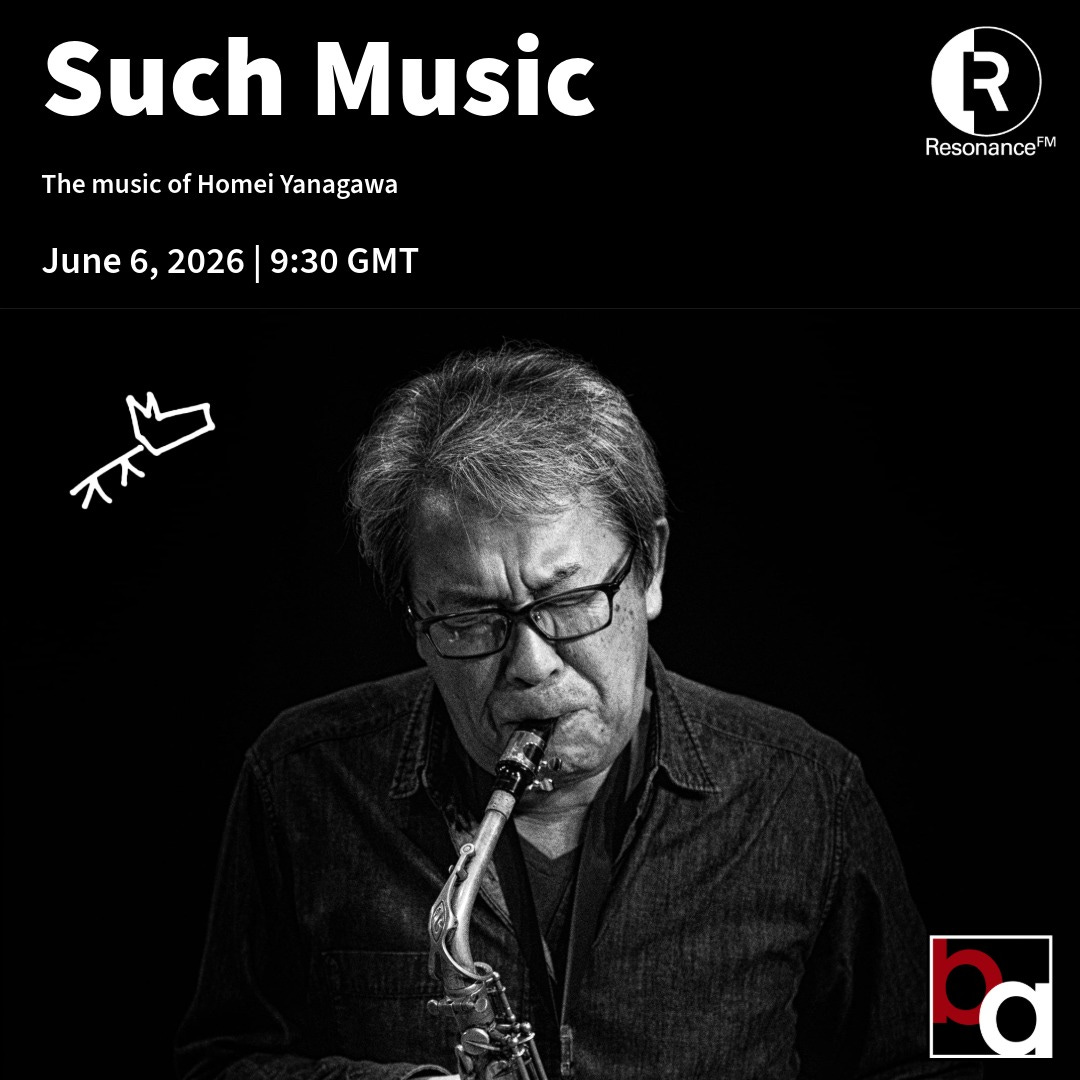
Such Music is a monthly radio show hosted by Rihards Endriksons, journalist and artistic director of Latvia's Skaņu Mežs festival, and devoted to new works of free improvised music, either previously unheard or created specifically for the show. The show is produced in collaboration with Burning Ambulance. This month’s show focuses on the music of Japanese free jazz saxophonist Homei Yanagawa, exploring his views on improvised music and playing a wide range of recordings, from his most recent album Solo Update to collaborations with guitarist Max Devereaux, fellow alto player Ryoko Ono, his wife Nobue Yanagawa on drums, and many others. The Gaya-based Yanagawa is a unique and highly respected voice on the Japanese free improvised music scene. His solo playing has been particularly praised by critics; he is known for a distaste towards acrobatic styles, and his music has been described as “serious and heavy.” Listen on Mixcloud.
If you’re a free subscriber, that’s it for today. If you’re a paying subscriber, stick around for articles on tradwife literature, programmer science fiction, and critic A.S. Hamrah, and a special exclusive offer!
Comments
Nothing yet. Say the first thing.
Sign in to join the conversation.