
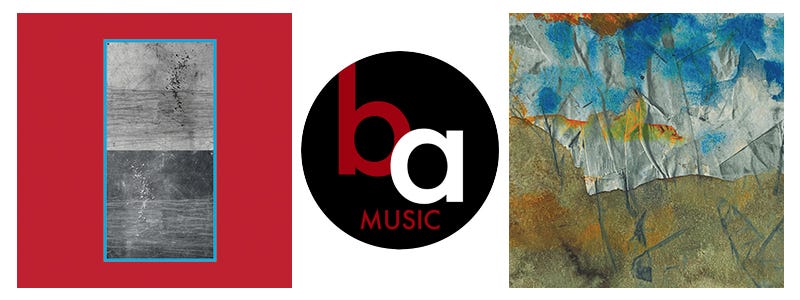
Pre-order our new releases! We’ve got two new albums coming out September 25.
Wadada Leo Smith’s Constellations And Hemispheres (above, at left) features tracks by four different ensembles: a trio with pianist Sylvie Courvoisier and drummer Marcus Gilmore; and a quintet, sextet and octet including, in various combinations, vibraphonist Bobby Naughton, electric guitarist Lamar Smith, bassists Melvin Gibbs and Bill Laswell, percussionists Mauro Refosco and Brian Jawara Gray, and drummer Pheeroan akLaff.
Michael Sarian’s In This Desert (above, at right) is the sixth release by his quartet with keyboardist Santiago Liebson, bassist Marty Kenney, and drummer Nathan Ellman-Bell. It’s their (and our) first-ever double CD, a beautiful collection of psychedelic electric jazz that blurs the line between ’70s Miles and ’90s trip-hop. (Sarian’s last album included a version of Portishead’s “Glory Box,” so you know I’m not off base with this comparison.)
It’s time for one of our monthly roundups of excellent new(ish) music. This time, we’ve got a set of clarinet-piano duos; a solo piano disc; some technical death metal from a veteran crew; some heavy, arty psychedelic rock; and an unearthed 1970s live album. Let’s dive in!
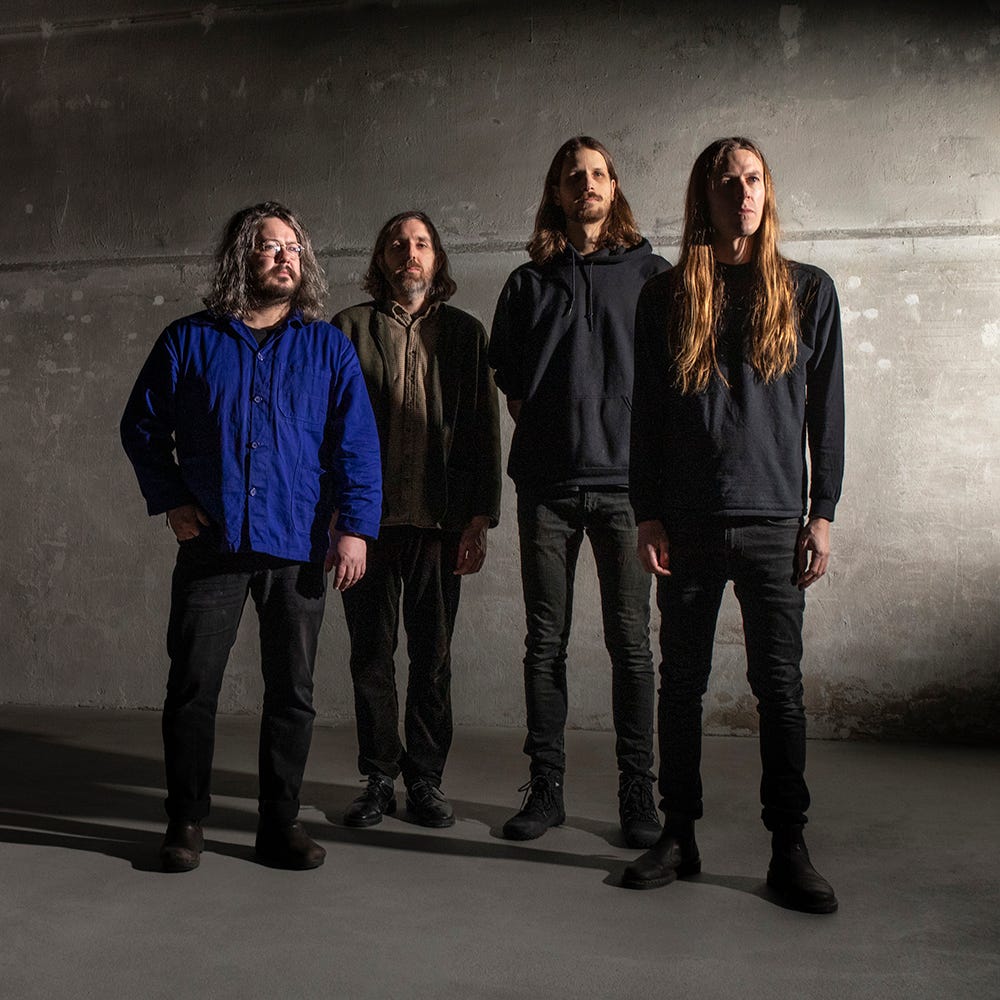
I’ve been a fan of the heavy psychedelic rock band Elder for almost a decade; I came on board, like many others, with their fourth album, 2017’s Reflections Of A Floating World. They’re currently based in Berlin, but got their start in Boston, and they have some qualities in common with another band from that city, Isis. Elder frontman Nick DiSalvo’s voice sounds a little like former Isis frontman Aaron Turner’s, at least when the latter is singing rather than roaring, and both groups favor long songs and patient rock-tumbler rhythms. But where Isis plumbed the ocean’s depths, Elder is much more interested in soaring skyward.
Through Zero, their seventh and longest album, was released at the end of May, and it took me a while to get around to it. When I finally did, I was blown away. The songs are quite long; five of the six run between eight and 11 minutes, which makes the six-minute final track, “Blighted Age,” feel like a tacked-on coda, and they combine a bunch of elements, all from the transcendent side of rock. “Capture & Release” has dreamlike AOR-prog synths, a motorik beat that eventually explodes, big anthemic riffs and howled vocals, and I’m sure the lyrics are about big life stuff, in a post-Ronnie James Dio sort of way, but I don’t pay attention to lyrics. I’m mostly interested in the way the music surges and recedes, and surges again, like ocean waves. Elder aren’t unique; there are other bands doing similar work. I would put their albums on the same shelf as Baroness, Kylesa and Mastodon (particularly Mastodon’s more hard-rock-oriented discs like Emperor Of Sand and Once More ’Round The Sun), and I hear a lot of commonalities between Through Zero and Fantasia, the latest album by French cosmic stoner trio Slift. Weirdly, the two records came out only a week apart. (Elder’s is better.)
Psycroptic is another band I’ve been aware of for a long time. The first album of theirs I heard was 2006’s Symbols Of Failure, which was a very good technical death metal record with the same level of complexity and punch as Decapitated’s Nihility or Cryptopsy’s Once Was Not. I stuck with them through their next release, 2008’s (Ob)servant, but they took four years to make another album and I had moved on. I hadn’t thought about them in years until their ninth album, The Pulse Of Annihilation, landed in my inbox. And no, I haven’t listened to any of the albums in between since getting this one, so these are only my thoughts on where Psycroptic are in 2026. The Pulse Of Annihilation is a catchier, more rifftastic album than Symbols Of Failure or (Ob)servant. It’s still very much death metal, but I would recommend it to fans of face-punching, aggro but still hooky (by death metal standards) bands like The Black Dahlia Murder or Misery Index. The vocals are clearer, less gurgling and guttural and more indebted to the furious ranting of modern hardcore. They give you a break every once in a while — “Our Pillars Fall” begins with a long moody passage before the riffs resume — but generally this is a high-energy, cathartically assaultive album.
Support BA! Burning Ambulance is a 501(c)(3) tax-exempt nonprofit. Donations to us are tax deductible under Internal Revenue Code (IRC) Section 170, and we are qualified to receive tax deductible bequests, devises, transfers, and gifts under sections 2055, 2106, or 2522. Support us through Fractured Atlas or BurningAmbulance.com, or by buying our CDs or becoming a paying subscriber! Everything helps!
Clarinetist Sayyod Mirzomurodov and pianist Mariya Akhadjanova have recorded an album of Contemporary Uzbek Music For Clarinet And Piano that’s called exactly that. (Classical artists need to come up with more exciting titles.) It consists of world premiere recordings of pieces by Farrukh Akramov, Mustafo Bafoyev, Anyar Ergashev, Nurali Erkaev, Habibulla Rahimov, and Sherzod Sobirov, none of whom I’ve ever heard of. (Mirzomurodov emailed me this album, and I was intrigued enough to give it a listen.) The instrumentation places a lot of limitations on the composers, so these are pieces that feature strong up-front melodies played on clarinet, with mostly delicate, romantic countermelodies from the piano. The other option would be heavy, clanging chords beneath shrill mathematical exercises from the reed, but I guess — based strictly on this evidence — there’s not a whole lot of atonality and/or dissonance in Uzbek music. Everything here is very pretty, and played with the precision and bright-eyed energy of the studied virtuoso. Four of the nine pieces are by Bafoyev; the other composers get one each. I wish I could hear Bafoyev’s 22-minute Sonata For Clarinet And Orchestra in the fullness of its grandeur, but even as a stripped-down duo piece, it’s quite nice. (The only place I’ve been able to find a physical copy of this album for sale is via the label, Samek Music; they’re based in the UK.)
Can instrumental music have polemical value? Composer Frederic Rzewski certainly thought so, and so does Colorado-based pianist Walton Lott, it seems. He performs Rzewski’s Four Pieces For Piano on his new album Impulses, alongside John Harbison’s Piano Sonata No. 2. In the liner notes, Lott writes, “Rzewski shows us that music can take on an observational role, shaping political topics into forms mimetic to the often inhumane aspects of our society.” I… guess? I don’t know. My favorite example of music being, in Dewey Redman’s phrase, in the ear of the behearer is Charles Mingus’s “Remember Rockefeller At Attica” — a title like that makes you expect roaring, Archie Shepp-esque protest jazz, but the actual piece sounds like the theme to a late night talk show. Anyway, Lott’s performance of Rzewski’s piece is quite beautiful, in an intense way, and the Harbison piece matches its energy quite well, while also feeling more conventionally romantic (whether with a lower- or upper-case R).
I grew up hearing one or two songs on the radio (“Roundabout” on the classic rock station, “Owner of a Lonely Heart” on the top 40 station), but the first full Yes album I heard, in the early 2000s, was the remastered two-CD version of their 1973 triple live victory lap, Yessongs. And while I’ve now heard all their Atlantic albums and most of the ones afterward, and I have a deep love for their golden-era studio recordings (Fragile, Close To The Edge, Tales From Topographic Oceans, Relayer and Going For The One), Yes’s live releases — Yessongs, 1980’s Yesshows, and the 2015 box Progeny: Seven Shows From Seventy-Two — have always been my favorite items in their catalog, because all the precision and shine of the studio work goes out the window and they become an ass-kicking rock band jamming out these songs with breakneck energy and anarchic zeal.
Live At Roosevelt Stadium, Jersey City, NJ July 17, 1976 is exactly what its title claims: a complete concert from 50 years ago by vocalist Jon Anderson, guitarist Steve Howe, keyboardist Patrick Moraz, bassist Chris Squire, and drummer Alan White. The show was broadcast on WNEW-FM (a station I grew up listening to), and has been bootlegged a million times over the years, but this is its first official release. I have no idea what source Rhino used for their version, but the mix is kinda rough, very focused on Anderson’s vocals and Moraz’s synths, and there are some passages of distortion and heavy tape hiss, especially during the version of “The Story Of I,” from Moraz’s solo album of the same name. (The concert also includes an excerpt from Anderson’s solo album Olias Of Sunhillow.) That said, it’s a really enjoyable document of Yes at their wooliest. Nearly two hours long, it includes versions of two of Relayer’s three tracks, “The Gates Of Delirium” and “Sound Chaser,” and a more than 26-minute version of “Ritual (Nous Sommes Du Soleil)” from Tales From Topographic Oceans. Plus, of course, classics like “Siberian Khatru,” “Long Distance Runaround,” “Heart Of The Sunrise” and more. If you’re as big a fan of Yes the ass-kicking rock band as I am, it’s a must-hear. Especially if, like me, you somehow neglected to ever see them while Chris Squire was alive. Get it from Amazon.
Burning Ambulance is a reader-supported publication. To receive new posts and support my work, consider becoming a free or paid subscriber.
Comments
Nothing yet. Say the first thing.
Sign in to join the conversation.