
Happy 250th, America
A Marketing Tip
What I’m Reading
From the Research File
Pun of the Day
==============================
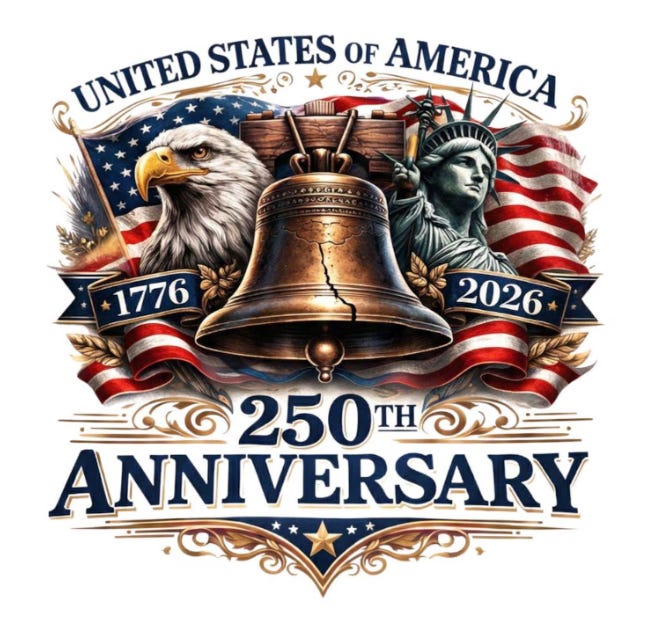
Happy 250th, America
I’ll be honest with you. I’m sentimental as heck about my country’s birthday. And very proud of the beliefs we were founded on that were tested during the Revolutionary War. Among them is the idea that all people are created equal, and that these people have fundamental rights, such as liberty, free speech, freedom of religion, due process of law, and freedom of assembly.
Individualism, equality of opportunity, free enterprise, rule of law, and limited government are what made us a superpower. While I’m concerned these have been weakened, I do have hope they can become strong values again.
Two hundred fifty years old, and still swinging.
I started making a list the other day of things Americans have actually done … not the talking-points version, the real one. Beyond the ideals of our Constitution and workings of our government, because we’re a country that values and supports innovation and commerce … here’s a short list of things invented and innovated that changed the world and how we live in it.
We electrified the world. The light bulb, the power grid, the modern age … born here.
We taught humanity to fly. Two bike mechanics from Ohio.
We put men on the Moon with less computing power than the phone in your pocket right now.
Speaking of that phone … we invented it. And the internet you’re scrolling on it. And the telephone before that, carrying the first human voice across a wire, connecting families and communities.
The telegraph, tapping messages across a wire before anybody had a phone to talk into.
The personal computer, turning machines built for labs into machines for every home.
The transistor, the tiny switch at Bell Labs that made every gadget since possible.
The microprocessor, the tiny chip humming inside nearly everything you own.
GPS, quietly guiding every car, plane, and ship on Earth.
The laser, quietly running your grocery scanner, your surgery, and the fiber optic cable underneath the whole internet.
Television, dreamed up by a 21-year-old Idaho farm boy while he was out plowing a field.
The digital camera, which changed how the entire world remembers a moment. And the Polaroid before it … instant photography, before anyone knew to ask for it.
The video game, starting with a little game of electronic ping-pong and turning into a global industry.
The assembly line, which took the automobile from luxury to everyday life.
The polio vaccine … and most of the modern medicine keeping your family alive.
The pacemaker, keeping hearts beating on time, decade after decade.
The blood bank, Dr. Charles Drew’s system for storing and shipping plasma. It’s saved more lives than we’ll ever be able to count.
The MRI machine, letting doctors see inside a body without ever picking up a scalpel.
The first successful organ transplant, giving families a shot at more time together that didn’t exist before.
The credit card, which changed how the entire world pays for things.
The sewing machine, the cotton gin, the reaping machine … the tools that built an economy from scratch.
Blue jeans, out of a mining town in California and onto every body on Earth.
The zipper, out of Chicago, holding the world’s pants together ever since.
The railroad, and the interstate, and the steamboat before both of them.
The Hoover Dam and the engineering behind the Panama Canal. Because sometimes American ingenuity just reroutes a river or connects two oceans.
Air conditioning, and anesthesia, offering a little more comfort with all that progress.
The Post-it Note, a “failed” glue that ended up organizing half the planet’s sticky notes and to-do lists.
The microwave oven, born from a melted chocolate bar in an engineer’s pocket.
After two world wars, we didn’t just win and go home. We rebuilt the ones we beat. The Marshall Plan alone poured what’s over $130 billion in today’s money into putting Western Europe back on its feet. And we did the same for Japan. Most victors in history take. We handed the tools back and helped rebuild the house.
And yes, even sliced bread. And the chocolate chip cookie. Because the small joys count too.
And this isn’t a definite list, is it? I know you thought “what about ___?” and “oh, you didn’t list ___”. And you’ve proven my point.
Two hundred fifty years in, and we’re still the place where the future gets built first.
I say it because it’s true. I say it because somehow many have forgotten it’s okay to just... be proud. Grateful, even. For the people who tinkered in garages and bike shops and basements and changed everything for the rest of us.
Happy Birthday, America. Here’s to the next 250.
==============================
Let’s talk about why people actually get online.
Not the mission statement version. Not “to connect and discover.” The real reason, the one very few put on a slide deck.
People scroll the internet because:
They’re bored out of their minds.
They’re lonely and crave a little human contact.
They feel like a nobody and want to feel like a somebody, even for five minutes.
That’s it. That’s the whole psychology of the internet, boiled down to three sad, beautiful, very human truths.
And here’s the thing … the people who’ve built the wildest online success stories? They didn’t stumble onto some secret algorithm. They just got this. They looked at the scrolling, refreshing masses and thought: these people aren’t looking for a sales pitch. They’re looking for a reason to feel something.
So they gave it to them. Entertainment for the boredom. Community for the loneliness. A spotlight … even a small one … for those who felt invisible.
Meanwhile, the rest of us are out here leading with our bullet points and our “10% off today only” banners, wondering why nobody bites.
Here’s your homework, and it’s a gut-check, not a to-do list: look at your last five posts, emails, or offers. Ask yourself honestly, did any of them make someone feel less bored, less lonely, or more important?
If the answer’s no, that’s not a marketing problem. That’s a mirror.
Fix that, and the marketing tends to take care of itself.
==============================
Fingersmith, by Sarah Waters

This book and I did not hit it off right away.
It was a Book Club pick, and the first couple of chapters had me side-eyeing my commitment to finishing it. First-person narrative and I have a history... and it’s not a friendly one. I like elbow room between me and the person telling the story. Waters doesn’t offer any. She puts you right inside the narrator’s skin and locks the door behind you.
The first couple of chapters were a struggle. Somewhere around chapter three, it clicked. And once it clicked, I was in for most of the story.
Here’s the bones of it: a thief named Sue gets pulled into a con to swindle a wealthy young woman, Maud, out of her inheritance. Marry her off to a fake gentleman, get her locked away, split the money. Simple enough.
Wrong.
And the fun part of that … being wrong … is this isn’t a one-twist book. Just when you think you’ve got your footing, another twist appears. The secrets underneath the secrets are the real magic trick here.
Then there’s a stretch where you learn what Maud has actually been doing in that house all along, and I had to set the book down for a second. Just... sit with it.
Waters also doesn’t let you forget where you are. Nineteenth-century London is filthy in this book. And I mean that as a compliment to her writing, not a complaint. You can practically smell it. And the asylum sections? Genuinely uncomfortable to read. Which, honestly, is the point. She wants you uncomfortable.
Now, where I landed critically.
I’m giving this one 4 stars, not 5. That first-person structure I mentioned wearing on me early? It never fully let up. There’s a scene about two-thirds through that lingers many beats past where it needed to, and the details get repetitive in a way that had me skimming instead of savoring. Tedious isn’t a word I use lightly, but it belongs here, at least in patches.
So here’s my honest take. This isn’t a book for everybody. If you love a slow-burn con artist story this is your book. If you want something brisk and plot-forward from page one, you might find yourself frustrated in those early chapters, and maybe you never come out the other side of it.
I’m more the “brisk and plot-forward from page one” kind of gal.
I finished it. I’m glad I did. I’m looking forward to Book Club to discuss and hear the other members’ take on it. I’m not interested in reading any other Sarah Waters books.
Have you read it? Tell me, what did you think of the twists and secrets?
==============================
aka random bits of info you may or may not be able to use in your life
The Great Leftover Revolution
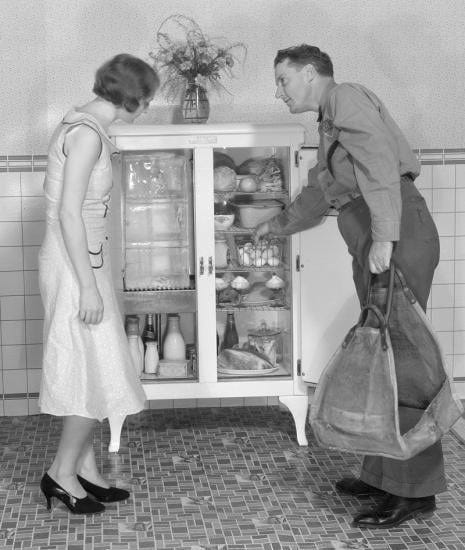
Confession: I have opened my fridge, stared at a mystery container, and thought “we’ll never know.”
Here’s the thing … that little ritual only exists because somebody, somewhere, solved a genuinely wild problem: how do you keep food cold before electricity was even a twinkle in Edison’s eye?
Turns out, colonial Americans were digging actual pits in the ground. Not root cellars, ice pits. Straw, packed ice, buried meat. Very “Little House on the Prairie meets a walk-in freezer.”
Then along came a guy named Frederic Tudor, who looked at frozen New England ponds and thought, “I could sell that.” So he did. Men with horses cut slabs of ice right off the lake (Note: had to be at least eight inches thick or it wouldn’t survive the trip) and shipped it across the country. They called him the Ice King, and honestly? Earned title.
By the 1890s, the wooden icebox showed up. Basically a fridge’s awkward teenage phase, tin-lined and needing ice blocks weekly. It wasn’t until 1927 that General Electric’s “Monitor Top” refrigerator made electric cooling something regular families could actually afford. By the Depression era, nobody was throwing out a perfectly good pot roast. Leftovers went from “sad” to “strategic.”
And then Tupperware waltzed in with its dramatic little “burp” seal, and the rest is Tuesday-night-casserole history.
So next time you’re side-eyeing week-old soup, give a nod to the Ice King. He’d be proud.
==============================
Why do chicken coops have two doors?
Because if they had four doors, they’d be chicken sedans.
🤣😂🤣😂🤣😂
==============================
My wish for you today…
May you always wake up one minute before your alarm.
Charlene Burke
P.S.
If you like this newsletter and want to support it, there are 5 ways you can do it. PICK ONE right now before you forget:
This is the paid tier… where the fluff gets cut, the real playbooks show up, and the insights can make you money.
Click here to buy me a cup of coffee
Hit reply and say hello.
Recommend me to your company to write their newsletter.
Comment your thoughts below
Comments
Nothing yet. Say the first thing.
Sign in to join the conversation.