
If you’ve been following us here on Substack or on our social medias, you may have journeyed with us through a very terrifying time in June.
If you’re new, here are the details.
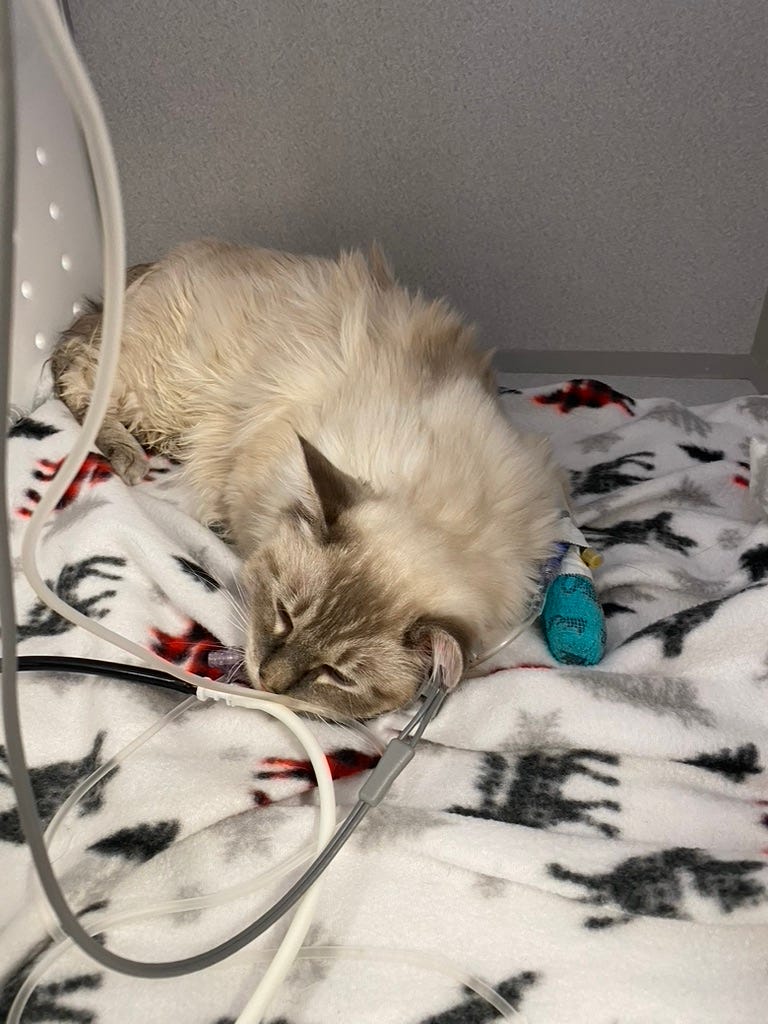
Our 8-month-old kitty Brix (who we adore) was acting odd and lethargic. I thought he was breathing weird so we took him in to Cedarwood Pet Hospital Sunday night. Ironically we were literally just there getting Bernoulli, our young Berner, to donate blood.
Brix was left overnight as the vet thought something was indeed up and by morning the little cat was struggling to breathe. It was very heartbreaking, but over the next few days a decision to start him on FIP anti-virals helped turn the corner, Brix got better and today our little Brix is doing great. In fact we just had his two-week checkup and he got a clean bill of health.
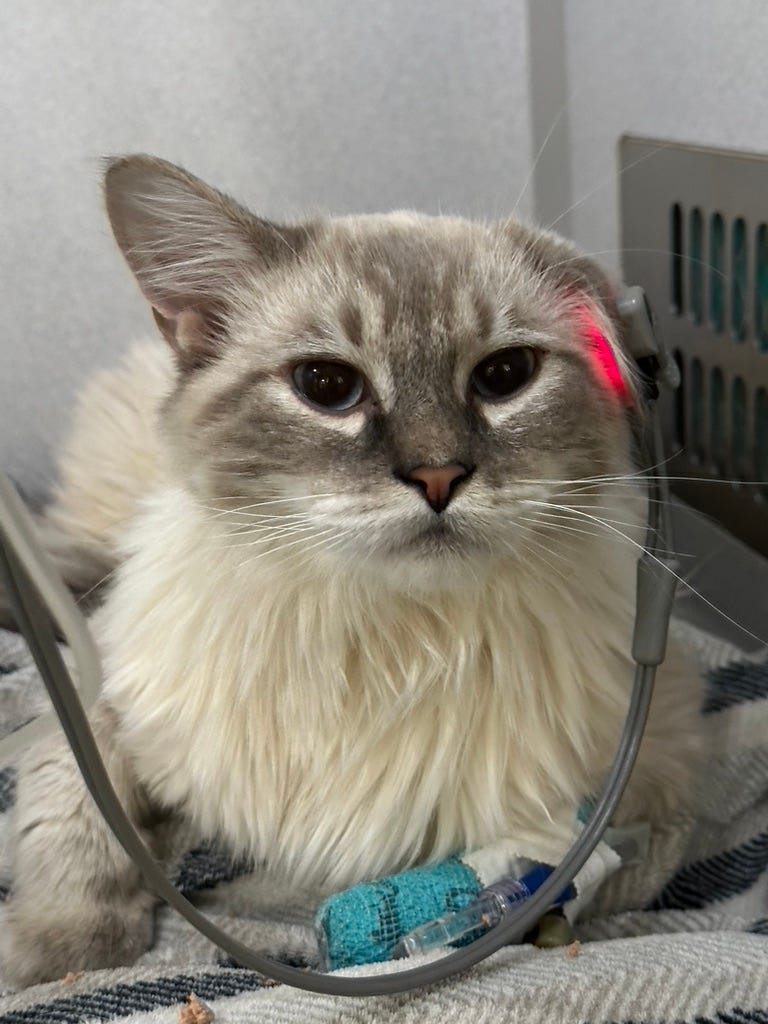
The question then, as many people have asked, what the heck is FIP?
Well if you have a cat, or you know people that do, listen up, because I’ve never heard of it.
FIP - Feline Infectious Peritonitis - starts its life as a cat virus.
What happened in 2020? Do you remember? There was this little thing called THE PANDEMIC. The thing that made everyone sick was novel coronavirus which had much higher mortality rate than the average virus that caused similar symptoms.
Cats are also susceptible to corona
viruses.
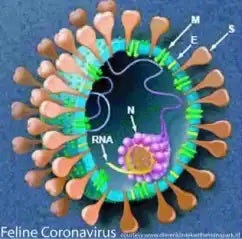
Anyway, the one that starts this whole thing off is Feline Enteric Coronavirus, a virus that a huge percentage of cats have right now. It isn’t dangerous, and at worst gives them runny stool. Studies show that 30-40% of cats in single cat homes have it, and it jumps up to 70-90% if your cat came from a rescue or you have a multi cat household.
FECV spreads from feces to cat, cat to feces and so on. In order for a cat to develop FIP they have to be infected with FECV, so the question is….where did Brix get FECV from?
Who knows. Another kitty in his litter tested positive for FIP, which means that that kitty had FECV so the most likely culprit was where we got Brix from. The virus was circulating, and Brix caught it there. Or Ginger, our son’s cat could have given it to him.
For reasons not well understood, a small percentage of cats who have FECV have a mutation occur in the virus. It is generally younger cats with the vast majority of FIP patients being under 2 years of age.
Instead of the virus attacking their digestive tract (remember the runny poos?) this new virus FIPV invades white blood cells and spreads throughout the body, triggering a severe, immune-mediated inflammatory response.
The symptoms come from one of two types of FIP. Wet FIP and dry FIP.
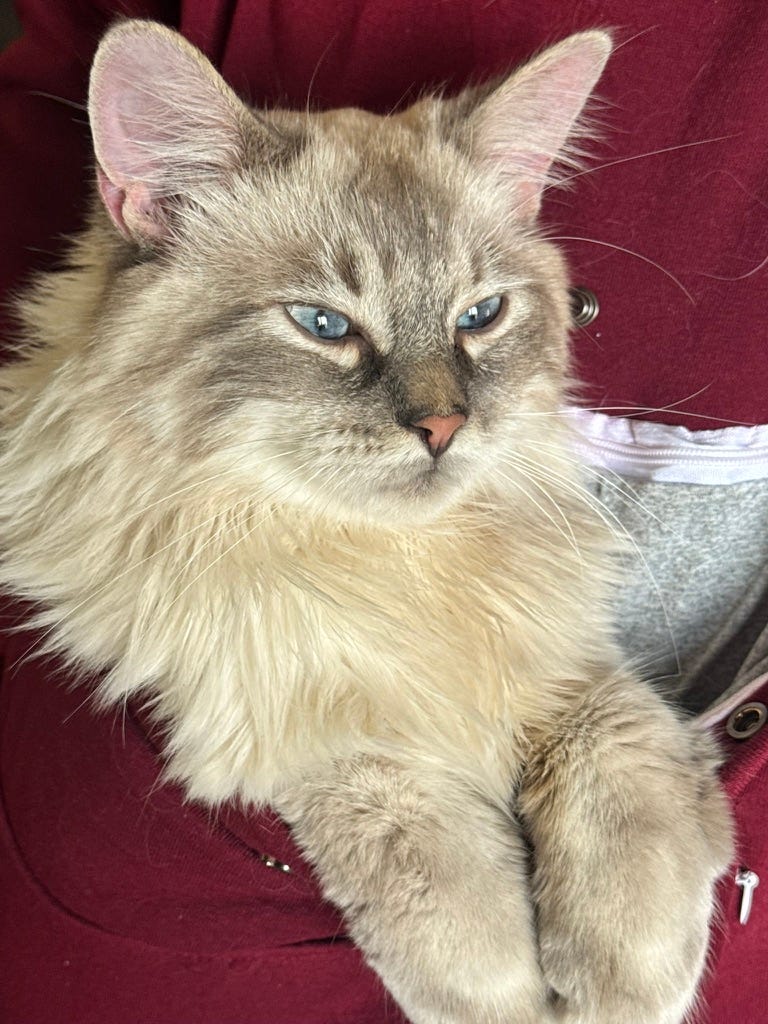
It is likely Brix had WET FIP. In Wet FIP the cat may have:
Fever, Trouble Breathing, Lethargy, and Fluid Build Up.
In Dry FIP, the brain is affected. Cats may have:
Lesions in organs like the eyes, brain, kidneys, or liver, causing more varied and sometimes vague symptoms.
FIP was first described way back in the 1960s, and for decades it was basically a death sentence. Like 100% fatal. A cat diagnosed with FIP was a cat you were going to lose. There was no reliable treatment, and vets knew it. When the vet team talked to us, many of them lamented dozens of cats lost to FIP, and all they could do was make the cat comfortable as it died.
The real turning point came from research into antiviral nucleoside analogs. A nucleoside analog is a drug that mimics a building block to a virus but it borks it up. It just hoses the virus and its ability to replicate, stopping the spread. Thing of someone putting a bunch of tater tots into a bin of Lego and then having to make Hogwarts Castle or something. It wouldn’t work well. The antiviral version that worked was called GS-441524.
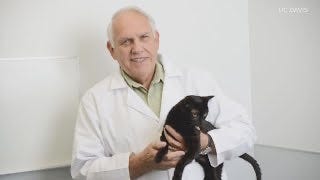
Dr. Niels Pedersen and his team at UC Davis were at the center of this work, and by 2018–2019, the results were showing real, strong efficacy. For the first time, FIP wasn’t automatically a lost cause.
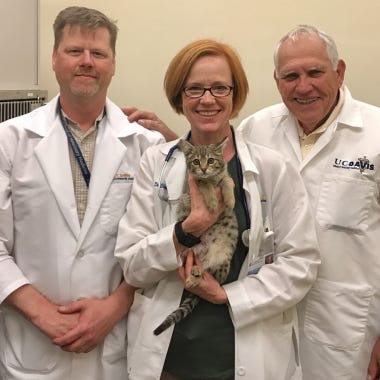
GS-441524 was used only two years later to help build an anti-viral called Remdesivir. If Remdesivir rings a bell, it was the antiviral which was used to help fight COVID-19 during the pandemic. Who knows if that drug would have been developed if the work on cats wasn’t started.
Sadly things didn’t improve. These drugs never got registered for veterinary use. So even though the science was there, vets couldn’t legally prescribe it. That left desperate cat owners with nowhere to turn but the black market — sourcing unregulated GS-441524 through online communities of other cat owners who’d been down this road before them. We heard horror stories of people driving across the country to get it, or buying it from unnamed people in far away countries only to get sent bubble solution. Awful.
By 2024 the drug was approved in most countries around the world, and our vet clinic here in 2026 literally had some ready to go and they gave it to Brix immediately. We were oblivious to the issues of getting the medicine, and Kris and I just thought it was normal.
Traditionally a 12-week (84-day) course was followed (and the drugs are still pricey) so the costs of treatment are high. Updated 2026 guidelines from the European Advisory Board on Cat Diseases found a shorter 42-day course can be just as effective for many presentations, and that is what Brix is on.
It appears that 85-90% of cats survive FIP when they are on GS-441524, with most who don’t make it, dying in the first few days. Some cats do relapse, studies in Europe and North America show a 10-15% chance of relapsing, and that stress can bring on a relapse, though it could be a host of other factors.
Now Brix didn’t have all the symptoms. One thing I didn’t mention was that the fluid buildup can be tested for certain proteins called albumin and globulin. Low albumin and lots of globulin make a ratio when divided, and anything less than 0.5 is a huge red flag. Brix had a healthy ratio.
FIP is sometimes super hard to diagnose until it is too late.
Through social media I’d say over 100 people contacted us with their own stories of kitties lost to FIP, and that they were praying/hoping for a good outcome for Brix. Until I did research and went through the papers I was ignorant of the disease.
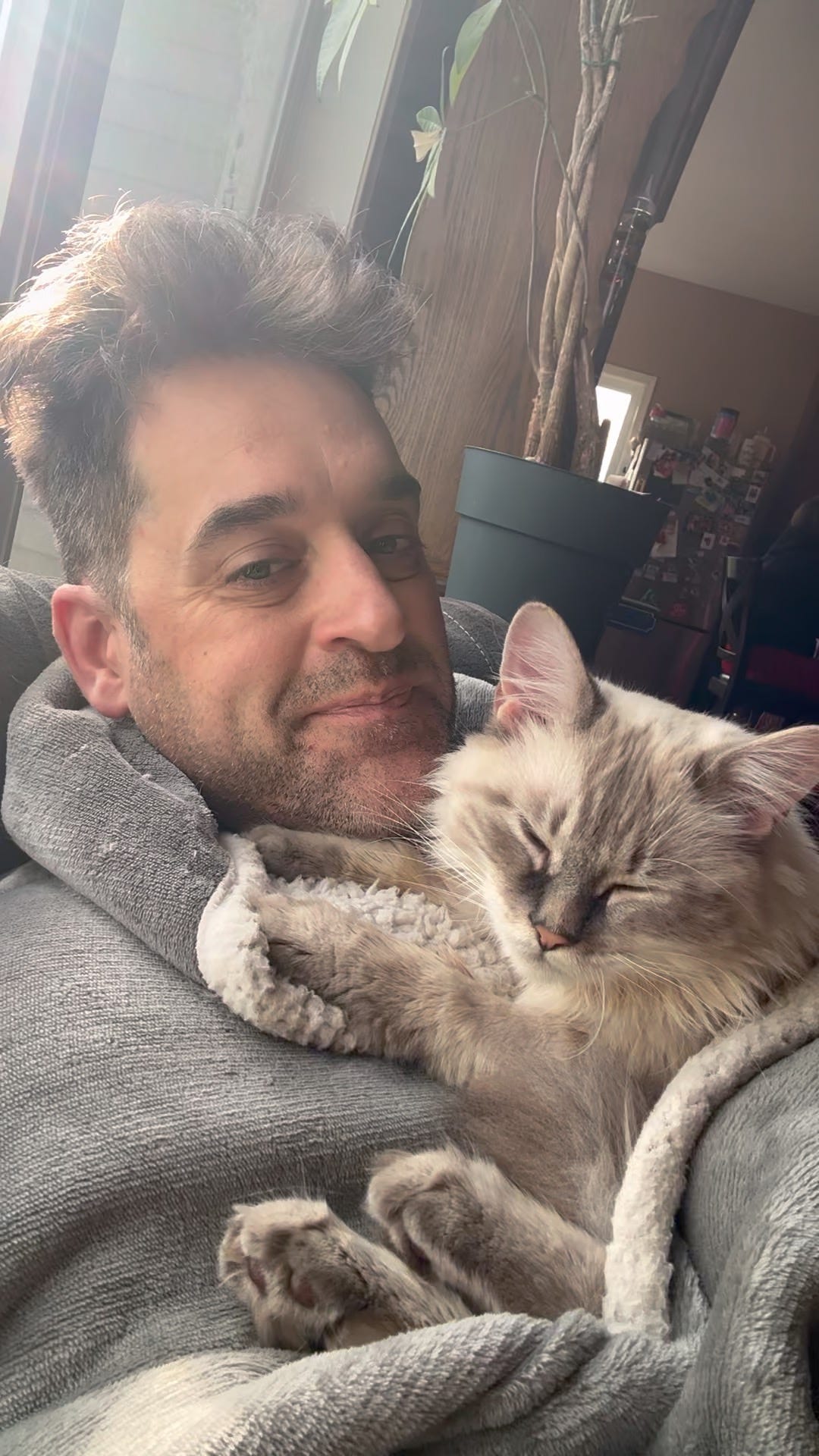
Today Brix is sitting on the chair right next to me as I type this up.
And yes, I’m going to give him a hug and a kiss.
I’ll let you know if he bites me.
No posts
Comments
Nothing yet. Say the first thing.
Sign in to join the conversation.