
Note: All numbers and data in this are very, very rough, and not deeply vetted. I believe that, for purposes of this line of reasoning, accuracy isn’t that important here, but I could be wrong.
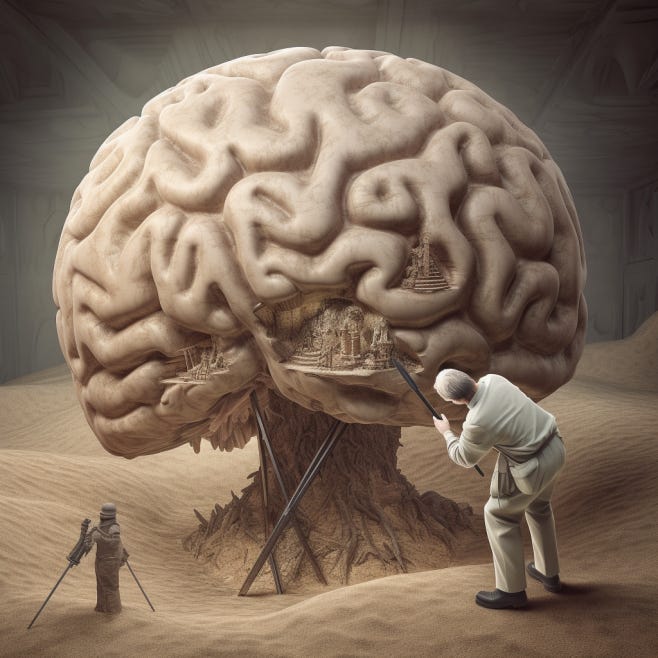
For at least a few millennia, humans have been asking this question.
We humans obviously are different in many respects from all other animals, as evidenced by our ability to create things - and especially societies - that are far more sophisticated than anything else in the animal world (at least on earth). But what core difference in humans makes this possible?
Current conventional thinking (as I understand it) is that around 200,000 to 300,000 years ago, the human brain changed in some way to gain the capabilities that would (later) enable us to create advanced societies, technologies, and civilization as we know it.
There are, and have been, many different theories for what really makes us different.
One of the earlier supposed distinctions was that humans were the only animals that used tools. This distinction was thrown by the wayside when it was “discovered” that many other animals, from simians to birds, also use tools.
The theory was revised to presume that humans were the only animals to create tools of our own making for specific purposes. Wrong again, unfortunately, since even crows have been found to fashion tools to allow them to get at certain kinds of foods. If a bird brain can do it, it’s probably not enough to tell ourselves how special we are.
An entirely different explanation comes from Yuval Noah Harari in Sapiens: A Brief History of Humankind. Harari suggests that the thing that makes us different is our ability to believe in things that are not real. This enables us to believe in fictions like nations, religions, and even financial concepts like money and corporations.
These two different answers reveal that this question is really at least two different questions in one:
1. What types of actions do humans perform that no other animal does?
Let me stop there for a moment. The answer to this question could be a huge list, which is not necessarily very enlightening. So, I’ll restate this in a more answerable and potentially useful way.
1. What is the most basic type of action that humans perform that no other animals do?
And
2. What is it about our mental capacity that allows us to do so many different things (such as religion, civilization, philosophy, and science) that no other animal does?
The first approach I mentioned above (how we use tools), addresses question number one. The second approach (by Harari) addresses question number two.
These two are obviously related. But which is more important and whether there is causality one way or another is a much stickier question, as we’ll see.
Let’s start with question number one: What is the most basic type of action that humans perform that no other animals do?
Many potential answers to this question have been proposed over the years, but over time most of them have turned out to not be unique. In fact, the more we learn about the rather amazing things many animals do with brains much smaller than ours, the more it seems maybe we’re not quite as special as our forebears would have liked to believe.
But there is one action that humans take which, at least so far, has not been observed in any other animal. It’s obvious when you think about it, but not usually the first (or tenth) thing that comes to mind:
Humans are the only animal known to cook our food.
This activity is pretty basic (requiring only very minimal tools, for example). And it turns out that the impact of this activity on our physical development is far, far greater than we would normally expect.
Consider that cooked food requires less energy to digest than raw food, thus ultimately providing more energy per unit of volume – and thus more energy output per unit of energy spent obtaining the food. Evolution very strongly favors efficiency in all things, but especially efficiency of obtaining energy from food.
Consider also that cooking food makes it possible to eat many foods which are not edible raw. So, the ability to cook food expands the range of foods available in almost any environment. This provides a level of food adaptability that is not present in almost any other animal (even cockroaches and rats, who are pretty darn adaptable).
Both of these factors make a pretty strong case for how developing the ability to cook food gave humans a strong evolutionary advantage. It enabled humans to adapt, survive, and expand better than just about any other animal on the planet.
Archaeological evidence supports this. Evidence strongly suggests that the development of cooking (as evidenced by the remains of cooking sites found) corresponds very closely with the initial great expansion of humans out of the traditional pre-human habitats.
This doesn’t necessarily tell us anything about whether cooking food changed our brains to allow us to think and behave differently.
However, the archaeological evidence also suggests that cooking food may have had something to do with the change in our brains and behavior. The development of the primitive culinary arts also coincides rather directly with an evolutionary scale “growth spurt” in size of the human brain.
This makes scientific and evolutionary sense because of the efficiency value of cooking food mentioned above: The additional efficiency of cooked food may have enabled development of the human brain that would not have survived evolutionary selection without the additional energy cooked food made available.
In other words, having a slightly larger and more complex brain may have had only small survival advantages (at least initially) relative to the extra energy required to support those changes. So, it wasn’t until cooked food provided excess energy that these types of brain changes were able to provide enough of an evolutionary advantage to be selected for.
Our ability to cook food, then, is likely at least a contributor to our increased adaptability and survivability. And it may also be the basic or ultimate cause for our species’ rapid expansion.
So, it’s hard to know whether cooking food was the direct cause of the change in our brains that enabled our ultimate development of societies and domination of the planet. But there’s a good chance that it was a necessary (though not sufficient) condition for it.
Of course, there’s a bit of a causality question here (chicken and egg if you prefer): which came first, the brain changes that enabled us to harness fire to cook food, or the cooking of food that enabled the brain changes that came (and continued) after?
But as with the answer to the actual chicken-and-egg problem, it’s likely that the answer is that it isn’t a direct causality issue, but an issue of concurrent development.
So, it seems likely that a very small brain change in the right place at the right time enabled an early proto-human to take advantage of cooking food. Then that ability to cook food provided survival advantages, and also the additional energy required for subsequent generations to have additional small brain changes.
Then, over time, those small brain changes added up and gave rise to whatever change it was that enabled us to create the large and complex societies and civilizations that came later.
Of course that’s speculation. But all discussion about this subject must be speculation until specific evidence is found to support or deny different avenues of speculation. So, at the moment I’ll lay the odds on (very small) brain changes preceding the cooking of food, and on cooking of food prompting additional brain changes after. YMMV.
If this is correct, then the ability to cook food is the physical activity that made the development of our brains possible, and ultimately led to our ability to form complex societies.
And that brings us to question number two: What is it about our expanded brains that allowed us to create these complex social structures?
Note: I’m going to intentionally keep the time estimates very rough. The time frames and differences involved are large enough that the same questions arise, even if I’m off by as much as 25% in all of the numbers.
When looking at this question, it’s important to once again look at the timeline from the archaeological record. Although the current evidence shows that modern humans emerged 200,000 to 300,000 years ago, current evidence suggests that modern humans didn’t form civilizations until only about 10,000 years ago.
That leaves 190,000 to 290,000 years of time when, despite the belief that our brains didn’t change significantly, we didn’t pull it together enough to form highly sophisticated societies.
For simplicity, I’ll use the 200,000 year mark as the emergence time frame for modern humans. And I’ll call the 190,000 year difference the “200,000 year gap.”
How can this gap best be explained?
One simple explanation is that it just took time and trial-and-error to develop social structures that were scalable enough.
Trial-and-error is both the way evolution works and the way pretty much all human progress in the last 10,000 years has worked. So, at least at first glance, this seems like a viable explanation.
Note: I believe selection happens across more than individual genes
True believers in the selfish gene theory might lambaste this explanation since it inherently implies some level of social selection, and they disagree that social selection happens at all.
However, as I’ll expand on another time, I’m fairly certain that selection is a fundamental property of the physics of time and happens at all levels of all things at all times. So, I can’t fully accept their (mostly untestable and thus not fully scientific) arguments for genetic selection being the only kind of selection there is.
A second explanation of the 200,000 year gap is that the capability for these complex societies existed within our brains 200,000 years ago, but that there was a significant change of environment 10,000 years ago or so (in many locations around the planet simultaneously) that enabled these societies to form. Of course, the end of the last glacial period fits this explanation rather well; emergence of complex societies didn’t happen anywhere on the planet until after the glaciers receded.
Both of the above explanations make sense, but both leave me with the same big question. If our brains were capable of forming complex societies 200,000 years ago, and the glacial period didn’t start until 115,000 years ago, why didn’t we form complex societies in the 85,000 years before the glacial period started?
After the end of the glacial period, complex societies were formed in multiple completely separate locations in less than 6,000 years. That suggests that, if our brains were capable of forming complex societies in the 85,00 years before the glacial period, it’s highly likely it would have happened then.
Again for simplicity, I’ll call the lack of civilization formation between the believed emergence of modern humans and the start of the glacial period the 85,000 year gap.
This gap doesn’t rule out explanations #1 and #2, but it does suggest they’re less likely.
A third explanation for the 200,000 year gap is that there was another small brain change around 10,000 years ago that makes us distinct from our ancestors of 200,000-300,000 years ago.
Interestingly enough, though I believe this is a possibility, I’ve never heard any scientist or archaeologist suggest this. In fact, from what I’ve read, it appears to be pretty much accepted that modern humans are basically genetically identical to our ancestors from 200,000 years ago. I believe the reason this is accepted is because when we sequence DNA from 200,000-year-old human remains, it appears to be pretty much the same as ours.
But I doubt the DNA evidence alone is enough to eliminate this explanation. The variation of DNA within human beings is tiny enough, and the functions of most human DNA is still unknown enough, that we can’t even fully explain the differences in characteristics like IQ even among family members (let alone different ethnicities or humans from different eras).
However, DNA evidence aside, it’s a fact that civilization arose in many different areas of the planet starting around 10,000 years ago. But the populations that founded those civilizations were geographically separated from each other significantly earlier than the ~10,000 year starting point (anywhere from 70,000 to 100,000 years ago).
And that earlier separation suggests that either the brain changes necessary to form complex social structures existed in our ancestors before the separation, or that whatever brain change enabled those societies happened separately multiple times in ancestors in different locations.
The chance that the same brain change happened separately in multiple different populations in such a short time period is vanishingly small. So, I’m going to rule this potential explanation out.
However, this brings us to a fourth possible explanation for the 200,000 year gap. What if there was a small brain change in humans just before the population split (at around 100,000 years ago or so)? However likely this is, it does seem plausible, and avoids the need to explain the 85,000 year gap. So, I’ll consider a pre-ice-age brain change a possibility.
Note: There’s no need to explore a 100,000 year gap
All things being equal, I might call the gap between this possible brain change and the formation of complex societies a 100,000 year gap. However, they aren’t equal.
The glacial period provides a very clear possible explanation for why – even if our brains were capable of it – complex societies weren’t formed during this gap. And in fact, the glacial period could even potentially be seen as a driver of the genetic change. And in fact (again), the onset of the glacial period could have provided the evolutionary pressure to precipitate this genetic change.
So, I won’t try to explain this 100,000 year gap (at least for now), since a ready and plausible explanation already exists.
(Or at least the evidence I’m aware of - which is guaranteed to not be complete).
Although I’m sure there are more possible explanations, I won’t address any more here. I’ll treat all three of the remaining explanations (#1, #2, and #4) as plausible, but note that there are significant questions about pretty much all of them.
So, I’ll now try to see how well these explanations hold up to other evidence.
The question I’ll ask now is: why did the timing of the development of civilization vary so much in different locations around the planet?
One theory about the difference in the starting times of early civilizations is a combination of our two explanations for the two-hundred-thousand-year gap. The receding of the glaciers provided a necessary change in the environment, and there was a period of trial-and-error needed to form civilizations in each area (ranging from only a thousand years or so to six thousand years or so in different locations).
There’s another possible explanation, as proposed by Jared Diamond in Guns, Germs, and Steel: That the difference in the time it took to develop civilizations, and in the advancement rate of those civilizations, depended on the difference in the environments of each population.
Diamond’s argument isn’t bulletproof. But it does suggest that human populations in areas with more abundant resources (including things such as edible grains and large animals) developed civilization faster.
This explanation fits into the proposed combination of environmental changes and trial-and-error determining when civilizations formed, adding a dimension of local environments to help explain the differences in time to develop civilizations.
I must note, though, that if we accept Diamond’s premise that local conditions affected the speed of civilization development, that seems to argue against the premise that our brains were appropriately wired to create civilization 200,000 years ago (explanations #1 and #2).
Because unless the environment our ancestors lived in during the 85,000 year gap was wholly inappropriate to forming civilizations, it seems highly likely that at least some complex civilizations would have formed in that 85,000 years. After all, even in locations which had almost none of the supporting factors Diamond suggests, civilization formed only 6,000 years after the end of the last glacial period.
So, how could our ancestors go a whole 85,000 years without forming a civilization in conditions that, at least from what we know, appear to be more suitable (in Diamond’s terms) for forming a civilization?
This suggests that the 85,000 year gap can’t really be accepted. Or at least, explanations that require us to accept this gap are much less likely to be true than those that don’t.
And if that’s the case, then only one of the competing explanations for the 200,000 year gap remains: that there was some brain change in humans between 115,000 and 100,000 years ago – before human populations became geographically separated – which enabled us to form complex societies.
So, I started this discussion with musings about what makes humans different, and different approaches to it that have been proposed in the past.
I think the evidence is fairly strong that, although the ability to cook food may not be the only thing that allowed us to diverge significantly from other animals, it’s likely it was a necessary condition for it. And cooking food likely paved the way for the changes to our brain that enable us to create complex societies.
And I concluded (unexpectedly to me) that it seems possible that the change in our brains that allowed us to form complex societies happened not 200,000 years ago, but between 115,000 and 100,000 years ago (between the onset of the last ice age and the split of human populations 100,000 years ago).
I fully acknowledge that I’m barely educated on any of this, and this is just my speculation, so it’s likely some or all of this is wrong – possibly to the point of laughability for anyone more knowledgeable about this than I.
Simple, just answer this question:
If we’re genetically identical to our 200,000 year old ancestors, why did they fail to form civilizations over the course of the 85,00 years between the brain change that happened 200,000 years ago, and the beginning of the last glacial period?
And take into account that multiple geographically separated groups of our more recent ancestors each made the jump to civilization in 6,000 years or less, under widely different conditions.
Comments
Nothing yet. Say the first thing.
Sign in to join the conversation.