
Earnings season delivered a clear theme last night: the cost of betting big on the future is showing up in the present.
Tesla’s free cash flow flipped negative as capex soared, IBM cut its full-year outlook, and Southwest’s fuel bill ballooned even as fares climbed.
The thread connecting all of it is the same tension playing out in every boardroom right now: conviction spending that the income statement hasn’t caught up to yet.
1. The Lead · Earnings
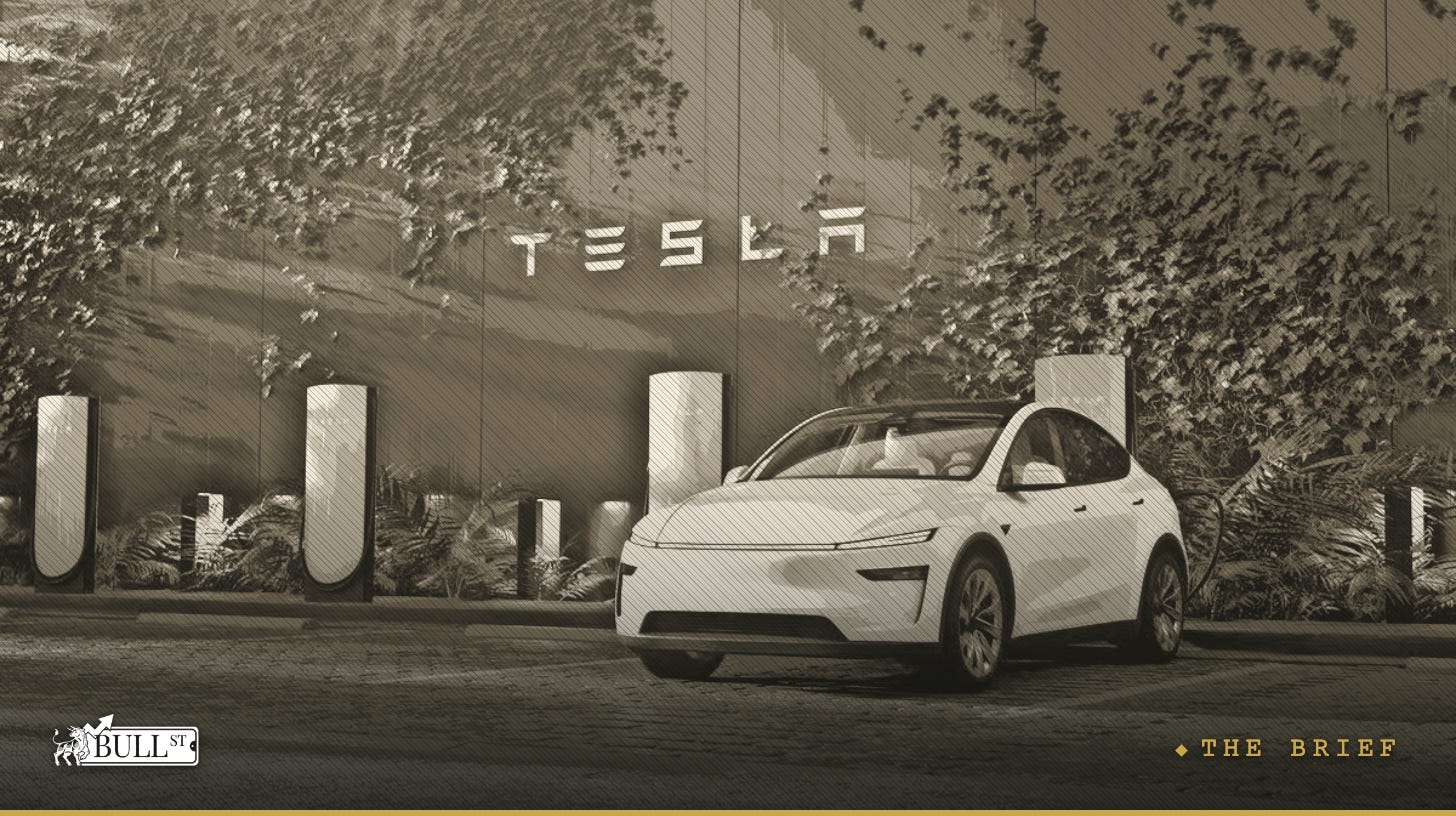
Tesla (TSLA) posted Q2 adjusted EPS of 33 cents against a 51-cent consensus, according to LSEG estimates compiled by CNBC, even as revenue of $28.24 billion cleared the $25.71 billion bar. The miss that matters most: free cash flow swung to a negative $1.1 billion from positive $146 million a year ago and $1.44 billion in Q1 2026. The culprit is capex, which soared 142% year over year to $5.79 billion as Tesla pours money into Cybercab production, Optimus robot manufacturing lines, and an AI chip fab. Gross margin of 16.8% came in far short of the 19.4% analysts expected and below the 17.2% posted a year ago. Operating margin collapsed to 1.4% from 4.1%. The stock fell about 4% in extended trading. Tesla is simultaneously a car company losing ground on price, a robotaxi business that hasn’t yet proven its safety case at scale, and a robotics venture with, by Elon Musk’s own admission, no existing supply chain.
-$1.1B: Tesla’s free cash flow in Q2 2026, reversing from positive $1.44 billion in Q1, per CNBC.
The Bull & The Bear
▲ Bull: The revenue beat was real, with automotive sales up 23% and services jumping 50% year over year, per CNBC. FSD subscriptions rose 56% to 1.48 million. If Cybercab and Optimus deliver anywhere near Musk’s vision, the capex being spent today is seed corn for a business worth multiples of the current auto franchise. Rising gas prices from the Iran conflict are pushing European buyers toward EVs, providing a near-term tailwind.
▼ Bear: Gross margin of 16.8% is nowhere near sufficient to justify the valuation on a car-company multiple, and the path to a robot/AI multiple requires execution that has not yet been demonstrated at scale. Operating expenses grew 47% while the company loses money on a free cash flow basis. Average selling prices are falling, regulatory credit revenue is declining, and Chinese competitors including BYD, Nio, and Xiaomi continue to take share in global markets. The stock is already down 17% for the year heading into this print.
The Bull Street Take
I take Musk at his word that Optimus is a generational bet. I also take the income statement at face value. A 1.4% operating margin and negative free cash flow in a rising-rate, rising-cost environment is not a comfortable place to be while you fund a moonshot with no existing supply chain. The revenue growth is real, the FSD subscriber momentum is encouraging, and the long-term thesis hasn’t changed. But capital allocators need to price the execution risk here honestly. This is a hold-with-eyes-open situation, not a buy-the-dip moment.
Tesla Q2 earnings full report: https://ir.tesla.com/#quarterly-disclosure
Markets in Review · The Tape
IBM shares entered Wednesday’s session already down 30% year to date following last week’s preliminary earnings warning, while the S&P 500 was up approximately 10% for the year, according to CNBC. Tesla fell about 4% in after-hours trading following its Q2 print.
The session’s dominant story was not a single index move but a margin compression narrative cutting across industries. Tesla’s gross margin of 16.8% missed analyst estimates of 19.4% by a wide margin, per StreetAccount data cited by CNBC, while IBM’s Z mainframe revenue fell 42% and pulled the company’s full-year growth outlook down to 4%-5% from over 5%.
In airlines, Southwest’s 67% surge in fuel costs to $2.22 billion for the quarter illustrates how commodity volatility tied to the U.S.-Iran conflict is still working its way through cost structures, even as fare increases provide partial cover. Average one-way fares rose nearly 21% year over year to $225.61, per CNBC.
In rates, the 30-year Treasury logged its longest stretch above 5% since 2007, according to MarketWatch, a milestone that raises the hurdle rate for long-duration bets across equities, real estate, and corporate credit.
Go deeper
IBM (IBM) confirmed its preliminary Q2 results, with adjusted EPS of $2.93 versus a $2.97 consensus and revenue of $17.16 billion against a $17.58 billion estimate; the stock is down 30% year to date, per CNBC.
Southwest (LUV) beat Q2 estimates with adjusted EPS of 94 cents versus 51 cents expected, but Q3 EPS guidance of 50-75 cents missed the 82-cent consensus, sending a cautious signal on the back half of the year, per CNBC.
The Bull Street Take
A tape this fixated on margins rewards the companies that fund their own growth, so I stay long the self-financing operators and make the leveraged stories prove it first.
2. The Tape · Semiconductors
TSMC reported a 77.4% jump in Q2 profit year over year, another record quarter, but the company is signaling that U.S. expansion will compress margins for years, according to CNBC. CFO Wendell Huang told investors that gross margin dilution from overseas fabs will run 2% to 3% early in the ramp and widen to 3% to 4% in later stages. Q2 gross margin was 67.7%, up from 66.2% in Q1, which leaves room to absorb the dilution. The catch: Morningstar senior equity analyst Phelix Lee estimates U.S.-made chips cost 20-50% more than Taiwan-produced chips, and that gap will largely land on TSMC’s customers.
$200B: Total U.S. manufacturing commitments TSMC has announced, including a $100 billion investment unveiled last week, per CNBC.
The Bull Street Take
A 67.7% gross margin buys a lot of forgiveness. TSMC is still the only toll booth on the AI highway, and the cost of the U.S. ramp lands on customers who have shown no sign they can walk away.
3. Earnings · Tech
IBM (IBM) confirmed Q2 revenue of $17.16 billion and adjusted EPS of $2.93, both in line with the preliminary figures released a week ago but short of the $17.58 billion and $2.97 consensus, per LSEG. The company trimmed its full-year constant-currency revenue growth target to 4%-5% from over 5%, citing a 42% collapse in Z mainframe revenue as customers front-loaded hardware purchases ahead of price increases, according to CNBC. IBM stock had already fallen 25% on the preliminary warning and is now down 30% year to date versus the S&P 500’s roughly 10% gain. The one bright spot: software revenue grew 5% to $7.76 billion and the company reiterated its target of $1 billion in higher free cash flow for the full year.
The Bull Street Take
Software up 5% and a billion more in free cash flow says there is a real business under the wreckage. I want one clean quarter before I believe the mainframe pull-forward has washed through.
4. Earnings · Airlines
Southwest Airlines (LUV) posted Q2 adjusted EPS of 94 cents versus the 51-cent consensus and adjusted revenue of $8.72 billion against an $8.58 billion estimate, per LSEG. The problem is what comes next: Q3 EPS guidance of 50-75 cents fell well short of the 82-cent consensus, according to CNBC. Southwest’s fuel bill surged 67% to $2.22 billion in the quarter even as average one-way fares climbed nearly 21% to $225.61. CFO Tom Doxey called domestic demand “really strong,” but volatile fuel costs tied to the Iran conflict are forcing the airline to cap Q3 capacity growth at flat to down 1% versus a year ago.
The Bull Street Take
Demand held and fares carried a 21% increase, so the franchise is fine. Fuel swings like this are why I trade airlines and never marry them.
Bull Street Pro · Special Offer
Bull Street Pro launches today: You get the Market Brief every market morning instead of twice a week, the Research Desk report each month, and a live sector deep dive with a guest who works that ground. Until August 31, the annual rate is $99 instead of $150, and the rate stays locked for as long as you stay. After that, the bell rings once and it’s gone.
5. The Fed · Rates
The 30-year Treasury yield has now logged its longest stretch above 5% since 2007, according to MarketWatch. New Fed Chair Kevin Warsh has contributed to uncertainty by repeating three phrases across five public appearances without clarifying their policy implications: “family fight,” “first principles,” and “inflation is a choice,” per CNBC. JPMorgan chief U.S. economist Michael Feroli says the “family fight” framing is an attempt at being folksy without departing from tradition. What the market cares about is simpler: a Fed chair who says less and a long bond that keeps climbing is a combination that raises the cost of capital across every asset class.
The Bull Street Take
A long bond above 5% argues with every growth multiple in the market. I underwrite as if it stays there, and anything cheaper is a bonus.
+ Also on the Tape
Deals: Germany’s Intersnack Group agreed to acquire Utz Brands (UTZ) for $14.25 per share in a $2.9 billion deal, a 91% premium to Utz’s pre-announcement close, taking the salty snack maker private, per Yahoo Finance.
Autos: GM sold approximately 715,000 vehicles in the U.S. in Q2, a 4.2% year-over-year decline, with much of the drop tied to discontinued models and a pullback in EV demand after the federal tax credit expired, per Yahoo Finance.
Tech: IBM introduced its Bob AI coding tool, which has been adopted by over 80,000 employees, and signed a letter of intent to build a U.S. quantum chip foundry, per CNBC.
Macro: TSMC is set to raise prices for advanced and mature chip production by up to 10% in 2027, according to a Nikkei report, as U.S. manufacturing costs estimated at 20-50% above Taiwan levels get passed downstream.
The Last Word
Capex is a promise. Free cash flow is the proof.
Bull Street is for informational purposes only. Nothing here is financial advice. Always do your own research.
Comments
Nothing yet. Say the first thing.
Sign in to join the conversation.