
The through-line today is capital in motion: big money flowing into AI infrastructure, a split Fed debating which direction rates go next, and a space race heating up as Blue Origin opens its doors to outside investors for the first time ever.
Underneath it all, Bank of America is flashing a warning about a K-shaped economy that makes the Fed’s job genuinely hard.
Let’s get into it.
1. The Fed · Rates
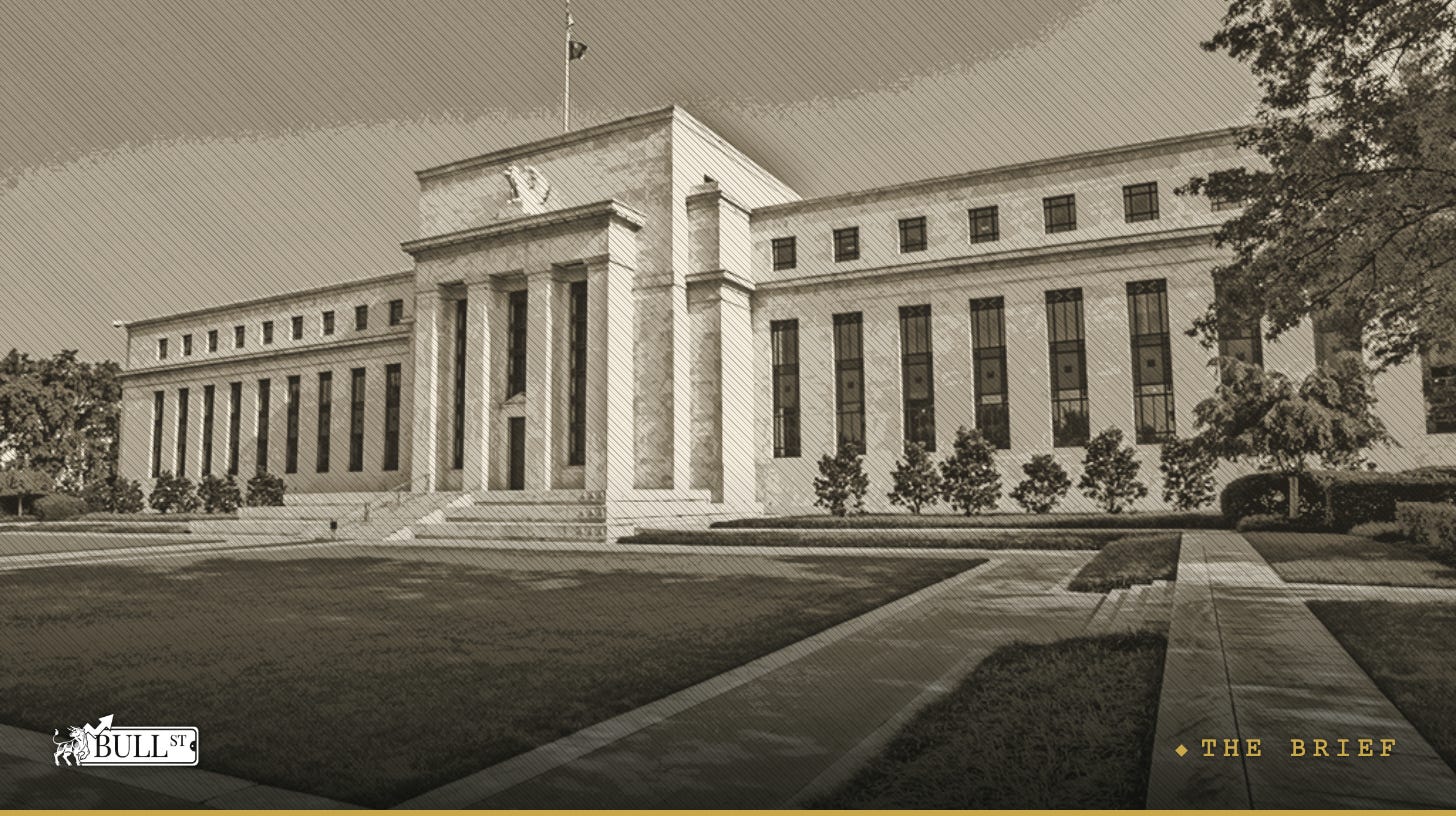
Minutes from Kevin Warsh’s first FOMC meeting as chairman, released Wednesday by the Federal Reserve, revealed a committee that is genuinely divided on the next move for interest rates. “Many participants” saw rates ending the year within or slightly below the current 3.5%-3.75% range, while “many other participants” judged that rates would need to go higher, according to CNBC. The dot-plot grid, in which Warsh did not participate, narrowly tilted toward one hike this year followed by cuts in each of the next two. Inflation, elevated by Trump tariffs and the Iran war’s energy shock, is expected to stay hot near term before easing as Hormuz disruptions fade. The committee also noted that AI infrastructure demand is sustaining upward pressure on tech goods and electricity prices. Warsh, consistent with his anti-forward-guidance posture, gave markets little to anchor on.
3.5%–3.75%: The Fed funds rate target range, unchanged for all of 2026, as the committee debates whether the next move is a hike or a cut.
The Bull & The Bear
▲ Bull: If energy prices keep declining and tariff pass-through fades as the Fed expects, inflation could retreat faster than the hawks anticipate, giving the committee room to cut without triggering a second wave. The unanimous hold and a chairman allergic to pre-commitment means policy stays nimble, which is exactly what a bifurcated economy needs right now.
▼ Bear: Bank of America is already forecasting 75 basis points of rate hikes this year, with PCE inflation projected at 3.5% and the unemployment rate holding near 4.3%, according to Yahoo Finance. If BofA is right, the Fed will be forced to tighten into an economy where lower-income households are already squeezed, and rate-sensitive small caps could see net interest expense jump 13% of 2025 EBIT by 2027.
The Bull Street Take
I read this as a Fed that genuinely does not know what comes next, and the honest answer is: neither does anyone else. The Warsh era started with a 14-page minutes release and a deliberately vague dot-plot. That is not weakness; it is intellectual honesty about an economy running two separate engines at two separate speeds. My read: the base case is a hold through year-end, but the bar for a hike is lower than markets priced in six months ago. Position accordingly.
Markets in Review · The Tape
Markets in Review
Stock market futures held negative and Treasury yields rose after the Fed released minutes showing a divided committee with no clear directional bias, according to CNBC.
Wednesday’s session was shaped by the Fed minutes release, which confirmed what many suspected: the FOMC under Chairman Kevin Warsh is operating without a strong prior on the next rate move. Futures stayed in the red through the afternoon, and bond markets pushed yields higher as traders digested the possibility that the next move could be a hike rather than a cut.
The real market mover on the session was Broadcom (AVGO), which surged nearly 5% after Apple disclosed a $30 billion+ chip supply agreement running through 2031, per CNBC. That kind of single-stock pop on a supply deal underscores how much the market is paying attention to every signal in the AI buildout narrative.
On the earnings front, Levi Strauss (LEVI) beat on both the top and bottom lines and raised full-year guidance, yet shares still fell more than 5% in extended trading, a data point worth noting for anyone trying to read sentiment in the consumer space right now.
Go deeper
Broadcom (AVGO) +~5%: The Apple chip deal, exceeding $30 billion and covering more than 15 billion U.S.-made chips, is the kind of long-duration revenue visibility that the market rewards immediately.
Levi Strauss (LEVI) -5%+ after hours: Clean beat, raised guidance, higher dividend, and still sold off. The market may be pricing in tariff and macro risk that the strong Q2 print has not yet resolved.
Treasury yields higher: The Fed minutes removed any residual easing bias from the June statement and showed several members open to hiking, giving bond bears fresh ammunition heading into the back half of 2026.
What they’re saying
“There’s some ambiguity in the minutes, suggesting several competing views on policy. The committee is working through a wide range of scenarios and will not commit to a specific scenario until the incoming data provides necessary clarity,” said Jeffrey Roach, Chief Economist at LPL Financial (via CNBC).
2. Deals · AI Infrastructure
Apple (AAPL) announced a multi-year deal with Broadcom (AVGO) expected to exceed $30 billion, covering more than 15 billion U.S.-made chips and a $1.5 billion expansion of Broadcom’s Fort Collins, Colorado facility, according to CNBC. The agreement centers on custom ASIC silicon, including wireless components for cellular, Wi-Fi, and Bluetooth, running through 2031. Broadcom shares climbed nearly 5% on the news. For outgoing CEO Tim Cook, this is the largest single commitment under Apple’s $600 billion, four-year U.S. investment plan announced in 2025. The deal cements domestic silicon supply at a moment when AI workloads are rapidly expanding ASIC demand across the industry.
$30 billion+: Apple’s commitment to Broadcom for U.S.-made chips, the largest piece of its $600 billion American investment plan.
3. The Tape · Macro
Bank of America’s mid-year outlook, shared with Yahoo Finance, describes a K-shaped economy: “reflation for higher income, stagflation for lower income.” Spending by the top 1% rose 9.0% year over year in the week of June 6, while lower-income spending grew just 5.5%, per BofA card data. The bank projects real GDP growth of 2.3% in 2026 alongside PCE inflation of 3.5%, a combination that leaves the Fed with no clean off-ramp. The implication is clear: the aggregate data looks healthy precisely because wealthy households are strong enough to carry the headline number, obscuring real stress at the lower end.
4. Deals · Space
Jeff Bezos’ Blue Origin is raising $10 billion at a $130 billion pre-money valuation, marking the first time the rocket company has sought outside capital since its founding in 2000, according to Business Insider. The round is led by Coatue Management with a $2 billion contribution from Bezos himself, per the New York Times’ DealBook. CEO Dave Limp framed the raise as a “vote of confidence” in a memo to staff. The move comes as Blue Origin races to close the gap with SpaceX, which raised a record $86 billion at its recent IPO surpassing a $2 trillion valuation.
5. Earnings · Retail
Levi Strauss (LEVI) reported Q2 adjusted EPS of 28 cents versus 24 cents expected, and revenue of $1.56 billion against a $1.52 billion consensus, then raised its full-year sales growth outlook to 7%-7.5% from a prior 5.5%-6.5%, according to CNBC. The company also raised its dividend. CEO Michelle Gass noted that about two-thirds of the quarter’s sales growth came from unit volumes, not price increases, a sign of genuine demand rather than inflationary cover. Shares still dropped more than 5% in extended trading, a reminder that even clean beats can’t overcome a skittish tape.
★ Featured Event · Live Webinar
Oren Klaff shares his work with 400+ current investors, and on Wednesday, July 16 at 9:00 AM PST he is doing it live: a real deal breakdown, plus the framework he uses to spot a private company with genuine upside before the broader market notices. 55 minutes, live only, no recording, and seats are limited. If you want to sharpen how you think about private-market access, be in the room.
+ Also on the Tape
Emergency orders, a 20-year demand record, and why bring-your-own-power is the next American buildout. This is the piece to read if you want to understand where the AI power story actually goes next.
AI Debt: Amazon filed for an eight-part bond sale targeting at least $25 billion to fund AI infrastructure, with maturities spanning 3 to 40 years, following roughly $64 billion in bonds already raised earlier this year, according to Yahoo Finance.
Rail M&A: Union Pacific (UNP) and Norfolk Southern (NSC) submitted the first tranche of data requested by the Surface Transportation Board for their $85 billion merger review, targeting a mid-2027 close, per Yahoo Finance.
Investing: Michael Burry disclosed a position split roughly 60% Flutter and 40% DraftKings (DKNG), betting that regulators will eventually rein in prediction markets and restore pricing power to licensed sportsbooks, according to CNBC.
AI Capex: The four largest AI spenders lifted Q2 2026 capital spending 74% year over year to $168 billion, with combined 2026 outlays on track to exceed $700 billion, according to Reuters via Yahoo Finance.
The Last Word
A split Fed is not a weak Fed. It is a Fed that is actually looking at the data.
Bull Street is for informational purposes only. Nothing here is financial advice. Always do your own research.
Comments
Nothing yet. Say the first thing.
Sign in to join the conversation.