
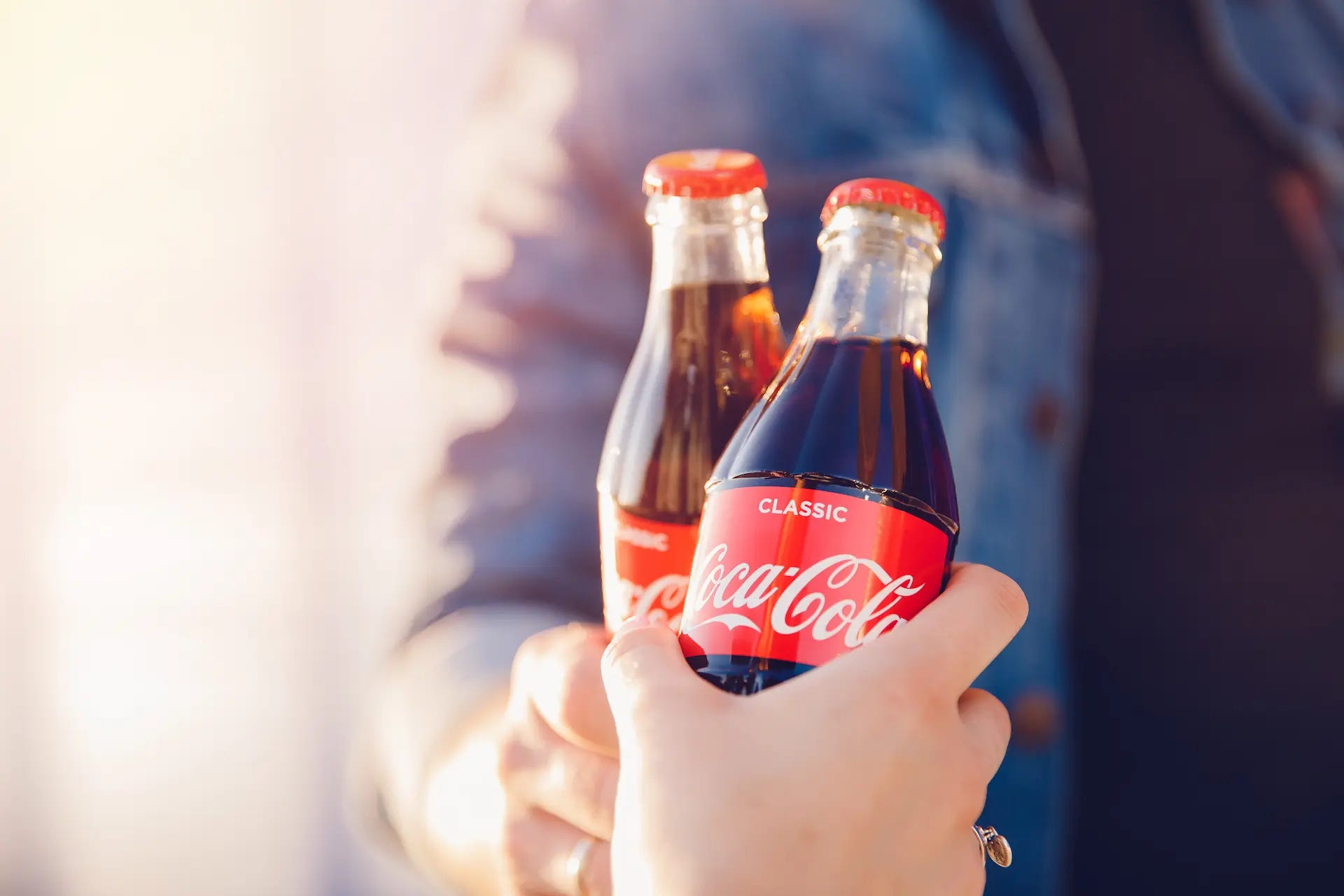
Coca-Cola is the most completely realized Innocent brand ever built, and I mean that structurally. Pull the Innocent out of Coca-Cola and what remains is caramel-colored sugar water that loses blind taste tests to Pepsi. That’s not a hypothetical, it’s literally what the Pepsi Challenge demonstrated in the late seventies, and it’s what Coke’s own researchers confirmed in the run-up to the New Coke disaster.
The whole case fits in one sentence: the product is beatable, the feeling never has been.
An authentic archetype match has to clear three tests at once. The Patron has to genuinely need what the archetype delivers. The brand has to genuinely behave that way. And the territory has to be open in the market. Coca-Cola clears all three so hard it practically invented the exam. Patron truth: people in every market on earth carry low-grade tension and want a small, reliable moment of relief that costs a dollar.
Brand truth: for roughly a century, nearly every dollar Coke spent on communication bought optimism, togetherness, and nostalgia, with a consistency no other advertiser has matched.
Market truth: Coke claimed happiness-in-a-bottle so early and so totally that Pepsi was forced to build its entire identity out of being whatever Coke wasn’t. Youth. Irreverence. The choice of a new generation. When your competitor’s archetype is defined as your negative space, you own the territory.
But the Innocent is also the most fragile seat on the wheel, because a brand built on goodness gets audited on goodness, and Coca-Cola has failed three audits in the last decade. We’ll get to those, but first, let’s look at the roots of the brand.
Start with the bottle. In 1915, the Root Glass Company of Terre Haute, Indiana won a design competition whose brief has never been topped for clarity: create a bottle a person could recognize by touch in the dark, or identify from a single shard lying broken on the ground. Notice what that brief skips. It never mentions beauty. It never mentions efficiency. What it demands is recognition without thought, comfort a person can find with their eyes closed, which is the Innocent’s promise rendered in glass. It’s also why the contour bottle still stars in the advertising a century later while nearly half of what the company actually ships is plastic.
Then there’s the formula, which functions less like a trade secret and more like a covenant, and the proof arrived on April 23, 1985. The company, armed with some 200,000 taste tests showing people genuinely preferred a sweeter reformulation, replaced original Coca-Cola with New Coke. By every rational measure the new product was better. The Patrons revolted anyway. Thousands of angry calls a day, protest groups with names like the Old Cola Drinkers of America, people hoarding cases in basements like the currency was about to collapse. Seventy-nine days later the company surrendered, brought the original back as Coca-Cola Classic, and president Donald Keough went on television to say: critics would call it a marketing blunder, cynics would insist the whole thing was planned, and the truth was “we are not that dumb, and we are not that smart.”
Most case studies still draw the wrong lesson from New Coke. What it actually proved is that people were never paying primarily for the liquid. They were paying for the continuity of it, for the guarantee that at least one small thing in a shifting world would taste exactly the way it did when they were nine years old. You cannot improve an Innocent brand’s product in a way that breaks its sameness, because for this archetype sameness is a feature the Patron is actively purchasing. For ninety-nine years the answer to “is it still here?” had been yes, and the company nearly bled to death in eleven weeks for changing the answer.
Trace the ad history and something strange emerges: the promise never moves. Media transforms completely, the century lurches through a depression and two wars, and the promise holds steady.
1929, the Depression opens, and Coke’s agency lands on “The Pause That Refreshes.” The line skips right past achievement and status and sells a pause, permission to put the weight down for five minutes. In 1931 the company commissions illustrator Haddon Sundblom, who spends the next three decades painting the warm, plump, red-suited Santa Claus that effectively standardized the modern image of the character. (Coke did not invent red Santa, whatever the internet legend says, but Sundblom’s version outcompeted every other Santa into extinction.) A soda company now co-owns the emotional infrastructure of Christmas.
1971 gives us Hilltop: the fogged-out flight to Shannon, Bill Backer’s napkin, five hundred young people on a hillside outside Rome, ten thousand thank-you letters for a commercial within ten days of air. Here’s what that means: Coke’s biggest swings are never about the drink. They stage the world briefly behaving the way we wish it would.
1979, Mean Joe Greene. The most feared defensive lineman in football limps snarling down a stadium tunnel and gets softened into a grin by a kid holding out a bottle. Watch the mechanic there: the ad recruits the scariest available figure specifically so innocence can disarm him on camera.
1993 brings the polar bears, dreamed up by an art director named Ken Stewart who reportedly got the idea from his Labrador retriever. Creatures from the harshest environment on the planet, rendered as a gentle family watching the northern lights together.
1995, “Holidays Are Coming,” the caravan of lit-up red trucks that a measurable chunk of the population now treats as the official starting gun of Christmas. Keep that 1995 ad in mind. It comes back later, for the worst possible reason.
And then 2011, the modern masterpiece. Share a Coke, born in Sydney from a 151-word creative brief, took the most recognizable logo on the planet and covered it with people’s first names. Trademark counsel fought it. Risk meetings multiplied. The company did it anyway, and in a country of under 23 million people it sold more than 250 million named bottles in a single summer. Young-adult consumption rose 7 percent in three months. When the campaign reached the US in 2014, it reversed a slide in Coke consumption that had run more than a decade. Marketing textbooks file all this under personalization and miss the engine entirely. Seeing your own name on a bottle was fun for about a minute. Finding your friend’s name and buying it for them, that was the mechanic, because it converted a two-dollar purchase into a small act of kindness. The campaign turned the Innocent archetype directly into a sales device, and nobody has done it better before or since.
Line the slogans up across the decades. It’s the Real Thing. Have a Coke and a Smile. Always Coca-Cola. Open Happiness. Real Magic. That’s one promise being rewritten by successive generations of copywriters: the world can still be good, and here’s your proof, cold, for a dollar.
Now the failed audits. There are three, and each one expresses a specific Innocent shadow from the framework, which is exactly why they cost Coke more than they’d cost almost anyone else. Nobody feels betrayed when a Rebel behaves badly. Betrayal requires belief first, and belief is the entire inventory here.
Stray one: the front group. In August 2015, Anahad O’Connor reported in the New York Times that Coca-Cola had put $1.5 million into creating the Global Energy Balance Network, a nonprofit of credentialed scientists promoting the message that Americans worry too much about what they eat and drink and not enough about exercise. The follow-up reporting made it worse. Released emails showed Coca-Cola helped select the group’s leadership, shaped its mission statement, and registered its website, and internal documents later analyzed by public health researchers described the network as a “weapon” to “change the conversation” about obesity in a “growing war” with the public health community. The group dissolved within months of exposure. Nutrition researcher Marion Nestle called the playbook what it was: straight out of the cigarette industry.
Map it to the archetype and the diagnosis is precise. The Innocent’s strength of Genuine Kindness carries one absolute rule, the refusal to manipulate. Reassurance is legitimate. Persuasion dressed up as reassurance is the single most corrosive thing an Innocent brand can be caught doing, because it retroactively poisons every warm thing the brand ever said. A Hero caught spinning is just competing. An Innocent caught astroturfing has been caught lying about the one thing it sells.
Stray two: the litter with your name on it. Break Free From Plastic runs global brand audits, citizen cleanups by hundreds of thousands of volunteers across dozens of countries, and those audits named The Coca-Cola Company the world’s number-one plastic polluter for six consecutive years, 2018 through 2023. Across the first five of those years, more Coke-branded waste was collected than the next two polluters combined. The 2023 audit set the company’s own record: 33,820 branded pieces pulled off beaches and riverbanks. Then in December 2024, days after global plastics-treaty talks collapsed in Busan, the company announced an “evolution” of its environmental goals (corporate for a lowering of them), and its 2022 pledge to reach 25 percent reusable packaging by 2030 simply vanished. No press event. Reporting at the time noted the company had essentially deleted the page. It had reached 14 percent reusable volume in 2023, and the replacement goals contain no reuse target at all.
The archetype violation runs double here. The Innocent literally sells purity and the world made clean, and its physical residue is the most-photographed trash on earth, helpfully labeled in Spencerian script. But the deeper cut is the manner of the retreat. The Innocent’s strength of Trust and Openness comes with a strange superpower: an honest brand can deliver bad news and have it land as integrity. Coke could have said “we promised 25 percent, we reached 14, here is why, here is the new plan,” and the archetype would have absorbed it, because Patrons forgive an Innocent that stumbles honestly. Deleting the promise instead is Avoidance of Conflict executed at corporate scale, and it converts a missed target into evidence about character.
Stray three: outsourcing the hearth. In November 2024, Coca-Cola released AI-generated remakes of the 1995 “Holidays Are Coming” ad. The backlash was immediate and vicious. “Soulless” was the consensus word, the creator of Gravity Falls joked that the red color came from the blood of out-of-work artists, and the company’s own head of generative AI poured gasoline on it by telling a reporter “the genie is out of the bottle.” Then they did it again in 2025, with AI animals in place of AI humans, and the comment sections were angrier the second time.
Now the honest complication, because a case study that hides inconvenient data is just a longer tweet. System1, a firm that tests ads against panels of real viewers, gave the 2025 AI spot a 5.9-star rating, the maximum score its model can produce. Ordinary viewers, the ones not on X arguing about AI, mostly experienced a charming Christmas ad, because the trucks and the snow and the music were all present and those assets do the heavy lifting regardless of who or what rendered them. So did the stray cost anything at all?
I’d argue yes, and here’s the position, arguable as it is: the damage isn’t in this year’s ad scores. It’s in the covenant. Christmas is the one moment Coca-Cola’s archetype cashes a century of deposits, the Sundblom Santa and the trucks and the ritual, and the company chose that exact moment to demonstrate, twice, in public, with a self-congratulatory making-of video, that the warmth is now a production efficiency. The CMO confirmed the AI pipeline shrank the timeline from a year to a month. Faster and cheaper belongs in the plumbing. Celebrating faster and cheaper on camera, at the annual moment your whole position rests on meaning it, teaches the Patron that the warmth was always a line item. New Coke taught this company that people aren’t buying the liquid. The AI trucks suggest it forgot the same rule covers the feeling.
Four moves, in order of difficulty.
Un-delete the promise. Restate a reuse target in public. A real number, even a smaller one, reported against annually whether the news is good or not. The company already operates a refillable-bottle pilot in El Paso that former EPA regional administrator Judith Enck has pointed out is working; scale it, and narrate the progress honestly, misses included. The Innocent doesn’t need a perfect record. It needs a visible one, and every quietly deleted webpage costs more trust than a missed target ever would.
Put humans back at the ritual moments. Use AI for plumbing: versioning, localization, media logistics, the thousand invisible production tasks where no covenant is at stake. But the Christmas ad, the Santa, the moments carrying the archetype’s full emotional weight get made by human hands, and the company should say so as loudly as it once talked about the secret formula. “Made by people” is about to become the most valuable claim in advertising, and no brand on earth is better positioned to own it. It is genuinely strange to watch Coke pay money to give that away.
Kindness with no message attached. The GEBN wound stays open as long as the company’s generosity looks strategic. The repair isn’t another coalition or commitment. It’s a decade of funded good, water infrastructure, community programs, whatever is real, with no conversation-changing agenda riding in the trunk, ever again. The Innocent’s kindness only banks goodwill when the Patron can’t find the invoice.
Keep telling the truth about the sugar. This is the one place the company already behaves well and should push further. It has never claimed the product is health food. Smaller cans, Zero Sugar, the basic honesty of selling a treat as a treat. The Innocent can say “this is a small indulgence” out loud; that’s moral clarity, which is a listed motivation of the archetype rather than a threat to it. What the company can never again afford is paying scientists to blur the question. It survived admitting New Coke was a mistake in eleven weeks. It can survive the sentence “drink less of us, and enjoy it more.”
Coca-Cola built the deepest Innocent moat in commercial history. A bottle you can recognize in the dark. A Santa it painted into the culture. A hillside song people phoned radio stations to request like a hit record, and a formula it learned at gunpoint never to touch. The moat still holds, and the System1 numbers prove the assets carry weight even when the company mishandles them.
But an Innocent brand’s Patrons don’t punish imperfection. What they punish is the discovery that they were naive to have believed. Concealment triggers it. Manipulation triggers it faster. And Coke has now brushed against both, plus a third thing its founders never had a word for: automating the sincerity. The archetype that forgives almost everything has exactly one unforgivable sin, and in all three strays it’s the same one. Getting caught not meaning it.
The company that once received ten thousand letters for a commercial should think hard about what today’s letters would say. Then it should climb back up the hilltop and remember what it was selling up there. It was never the Coke.
No posts
Comments
Nothing yet. Say the first thing.
Sign in to join the conversation.