
How do you hide a massive tax hike in plain sight and then ask for a pat on the back?
It is the perfect crime. The getaway car is a budget spreadsheet, and the victim pays for their own assassination. When Nashvillians saw their property assessments skyrocket by 45%, they panicked. But that 45% inflation was just the camouflage used to hide the real crime: a hidden 25% out-of-pocket tax rate increase.
TL; DR - In the face of a storm of criticism from Nashville’s small founding businesses and thousands of frustrated working Nashvillians, Mayor O’Connell keeps slipping in his victory lap talking point: “the lowest effective tax rate in history.”
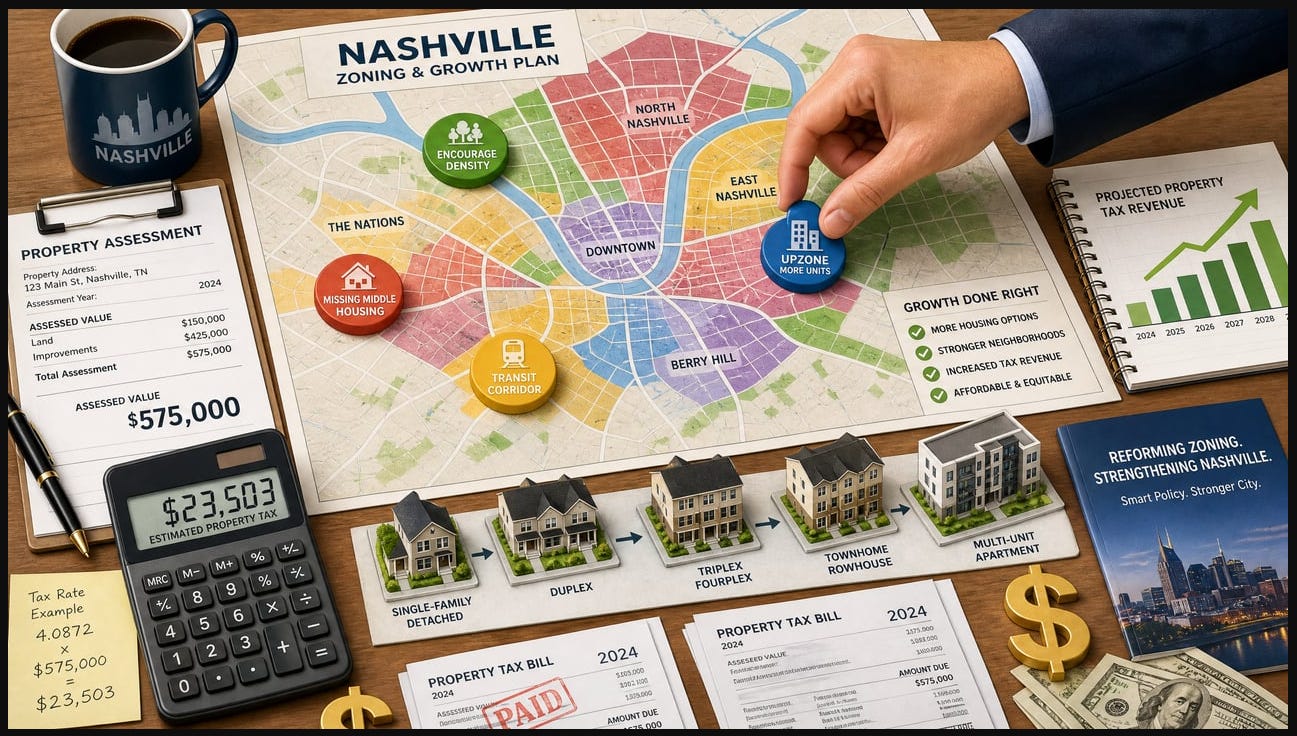
Every time I hear it, I’m stunned by how untethered from reality he and his supporting Council members have become so divorced from the facts they seem to be governing from an alternate universe. Here’s the truth: If Davidson County property values hadn’t been conveniently inflated by 45%, he would have had to announce a $4.08 tax rate, a brutal 25.4% out-of-pocket increase. Instead, he hid an $826 tax hike behind the Assessor’s inflated appraisals and called it savings. And here’s the kicker: when the Council upzones a single property from single-family to a quadplex, the city’s tax revenue from that lot jumps from $4,080 to $23,503, a massive 476% cash hit for Metro’s treasury, due upon completion.
Lost in the finger pointing? Read on to see exactly how the shell game works - and who’s really to blame.
Decode the City - Stay Informed
An author’s note for MC23 and the Mayor: Several have advised me to find another project, ”no one cares about the numbers.” But here’s what the numbers actually show: You’re not governing for the people who live here. You’re building an extraction economy designed for future residents who don’t exist yet, while taxing current Nashvillians out of their own city.
Deeply experienced city planners understand that when cities prioritize visitors and investors over residents, there’s no one left to care. Real community strength comes from thousands of small acts of stewardship carried out by people who care deeply about where they live. Not from massive institutional projects that maximize returns on a spreadsheet but never become part of the local cultural fabric. Being “part of” takes more than sponsoring a little league team.
Your constituents counting their dollars every day are witness to your failing standard of care. Do us a favor: govern for the people who actually live here, not the ones you hope will replace them. Great city planning doesn’t begin with national templates and fill-in-the-blank prototypes. It begins on the streets and in the neighborhoods where we actually live, sometimes a little messy, always organic, but real community that people want to be part of vs. passing through.
In Volume 1: Why Rezoning is Nashville Metro’s Poppy Field, I broke down how the city’s upzoning addiction artificially inflates your property value to feed the municipal debt machine needed to pay for the Metro budget.
The pain lingers from the 2025 tax bills and Metro officials continue to promote their “effective rate” and point fingers at the Property Assessor, it’s time to cut through the spin and settle the question: Who actually raised your taxes?
Over the past few weeks, Metro’s elected officials and those taking the political bait have been pointing their fingers squarely at the Property Assessor for your skyrocketing tax bill.
It’s an absurdity of absurdities. This is a classic “Whodunit” mystery, except the culprits are standing in plain sight.
Let’s be clear: the Assessor is a player. But she’s the estimator, not the architect. The architects are sitting in the Metro Council chambers, and their director is the Mayor.
Propelling this misdirection is a true public relations overachievement, born of ignorance and relying entirely on our apathy. This MC23 is a collection of political elites who loves to claim they “follow the data,” but their data is ruthlessly curated and cherry-picked without a trace of the scientific method. It is pure Truth-Grooming - they took a national “Missing Middle” narrative template, filled in the blanks with Nashville’s numbers, and called it analysis. When the data didn’t fit the template? They carefully worded the presentation to be factual - just not true. The claim of 91K new housing units needed from 2024 to 2034 is a textbook example: technically a number, fundamentally a manufactured manipulation, one of many.
Right now, the administration and MC23 is running a very specific, highly cynical playbook. Their entire survival strategy relies on three things: maintaining complexity, a quickly vanishing news cycle, and the hope your frustration from the lacking clarity leads to your surrender and for most, a short memory. They are banking on you getting so dizzy from the political spin that you just groan, write the check, and forget who actually raised your taxes.
I’m publishing this to provide the missing clarity and settle who’s to blame.
Spoiler: it’s the people we elected the executive and legislative branches.
If you want to know the motive for the “crime”, follow the money. Look at how Metro Nashville actually funds itself:
Property Taxes: 56.69%
Local Option Sales Tax: 19.67%
Other Governmental Agencies (State/Federal): 12.39%
All Other Revenues (Fees, fines, licenses, etc.): 9.98%
Fund Balance Appropriation: 1.27%
MC23 has moved from Nashville’s strategic recruitment to the blind assumption that all growth is gospel and all new housing supply is salvation. But here is a snappy reality check: You can’t pave your way out of a spending problem, and you can’t rezone your way out of a spending management problem.
Decode the City - Stay Informed
Let’s ruin their playbook.
We’re going to track one sample property across four “model” tax invoices to understand the consequences from the Metro Budget, the total root of the property tax increase problem. Every number is sourced directly from Metro’s own documents and Tennessee law. No spin. Just math.
Here’s the villain origin story: The Metro Council (MC23) controls your property’s zoning (your Council Member is your “Chief Zoning Official”) - the legal entitlements that determine what can be built on your land. When they up-zone property in your neighborhood (“adding options”) and community, they’re not just changing a map; they’re resetting your property’s “highest and best use” to maximum density levels, one element and the most important of your property assessment.
Let's be clear: for a municipality, zoning reform is nothing more than tax reform bundled with virtuous narratives. Every time the Council upzones a property, they're not just changing what can be built - they're changing how much tax revenue that dirt generates."
The Assessor is then legally required by Tennessee law to appraise your land based on that inflated entitlement (what you can do options) potential, whether you ever intend to modify or develop it or not.
The Council designs and approves the zoning. The Assessor prices the trap. You pay the bill and you property is the guarantee for the debt. (Simplified, if they don't inflate your property, they can't achieve the "credit" required to borrow.)
And here’s the critical point most appraisers will tell you: land value is a function of both location and the legal rights to generate profit (highest and best use) from that location or parcel.
Using an example lot in The Nations, the lot isn’t worth $500,000+ for 0.2 acres because of the dirt alone. It’s worth that because the Council granted via an Urban Design Overlay the legal right to build eight units on it, and each of those units can generate revenue. The more profitable the “allowed use”, the higher the land value. Strip away those entitlements, and the profit potential (and therefore the land value) collapses.
This is also why upzoning turns your neighborhood or community into a corporate shopping list. Developers and institutional buyers will always outbid you for land that can generate eight units of revenue instead of one. This is why upzoning is the city’s favorite revenue weapon: it inflates your property’s profit potential on paper (and the new annual tax payment to Metro), whether you ever intend to develop it or not.
Decode the City - Stay Informed
Below we are going to track a sample single-family residential property in the Urban Services District (USD) across four “mock” tax invoices to expose exactly how this shell game works.
(Note: This analysis uses a USD single-family housing unit as the baseline, but commercial properties - retail, office, industrial - were hit even harder by the reappraisal and face brutal tax increases under this same extraction model.)
The Model Property in each example below: According to the city’s own independent consultants (The April 2025 Raftelis Technical Memorandum), the official baseline for an average single-family home before the recent reappraisal was $400,000. This is the property we’ll track across all four scenarios to isolate exactly where your tax increase came from.
Let’s rewind to 2020. Mayor Cooper and the Metro Council had a massive budget deficit. This was not a county-wide reappraisal year. Property values stayed completely flat. Because they couldn’t hide behind newly inflated appraisals, they had to print an honest receipt: a naked 34% rate hike (executed via Substitute Ordinance BL2020-287).
Based on the city’s FY 2021 Operating Budget Book, the sample baseline home at that time was valued at roughly $290,000.
Sample Property Value: $290,000 (Stayed flat)
The 2019 Invoice: $2,287 (At the $3.155 rate)
The 2020 Invoice: $3,060 (At the new $4.221 rate)
Out-of-Pocket Increase: +$773
The Takeaway: Because there was no 45% property value inflation to hide behind, Metro Council had to stand in front of the public and openly pass a 34% rate hike. The reason this sample bill went up was 100% City Spending.
Now, fast forward to Mayor O’Connell’s recent $3.8 billion budget. Let’s ask a simple question: What if the current administration had to play by the 2020 rules?
According to the city’s own independent consultants (The April 2025 Raftelis Technical Memorandum), the official baseline for an average single-family home before the recent reappraisal was $400,000. If that value stayed completely flat, what tax rate would the Mayor have needed to charge to fund his new budget?
Sample Property Value: $400,000 (Kept flat from the 2024 baseline)
The 2024 Invoice: $3,254 (At the $3.254 rate)
The 2025 Invoice Needed: $4,080 (The revenue Metro ultimately extracted from this property to cover the new $3.8 billion)
The “Honest” Rate Required: $4.08 (a plus 25.4% increase)
The Takeaway: If property values hadn’t been conveniently inflated by 45%, Mayor O’Connell would have had to stand at a podium and announce a rate hike to $4.08—a 25.4% out-of-pocket increase. Instead, he gets to claim he “lowered” the rate. That’s not governing. That’s a magic trick.
The actual spending increase between the two mayors is nearly identical in its impact on your wallet (a $773 hike in 2020 vs. an $826 hike today).
So how does O’Connell pass an $826 tax hike while bragging about the “lowest rate in history”? He uses the Assessor’s 45% inflation to Math-Wash the budget.
Under the state’s Truth in Taxation law, the revenue-neutral baseline was strictly certified at $2.222. But Metro Council deliberately voted to hike it by $0.592 above the neutral line, please don’t ask me how that is neutral, it is just more magic tricks for politicians.
Here is what your actual receipt looks like:
The 2024 Value: $400,000
The 2025 Value: $580,000 (The Assessor’s 45% inflation)
The “Low” Rate: $2.814 (Instead of the state’s $2.222 neutral rate)
The Final 2025 Invoice: $4,080 (a match to the Invoice 2 example)
The Takeaway: The out-of-pocket cost to the taxpayer is exactly the same: $4,080. But by relying on the Assessor’s hyper-inflated property values, the Mayor gets to claim he lowered the rate, rather than admitting he passed a 2020-style spending hike. They are using the Assessor as a human shield for their budget.
As noted in my previous Substacks:
What is the true motivation to convert our residential neighborhoods into commercial properties? Look no further than the modeled sample below, the commercial conversation for rentals:
Finally, let’s test the “Supply Cures All and Creates Affordability” gospel. Density advocates claim that if we upzoned this dirt and build a four-unit quadplex, housing will magically become affordable. Note, per the Housing and Infrastructure study for the top 30% of earners under current market rate policy). Let’s see what actually happens to the taxes.
Let’s surrender to their argument and assume the developer’s one-time per-unit capital cost drops by a generous 10% because of density. Here is what actually happens:
The Property: The sample single-family home is demolished and replaced with a 4-unit Quadplex.
The “Cheaper” Market Price: $522,000 per unit (We gave them their 10% discount compared to the $580k home).
Total Appraised Property Value: $2,088,000 (4 units × $522,000)
The Density Penalty for Rental or Lease: 40% Commercial Assessment (Tennessee Code Annotated § 67-5-501(11) legally mandates that any property with two or more rental units is stripped of its residential status and taxed as commercial).
New Taxable Value: $835,200 (40% of $2.088M)
The Tax Rate: $2.814
The Quadplex Tax Invoice: $23,503
By upzoning one single piece of dirt, the city’s tax revenue from that lot jumped from $4,080 to $23,503 - a massive 476% cash hit for the Metro Treasury and the tax invoice is due upon completion.
Did this upzoning create affordability for the renter? Absolutely not. Because that $23,503 commercial tax bill must be divided among the four units, the annual property tax operating expense for each family is $5,876.
The single-family homeowner was paying $4,080 in taxes. The quadplex resident in the supposedly “cheaper” unit is paying $5,876 annually in taxes. A minor, one-time 10% capital savings on construction is instantly obliterated by a 44% permanent increase in ongoing operating expenses. This is Extraction-Urbanism in its purest form.
When you look at the brutal math of Invoice 4, you realize the ultimate tragedy of this extraction model.
You can do everything right. You can pay off your mortgage. You can painstakingly maintain your home. You can live responsibly in your neighborhood for decades. But if the tax bill never stops rising, and the government can eventually take your home because you cannot pay it, then your ownership is an illusion.
Ownership is conditional. You are simply renting your own equity from the Metro Government.
And this punishment does not stop with homeowners. Renters pay the price through constantly escalating rents required to cover massive commercial tax burden. Legacy businesses pay the price through unsustainable overhead, closing multi-generational village bodegas to make way for the corporate franchise. Business owners and workers pay the price through lower wages and fewer local opportunities.
Rampant property taxes, weaponized by speculative upzoning, punish neighborhood improvements, discourage mobility, distort housing markets, and raise costs across the entire local economy. In a time when affordability is already the biggest crisis in America, Metro’s tax-and-zone scheme makes it harder to buy, rent, build, invest, and stay rooted in your own community.
The system isn’t broken. It’s working exactly as designed.
And the architects of this system - Mayor O’Connell, the Metro Council, the Planning Department and an ecosystem of consultants are counting on you to forget who built the gentrification machine by the time the next election rolls around.
Don’t.
Decode the City - Stay Informed
Metro is growing its gluttonous appetite for tax dollars at a rate 6x faster than Nashvillians’ actual ability to pay. (26.6% Tax Hike ÷ 4.4% Income Growth = 6.04x). That extra $826 per household didn’t vanish; it went straight into the Metro Treasury to fund a $3.8 billion spend.
For those who want to fact-check the politicians claiming the Assessor is “arbitrarily” inflating values, here are the receipts. The Assessor doesn’t write the zoning laws; the Council does. The Assessor is legally bound to appraise the traps the Council sets.
State Board of Equalization Mandate (Rule 0600-12-.06): The Tennessee State Board of Equalization, the governing body that oversees all local county assessors, strictly regulates how market value must be determined. Under its administrative rules for property assessment, the state explicitly commands: “In determining the market value of the property, the assessor shall determine the highest and best use of the property.” This eliminates local discretion, establishing highest and best use as a strict, state-mandated appraisal standard.
Statutory Market Value (TCA § 67-5-601): Tennessee law requires that all property be appraised based on its immediate value for a sale between a “willing seller and a willing buyer.” In real estate economics, a willing buyer will naturally pay for a property’s maximum legally permissible development potential. When Metro Council upzones land to allow for higher density or commercial activity, the Assessor is legally bound by this statute to measure the property’s value using the same “highest and best use” logic that dictates the open market. Justia Law
Reference: Tennessee Appraisal Brief: How Zoning Can Affect Your Property Value
Related Articles:
Christopher Remke [AIA ret.] brings an unusual combination to real estate analysis: the quantitative rigor of a veteran Design-Build-Development Advisory Professional merged with the cultural awareness of a Context-Sensitive Urbanist. As Principal of Linked, L. L. C., he’s the rare voice who can deconstruct a pro forma, read municipal debt structures, and simultaneously ask whether the project destroys or enhances the neighborhood’s social fabric.
This dual perspective - analytics meets urbanism - allows Chris to expose what architects, planners, builders, and conventional real estate experts miss: how financialization, zoning manipulation, and tax policy don’t just change property values, they fundamentally alter how cities function as communities.
As President of Save Our Nashville Neighborhoods (SONNinc.org), Chris fights extraction-urbanism’s standardized templates and champions genuine neighborhood diversity. Through his writing, he operates in “Decoder Mode,” making complex policy accessible while revealing the truth behind political narratives.
His mission is simple:
Neighborhoods need a voice, Working People need a voice, and the City needs a gut check.
Because transparency builds trust. Manipulation destroys it.
No posts
Comments
Nothing yet. Say the first thing.
Sign in to join the conversation.