
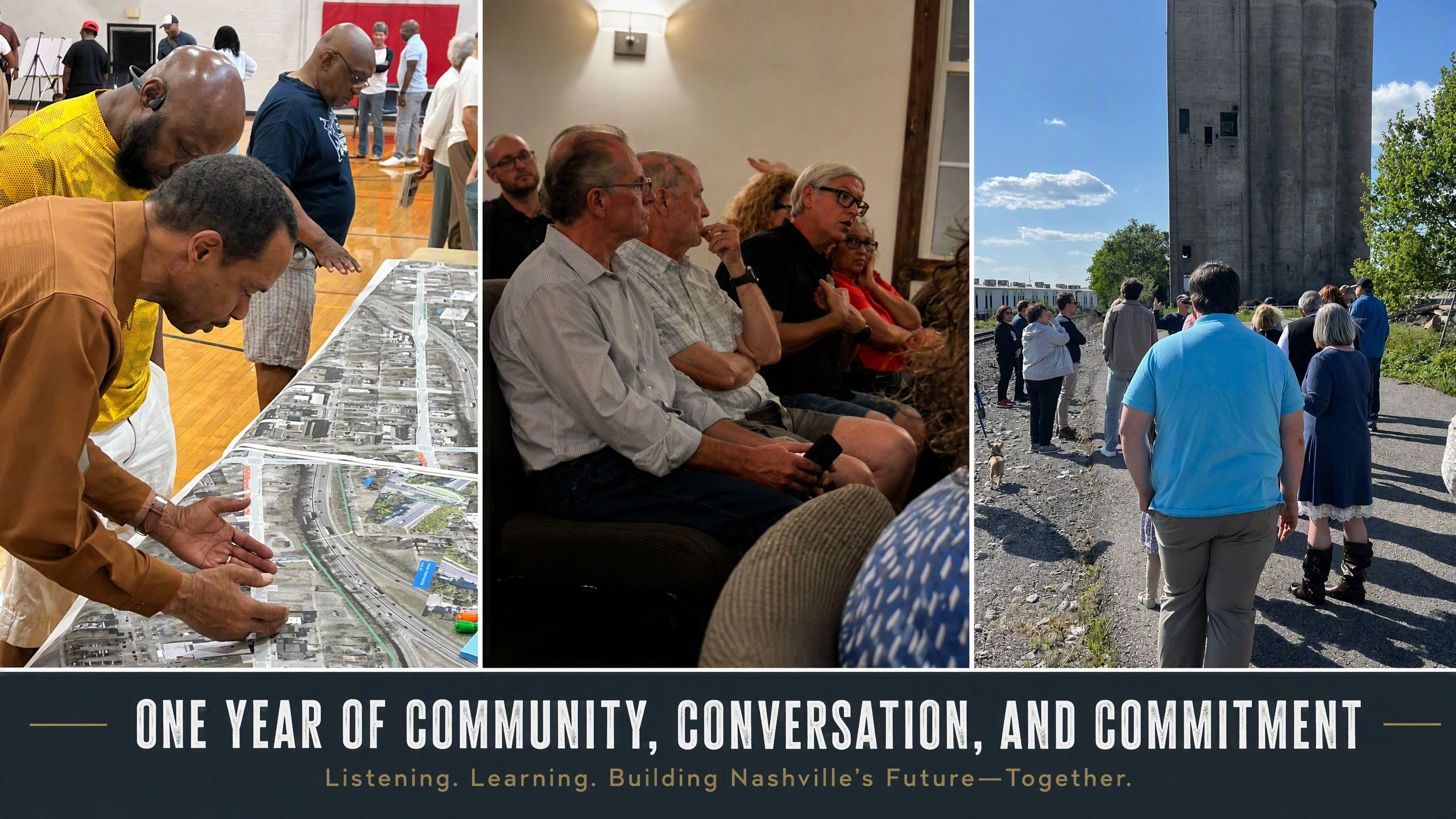
Before the next chapter of this work begins, I owe some people a thank you.
This publication did not grow on an algorithm. It grew because people from all sectors asked questions, beginning with a challenge from the neighborhood associations of council districts 20, 23, and 34, from which today’s Save Our Nashville Neighborhoods (SONN) began to form, but that is ultimately its own story. Built to Think was established on the hope that people shared a curiosity about civic memory, the sense of place a neighborhood keeps, and what lies behind the borrowed, scripted podiums of change. Thankfully, they did: readers shared it, questioned it, improved it, and sent it to a neighbor with a note that said, “This is the thing we were trying to explain.”
So, thank you to Nashville’s neighbors and friends, to the volunteers of Nashville’s many neighborhood associations, especially those taking time to invest in conversations about Nashville’s neighborhoods, our home, and to the planners, design professionals, policymakers, businesses, academics, and everyone who sent comments, questions, and challenges. Some of you brought documents. Some brought history. Some brought the harder gift of telling me their story and their efforts to simply be heard in an ecosystem built on stagecraft and control, when all they sought was a forum where attendees could speak freely and respectfully, and have their input heard. Every time I hear that, it pains me a little, because to me, one of the virtues of Nashville is speaking freely and respectfully in a civil forum. That is the minimum price of admission.
Some of the most thoughtful people I met this year will not post a word, not for lack of a view but because they have watched what happens to neighbors who share one. That silence is the real cost, and the field only grows louder and more polarized as it spreads.
Built to Think began a year ago, alongside a conversation with Metro’s planning department about how the data behind Nashville’s housing strategy was being interpreted. I brought my analysis and made a simple offer: I was willing to be wrong to make sure Nashville was right. That offer was never legitimately tested in a collaborative lab or in correspondence, and when others raised the same questions in official community meetings, they were brushed off with courteous non-answers. The replies that did come promised the supporting documents once the studies were complete, the same studies that were presented as providing results to the Housing and Infrastructure study. That, of course, is an odd order of functions.
The studies' recommendations had been completed and published five months earlier, which did not improve my trust in the public-facing rhetoric. The finished documents never came. This publication is what I built instead of waiting for them.
The second promise, as most of us understood it, was a condition assessment of the city’s infrastructure; half the H&I acronym remains a ghost. When it does arrive, will it be a true engineering study or another set of cobbled-together educated guesses without true field assessments conducted by qualified specialists? Hope remains, but performance causes concern.
A year and almost 80 related articles later, my original questions remain. What was promised, what the controlling documents require, whether the evidence holds, who pays, who benefits, and what each decision sets in motion for the people who inherit it? Do those decisions improve the neighborhood for the people who live there?
What has changed is how clearly I can say what this work is for. I spent part of this summer working on rezonings from the inside rather than watching them, alongside neighbors making their case. More than once, a neighborhood arrived with a clear majority behind one outcome, and the Council decision went the other way. The wider view came separately, from many meetings with everyday residents, PhDs, Council members, lobbyists, and a newer category: associations that have formed over the years and found the lift heavier than expected, often defeating. Across that array of focused groups the conclusion was strikingly common. Informed opinion is humored at Metro, and the forum that receives it is staged. Learning to read that gap, and what keeps producing it, is a large part of what comes next.
An element of this work was rewriting the About page to focus less on describing the publication and more on my commitment to the audience the Built to Think effort serves. It is also where I lay out the mechanism that settles most land use votes before anyone speaks. Nashville calls it councilmanic courtesy. Chicago calls it aldermanic privilege. Philadelphia calls it councilmanic prerogative. The name changes, but the mechanism does not. If you have ever left a meeting feeling that something did not add up, start there. It is all built around one question: how do we make decisions today that leave tomorrow thriving and worth inheriting?
One promise I will not make is that this page has no point of view. It does. When the public record is treated carelessly from a podium, most often the elected one, I will say so plainly, and occasionally with an edge. But the starting point will always be an assessment of the end result: what a project becomes once it completes its cycle through the series of special purpose silos, and what to expect when the keys emerge from the last one.
What I can promise is the standard underneath it: every figure cited to its page, every source named, and any number that fails your own replication corrected in full, in public. You are welcome to reach a different conclusion. The point is that you should be able to reach it from the same documents I used.
So here is what is coming. The first of two papers arrives on the heels of this letter, the product of a year of document review. It follows Nashville’s housing numbers to a place the official studies did not expect them to go. The second lands at the end of the week, with its full exhibit for paid subscribers, and shows how the answer kept its job anyway. After that, a steadier rhythm: one short read and one substantial piece each week.
Thank you for reading and asking great questions. And to readers far from Nashville: after Tennessee, the highest readership comes, in order, from California, Texas, Georgia, and North Carolina. Readers should know that our city, Nashville, supplies the evidence, not the subject.
The subject is the sense of place: the communities we grew up in, the communities we hope to live in, and what creates community and livability. How do we find that in a period when zoning is mistaken for vision and city planning? The work ahead is the same work it has always been, asking the question that started it all.
Who is representing the community?
Chris Remke, Architect [lisc. ret.] - Built to Think
The About page explains what this publication does, who it is for, and how the numbers are checked. Click the image below

About Built to Think
Built to Think is a working laboratory for civic sensemaking, founded by Chris Remke, RA (Lic. Ret.). It follows evidence across the full life cycle of place-building, from public promises and development rights through finance, design, construction, operations, market price, infrastructure, taxation, and neighborhood life. Drawing on more than forty years of leadership across those disciplines, Chris tests whether promised outcomes survive the handoffs, who creates and captures value, who carries the costs, and what each decision preserves, consumes, or leaves others obligated to repair. The work is strengthened by professionals, scholars, nonprofit leaders, and neighborhood stewards whose knowledge helps reveal what no single report, dataset, or discipline can see on its own.
Built to Think follows not only what a decision says, but what it sets in motion.
Decode the City. Stay Informed.
No posts
Comments
Nothing yet. Say the first thing.
Sign in to join the conversation.