
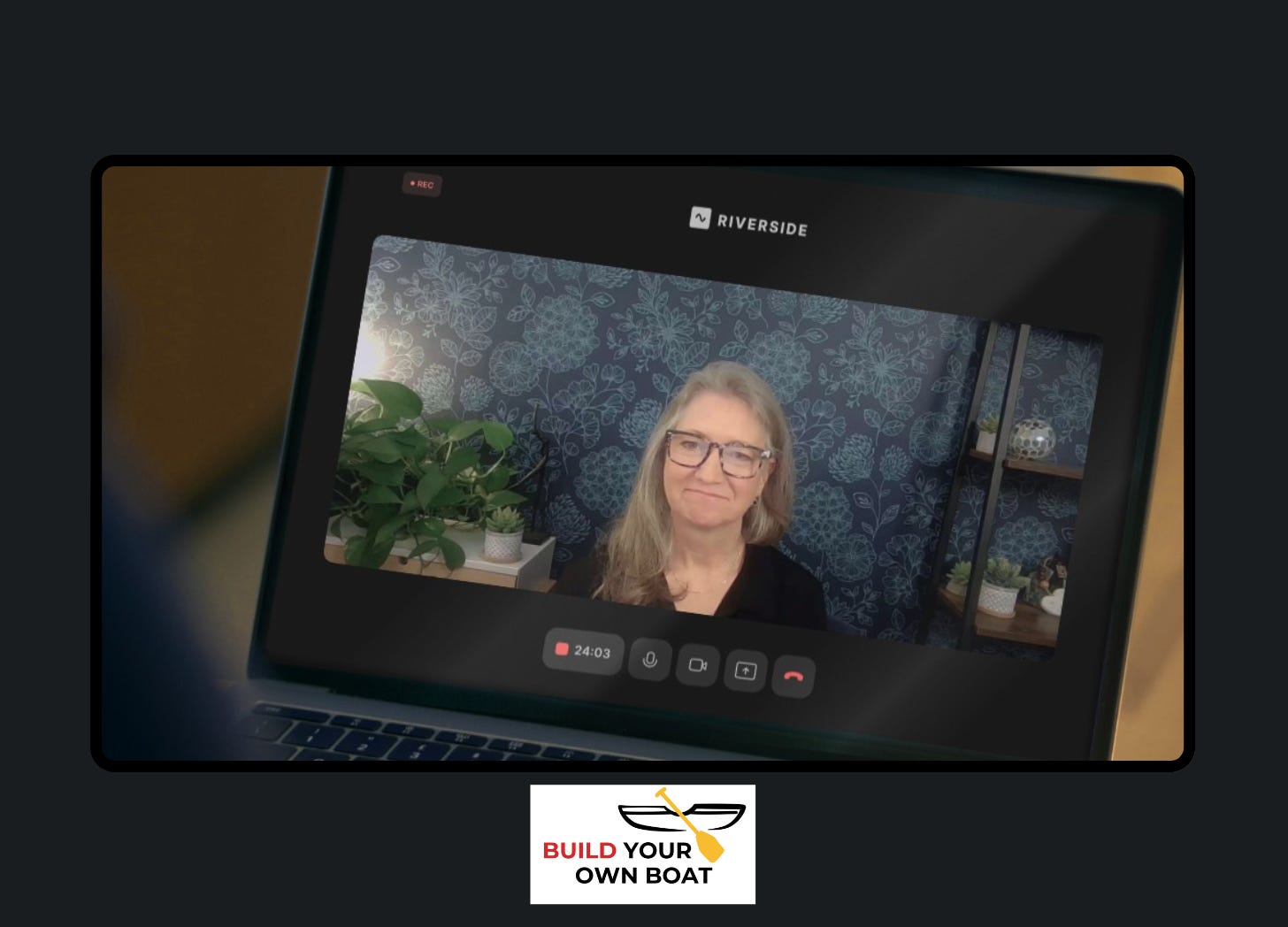
Kristen Harris spent two decades running global tech teams. Then a layoff forced the question she’d been avoiding: what do I actually want?
Six months before Kristen Harris was laid off, she already knew something was wrong.
Not wrong like I need a vacation wrong. Wrong like I should have listened to my gut wrong. She’d left a VP role she’d held for nearly a decade—a seat at the leadership table, real influence, work she was genuinely good at—to try something new. The new thing turned out to be the wrong thing. Her gut had told her that in the interview process. She went anyway.
“In craving that change, while my gut kind of said to me, even in the interview process, this might be something you should be careful about—I just said, this is your risk to take, go for it.”
She wasn’t ready yet. And then she didn’t get to decide when ready arrived.
Kristen had spent her career at Oracle running the web platforms that powered the entire company—nine languages, global reach, every internal team touching what her team built. Then VP of Service Delivery at Zia Consulting, a software engineering firm where she was, in her words, “a critical cog in a smaller wheel.” She led project delivery, resourcing, profitability. She built teams the way other people breathe—naturally, continuously, with a genuine fascination for what each person on that team could do that no one else could.
She had survived the 2001 downturn. She had survived 2008. She had survived breast cancer, going to radiation at lunch and returning to work the same afternoon to pick up her kids.
And then, during the post-pandemic hiring chaos, she was laid off.
“Anytime I feel a little out of control of my situation, it definitely feels pretty devastating to me.”
The hard part about that sentence is its honesty. She already knew the role wasn’t right. She had already been working with a coach, trying to get clear on what she actually wanted next. But there’s a difference between choosing to leave and being pushed. Even when you know the door should be open, having it removed from its hinges by someone else is its own specific kind of shock.
What she did next is the story with terrific lessons for all of us.to
Kristen is now the founder of Kristen Harris Coaching, where she works with leaders—at all career stages—who are hungry to lead, not just to have a leadership title. She runs a cohort program called The Perfectionist’s Edge, leads corporate facilitation on leadership and operations, and does one-on-one coaching through career transitions and life transitions, including cancer.
Her formal credentials are formidable: Oracle, Zia Consulting, project management certifications, an accredited coaching credential. Two-plus decades of building cross-functional teams, bridging departments, and figuring out how to make very complicated things work.
But here’s what she almost missed: the experience she was most tempted to soft-pedal—the breast cancer diagnosis, working through treatment, the daily negotiation between what she had to show up for and what she had left—turned out to be core to what she offers.
“I went to work, went to radiation at lunch, came back to work, went to pick up my kids. I couldn’t do that without choosing specifically how I was going to build my presence.”
Presence. Resilience. The bridge-building that comes from spending years as the connective tissue between departments. To Kristen, those aren’t just things that she experienced, they are built into her methodology. And they came, in no small part, from having to build them under pressure no one asked for.
Kristen’s advice to the woman sitting at her kitchen table, asking herself can I actually do this, is characteristically direct. She doesn’t lead with a pep talk.
Start with the dream, not the logistics. “What is your dream? Can you envision yourself in that dream? Do you see that character—do you see yourself doing it?” Get the vision clear before you start building the spreadsheet.
Stay where you are while you build the runway. For many women, the smartest first step isn’t quitting—it’s testing your concept while you’re still employed. Network, gather input, share your ideas. “How do you use your network? How do you share your ideas with people, test your concepts?”
Check your resilience before you check your savings account. “Are you ready to be resilient? If you have a solid foundation financially, in your relationships—you can feel rejection in the early stages and you’ll bounce back.” The financial math matters. So does the inner infrastructure.
Build a board of directors. You don’t need a formal advisory board. You need trusted people across different domains—former colleagues who can open doors, coaches who have been through what you’re going through, family members whose expertise covers your blind spots. “I cast my net really wide, and I also hope to give back to those people.”
Network with strangers. This one surprised even Kristen. After years in corporate environments, learning to show up in a room of people she didn’t know—including that Denver female founders meetup where she walked in with her “gray hair and happy wrinkles” and felt, briefly, like she didn’t belong—turned out to be some of the most valuable work she’s done. “You never know what nuggets you’re going to get out of a conversation with a stranger.”
So here’s what happened: I called myself a recovering perfectionist in our conversation, and Kristen stopped me.
Her argument is not that perfectionism has no shadow side. She’s clear that some perfectionist patterns need real clinical work. But she pushes back—hard—on the cultural reflex to pathologize the drive for excellence, particularly in women.
Kristen shared with me that studies show that 85% of high achievers identify with some form of perfectionism. “If 85% of people achieving great things are pathologically defined,” Kristen says flatly, “that’s a problem.”
I felt like I needed to fix my flaws. And I did work toward that—I wanted to deny that perfectionism was good for me. And I found that when I did that, when I denied it instead of embracing it, I got worse.
She draws on psychologist Katherine Morgan Schafler’s typology of perfectionists—Kristen herself is what Schafler calls a “Parisian perfectionist,” beautiful on the outside, messier than anyone suspects on the inside—and builds her coaching around helping leaders identify their specific perfectionist strengths and sharpen them rather than sand them down.
The real insight isn’t that perfectionism is always fine. It’s that the story we’ve been told about who needs to fix their perfectionism—and who gets celebrated for it (Steve Jobs, Michael Jordan, Walt Disney: all openly perfectionist, all touted as visionaries)—reveals a double standard that has been costing women something.
Kristen’s work is, among other things, an argument for getting that something back.
There’s a line Kristen said near the end of our conversation that I think is relevant to many of us, especially in this time of massive layoffs:
The layoff was devastating, even though I wanted to leave.
She said it simply, without drama. And I think it’s one of the most honest things I’ve heard on this show, because it names something real: the hard part of building your own boat is not always the building. Sometimes it’s the moment someone else decides you’re no longer needed, before you’ve figured out what you need next.
Kristen figured it out. With precision, with high standards, and with the kind of clear-eyed resilience that, as it turns out, she’d been training for her whole career.
If this conversation sparked something for you, subscribe to the Build Your Own Boat podcast wherever you’re listening, and check out the interviews of other women who have decided to build their own entrepreneurial ventueres in midlife and beyond.
And send this to the woman in your life who is standing at that edge. You know who she is.
Connect with Kristen Harris:
Website: kristenharriscoaching.com
LinkedIn: Kristen J Harris
Substack: Kristen Harris
What Kristen offers:
Leadership facilitation (agile, operations, complex project delivery)
The Perfectionist’s Edge — a cohort-based leadership mastery program for leaders with a perfectionist mindset
One-on-one coaching for career and life transitions
No posts
Comments
Nothing yet. Say the first thing.
Sign in to join the conversation.