
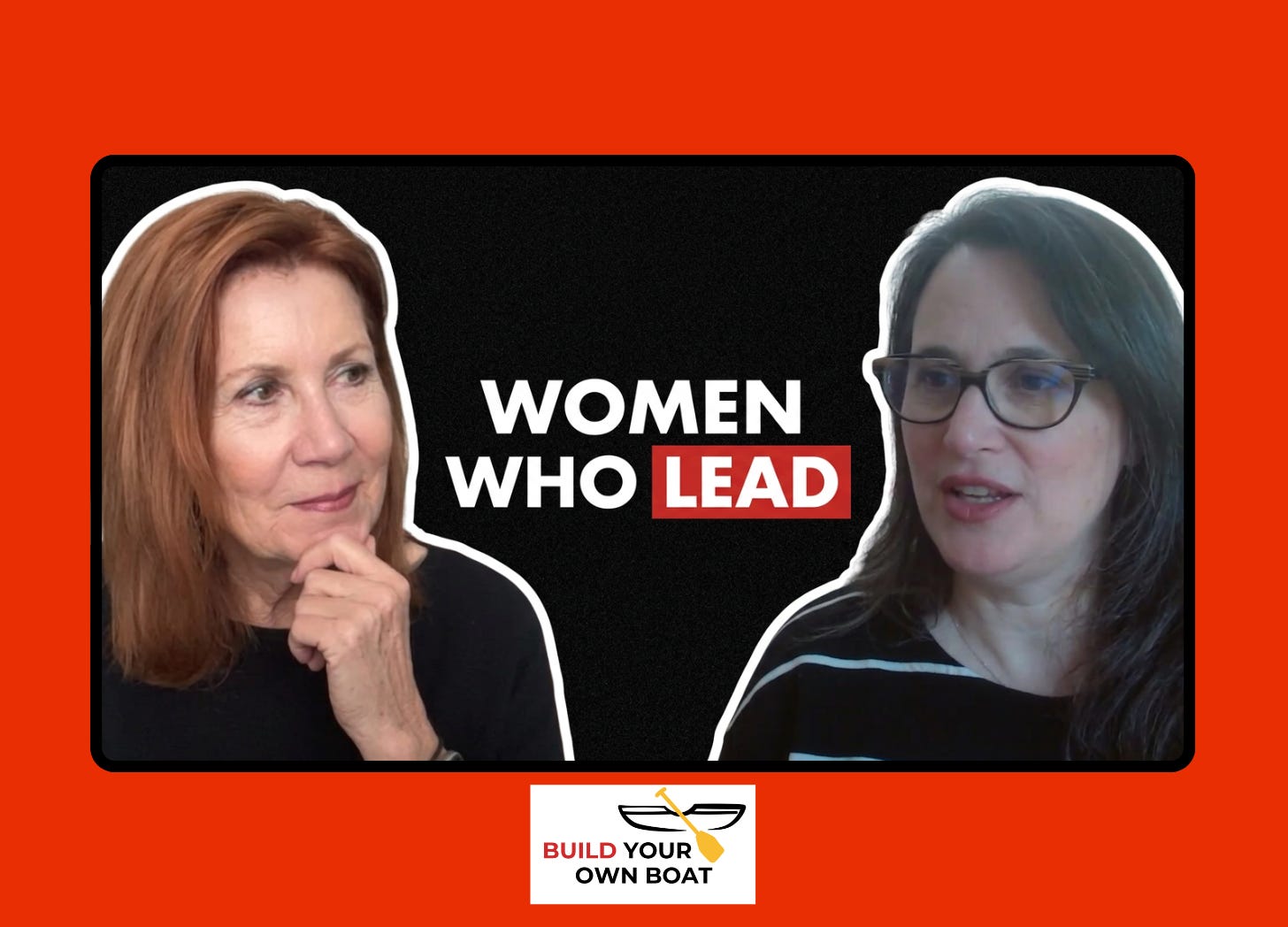
When I asked if she’d ever failed as an entrepreneur, she didn’t reach for a story about a lesson learned years ago. She reached for today.
“I’m failing presently. How’s that for a really honest answer? I’m in a moment of failure as we speak.”
Thanks for reading Build Your Own Boat! Subscribe for free to receive new posts and support my work.
Her income this year is lower than last year. That morning, she’d moved money into her retirement account—less than her own plan called for, because the money simply wasn’t there. Most founders would never say that out loud on a podcast. Cindy said it, then explained exactly what she’s doing about it: doubling down on marketing, chasing the next client, refusing to pretend the spreadsheet always cooperates.
That’s the kind of direct talk that I’ve come to expect from Cindy since I met her at the American Society on Aging a few years ago. And that mix—rigorous planning paired with radical honesty—is what makes Cindy worth listening to.
Two Boats, Two Very Different Reasons
Cindy is building what looks less like a boat and more like a fleet. There’s The Benson Agency, her consulting firm that handles the behind-the-scenes work nonprofits need to make their missions real. That’s the one that pays the bills. And there’s Women Who Change the World, the passion project she’s building now—teaching women to write strategic plans for their own lives.
She named the Benson Agency for her two sons, Ben and Jackson. She started the first version of it so she could be their mom, after a marriage to someone who “could not/would not” adjust his schedule. So she adjusted hers. For years, the business took the back seat by design.
The joy of entrepreneurship is that it’s as big or as small as you want it at any period in your life.
When her kids were small and she wanted to take them on a special trip, she’d simply take on one extra client to pay for it, tucking that money into a separate account. When an emergency expense hit: one extra client. She ran the business at exactly the size her life required.
Then COVID arrived. On March 13, 2020, everyone was told to stay home. Within two weeks, Cindy lost every client but one. She’d already given notice to a major client weeks earlier, confident her business was growing. Suddenly she was on the phone with her mortgage company, crying, asking what her options were.
A former client’s referral led her to the American Society on Aging, where she became Chief Advancement Officer—and where the two of us met. She’s said that job “saved my life, then changed my life.” She stayed three and a half years and loved it.
The Four-Year Plan Nobody Tells You to Make
Here’s where Cindy diverges from almost every founder I’ve interviewed. Most women tell me the same thing: just do it, take the plunge, the first step is the hardest. Cindy believes in the plunge, too. But she noticed something that took her in a different direction.
We put a lot of time and energy into planning for others. And we put very little investment into planning for ourselves.
So when she realized she had roughly four years left before her younger son finished high school and she’d be free to build anything she wanted, she didn’t wing it. She spent six months interviewing sixty to seventy women she admired—I was lucky enough to be one of them—asking each one a single question: What did you do right in your life?
I teach strategic planning. I do strategic plans. The least I could do is a strategic plan for myself.
What she learned reframed everything. No woman was doing everything at once. And nearly all of them felt quietly ashamed of that. Cindy’s response was to strip out the shame entirely. We celebrate every milestone in childhood—rolling over, crawling, the first word—and then, she points out, we hit our late twenties and are expected to have the next sixty years figured out. She finds that idea absurd. “Childhood development is actually human development. I just happened to be a human, it turns out.”
Cindy’s Playbook for Building on Purpose
Talk about money. Out loud. With everyone. Cindy knows the exact retirement number she needs by 50. She budgets a 6% average return, tracks every month in an Excel spreadsheet, and contributes far above the 401(k) minimum to make up for the lean early years. “Please talk about money with all of your friends, your mother, your sisters, your daughters, your nieces.”
Land an anchor client before you go all in. When she relaunched The Benson Agency, she reached into her network. A woman who had never even met her trusted a mutual friend’s referral and brought her one contract—big enough to feel secure. “If that was all that had happened, it would have been enough.”
Invest in your business before you feel ready. Within six months of relaunching, Cindy hired a third team member specifically to market the agency—”as soon as I had enough income to ensure that I could pay them.” Too many founders starve their own growth. She refused to.
Practice failing on purpose. Knowing she’d stumble, Cindy deliberately took up things she’s bad at. She enrolled in a Wednesday-night art class after thirty years of doing nothing creative. She hired a personal trainer because she hates exercise. “It is really important to get comfortable with not being good at things.”
Ask the people who seem too big to ask. She went to the giants in her field and asked how they did it, and whether they’d help. “Not one of them said no.”
The Three Words That Made Her Cry
Cindy runs a Substack for Women Who Change the World, and she’s committed to being publicly, uncomfortably honest in it—medical issues and all—because she believes women can’t build what they can’t see other women building.
One piece nearly broke her. A SWOT analysis of herself, laid bare. She let it sit unfinished for weeks, dreading that her parents would read it. Finally she published it, misspellings and all, unedited, because she knew if she didn’t hit publish it would never happen.
The next day her father—a man who “does not say those things”—sent her a message:
You are amazing.
“He saw all the things I don’t want them to know. And he wasn’t ashamed of that. I would never have heard it if I had not put it in the world to begin with.”
Why This Matters Beyond Cindy
We are told a story about women in midlife: that the workforce is done with us, that our best building years are behind us, that risk belongs to the young. Cindy’s life is a rebuttal written in spreadsheets and art class attendance. She isn’t waiting for permission or a rescue. She’s engineering her own financial security so that her sons will never have to—”this is the greatest gift I can give to my family.” That is what building a boat looks like when a woman decides her own future is worth the same rigor she gives everyone else’s.
Cindy has never assumed she had all the answers. She asked better questions instead. She asked people some of us would decide were “too important” to bother. And nobody said no.
So here’s mine to you: who is the person you’ve been telling yourself you can’t ask? Go ask them.
If Cindy’s story lit something up in you, subscribe to Build Your Own Boat and forward this to the woman in your life who’s been quietly planning her next chapter. She’ll know you meant her.
And be sure to check out the podcast of this interview, where you can hear all of Cindy’s wisdom, in her own words.
Connect with Cindy Morris
The Benson Agency: thebensonagency.com
Substack: Women Who Change the World
LinkedIn: Reach out directly to Cindy—She says she’ll sit with anyone who needs a few minutes to talk through their plans
Thanks for reading Build Your Own Boat! Subscribe for free to receive new posts and support my work.
Comments
Nothing yet. Say the first thing.
Sign in to join the conversation.