
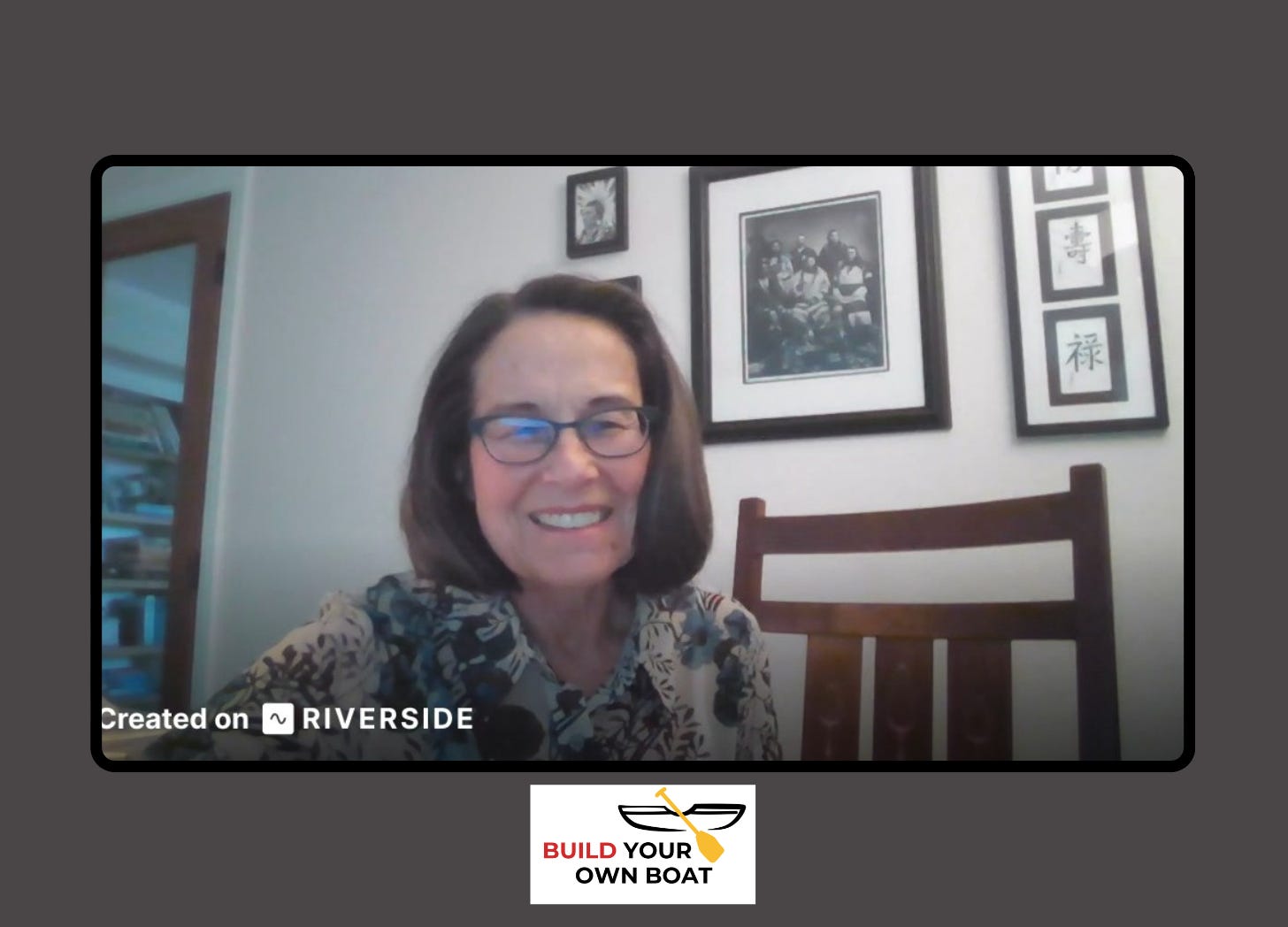
Karen Brown was the only woman on the science side at Mesa Petroleum, working directly for Boone Pickens in an era when that meant something. She had the biggest exploration budget of any geoscientist on staff. She sat next to the CEO in management meetings.
They also called her “the token woman.” To her face.
“So call me anything. I’m living in a world of dreams. This is wonderful.”
That line tells you almost everything you need to know about Karen. She noticed the insult, filed it away, and kept building. She went on to run Energy Outreach Colorado as CEO — her first quiet step away from the for-profit world, and, though she didn’t know it yet, the beginning of a much bigger departure.
The turning point wasn’t a firing or a divorce. It was a drive home.
For nearly a decade, Karen was a caregiver while still working full-time. It arrived in tiers, she told me. Tier one was small — a little help with her parents’ finances, her in-laws’ yard. Tier two got harder: her mother’s macular degeneration, her father’s degenerative neurological issues, arranging transportation, bringing in a couple of caregivers.
Then came tier three. A stroke. Lewy body dementia. Ataxia. Her in-laws’ breast cancer and heart disease. Suddenly her mother needed round-the-clock care, and Karen was driving between cities, trading weekends with her brothers, and still coming up short.
It doesn’t matter how many caregivers we have. We don’t have enough. We don’t have enough money to pay them all. My mom spent $250,000 a year for 24-7 care.
That was the moment. Driving back from her mother’s, doing the impossible arithmetic, Karen decided: You need to go into the aging space. Not to pity older people — to give them, in her words, “independence, choice, and control as much as possible, no matter their circumstance.”
Where did that conviction come from? Partly from her mother, who refused to be managed. Whether or not I can walk, whether or not I can see, I am still a living human being, she told Karen. And if I want to eat that candy bar, Karen Brown, I’m going to. That line really resonated with me—I remember my Dad saying the same thing about apple pie.
Here’s what makes Karen’s story more than the typical career change story. She was 58 when she made the leap, and the loudest voice telling her she was too old was her own.
She borrows a term from Chip Conley’s Modern Elder Academy to explain it: scripts. The pre-written stories we inherit without noticing.
The script was based on Social Security in 1935. You lived to 60, 65. I’m 58? I’m old. I’m near death. I’m supposed to be retired, being with my grandkids.
Except Karen and I are going to have decades more life. And she knew it. So she did something worth stealing: she didn’t wait to feel ready. She experimented her way in.
She volunteered with a few aging organizations first — a low-stakes test of whether the work matched what she imagined. It did. She also had a runway: her husband was still working in energy, which gave her room to say, I can give this a couple of years and see where it takes me. Frightened but committed, she made the call.
I’ll leave the money behind, I’ll let my ego be deflated, and I’ll support older people.
The invisibility was worse than she expected. Do you know how often someone in skilled living gets a visit? Once every nine months. People simply disappear.
So Karen went to work on it from every angle. She became an angel investor, backing close to four dozen age-tech startups over 13 years — the ones solving problems she’d lived, like the macular degeneration that took her mother’s sight. She learned that this market moves like a marathon, not a sprint. And she saw, up close, how brutally the funding rooms treat women.
“The minute she walked in the door, I thought: she’s not getting funding. You could actually feel it in the room.”
An attractive, mid-career woman with a solid pitch, sized up and dismissed by 30 or 40 men before she’d finished a sentence. Karen traces it back to those same inherited scripts — the ones about who a “real” founder looks like. (When I asked five AI image generators to draw me an entrepreneur, every single one gave me a young man in a hoodie. We are not making this up.)
These days, Karen’s newest boat is workforce. Through her consulting, she helps employers keep and hire workers over 50 — because the throughline of everything she’s learned is money. If you can work in any capacity longer, that’s a win. More money means more choices, and more choices mean more dignity.
Experiment before you commit. “The easiest way into aging is to do some volunteering.” Test the water with something low-stakes before you jump.
Build a runway, and name it out loud. Karen used her husband’s income as a two-year cushion — not as a hiding place, but as permission to try.
Invest in problems you’ve actually lived. The companies she funded solved challenges she and her family had faced. Your scars are market research.
Give people a buffet, not a lecture. Her employer clients don’t want a one-off training; they want options they can hand to their managers. Listen, then let them pick.
You don’t need a website to start. Karen’s is finally going live 13 years in. The boat floats without it.
We love to call this kind of move a leap of faith. Karen’s was a leap of clarity. She looked at where the money and brains were pooled, looked at where the need was screaming, and walked deliberately toward the harder thing — not because it was noble, but because it was smart and it was needed and somebody had to.
The world keeps telling women over 50 that their story is winding down. Karen’s is proof the math is wrong. The average woman her age has two, three, maybe four decades ahead.
You have many next chapters. Take a step towards the next one.
So here’s my question for you, reading this at your own kitchen table: which script have you been following without ever choosing it? And what would you build if you stopped?
👉 Check out the podcast of this interview, and those of the other amazing women that I’ve interviewed to be inspired and to glean ideas and tips from the playbooks they share.
If this conversation lit something up in you, subscribe to Build Your Own Boat and send it to a woman who needs to hear it. You know who she is.
Connect with Karen Brown: Find Karen on LinkedIn, where she shares her work on aging, age tech, and building age-friendly workplaces — her email is listed on her profile. Her website launches September 15.
No posts
Comments
Nothing yet. Say the first thing.
Sign in to join the conversation.