
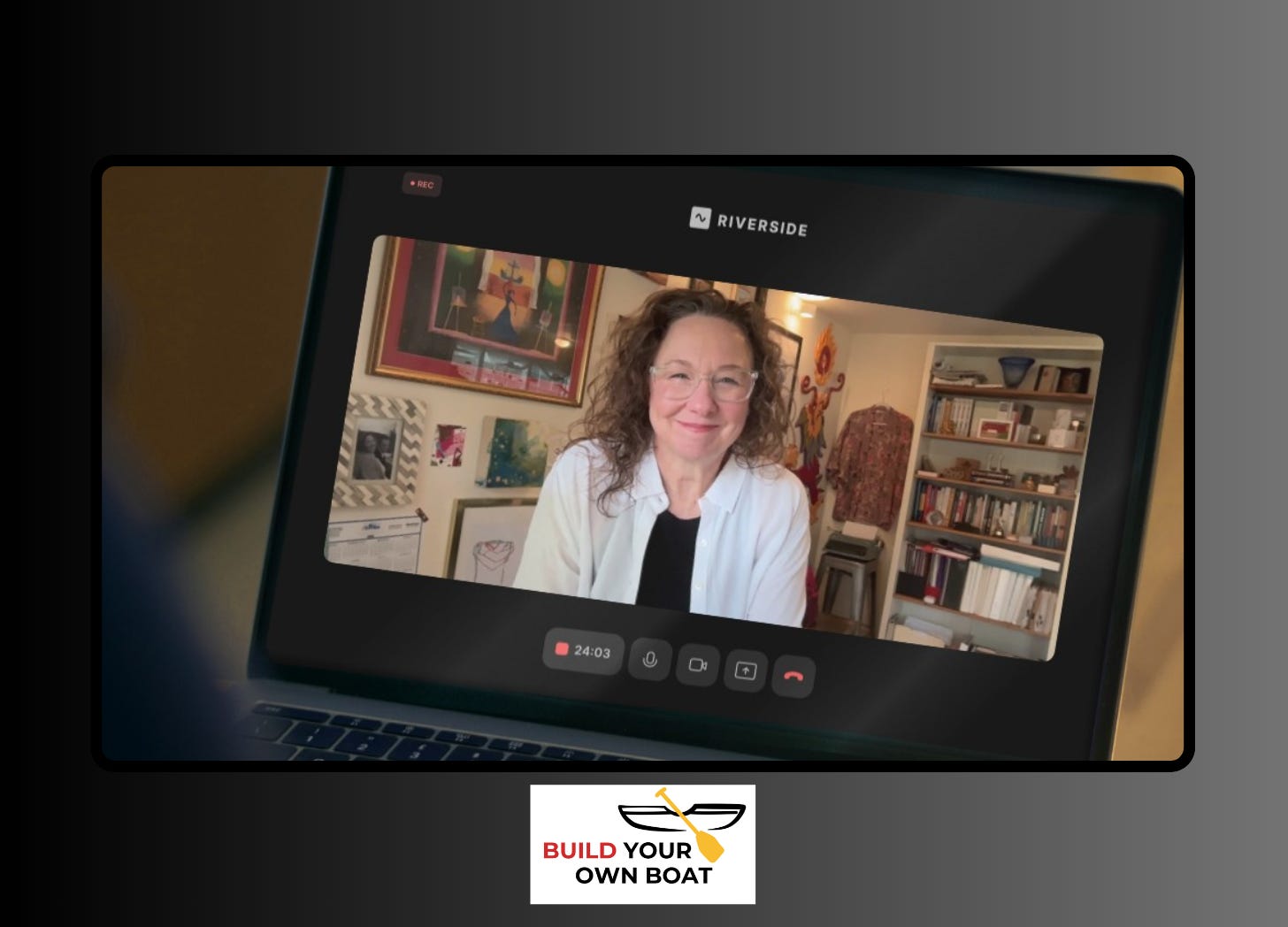
Most entrepreneurs I talk to are chasing a bigger number. My friend Hatton Littman spent last year chasing a smaller one.
She turned 50. She was six years into Surf HL, the consulting firm she built in Montana after more than 25 years in leadership positions education, government, and nonprofits. Business was good. The flywheel was spinning. And she looked at the year ahead and decided, on purpose, to allocate herself at three-quarters time and plan for revenue to drop by about a quarter.
Who does that?
“The reason I started this business,” she told me, “was to make the kind of impact I was making and do good work in the world, but stop burning myself out hustling for other people. And if I was gonna be the good boss to myself I knew myself to be, I needed to commit to it.”
I’ve known Hatton for years—she used to work with me at my consulting firm—so I’ve watched this boat get built in real time. What makes her story worth your kitchen-table attention isn’t rags to riches. It’s something rarer: a woman designing her work deliberately, then having the guts to redesign it when she realized something important about herself had changed.
The turning point came at the end of 2020, during her annual review. Hatton was director of communications for a large Missoula school district, part of the superintendent’s cabinet, running technology and communications for a network she’d scaled from 3,000 to 10,000 users. She’d helped pass $158 million in public bonds and built a 21-mile fiber network—work she says changed the face of her city for the next 50 to 100 years.
Then her boss told her the job wasn’t going to grow the way she’d hoped.
At the time I really didn’t like receiving that message. But over time I’ve realized that boss was so kind by giving me that clarity.
Here’s what is worth thinking about: Many women hear a message like that and quietly decide well, that’s just how it is. Hatton didn’t. She took it to two trusted friends—both women, both a little older, both further down the road she was standing on. She asked them what they thought.
They told her the same thing: it sounds like it’s time.
Her husband, who worked in the same district and held his own big leadership job, said the quiet part out loud: you’ve been wanting this for a while. We’ll figure out the income issues. Then the president and CEO of Leadership Montana came to her with a project big enough that it stopped being a side hustle. That was the anchor client. That was the moment she stopped rehearsing and jumped.
I ask every woman I interview about her unfair advantage—that combination of connection, insight, and experience nobody can go buy on the open market. Hatton’s answer was two words: relational courage.
It sounds squishy until you understand what it means and how it shows up.
It looked like walking into that school district and, inside her first hundred days, naming a personnel problem three managers before her had avoided—a single individual whose limitations were affecting 10,000 users. By the end of year one, she’d rebuilt the team.
It looked like firing herself from a paying client. She’d been hired to run an anniversary fundraising campaign for a homeless-services nonprofit, but the pandemic had scrambled the giving landscape, and the outcomes weren’t going to materialize.
I couldn’t let them keep paying me if I knew we weren’t gonna accomplish the goal. So I fired myself from a client. It was the first time I’d ever done it. But that’s what relational courage looks like.
This is the thing she believes protects her as AI reshapes her field. You can get talking points and scripts from a machine. You cannot get a human being willing to look a client in the eye and say this isn’t working, and here’s the truth. That’s what people are paying for.
Having known Hatton for a long time, I know she’s the one always asking the hard questions. In her peer groups, Hatton is the one raising her hand and asking the question everyone else tiptoes around: can we please talk about money?
She’ll name numbers out loud, which most accomplished women won’t. Her first anchor client was a $50,000 annual contract. This year she’s competing—with a small team of other women who run firms like hers—on a contract worth half a million. A tenfold jump in six years.
She’s blunt about why the silence persists. “Culturally, women, we didn’t get raised talking about money a ton, and we didn’t always have our value placed or attached to money. We just weren’t used to it.”
When she started, the women she asked were generous with the truth—some pricing off an hourly rate like a contractor billing materials and labor, some on monthly retainers, some already working from value-based pricing, charging for the worth of the outcome rather than the hours. That range became her education.
And the little voice that still whispers when she raises her rates? She argues back with evidence.
I’m delivering on employee retention equal to a million dollars in lost recruiting expenses. Or $32.2 million of public funding for a school district. I am worth what I’m charging because I know the outcomes I can deliver.
We talk a lot on this show about pivoting when the market shifts. Hatton is navigating something more personal: what happens when you shift.
Somewhere in her 50s, the raving extrovert I first met noticed her introversion preference growing stronger. The work that pays best—a full day facilitating a room of ten people in conflict, a keynote, days teaching in a classroom—is also the work that now costs her the most energy. Afterward, her focus dropped. Her patience thinned.
She didn’t file it under aging. She named it as authenticity. And now she’s rebuilding her business model around it—shifting toward value-based pricing that accounts for what the work actually takes out of her, and carving out quieter analytical projects, using AI as a kind of executive assistant to handle the parts that don’t require her in the room.
Set the number before you leap. She promised herself she’d match her old all-in salary within 18 to 24 months. She blew past it—and having that target is what later gave her the confidence to plan a lower year on purpose.
Find an anchor client first. “Even if you’re thinking of something as a side hustle, having that anchor client gives you the security to make the move.”
Ask about money out loud. Invite someone to coffee. Ask how they price, what they charge, what they’d charge you. Be thoughtful about who you ask—but ask.
Chart your outcomes every year. If your work doesn’t require a client summary report, write one anyway, for yourself. It’s how you build the confidence to raise your rates without flinching.
Guard against blind spots, not feedback. “We should care a lot more about having blind spots than receiving the feedback that helps us grow through them.” Build intentional networks across ages and industries on purpose.
Hatton studied philosophy of science—specifically how paradigm shifts happen, how the world’s big theories break and get replaced. So she sees this uncertain moment differently than most. Chaos, she reminds me, is what opens the window. Agrarian to industrial to knowledge economy—every shift created new room to build. Her advice for the woman still inside the corporate walls is not to assume the market is saturated. The opposite is true.
That matters, because women over 50 are still treated as an afterthought in the story of who gets to build something. Too many of them hear one growth-limiting conversation and read it as a ceiling instead of a door. Hatton read hers as a door.
She’s not defined by the age she started. She’s defined by what she built, unbuilt, and is building still. At 50 she turned the boat around, and now she’s accelerating.
If you are an enterprising person, all you’re doing is shifting the hustle you used to do for your W2 job—for a boss who maybe did or didn’t see all your magic. You’re believing in yourself. You’re investing in yourself. And wherever I put my energy and my focus, I win.
So here’s my question for the woman reading this at her kitchen table, wondering whether it’s too late, whether she’s too old, whether her skills still count: what would you build if you invested in your own magic the way you’ve spent years investing in everyone else’s?
👉 Check out the podcast of this interview, and those of the other amazing women that I’ve interviewed to be inspired and to glean ideas and tips from the playbooks they share.
If this one moved you, subscribe to Build Your Own Boat and forward it to the woman you just thought of. You know who she is. And if you’ve got your own boat-building story, hit reply—I want to hear it.
Connect with Hatton Littman:
Founder, Surf HL — leadership development, expert facilitation, and strategic communications, based in Montana.
Website: surfhl.com
LinkedIn: https://www.linkedin.com/in/hattonlittman/
Ask her about her new body of work on building symmetrical systems of power, and check out Compass in Chaos by Chantel Schieffer, to which she contributed.
No posts
Comments
Nothing yet. Say the first thing.
Sign in to join the conversation.