
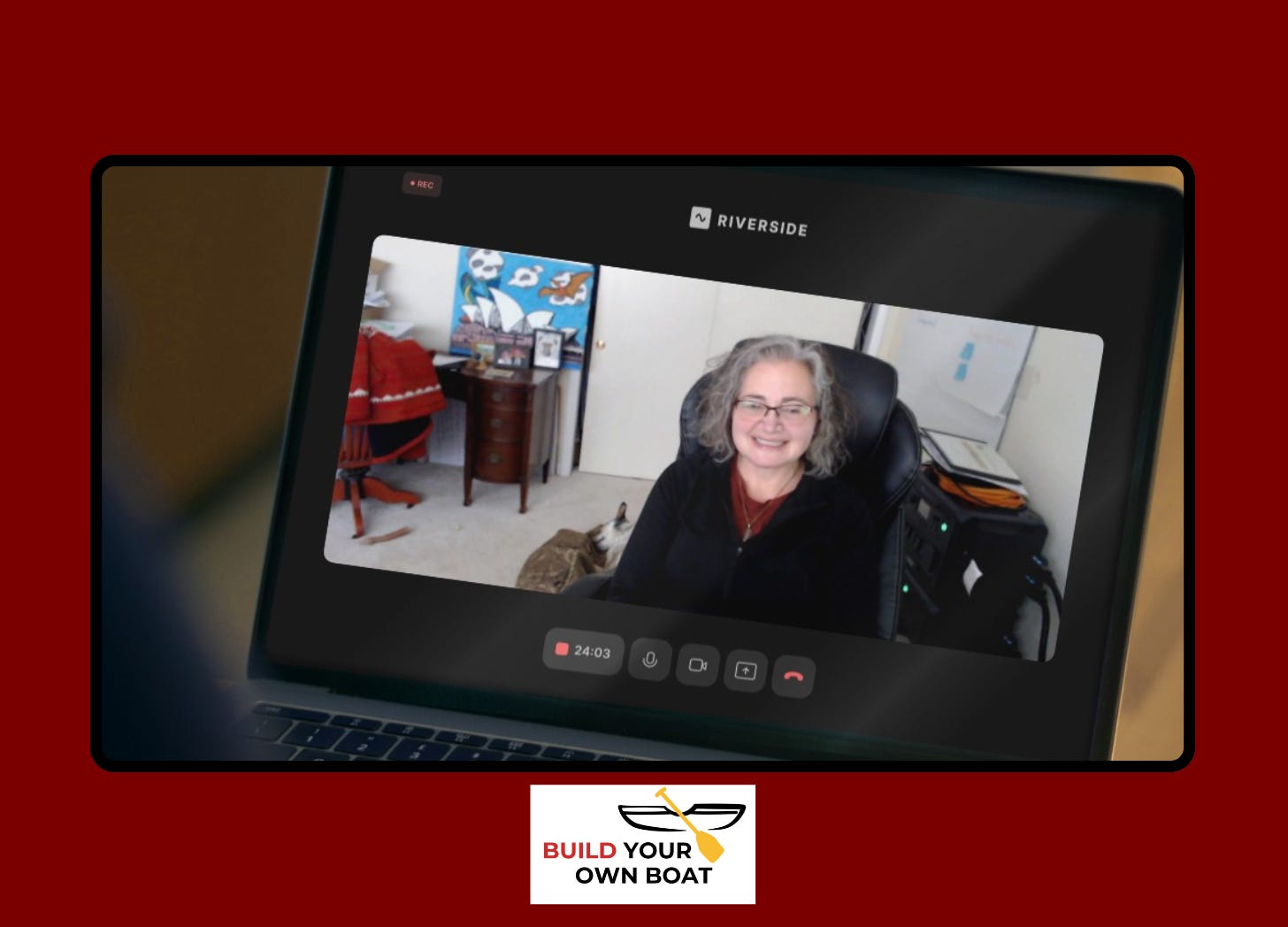
Rachel Cohen was told to pick a lane—social worker or planner. She refused, launched Aging Dynamics at midlife, and turned her “generalist” label into her sharpest advantage.
For a full year after Rachel Cohen started her business, she didn’t buy a single pair of socks.
Thanks for reading Build Your Own Boat! Subscribe for free to receive new posts and support my work.
Not because she didn’t want to. She loves Merino wool socks—loves them—but that first year, they landed on the wrong side of the math. “That was like my threshold,” she told me. When you can’t justify socks, you know exactly how thin the margin is between building something and going back to a paycheck.
That’s the part nobody puts on the Entrepreneur cover stories. And I’ve heard similar stories from and .
Before the 10-year anniversary, before the national conference stages, before the “problem solver” reputation—there was a woman doing the terrifying arithmetic of whether she could cover the mortgage.
“It was terrifying, I will say that. Like there’s no question.”
The lane she refused to stay in
Rachel didn’t stumble into Aging Dynamics. She spent decades building toward it without knowing that’s what she was doing.
She started as, in her words, a tree hugger—environmental commissions in high school, an NGO in Israel after college, then brownfield work with the National Wildlife Federation as their first urban hire in Detroit in the early 2000s. There, working alongside older block captains who had come up from Georgia and Alabama and were re-gardening the city, the light bulbs started going off. This was never really about sites. It was about people in place.
So she kept adding. Community planning, then social work and gerontology when planning felt like it was missing the people. Affordable housing for formerly homeless women and children in Philadelphia. Three years at an Area Agency on Aging. Healthcare, public health, academia, consulting for retirement communities and nursing homes across the country. Each field had a thread. None of them had the whole picture.
And each field kept handing her the same message: pick one.
They kept saying, well, you’re either a social worker or you’re a planner. And I go, no, no, I’m both.
She was labeled a generalist—which, as she points out, “is not a compliment most of the time.” Inside the consultancies where she worked, that meant her real vision kept hitting a wall. She wanted to break down the silos between housing and health and aging. Her employers wanted her to finish the strategic plan for the nursing home, full stop. “It wasn’t my vision for the company,” she said. She’d become a director. It didn’t matter. She was also, more than once, told she was “too much of an advocate.”
Eventually there was nothing left to do inside someone else’s boat. So she built her own.
Starting over without the warm network
Here’s what makes Rachel’s launch a little different than some others we’ve told in this series: she didn’t walk out the door with a book of clients.
Her prior consulting had been narrowly senior living. Aging Dynamics was broader—the whole cross-sector vision she’d never been allowed to run. Which meant she wasn’t the consultant who peels off with her entire Rolodex intact. “This was almost a fresh start.”
A part-time public health gig—no benefits, just enough to steady the mortgage—bought her breathing room. The clients came the slow way. She showed up in rooms where her people were. At a one-day conference for public-health-meets-parks-and-rec folks, she scanned the attendee list ahead of time, spotted an organization struggling with growth, and sat herself down next to its executive director. Four or five conversations later—no pitch, just what are your problems and how might I help—she had a small contract. Then a warm handoff from a board she served on became client number two. Then word of mouth did what word of mouth does.
And that steadying part-time gig? Six months in, she walked into the deputy director’s office and asked to convert it into a consulting contract. It’s now been a 10-year relationship.
Rachel’s Playbook: What she wants you to know before you send that first proposal
Rachel came out of social work school, where, as she puts it, “all you’re taught basically is money is bad. It is evil. You don’t ask for it. You don’t talk about it.”
Unlearning that has been the work of a decade. Here’s what she’d tell the woman staring at a blank proposal:
Ask around—money isn’t a secret, even when people act like it is. Some consultants got cagey, but enough shared their rates to give her a real sense of the market. Find the women who’ll talk numbers with you.
Notice how the low-ball feels. Early on she charged “ridiculously low rates just to get a contract.” Then she’d do the work and feel awful. “It sucked because I wasn’t being valued.” That feeling is data. Use it.
Do the gut check every time. Her literal check-in: If I made X for this work, would I feel okay—or would I feel cheated? Price to the answer.
Price the value, not the hours. Stop counting the hours a project takes and start naming what the client actually walks away with—stronger organization, more funding, real change on the ground.
Understand that underpricing isn’t humble—it’s harmful. “When we don’t charge appropriately or at all, we’re actually hurting the rest of our community of female entrepreneurs. Because then we set the expectation that you shouldn’t have to pay for this stuff.”
She’s living it. After watching others speak up about the value of their time, she started charging for speaking engagements two years ago.
I’ve got over 30 years of experience. You want me to just show up and make your conference for what?
Note from me: Amen, sister!
Too young, then too old, never just right
Rachel has been fighting ageism from both directions her entire career. In her twenties in the aging field, she got told flatly she was too young to know what she knew—she was “so excited to turn 30, literally 30 and a day,” just so she could say she was in her thirties. Now the stereotypes flip: You’re probably not up on the technology. You’re not quick enough. Assumptions made before anyone asks what systems she actually uses.
It goes back and forth. Sometimes you’re too young. Sometimes you’re too old.
I call this the Goldilocks syndrome—women are never just right. Too green, then too distracted by the kids’ soccer games, then suddenly there’s an expiration date stamped on your forehead. Rachel even stopped dyeing her hair right before starting the business and found, to her own surprise, that the gray gave her credibility she’d previously had to manufacture by looking younger. Same woman. Same 30 years of expertise. Different reception.
Her real, specialized edge isn’t that she knows one thing deeply. It’s that she can walk into any room—housing, healthcare, public health, aging, universities—speak the language, translate it so it’s usable, and then actually get the thing done. “It’s not something you grow per project. It’s something you walk in the door with.” The label said generalist. What it really means is she takes one hat off, puts another on, and moves a stuck project forward.
The thing she got tired of waiting on
Ten years in, Rachel is done being halted by the same wall: age-friendly plans that stall out the moment the funding does. Sound familiar, anyone?
So instead of waiting for a grant or “just the right organization,” she’s building. Aging Dynamics is launching its own podcast—age-friendly communities told through the stories of the people who pushed past the barriers and will talk honestly about what didn’t work. A national learning collaborative is next.
I can’t wait for the funding. Let’s just do it.
That’s the whole thing, isn’t it? Not the leap alone—Rachel is quick to say she didn’t just leap. She leapt with 30 years of experience and a refusal to stop being curious. The world keeps telling women in midlife that their range is a liability, that their timing is off, that their expertise should be free. Rachel’s decade is the counterargument.
When I asked what she’d tell the woman with 20 or 30 years of varied, mission-driven experience who’s afraid to charge for her own gifts, she didn’t hesitate:
“Take the leap. Trust yourself. Trust what you know. Trust what you value. And put that at the center. You have something to offer to this world.”
👉 Check out the podcast of this interview, and those of the other amazing women that I’ve interviewed to be inspired and to glean ideas and tips from the playbooks they share.
So—what’s the thing you’ve been putting off because the funding, or the permission, or the perfect moment hasn’t shown up yet? What would happen if you just did it?
If Rachel’s story landed somewhere real for you, hit reply and tell me about the boat you’re thinking of building. I read every one.
Find Rachel Cohen and Aging Dynamics:
Website: aging-dynamics.com (sign up for the newsletter there)
LinkedIn: https://www.linkedin.com/in/rachelbcohen/
Thanks for reading Build Your Own Boat! Subscribe for free to receive new posts and support my work.
Comments
Nothing yet. Say the first thing.
Sign in to join the conversation.