
She walked into a nursing home lobby in Baltimore carrying a tree.
Not a metaphor. An actual ficus tree, hauled from a nursery, planted in the entryway of a long-term care community. Beside it, hung handwritten cards with three questions on them—What is it like to be your age? Have you ever been judged for your age, and how?—and set out some pens. Then she stepped back and watched what happened.
Thanks for reading Build Your Own Boat! Subscribe for free to receive new posts and support my work.
Residents stopped. Family members lingered. People who walk past each other in hallways every day started talking about something they never name out loud. By the end, the tree held about a hundred cards. The next year, ten of those trees showed up at a national aging conference in Denver.
That ficus was the first thing Art Against Ageism ever built. The woman who hauled it in had spent nearly three decades learning exactly why it would matter.
From the Person Asking the Questions to the One With a Story
For most of her career, Meg told other people’s stories. She spent almost a decade as managing editor of Provider Magazine, covering long-term care from the inside—dozens and dozens of long-form interviews and cover stories about nursing homes and assisted living.
“That was probably one of the best things that I think ever happened to me,” she says. She fell for the field through the people in it: The medical directors who weren’t in it for the money, the caregivers nobody writes profiles about, the residents whose lives the rest of the world tends to look past.
“Other people’s stories to me are just so fascinating—way more fascinating than my own.”
That instinct is exactly what made the turn so strange. After grad school and the magazine, Meg got hooked on Humans of New York and decided to build a version of it for older adults. She called it Age in America and started interviewing people in their seventies, eighties, and beyond. The dean of her master’s program saw it and told her to teach a course on it.
She’d never written a syllabus in her life. She built one around a question she was only beginning to understand: How can art chip away at the stereotypes we carry about getting old? Four students signed up. One of them was Jordan Evans.
The Year the World Said the Quiet Part Out Loud
Then came 2020.
Meg was working at the Green House Project, which reimagines the nursing home as small, private, human—and she had what she calls “a third-row seat” to what the pandemic was doing inside these communities. The small homes were faring dramatically better. The deaths were concentrated where people were warehoused.
And she watched the culture react. Protective equipment wasn’t prioritized for nursing homes. A hashtag spread across social media calling the virus the “Boomer Remover”—a joke about killing off a generation.
“The pandemic was revealing this ageism toward older adults. And so Jordan and I just started talking about how sad it was.”
So they stopped talking and started building. They took the syllabus from that four-student class and turned it into an organization. Art Against Ageism launched in 2021.
Here’s the part Meg didn’t plan but loves to point out. She and Jordan are 30 years apart. They were starting a venture to fight ageism—and their own partnership is a textbook example of one of the most reliable things research says reduces it: intergenerational connection.
“It was just happenstance,” she says. But she’s honest about what he gave her. “I think I had fear of launching this thing on my own. Him being there at my side, doing it with me, was something that made a huge difference.”
There’s a quiet flip in their story, too. Jordan—the young one—barely uses social media. Meg, the elder, runs all of it. So much for who’s supposed to be glued to a phone.
Meg’s Rules for Building Your Own Boat
For women sitting at the kitchen table wondering whether they’re too late or too scared, Meg’s advice is specific and earned.
Kill the narration first. “Stop that voice”—the one telling you you’re too old to start something. Replace it with the evidence: Creativity tends to deepen with age, and entrepreneurs over 50 are roughly twice as likely to succeed as their younger counterparts.
Find a partner who believes in you. Meg isn’t naturally fearless. Jordan is. Pairing up didn’t just split the workload—it got her off the launch ramp at all. “Do it with a partner, if that helps you get launched.”
Start with the one yes. Art Against Ageism began because she emailed one nursing home CEO she’d met years earlier. That one yes led to an artist-in-residence, then a board member, then the ficus tree. “It was kind of a numbers thing—just finding people who were open.”
Name your unfair advantage and lean on it. Meg’s is a rare stack: Decades inside aging services, plus a marketing and communications career, plus a knack for spotting trends. “I haven’t had to pay anyone yet to create a campaign.” Whatever your version is, it’s something a competitor can’t buy off the shelf.
Steal like an artist. The tree came from Yoko Ono’s Wish Trees. The street murals came from the artist JR’s Inside Out Project. Meg didn’t invent from nothing—she found what moved her and bent it toward her mission.
The Bigger Picture
Meg’s work runs straight into a barrier most of us never question: We don’t treat nonprofits as entrepreneurial ventures. But everything about Art Against Ageism is entrepreneurial—the cold emails, the experiments that flop and the ones that take off, the relentless hunt for funding in a year when funding is thin and competition is fierce.
She’s clear-eyed about that pressure. She filed three grant applications in recent weeks. The Own Your Age photo booth, which invites people to creatively claim their age at conferences and events, has become a real revenue engine. She worries about sustainability “all the time”—same as every founder running something she believes in with a shoestring behind it.
And the work itself pushes against a media landscape that renders older women, and older people generally, nearly invisible. Seventy-five life-size portraits of residents, staff, and volunteers, pasted across the front of a building on a busy Washington, D.C., street for almost a year. People who could not look away.
That is the whole project: make the invisible impossible to ignore.
“It’s about the people and the humanity that happens inside of nursing homes every single day.”
If you’ve been telling yourself the story that the moment for your big swing has passed—what would it take to walk into the room carrying your version of the tree?
Connect with Meg LaPorte and Art Against Ageism:
Website: artagainstageism.org — where you can find all of the projects, the mural work, the Own Your Age photo booth, and how to get in touch with Meg and her co-founder Jordan Evans.
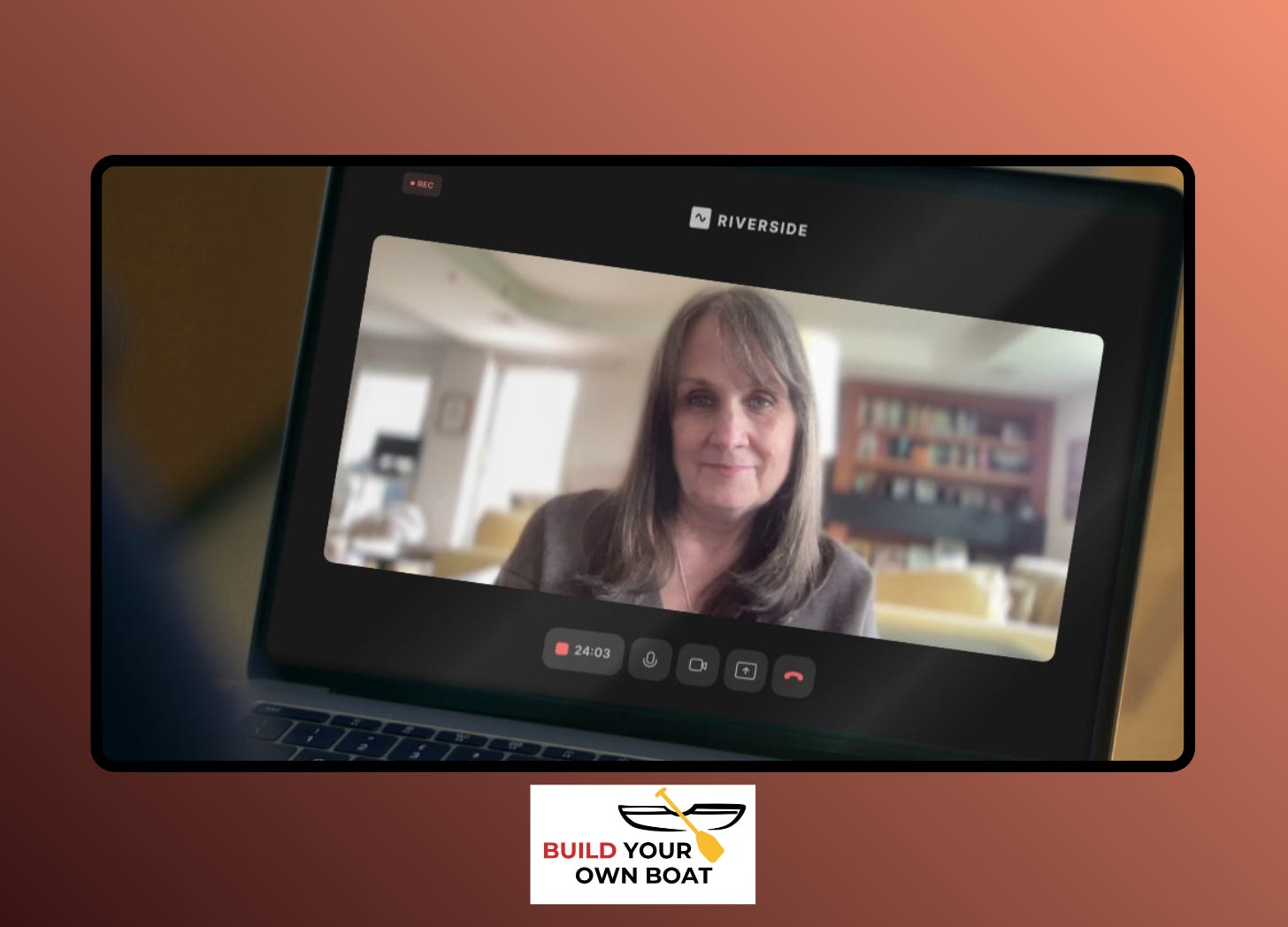
Check out the podcast of this interview, or those of any of the amazing women that I’ve interviewed.
If this episode touched something in you, subscribe to Build Your Own Boat and send it to a woman who needs to read it. You know who she is.
Thanks for reading Build Your Own Boat! Subscribe for free to receive new posts and support my work.
Comments
Nothing yet. Say the first thing.
Sign in to join the conversation.