
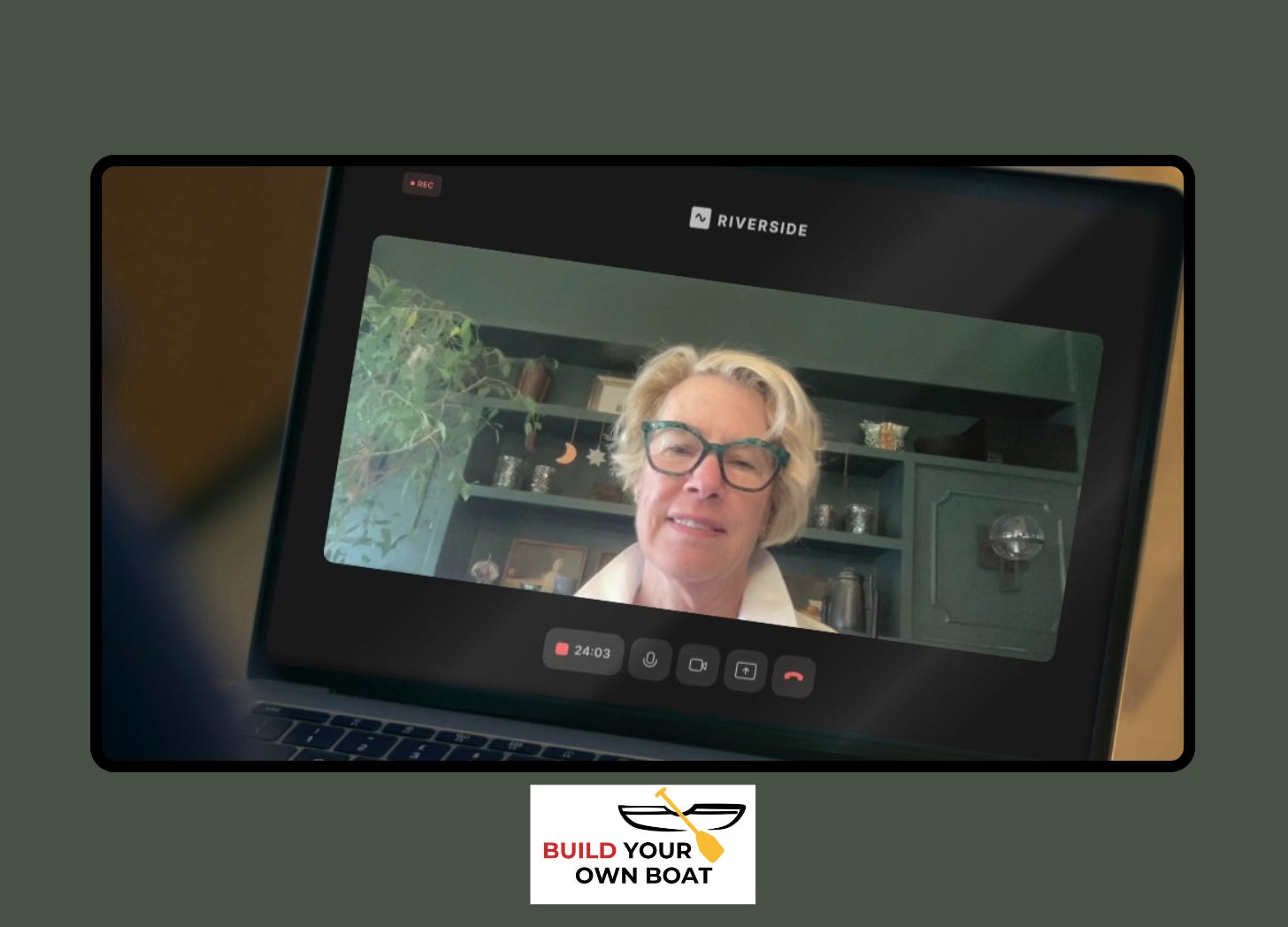
Anne Patton’s son Chris is 42. He lives with autism. He lives in his own home—a home he owns through a special needs trust, close to where Anne lives in Denver. He has staff who support him, a schedule built around what actually works for him (not what fits neatly between nine and three), and a life that looks the way he and his mother always hoped it could look.
None of that happened automatically. Most of it happened because Anne built it herself.
Thanks for reading Build Your Own Boat! Subscribe for free to receive new posts and support my work.
In 2013, after years of navigating school systems, advocacy organizations, and state-funded residential programs that weren’t quite right—and after a crisis involving a caregiver who showed up drunk and left the front door unlocked while Chris watched over him—Anne made a decision. She quit her job. She learned the state rules and regulations. She became a Medicaid-approved provider. She formed a Program Approved Service Agency called A Better Life.
She did not call herself an entrepreneur for a long time.
The Business Nobody Recognized
Here’s what a Program Approved Service Agency actually is, for those unfamiliar with the term: it’s a funding mechanism. It allows a family to bill Medicaid directly for their loved one’s support services, rather than routing everything through a large agency that takes—Anne will tell you plainly—between 30 and 50 percent of the funding as overhead.
What it also is, in practice, is a small business. Complete with HR, compliance, financial management, Medicaid billing, staff scheduling, and enough regulatory paperwork to bury a person.
“There were just more rules and regs coming down the pike from Medicaid,” Anne told me. “COVID hit. The city and county of Denver with all their rules. The Family Care Act, the Colorado Secure Savings Programs—all mandatory, all built into the operations. The admin of it was just getting heavier and heavier.”
She paused, and then said something I’ve been thinking about ever since (since it sounds SO MUCH like me):
I’m not an admin person. I’m a problem solver and an idea person.
That’s a sentence that belongs on a wall somewhere. Because what she was describing—the gap between the work she was actually doing and the work she was meant to be doing—is something a lot of us recognize. Whether you’re running a business, leading a team, or holding a complex operation together with institutional knowledge and sheer force of will, there often comes a point where the overhead threatens to swallow the mission.
One foot in front of the other. Some days not very well. And I needed to rely on my friends to kind of help pick me up and say, you can do this.
The Exit Strategy That Became a New Business
About six or seven years ago, Anne started having conversations with other mothers in Colorado who were doing exactly what she was doing: running their own small agencies to support adult children with disabilities, largely alone, largely without infrastructure, quietly burning out.
“We’d meet, but we all had busy lives supporting our kids,” she said. “It took a long time and a number of iterations.”
What emerged from those conversations—and from a stint at the Chanda Plan Foundation where Anne led care coordination—was a recognition that the problem was bigger than any one family.
There is what Anne calls an aging caregiver crisis unfolding right now, largely invisible to everyone outside the disability community. Parents in their sixties, seventies, and eighties are running organizations, managing budgets, and supervising staff—with no succession plan, no transition support, and no clear off-ramp.
“There’s no transition,” Anne said. “We look at transition for kids from pediatrics to adults, from school to the community. But there’s no transition at the …—” she caught herself, and the unfinished sentence said everything. There’s no plan for when the parent can’t do it anymore.
So Anne co-founded Our Back Office Colorado with her colleagues Christy and Catherine. The organization is still in a pilot phase, but its mission is precise: Give aging family caregivers who are running their own service agencies the shared infrastructure, peer support, succession planning, and—eventually—shared back-office services they need to sustain what they’ve built.
The need, as it turns out, is not subtle. A needs assessment Anne and her team conducted across Colorado found that 100% of participants agreed a shared back-office support system could help ease the operational burden and improve sustainability.
Some days I was ready to just shoot myself in the foot and think, what did I do? Why did I do this? And then I get calls from families, and they emphasize the value of this kind of resource—and I come out of team meetings thinking, we’re doing good work. It makes me so happy to see this whole dream coming true.
Anne’s Playbook: What She’d Tell Women in Similar Situations
I asked Anne what she’d say to a woman who has been managing her family’s complex needs for years, never once called herself a builder, and is sitting somewhere tonight wondering if she could turn what she knows into something bigger.
Her answer was characteristically direct.
Be curious, and keep learning. “Learn as much as you can about what you want to do. Don’t be afraid to talk to a lot of people.” Conferences, peer networks, parent listservs—the information is out there, but you have to go looking for it. Our Back Office Colorado’s monthly coffee talks exist precisely for this reason.
Know that your experience is your unfair advantage. “We have a whole lot more experience than most of the professionals out there that deal with disability.” That’s not just true in the disability space. If you’ve spent years navigating a complex system on behalf of someone you love, you know that system better than anyone who studied it from the outside.
Understand the financial mechanics before you decide. If you’re a caregiver who is already doing the work of running a service agency through a larger organization, becoming your own Medicaid-approved provider means cutting out the middleman—and keeping the 30 to 50 percent that’s currently going elsewhere. That’s not a small number. For many families, it changes the math entirely.
Find your people. Anne didn’t build either of her organizations alone. She leaned on co-founders, friends, colleagues, and a peer community. “Some days, not very well,” she said of managing the hard stretches. The monthly coffee talks she hosts through Our Back Office Colorado are, by her account, described by participants as “the meeting they look forward to most every single month.” That kind of community isn’t just a nice-to-have, it’s the foundation.
Don’t wait for a perfect plan. Anne and her co-founders have been, in her words, “scrambling by the seat of our pants all the time, which is all we’ve done anyhow.” The piloting, the iterations, the grant applications that nearly broke her—all of it moved the work forward. Done and imperfect beats polished and theoretical every time.
The Bigger Picture
There are many women like Anne in Colorado and in every state. They built businesses out of necessity, out of love, out of the specific kind of knowledge you can only get by living something for forty years. They navigated Medicaid waivers, employment law, state compliance requirements, and a global pandemic—while never once appearing on a list of top entrepreneurs to watch.
That invisibility is not accidental. It reflects the same forces that make women over 50 largely absent from business media, underfunded relative to their younger counterparts, and easy to overlook in a culture still convinced that entrepreneurs are young men in coffee shops.
Anne’s work also sits at a second invisible intersection: aging and disability. The families who built their own agencies took healthcare policy and finance—specifically, the state departments managing Medicaid—off the hook. They created solutions the system couldn’t or wouldn’t. And they did it largely without recognition, without adequate funding, and without each other.
Our Back Office Colorado is trying to change that last part, at minimum. The dream is bigger: legislative change, a viable funding stream, and a pathway that doesn’t require every aging caregiver to figure it out alone from scratch.
Anne said something near the end of our conversation that I keep returning to. She talked about her two younger children, who aren’t particularly interested in taking over the business she built for Chris. She talked about the families whose parents are in their eighties with no written succession plan. She talked about not wanting Chris to lose his home.
“This is why I’m here,” she said. “This is why I exit Saturday to start a new business.”
Her exit strategy, at the stage of life when most people are winding down, is to build something new—something that gives other families the foundation she had to construct entirely on her own.
If that’s not what building your own boat looks like, I don’t know what is.
Want to know more about Our Back Office Colorado—or find out if this model could work for your family? Visit ourbackofficecolorado.org to learn more, sign up for the monthly coffee talks (first Wednesday of each month, 8 a.m.), or reach out directly. You can also find Anne’s contact information on the website.
If this conversation moved you, I’d love for you to subscribe to Build Your Own Boat wherever you’re listening—and send this episode to someone who needs to hear it. You know who she is.
And if you’re a woman in midlife and beyond who has built something—or is thinking about it—tell me your story. This project isn’t about telling you what’s possible. It’s about showing you who’s already out there doing it.
Thanks for reading Build Your Own Boat! Subscribe for free to receive new posts and support my work.
Comments
Nothing yet. Say the first thing.
Sign in to join the conversation.