
Last week, I hit a wall.
Not a creative wall.
Not a technical wall.
A session limit wall.
I was in the middle of preparing a post — iterating on structure, refining tone, pushing the idea further with Claude — when suddenly:
“You’ve reached your usage limit.”
That was it. Flow broken. Context gone. Momentum dead.
And apparently, I’m not alone.
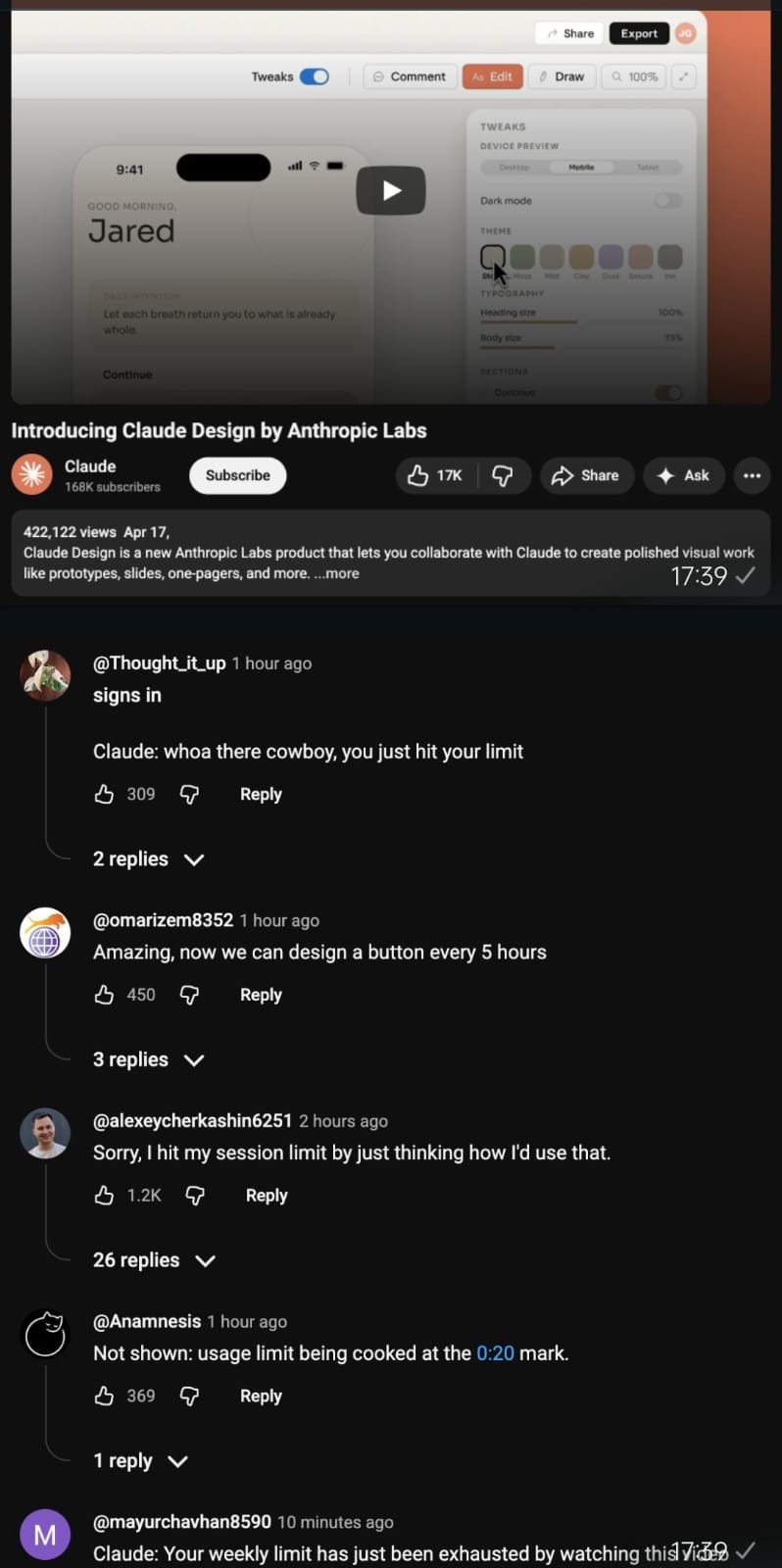
If you scroll through any recent discussion around Anthropic’s Claude, you’ll see a pattern:
“I hit my limit just thinking about how I’d use it.”
“We can design one button every 5 hours now.”
“Usage limit being cooked at the 0:20 mark.”
These aren’t edge cases.
They’re becoming the default experience for power users.
Which led to the most accurate description I’ve seen:
Claude is the Gen Z intern who needs a vacation after two pomodoros.
And the frustrating part?
It’s also one of the best AI collaborators out there.
Claude feels different when you use it.
It’s:
more thoughtful
better at writing
more coherent over long outputs
surprisingly good at design thinking
You don’t just use Claude — you collaborate with it.
And that’s exactly the problem.
Because collaboration requires continuity.
And Claude, right now, struggles with that.
The issue isn’t just “message limits.”
It’s the combination of:
long context windows being expensive
iterative workflows consuming tokens quickly
sessions silently accumulating cost
limits hitting right when you reach peak clarity
In other words:
The better you use Claude, the faster it stops working.
After talking to builders, designers, and devs, a few patterns are emerging.
Instead of long sessions, people use Claude in short, high-intensity bursts:
dump context
get high-quality output
exit before hitting limits
Think of it less like a teammate and more like:
a consultant you hire for 30 minutes at a time.
A lot of power users are quietly doing this:
Claude → ideation, writing, deep thinking
OpenAI models → iteration, formatting, continuation
others → bulk or low-stakes tasks
This reduces Claude usage dramatically while keeping its strengths.
One of the biggest mistakes:
treating Claude like a persistent workspace
Instead, experienced users:
start new chats frequently
paste only what’s necessary
avoid dragging long histories forward
Because context = cost.
The smartest workaround I’ve seen:
People are building their own “memory layer” outside AI.
Simple setup:
a folder of .md files
structured notes
reusable prompts
Instead of relying on Claude to remember everything, they:
bring only what’s needed into each session.
Some teams are doing something more interesting:
They’re not fighting the limits.
They’re designing workflows around them.
shorter cycles
clearer prompts
modular thinking
defined “handoff points” between tools
In a weird way, limits are forcing better discipline.
This isn’t just about Claude.
It’s about a new constraint we didn’t have before:
AI is no longer limited by intelligence — it’s limited by continuity.
We finally have systems that can think at a high level.
But they can’t stay with us long enough to finish the work.
If you’re building in this space, this is the real opportunity:
Not better models.
Not bigger context windows.
But:
Systems that preserve flow across models, sessions, and limits.
Because right now, the biggest productivity killer isn’t bad output.
It’s interruption.
Claude might be:
the smartest intern on your team
But until it can work a full shift…
You’ll need to design your workflow like it clocks out early.
And maybe that’s the real skill we’re all learning now.
If you’ve figured out better ways to deal with AI limits, I’d love to hear them. This is one of those problems the community is solving faster than the tools themselves.
Leave your comments here or on linkedin.
No posts
Comments
Nothing yet. Say the first thing.
Sign in to join the conversation.