

Happy 4th of July!
📝Survey About FNCE

Can you help us out by doing this SURVEY? Click HERE it will probably only take you about 5 minutes and you’ll be entered to win a $25 gift card to one of our RD merch partners - we’ll be giving away TWO (2) $25 gift cards on or about 7/11.

#Partner - Check out fun RD (on just nutrition/food nerd) merch from our friend, dietitian Andy Mathis of Beautiful Eats and Things. When you use promo code: budDiscount you’ll get 15% off!
💊Vitamin Deficiencies: What’s in your “tank”?
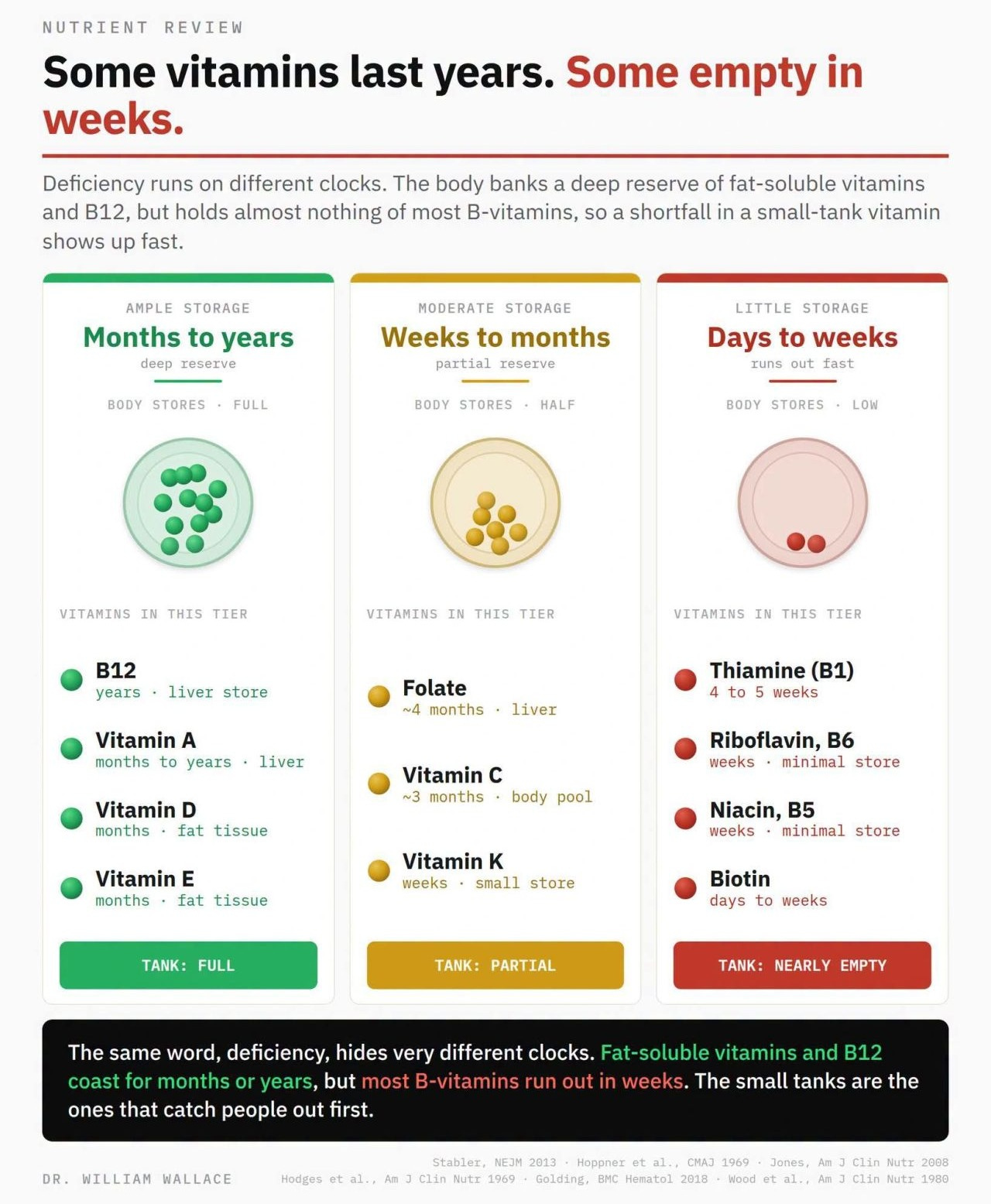
This was a particularly helpful LinkedIn post by Dr. William Wallace:
“The word deficiency gets used as if it means one thing, but the body runs every vitamin on its own clock, and the clocks are not close. Some vitamins sit in a reserve deep enough to last years.
Others hold barely a few weeks of buffer, and once intake stops the tank drains fast. The difference is not about how important the vitamin is. It is about where and how much the body can physically store, and that single fact decides how quickly a shortfall turns into a problem.
The big tanks belong to the fat-soluble vitamins and to B12. Fat-soluble vitamins dissolve into tissue rather than washing out in urine, so the body can stockpile them. Vitamin A is held in the liver in quantities measured in months to years of supply, confirmed in direct liver-store measurements going back decades. Vitamin D and vitamin E bank into fat tissue and turn over slowly, with circulating vitamin D carrying a half-life measured in weeks and a reserve that buffers for months. B12 is the standout among the water-soluble vitamins: the liver holds a store large enough that deficiency from low intake alone takes years to surface, which is why true dietary B12 deficiency is slow while the faster cases usually come from an absorption problem rather than an empty tank.
The middle tier holds vitamins with a real but limited reserve. Vitamin C is the classic example. The body maintains a pool of roughly 1500 milligrams, and experimental studies in which volunteers ate no vitamin C at all found that scurvy did not appear until the pool fell below about 300 milligrams, which took around three months. Folate stores in the liver buffer for a few months as well, with megaloblastic changes appearing after roughly four months on a deficient diet. Vitamin K sits at the lower edge of this group, with a smaller store and faster turnover that buys weeks rather than months.
Most of the B-complex vitamins are water-soluble, barely stored, and continuously flushed, so the reserve is days to weeks rather than months. Thiamine is the sharpest case with real data behind it: in a controlled restriction study, measurable depletion appeared in just four to five weeks. Riboflavin, B6, niacin, B5, and biotin share the same basic problem of minimal storage, which is why deficiencies in this group can develop quickly when intake drops, when needs rise, or when something interferes with absorption.
A gap in a deep-tank vitamin like A or B12 can go unnoticed for a very long time, while a gap in a small-tank vitamin like thiamine shows up on a timescale of weeks. When intake suddenly drops, whether from a restrictive diet, heavy alcohol use, or an illness that wrecks appetite, the small tanks empty first and are the ones worth thinking about soonest. The deep reserves are a luxury the body only affords for a handful of vitamins.”
Stabler, NEJM 2013
Hoppner et al., CMAJ 1969
Jones, Am J Clin Nutr 2008
Hodges et al., Am J Clin Nutr 1969
Golding, BMC Hematol 2018
Wood et al., Am J Clin Nutr 1980
✅Worth Checking Out
☑️💊Obesity Medicine? Longevity Medicine? What's the Diff? - ConscienHealth
“…treating obesity is one of the most powerful ways we have to improve long-term health. Calling that longevity medicine may sound fashionable, but for now it mostly sounds like new branding for an old idea.”
☑️🌳LinkedIn: Tick-Borne Illness — What You Need to Know Before You Go Outside
“…Most people think of ticks as a nuisance. The reality is that a single tick bite can trigger a condition that changes what you eat for the rest of your life — and most patients go undiagnosed for months or years before anyone thinks to check for it….”
☑️💊Substack: Every Probiotic Label Should Answer These Five Questions. Most Don’t.- by William DePaolo, PhD
On probiotics:
Before you buy, ask:
What exact strain is this?
What outcome was it tested to improve?
Who was studied?
Was this dose and formulation tested?
Is there human evidence for the finished product?
A product that can answer all five questions has earned a closer look.
A product that answers none of them has earned skepticism, no matter how beautiful the packaging is.
The microbiome is complicated.
That does not mean the buying decision has to be mystical.
You are not looking for the most bacteria.
You are not looking for the most expensive bottle.
You are not looking for the product with the happiest shade of green.
You are looking for a clear question and credible evidence that a specific intervention can help answer it.
☑️🤔Substack: Yes, It Sucks. Welcome to Cancer. Please Take a Number and Question Everything. What Newly Diagnosed Cancer Patients Actually Need to Know - by Hans Casteels
“…Trust your oncology team more than strangers with avatars and strong opinions. Trust trained professionals more than people whose medical qualifications consist of having watched three videos and owning a blender…”
☑️☠️Poison is a bad word - by Richard Williams
“…We can find “poisons” everywhere, particularly now with extremely sensitive equipment. In the 1960s, we could find chemicals in parts per million—essentially a drop of a chemical in a coffee cup. Today, we can find things in parts per quadrillion: a few drops of a chemical in a shallow lake the size of three football fields…”
📚CEU Corner

Sponsored Webinar: Plant-Based Nutrition and Human Performance - Evidence, Application, and Innovation in Practice (Recording) | ASN DiscoverNUTRITION
1.0 CPEU - FREE
👀What Will the Dietetics Profession Look Like in 10 years
Here’s what RDs had to say - this is a newsletter just for paid subscribers…consider this an encouragement to upgrade your subscription! Until July 31st, when you become a PAID annual subscriber, you’ll get 10% off the cost AND we’ll donate to $10 to World Central Kitchen!
Don’t feel like becoming an annual subscriber? You can become a monthly subscriber.
Don’t feel like subscribing to the newsletter? You can just ‘Buy Us a Coffee’ ☕with a one-time “tip” by clicking HERE.

Comments
Nothing yet. Say the first thing.
Sign in to join the conversation.