
🗣️Should We Comment on Bodies?

Exclusive: Expert Weighs In on JD Vance's Weight Loss Amid Ozempic Speculation (dietitians mentioned)
There seems to be a lot of talk online about celebrities and whether they are using (correctly or incorrectly) medications for obesity. If you, as a nutrition professional, were asked by a media outlet to speculate about whether a celebrity (or a VP) is using Wegovy or other medication for obesity or what to make of their weight loss/gain…what would you say (or not say)?
Here’s what dietitian Lauren Harris-Pincus said in this article (hyperlink in title), “It's a good policy to avoid publicly commenting on people’s bodies,”
Lately we’ve seen a lot of reels that start with, “I don’t usually comment on a person’s body/weight BUT….”
…and then these same people proceed to express concern about a specific person’s weight/size and guess/assume/speculate that they’re taking some sort of medication for obesity.
What do you think? Is this ethical?
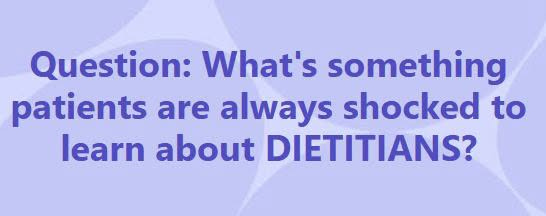
Here were some of the responses with the most “likes” from our Facebook page:
Bri L. “That we do more than make meal plans.”
Jason Z. “That we are actually qualified to discuss nutrition unlike "influencers" and personal trainers.”
Kristen H. “That we come in all shapes and sizes and we aren’t immune to health problems.”
Mo L. “How much we know about the human body.”
Julia S. “How much education we must have to obtain our credentials.”
Patrick M. “That we actually want them to eat!”
Savannah P. “That I don’t always carry a menu and I’m not in charge of the kitchen.”
Linda T. “That we even went to college, let alone grad school! Also, that we look at lab results, medications, medical history.”
Laura H. “That we don’t cook all of their meals ourselves.”
Jennifer W. “We like to eat dessert and pizza!”
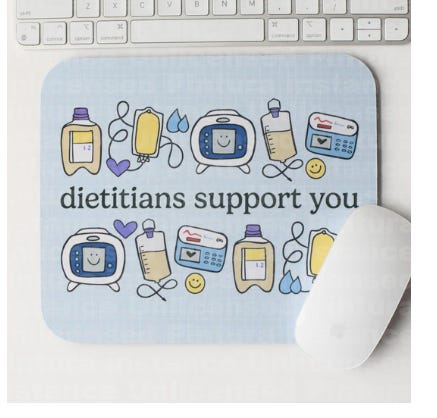
Check out merch from Donut Season - use promo code: BUDSpring26 for 15% off.

”…We named orthorexia when the pursuit of "clean eating" curdled into obsession. We named orthosomnia when chasing the perfect sleep score started wrecking people's actual sleep.
…Orthometria - orthos + metron, "measure" - obsession with correct measurement of the self.
…It's the compulsion to measure. The ring on your finger, the patch on your arm, the score that greets you before your feet hit the floor. The steps, the streaks, the accomplishments, the rings made whole. We've wired ourselves to a thousand tiny dashboards, and somewhere along the way, the dashboard stopped serving life, and life started serving the dashboard.Eight hours of sleep used to feel good. Now it's a number you either hit, or you fail. A walk used to be a walk. Now it's steps, pace, zones, recovery. We turned being alive into a quarterly review with ourselves as the underperforming asset.
I think there's a cost. The more we monitor, the more fragile we become. Every metric is one more way to fall short. One more reason to distrust how we actually feel in favour of how the device says we should feel. Anxiety doesn't come from a bad number. It comes from believing the number defines and knows you better than you know yourself. Fear of a glass or two of wine, fear of a transatlantic flight, fear of eating a croissant, fear of... insert [event] that disrupts something that we're tracking!
… But measurement was supposed to be a window, not a mirror we can't stop checking.
Maybe there's a metric worth protecting. Life. The one that nothing can track.
Don't fall prey to orthometria. Life is worth living without obsession about how well it shows up in your stats!…”
… But measurement was supposed to be a window, not a mirror we can't stop checking.
Maybe there's a metric worth protecting. Life. The one that nothing can track.
Don't fall prey to orthometria. Life is worth living without obsession about how well it shows up in your stats!…”

From Dr. Karl Nadolsky
“It’s a contradiction to criticize pharmaceutical companies for being profit-driven while simultaneously selling unproven peptides or supplements that lack the very evidence standards designed to protect consumers.
If a product has not been adequately studied in humans, we often don’t know whether it works, what dose is appropriate, what side effects may occur, who should avoid it, or what the long-term risks might be. Those questions can only be answered through rigorous clinical trials.
Pharmaceutical companies certainly seek profits, but the requirement for preclinical studies, phased human trials, safety monitoring, and regulatory review exists because evidence, not marketing claims, is how we determine whether a drug’s benefits outweigh its risks.
Selling products without that evidence while dismissing the value of the research process is not an alternative to “Big Pharma” - it’s asking consumers to take on greater uncertainty with less accountability and unethical.”
For more on peptides, this is a good listen from Science Vs on Peptides

Comments
Nothing yet. Say the first thing.
Sign in to join the conversation.