
The Philadelphia City Planning Commission met last Thursday afternoon at 1515 Arch Street, working through a full agenda that included a revised capital budget, a contested zoning permit bill, a major rezoning tied to a contaminated South Philadelphia site, and several overlay district updates. Read on for our highlights from the meeting.
Capital Budget: Bills 260213 and 260214
The most substantive action item of the meeting was a pair of bills amending Philadelphia’s FY2026 Capital Budget and the six-year FY2026–2031 Capital Program. Both were presented by Nate Dorfman and approved by the commission.
The revised capital budget includes $145.4 million in City-backed appropriations for pre-financed loans. The spending covers a range of city infrastructure needs, including library branch improvements, recreation center renovations, Vision Zero related improvements and health center upgrades. The six-year capital program was revised to increase $16.1 million in total appropriations.
Zoning Bill 260133: Permit Lapse Clarification — Not Recommended
One of the more procedurally interesting items was Zoning Bill 260133, introduced by Councilmember Jeffrey Young and presented by David Fecteau, proposes amending Section 14-303 of the Philadelphia Code to clarify exceptions to the lapse of zoning permits issued without construction documents.
The change is narrow in language but significant in practice. Under current code, a “zoning permit issued without construction documents” — the kind a developer typically obtains early in the process, before full construction drawings are complete — remains valid for six months, provided that an application for a Certificate of Occupancy is submitted within that window. The bill would amend that standard by adding four words: the CO application must be submitted “and granted by the Department” within the six-month period.
Submitting a CO application is something entirely within the applicant’s control; having it granted is not. Departmental review timelines vary, and a developer who submits promptly but faces a processing backlog would see their zoning permit lapse through no fault of their own. Commissioners raised the practical financing dimension. Lenders routinely require an active zoning permit before releasing construction financing, so a permit that lapses during CO review could unwind a project’s capital stack even if the developer has done everything right.
Staff recommended that the commission not approve the bill, citing concerns about how the changes could affect development momentum and interact with other code provisions. Commissioners discussed the tension between preventing permit hoarding and not creating unnecessary obstacles for developers who legitimately need financing time before breaking ground — noting that lenders often require a zoning permit before they will finance a project. The commission accepted the staff’s non-approval recommendation.
Zoning Bill 260165: Seventh District Overlay Consolidation — Approved
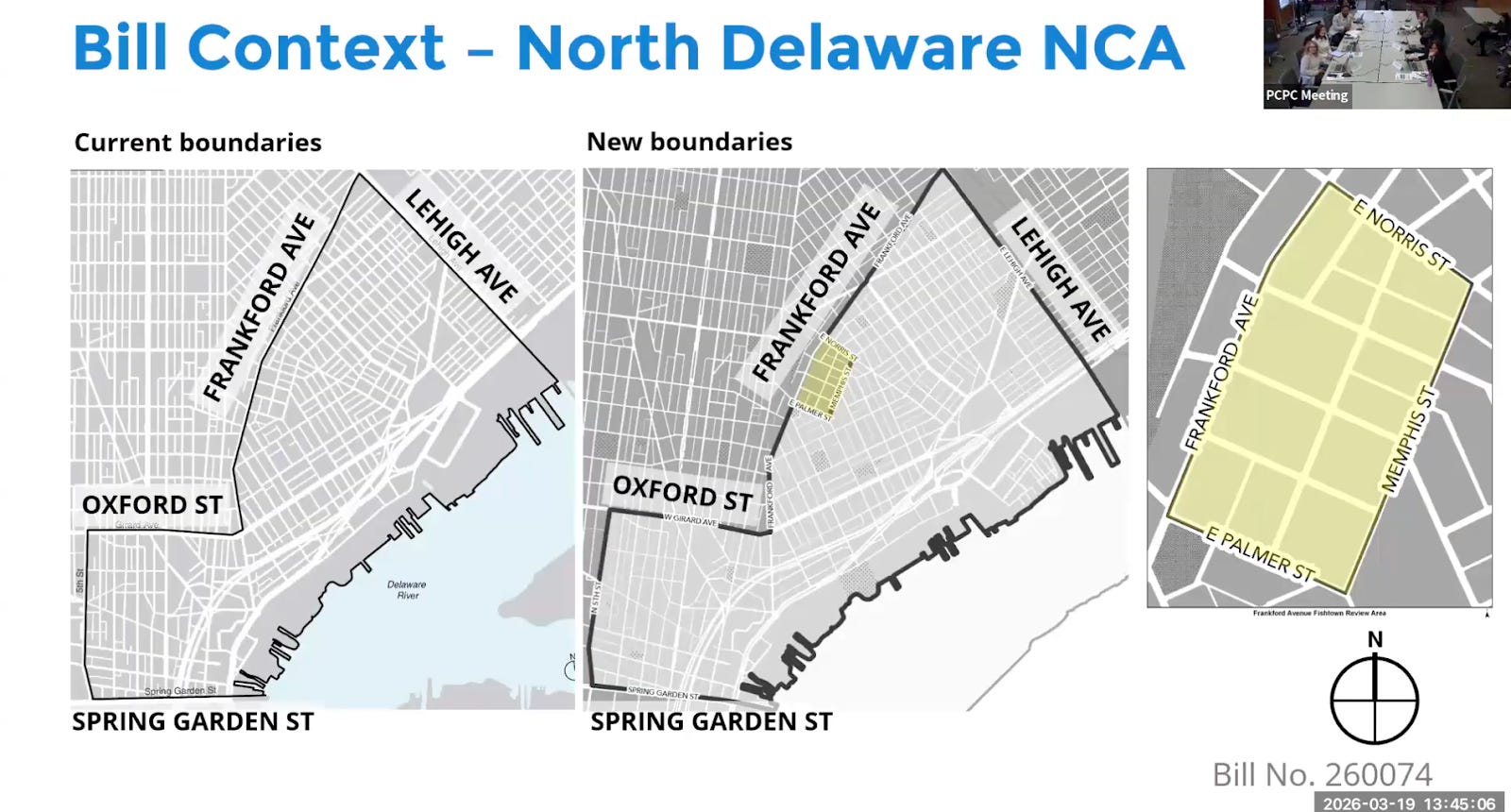
David Fecteau also presented Bill 260165, a more complex overlay district reorganization introduced by Councilmember Lozada. The bill folds provisions from the American Street Overlay District (AME) and the North Delaware Avenue (NCA) Neighborhood Commercial Area Overlay into the Seventh District Overlay (SEV), and removes the /AME overlay from the zoning code entirely.
The consolidation matters because the American Street Overlay was added to the code in 2013 with the intent of encouraging residential development with affordability guarantees. According to Fecteau’s presentation, the overlay had in practice been generating unintended outcomes. Projects were flowing through civic design review and receiving what amounted to bonus dwelling units without meeting the affordability standards the overlay was designed to enforce.
The bill removes the previous affordability standards and instead defaults to the affordable housing requirements in the Mixed Income Neighborhood Overlay (MIN.) Under MIN, projects with ten or more units must set aside 20 percent of those units at 40 percent of Area Median Income; density bonuses are available, but there are no direct subsidies. The bill redraws the North Delaware NCA overlay, migrating the 7th district portion into a separate District 7 overlay. The NCA remains unaffected in Districts 1 and 5.
The commission approved the staff recommendation. Fecteau noted that neighboring council districts 1 and 5 would need to be engaged as implementation proceeds, given the geographic reach of the affected overlay areas.
Zoning Bill 260207: Penrose Ferry Rezoning — Discussed, Developer Testimony Heard
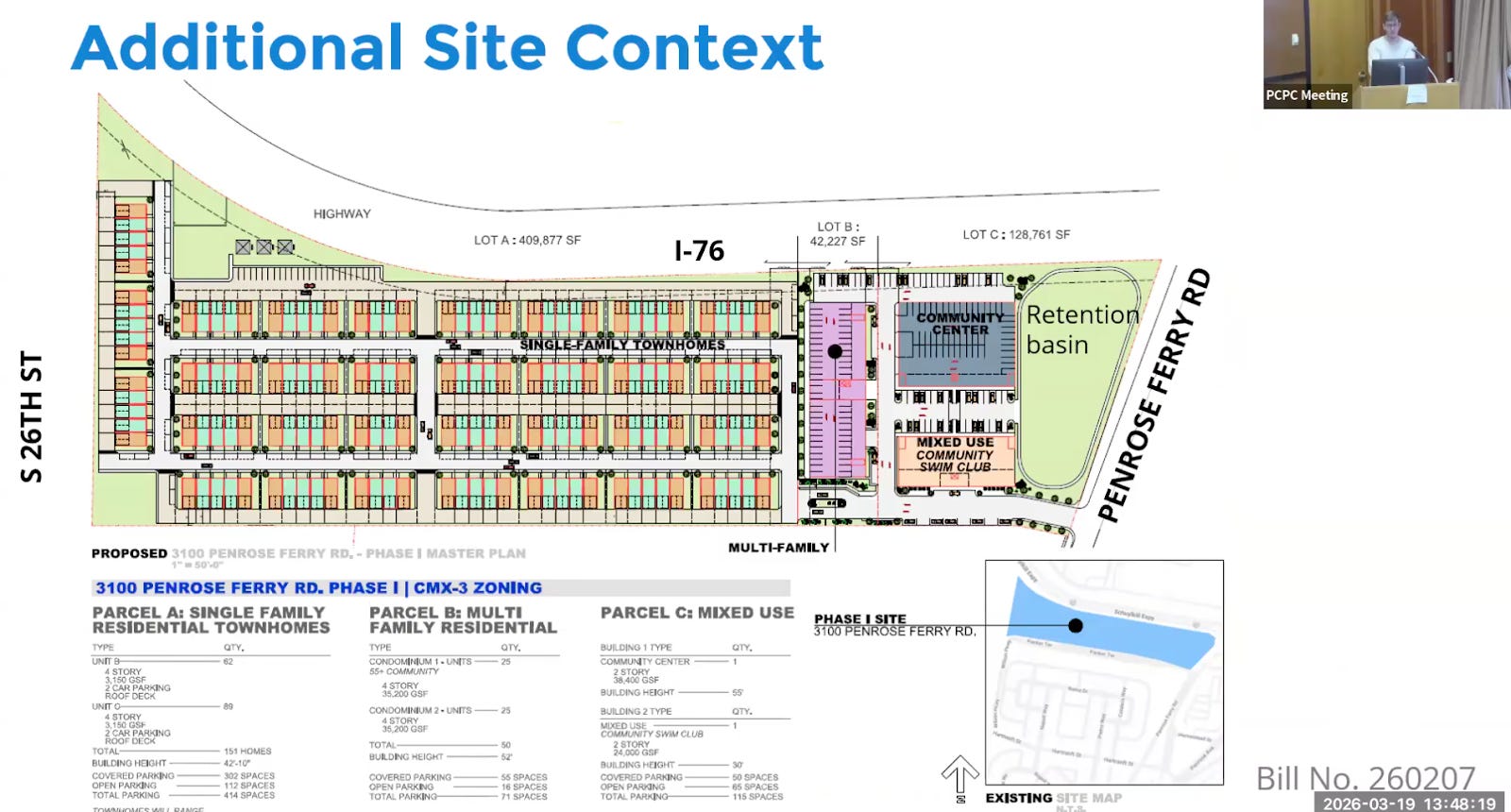
Presented by Dan Farrell, Bill 260207 would rezone a parcel bounded by I-76, the Schuylkill Expressway ramp, Hartranft Street, and the Conrail right-of-way — in the area near Penrose Ferry Road in South Philadelphia.
The developer, Trove Capital, appeared before the commission to describe a proposed mixed-use project on what they acknowledged is a heavily contaminated site currently under environmental remediation. Their plans include a 50-unit multifamily building, 151 single family homes and ground-floor commercial space. A representative from Trove noted the firm has completed approximately 40 similar projects to date and characterized the proposed development as consistent with what the neighborhood wants.
The developer indicated that contamination management and infrastructure coordination would continue to be addressed as the project moves through the development process. Commissioner Somerville also asked about the commercial component and whether residents would be able to purchase goods on-site.
Zoning Bills 260211 and 260212: Neighborhood Rezonings - Approved
The commission also took up two additional map amendment bills:
Bill 260211 (presented by Dan Powers) covers an area bounded by Erie Avenue, Front Street, Lippincott Street, and 2nd Street in North Philadelphia — Councilmember Lozada’s district.
Bill 260212 (presented by Michael Gall) covers an area in the Northeast bounded by McKinley Street, Leonard Street, Devereaux Avenue, and Bustleton Avenue — also introduced by Councilmember Lozada. Commissioners asked briefly whether any zoning modification was contemplated alongside the map change; the answer was no.
Both bills were approved with little fanfare.
Administrative Streets Bills
Five streets encroachment bills were approved administratively, covering an elevator encroachment near 3400 Aramingo Avenue (Bill 260095), right-of-way improvements on the 7600–7800 blocks of Ogontz Avenue (Bill 260131), various citywide right-of-way encroachments (Bill 260161), a dumpster encroachment at 509–19 Vine Street (Bill 260216), and a sidewalk café and canopy installation at 2655 South Juniper Street (Bill 260217). These are routine items but reflect the steady pace of physical infrastructure change across the city.
Commentary
Thursday’s PCPC meeting was workmanlike rather than dramatic, but it surfaced a few dynamics worth watching.
Councilmember Young’s permit lapse bill (260133) is a good example of zoning legislation that actually has real consequences for housing production. The amendment — requiring that a Certificate of Occupancy be not just applied for but actually granted within six months — shifts risk onto applicants for government processing delays they can’t control.
Lenders require active zoning permits to release construction financing, so a permit that lapses during a CO backlog could kill a project even after the developer has fully complied with all requirements. The staff’s recommendation against the bill, and the commission’s acceptance of it, reflects a reasonable instinct to protect the development pipeline. Commissioners commented that this in particular would harm affordable housing, and that they had not been able to talk to CM Young about this legislation, a surprise to no one who follows land-use legislation in the City of Philadelphia.
In general, the city has a legitimate interest in preventing long-dormant permits from accumulating on paper. CM Young has identified an important area for city review, looking at the ways city permitting rules might encourage land speculation instead of timely redevelopment. Whatever fix eventually emerges should account for both concerns and time the process for how long different types of projects actually take to complete. BPN’s analysis of the bill found that 92% of development projects from 2010-2025 wouldn’t have been able to meet the new deadline Young proposed. And about a third of the narrow slice of projects currently subject to the 6-month deadline also fail to meet it. The existing deadlines could use a fresh look—just not in the way CM Young is thinking.
The Penrose Ferry rezoning is the item most worth watching as it moves to City Council. The site’s contamination profile, its proximity to I-76 infrastructure, and the scale of the proposed multifamily component all make this a more complicated project than the developer’s testimony suggested. The first question from the Commissioners noted that this development feels more appropriate for the suburbs, which is on point. Commissioners also raised questions about parking with the developer noting there are over 1,000 planned parking spots across both phases, including more than 700 for the Phase 2 multifamily building alone, not including parking for the community spaces and retail. According to the developer, condos and homes are expected to start at $400,000.” The timing of the bill is notable: the site is near the Bellwether District, and commissioners noted that traffic and access patterns in the area will likely intensify as the broader corridor continues to develop.
Taken together, the Penrose Ferry project and the nearby Bellwether District point to a tension in how Philadelphia thinks about its former industrial land — and who it’s actually for. Brownfield sites are back in high demand, but not primarily for housing. An emerging energy supply crunch, surging data center load, and the electrification of transportation and buildings are putting new strains on the grid, and heavy industry is once again competing aggressively for the kinds of large, accessible, infrastructure-adjacent sites that define Philadelphia’s industrial waterfront. The Bellwether District’s pitch is precisely that: a life sciences and advanced manufacturing campus positioned to capture that demand. That’s a good bet, and the city and PIDC are right to pursue it.
What’s less obvious is why housing needs to be part of the equation at sites like Penrose Ferry. Philadelphia isn’t short of places to build homes — it has transit-oriented corridors, underutilized parcels near schools and neighborhood commercial streets, and a growing TOC zone framework designed to concentrate new development where people can actually live without a car. Brownfield land along highway infrastructure is not that. And building it requires working around serious environmental constraints.
Both Penrose Ferry and the Bellwether District are enrolled in Pennsylvania’s Act 2 Land Recycling Program, which permits contaminated sites to be reused provided they meet state DEP standards, a bar often cleared through capping rather than full remediation. At the Bellwether District, community groups have raised pointed concerns about long-term soil containment, flood risk at a low-lying site along the Schuylkill, and the environmental justice implications of redeveloping land that burdened surrounding neighborhoods for generations.
Those concerns deserve serious answers, not assurances that cleanup is ongoing. As the city pursues its reindustrialization and economic development goals, the standard it sets for environmental remediation on these sites will matter — both for the communities that have already borne the costs, and for the integrity of the projects themselves.
Comments
Nothing yet. Say the first thing.
Sign in to join the conversation.