
What’s more important to city growth: the individual or the system?
This question comes up often at Build Order. In their latest conversation, Jen and Lauren went deep into World Class Capital and how it — and its singular founder — might have changed Austin’s trajectory as a commercial real estate market.
Jen argued how Nate Paul and World Class Capital were critical to Austin’s market formation. Lauren argued that the city’s rise was driven by deeper forces already in motion. We’re sharing each of their “5 Reasons” today.
They couldn’t agree. Read both arguments below, and we’ll let you decide.
Some will say Austin was inevitable because of population growth, tech inflows, quality of life. That’s fine, but it confuses direction with timing. Lots of cities grow. Very few become institutional real estate markets on command.
According to ULI and PwC’s Emerging Trends in Real Estate® 2026, local/private capital tends to move first, institutional capital follows cautiously, and large pools of capital deploy in bursts once conviction or liquidity changes.
Institutional capital does not move because a city is improving. It moves when someone creates a forcing function — real transactions, real pricing, real scale — that makes not investing feel like a decision rather than a default. Before that, the city lives in the “interesting but not actionable” bucket indefinitely.
This is what early actors do. They compress the waiting period. Nate Paul wasn’t reacting to a fully formed Austin market; he was behaving as if one already existed. That matters because once an institutional investor writes large checks at scale, the rest of the market has to update. You can disagree with the price, but you can’t ignore it.
There’s a reason private equity firms talk about “creating a market” rather than “finding one.” The act of buying — especially when no one else is — that is the market formation.
In a place like New York, pricing is continuous. In a place like Austin circa early 2010s, pricing was episodic. There were long stretches where nothing traded at scale, which means there is no real “market,” just opinions.
When Nate Paul was buying, he was often the only credible bidder on certain assets. That’s not just opportunism; that’s price setting. Even if those prices were aggressive, they became comps. And comps are how institutional capital underwrites reality.
One may argue someone else would have done this. Maybe. But the first buyers matter because early pricing anchors expectations. If that anchor comes later, the entire curve shifts.
There’s a difference between:
“Austin is worth X someday”
and “someone just paid X today”
Only one of those moves capital.
Buying a building is a micro decision. Aggregating dozens of assets in one city is a macro one.
At a certain point, Nate Paul stopped making property-level bets and started making a city-level bet. Office buildings, development sites, South Congress parcels — it adds up to something closer to a synthetic position on Austin’s future than a traditional real estate portfolio.
That has two effects.
First, it concentrates attention. Investors don’t track isolated deals; they track patterns. A visible, growing portfolio signals conviction, whether or not that conviction is ultimately justified.
Second, it creates optionality. If you control enough of the right land, you’re not just responding to growth — you’re waiting for it, and in some cases constraining it. That’s uncomfortable, but it’s also how markets transition from fragmented to institutional.
Some will say this is inefficient or risky. That’s true. But inefficiency is often what creates the opportunity that interests large investors and propels step-change.
Austin looks unusual because the behavior is concentrated in one person. In most cities, it’s distributed.
Take Seattle. Pre-2010, Seattle was not treated as a core institutional market in the way it is today. What changed wasn’t just fundamentals — it was a combination of actors behaving as if the city was already inevitable. Amazon scaled aggressively, developers built ahead of demand, and capital followed. Office supply surged, rents caught up, and Seattle became a “must-own” market.
Or take Dallas. For decades, it was a strong regional economy that didn’t always get core-market treatment. Firms like Trammell Crow Company operated at scale, institutionalized development, and helped create a market that large capital could consistently allocate to. Dallas didn’t flip a switch — it accumulated credibility through repeated, visible bets.
The common thread is not perfection. It’s early, large-scale action that looks slightly premature until it doesn’t.
Austin’s version of this phase was just more concentrated from a timeline perspective and, as a result, more volatile.
The cleanest argument against Nate Paul is that it didn’t work — legal issues, forced sales, assets changing hands. That’s fair, but it assumes the goal was for him to finish the story.
That’s not usually how this works.
Early-phase actors often:
assemble assets
push pricing
attract attention
…and then lose control of the outcome. The assets don’t disappear. They get transferred to more stable operators who execute in a more conventional way.
That’s exactly what happened in Austin. Properties moved. New owners stepped in. Development continued.
If anything, that strengthens the case that the phase was necessary. The early risk was taken. The market was established. Then it normalized.
(And as I argue in the full episode, if Nate Paul’s properties had been developed, Austin’s rent and occupancy metrics would have been worse! Nate Paul’s lack of development left some alpha on the table in Austin for real estate developers.)
Others will say this proves inevitability. The stronger counter is that inevitability still requires a mechanism. This was it.
By 2016, Nate Paul had achieved his life-long dream of turning a sleepy college town into a southern boomtown full of high-paid tech jobs, high rises, and an enviable cultural roster.
Oh. Wait a minute.
In our first episode of Build Order, Jen and I discussed how Austin was booming well before anyone “noticed.” From 2012 to 2016 — while Nate Paul was amassing the World Class empire that would secure his spot on the Forbes 30 Under 30 list — Austin was busy assembling the ingredients of commercial real estate destiny.
This included local population growth, national migration appeal, satellite offices for large companies, higher household incomes, and a top-tier research university graduating thousands of students, many of whom wanted to stay in Austin.
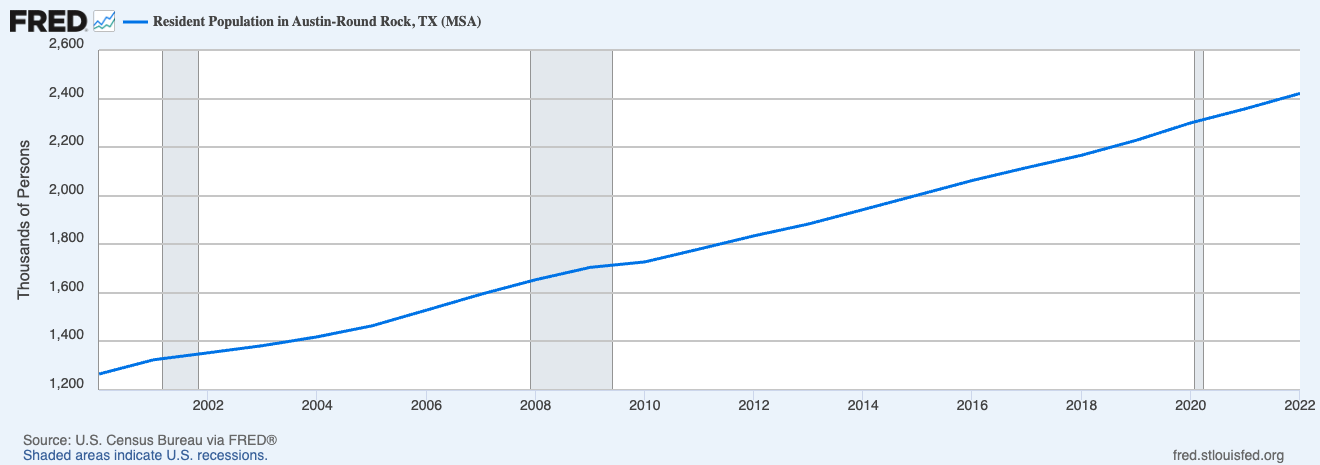
This wasn’t a commercial real estate market waiting to be created by any individual. This was a market waiting to be seized. When markets become legible unevenly, the people who notice first look prophetic.
This is no small achievement. But it is not causal.
These individuals are early to a trend that broader fundamentals set in motion.
I won’t try to argue the point that Nate Paul was unusually effective at selling a story— including, for a time, to very sophisticated investors. He was.
But long-term institutional capital doesn’t run on charismatic pioneers.
Large pools of capital do not allocate to cities because one person makes a loud bet or a splashing success. This may raise eyebrows and turn heads, but true allocation occurs later, when enough information is gathered and enough signals repeat.
In 2006, Equity Office Properties (now EQ Office) paid $188M for the Frost Bank Tower, Austin’s first iconic skyscraper. A year later, the Los Angeles-based Thomas Properties Group (now part of Cousins Properties), alongside partners like the California State Teachers’ Retirement System (CalSTRS), acquired a 10-property Class A Office portfolio in Austin that included the Frost Bank Tower and other marquee properties like 300 West Sixth. This was well before Nate Paul.
National investors were in Austin honing their underwriting and operational experience, and building market conviction, in the 2000s. They would have done this with or without World Class Capital, but it does take time.
In thin or early markets, an early buyer can set the tone on price. And, early on, Nate Paul was the only serious bidder for certain Austin assets.
But aggressive trading doesn’t suddenly create a market and can just as easily distort one.
How can we better judge these supposed market-making efforts?
Again and again, Nate Paul sat on trophy assets without leasing, developing, or otherwise putting them to productive use. This slowed the development of some of Austin’s most valuable sites and, for a time, held back the city’s physical evolution. His hit list of music venues in this Live Music Capital of the World runs particularly deep: Kingdom, Karma Lounge, Metal and Lace, La Zona Rosa, Momo’s, and more. Some of his properties still remain in limbo. Consider the iHop on East Cesar Chavez, adrift in a parking lot, squatting on some of the most desirable dirt in the city (sorry iHop…), waiting on bankruptcy proceedings.
Durable markets are not built by one buyer making bold bids. They require repeated validation through multiple buyers, financings, and uses over time. Otherwise price is not being discovered as much as being asserted, and anything can be asserted until a real buyer appears.
This brings me to my next point: if Austin needed anything in the 2010s, it wasn’t a louder protagonist. It was capital that was capable of translating demand into durable supply, productive land use, and true pricing. This is a different and more difficult job.
The story of post-2022 Austin is as much a “return to the mean” because of Covid exuberance as it is a reckoning with the choices made over the last decade. Consider its Office sector: around 2019, net absorption versus deliveries began to diverge meaningfully. Vacancy, which had hovered around 10% for years, climbed to nearly 25% by late 2025. Did Austin’s fundamentals change that dramatically or did the hype cycle push the city into misallocation?
Austin did not lack for cheerleaders in the 2010s. What it needed, and still needs, is what every good city needs: disciplined capital allocation for growth to convert into durable urban value.
Individual genius and chutzpah undeniably move the needle in cities. Leland Stanford created some of the underlying conditions for Silicon Valley through a university. Robert Moses changed New York’s physical form at unprecedented scale before Jane Jacobs forever shifted the conversation around urban planning. Would Detroit or Pittsburgh be the same without a Ford or a Carnegie? Individuals permanently changed what was plausible in each of these locations.
But durable urban growth isn’t the work of one hero. It is the cumulative result of many actors reading market signals and making mutually reinforcing bets. The employers that hire, the universities that graduate talent, families moving in, developers building, lenders underwriting, and local business owners proving there is money to be made. These distributed processes are less cinematic than a single empire-builder, but they are more important in the long-run.
Nate Paul deserves credit for helping to shape the story of Austin around its coming of age. But I tip my hat to the city systems beneath it all: the ones that we try to model, never fully master, and ignore at our own investing peril.
This essay grew out of a Build Order conversation. If you haven’t caught it yet, you can watch all our episodes on all your favorite platforms: Substack, YouTube, Spotify, Apple Podcasts, Pocket Casts, iHeartRadio, and Overcast.
Thanks for reading! Subscribe and share for more amazing Build Order content.
Comments
Nothing yet. Say the first thing.
Sign in to join the conversation.