
Before we get started: I built a full capital-city screen behind this piece, including the complete list of state capitals with and without university anchors, migration signals, permitting data, and category tags. If you’d like to see the full report, reply CAPITAL to this email or leave a note in the comments.
When was the last time you were asked to remember the name of a state capital, and how’d you do?
Most of us think of state capitals as unremarkable government towns, if we think about them at all. They have marble buildings, they host school trips, and many were purposely placed inland, away from the largest and most interesting commercial centers in the United States. The last time it was critical to remember their names was in the fifth grade.
Now let’s rattle off a few cities. Austin. Nashville. Denver. Phoenix. Atlanta. Raleigh. Boise. Salt Lake City. Columbus. Richmond. It turns out that a surprising number of the most discussed growth markets of the last decade are state capitals. The U.S. has nearly 20,000 incorporated cities, towns, and villages, and yet on a typical “top 20” markets list, as many as half the names may come from this one exclusive club: our 50 state capitals. Is this just a coincidence, or is there something about capital city status that helps city growth compound?
The theory we wanted to test on Build Order is whether capital cities, when paired with a major research institution, have something going for them: a market with a government-backed floor plus a flywheel almost perfectly designed for 21st-century growth. If this is true, then capital cities are more than just trivia answers. They are their own distinct category of growth market.
So are there any that haven’t fully broken out yet? At least one surprised us.
Not Just Marble Buildings
We think we know all the most important capital cities. Boston and Providence were early commercial and industrial powerhouses. Atlanta became the capital of the “New South” after the Civil War. Phoenix and Denver evolved into dominant regional markets later in the 20th century.
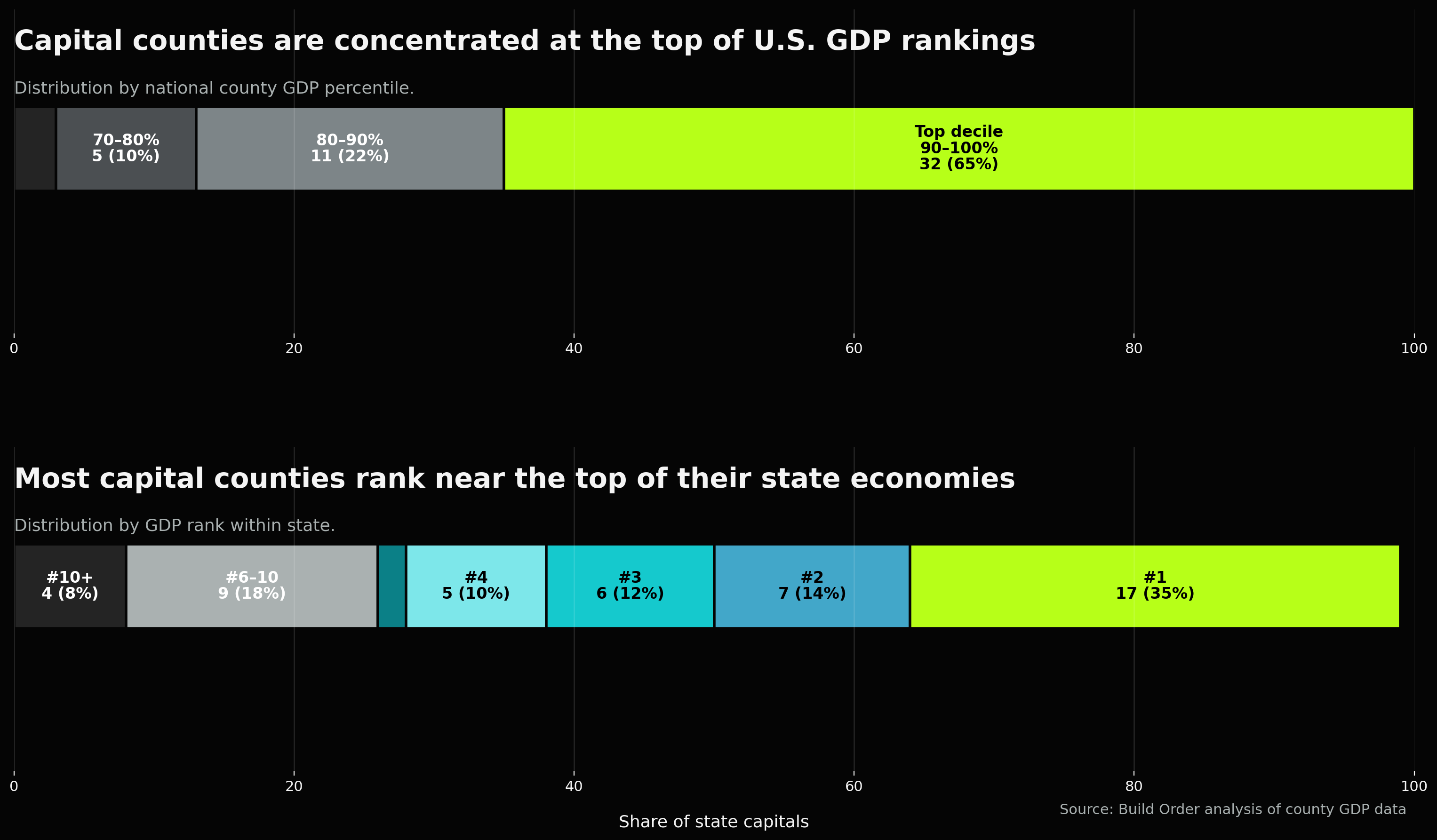
But these cities are not exceptions. They are evidence of the broader pattern that many state capitals are more than just government towns with inflated public-sector numbers. According to the U.S. Bureau of Economic Analysis, roughly 65% of state capital counties rank in the top decile of all U.S. counties by GDP. About 35% are the number one GDP county in their state. The pattern still held when I excluded local government and government enterprises from the county GDP comparison. Many capital cities are strong markets with migration momentum, industry depth, and forward-looking investment relevance.
The Floor and the Flywheel
It wasn’t always this way.
Austin’s early history, by way of example, reads like a series of false (nearly disastrous) starts. Mexican forces threatened the surrounding area twice in 1842 and hundreds of citizens were forced to evacuate. Then Austin briefly grew, benefitting from its position as a westward trading nexus in the 1870s, only to be outcompeted by other cities as railroads pushed farther across Texas. In the late 1880s, the city’s first dam across the Colorado River failed to produce enough hydroelectric power to attract manufacturers. The dam silted up the lake and collapsed in 1900. So for nearly a century after Austin was established as capital in 1839, growth mostly just crept along. From a perch overlooking the sprawl of downtown Austin in 2026, you have to ask: why did Austin have nine lives? Why didn’t it just fail?
The importance of being a capital city is hard to overstate here. A capital is not only the seat of state government — where the legislature meets, agencies cluster, and administrative decisions get made. It is often home to tens of thousands of state employees and the physical home of public documents like land deeds, legal records, legislative notes, and court filings. For most of human history, whoever physically held the records held the legitimacy of the government. All capital cities benefit from this institutional floor. So long as they remain the capital, they retain a reason to matter.
Even if we don’t remember their names.
In the late 1930s and early 1940s, the New Deal, LCRA, and LBJ’s political muscle helped give Austin reliable dams on the Colorado River and, with this, much needed flood control and energy and water assets. Those investments removed a ceiling on Austin’s growth. But infrastructure is not the same thing as a growth engine and, for that, Austin had another asset: the University of Texas.
Austin was chosen as the site of the state university by a statewide vote in 1881, and today, UT has 55,000 students across its undergraduate and graduate programs and leading academic and research programs. To understand why UT mattered so much, it helps to zoom out. Unlike European capitals, which are typically the most important cultural, political, and commercial centers of their country, many American capitals were deliberately founded as compromise cities. They were placed inland to enable territorial expansion, separated from coastal elites and commercial centers by design, dropped in the center of a map to appease competing interests, and chartered on ample land where a city could be imagined from scratch. At the root of this was a deeply held American — and even, Jeffersonian — conviction that political power should be fragmented from commercial power to avoid any one interest holding too much control.
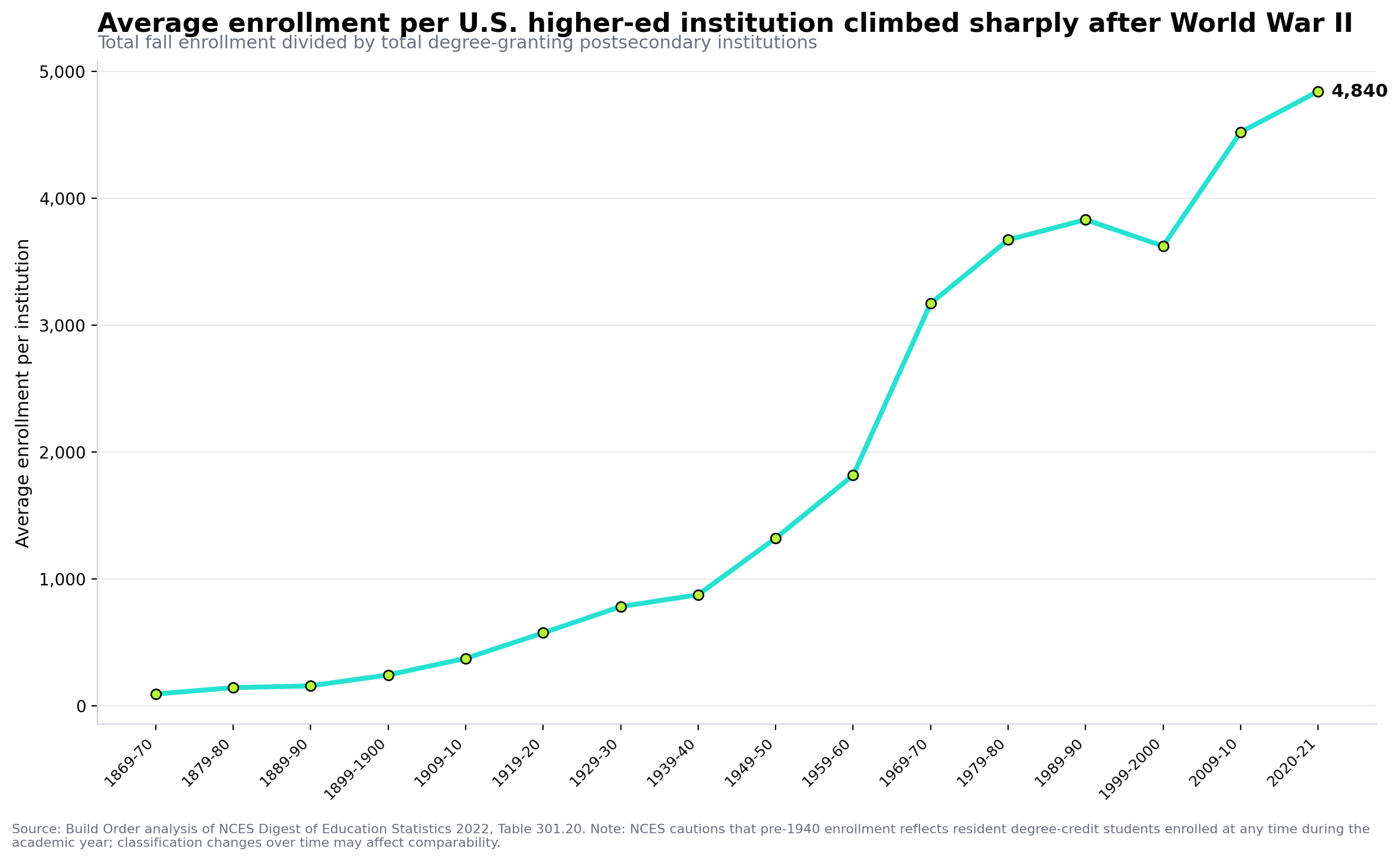
But many of these new capital cities were also endowed with state universities. Universities, like capitals, were another piece of the institutional architecture of state-building. They were centers of civic prestige, public education, and elite formation. In the 19th century, that mattered, but the economic weight of a university was relatively contained. From 1869 to 1870, by my calculation from NCES historical data, the average postsecondary institution enrolled just 93 students. Then, in the mid-20th century, the purpose or even meaning of a university began to change. Several trends compounded at once: the federal government’s commitment to funding university research, accelerated by the war effort around World War II, the rise of white-collar work, and the importance of postsecondary education as a credentialing system for that workforce. Average enrollment took off.
Large universities do a lot more for their cities than export talent to the rest of the country. When they are at their best, they create a local flywheel for growth. They host tens of thousands of students and professors who enliven city culture, create an educated talent pool for local businesses to hire from, and, importantly, spin out research and startups into the surrounding area. Over the last seventy years, our nationwide focus on innovation and technology has turned major universities into one of the most powerful urban growth engines in America.
To be clear, this essay is not trying to claim that capital cities with universities outperform university markets overall. That will have to become a future Build Order rabbit hole. The point here is narrower: capital cities with major research institutions have a distinct operating system. The university is the growth engine, but the capital gives the city a floor. This floor isn’t a guarantee of city immortality, at least not in the 21st century, but it does keep a durable base of public-sector employment, policy networks, procurement dollars, and civic leadership alive even when the private-market story is less compelling. It is the combination of the two — the floor and the flywheel — that is a distinct urban advantage.
It is also ironic. Universities have unintentionally helped to convert places designed simply to “hold” government into cities where talent, research, policy, and procurement circulate in the same place. In Austin, that combination began to show up in the data. Demographic growth started to pick up in the 1930s and 40s and did not stall again.
How to Spot a Sleeper Capital
If you’ve bought into my argument that capital cities, when paired with a major research institution, have a powerful engine for long-term city growth, then two questions follow.
The first is how many capital cities are worth watching as real estate markets. By my simple institutional screen, the answer is roughly half: capitals with either an R1 university, meaning a top-tier Carnegie research designation, or more than 20,000 students enrolled nearby. The second question — and the one I’m most interested in — is whether we can use this information to predict anything. And I particularly want to know if there are any “sleepers,” or capital cities like Austin and Nashville circa 2000, before they became obvious.
So I built a screen.
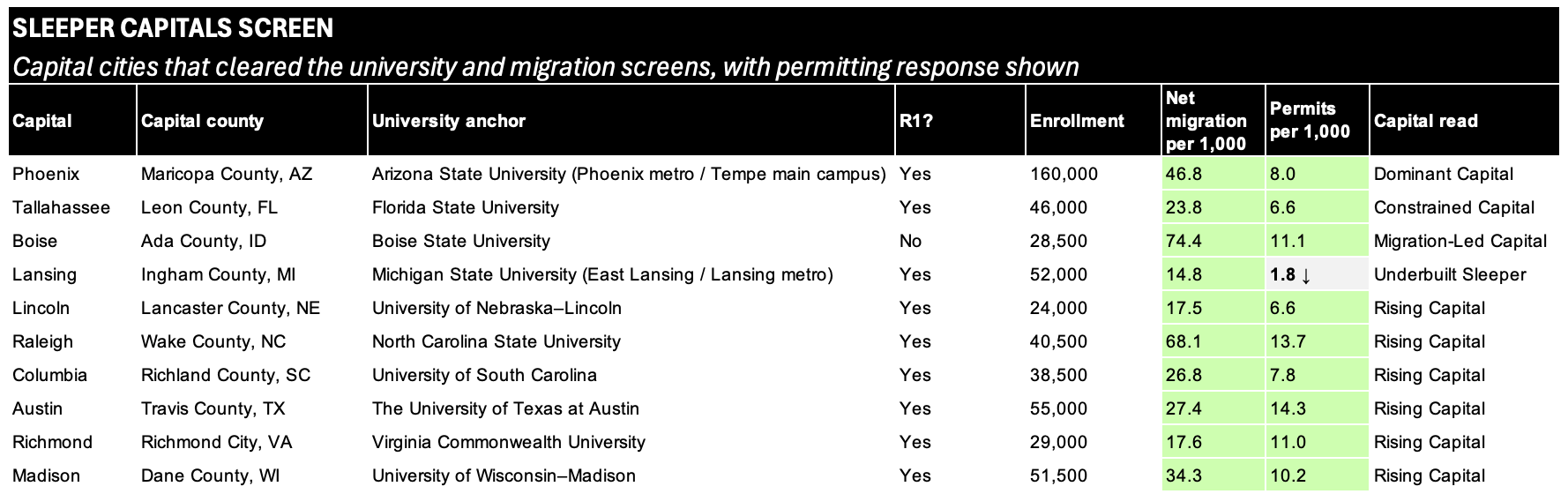
I took forty-nine of the fifty capital cities1 and looked for three signals: a meaningful, research-oriented university anchor, above-median migration momentum (suggesting that the flywheel may already be turning), and evidence of whether the housing market is already responding through new permits.
The screen surfaced a few different kinds of capital cities. Phoenix is already a dominant state capital experiencing fresh growth alongside the local explosion of semiconductor fabs and data centers. Tallahassee has momentum today, but may be constrained long-term by Florida’s larger economic centers. Boise, the one capital in the screen without an R1 designated university, looks like a migration-led growth story, driven by lifestyle appeal. The largest cohort are rising capitals: Lincoln, Raleigh, Columbia, Austin, Richmond, and Madison. These are cities that may not have been regionally important until recently but have institutional scaffolding, migration momentum, and, increasingly, national attention.
And then there is Lansing, Michigan.
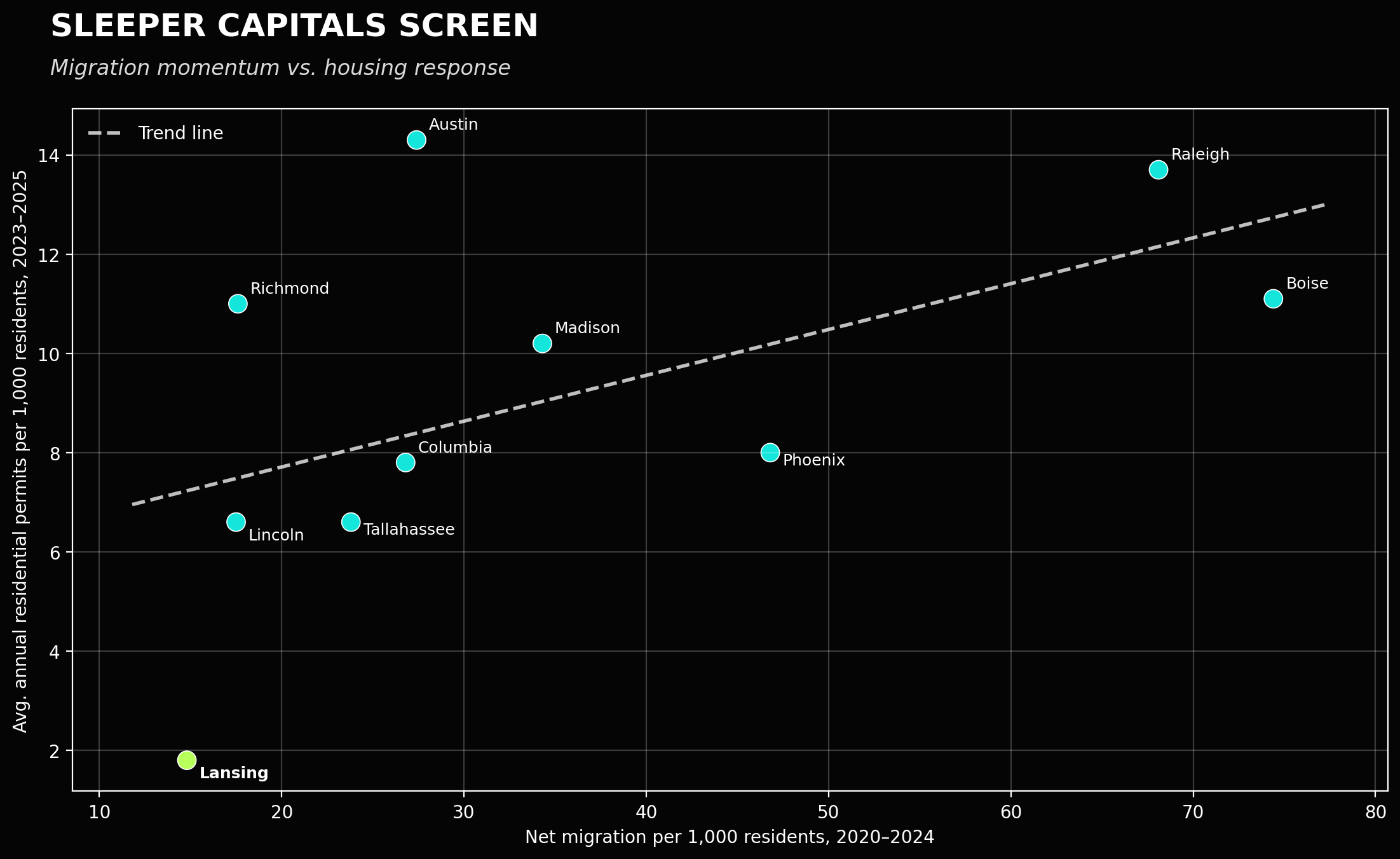
Lansing is the one city in this screen that clears the university and migration filters, but not the permitting filter. The migration momentum is there, but compared to the other capital cities in the screen, the built environment has not responded at the same pace. Why not?
The Lansing Mismatch
Lansing has a great origin story that is almost too perfect for a real estate essay. In 1835, two brothers sold plots of undeveloped swamp land to unsuspecting New Yorkers who arrived only to find there was no town. Too broke to leave, they stayed and established Lansing. And while the real history is messier, the story persists. Lansing, nicknamed “Old Swampy,” later became the state capital of Michigan in 1847 because Detroit was considered too vulnerable to attacks from British-controlled Canada.
Today, aside from being memorialized as the birthplace of the Oldsmobile, Lansing is an emerging deep tech and biomedical startup incubator city, anchored by Michigan State. It retains its small-town feel and is an affordable place to live. It’s also an hour and a half from Detroit. Is Lansing too close to the state’s historic economic center to achieve breakout growth, or just far enough during a period when Detroit is no longer absorbing the state’s full attention?
With Lansing’s housing market seemingly more stable than strained, the answer isn’t likely to be simple. So this is where we’ll travel to in our next city deep dive: to Lansing, Michigan, to test if the city is a sleeper capital quietly assembling the conditions for its own breakout growth story.
In the meantime, I hope I’ve left you with a healthy suspicion that no capital city is ever quite as sleepy as it looks.
This essay grew out of a Build Order conversation. If you haven’t caught it yet, you can watch or listen to our episodes on your favorite platforms: Substack, YouTube, Spotify, Apple Podcasts, Pocket Casts, iHeartRadio, and Overcast.
Thanks for reading! Share this with a friend who thinks capital cities are just government towns with better-than-average rotundas.
1 Hartford, Connecticut was excluded from the screen because county-level data is not directly comparable following Connecticut’s transition from counties to planning regions. The rest of the analysis uses one county or county-equivalent selected for each capital city as an approximate geography.
2 One county or county-equivalent was selected for each capital city as an approximate geography. University anchors and enrollment are approximate, based on reported 2024–2025 student counts. Net migration reflects 2020–2024 cumulative county-level net migration from the U.S. Census Bureau Population Estimates Program, Vintage 2024. Residential permitting reflects average annual housing units permitted from 2023 to 2025, including both single-family and multifamily units, from the U.S. Census Building Permits Survey. Migration and permitting are normalized per 1,000 residents using 2020 county population. Screen thresholds were set at above-median net migration and above-median residential permitting among capital counties; raw totals were also reviewed as a scale check.
Comments
Nothing yet. Say the first thing.
Sign in to join the conversation.