
One of the short stories from our latest podcast episode perfectly explains why the places you think should see growth because of AI just… won’t.
Jen: Perhaps my favorite John Gray [the guy who ran the Austin Economic Development Council in the 60s] story, which I believe you also know, Lauren, is the bedsheet flyover story.
Lauren: Oh, I don’t know this one.
Jen: You don’t know this one. Okay, so Texas Instruments was interested in site selection in Austin, and they were more public about it that, hey, we’re interested in evaluating Austin. But they were so busy with all of their other site selections that the president did not have time to physically go and meet with the Austin Economic Development Council to check out the site, however he had time to fly his private jet over the site a couple of times.
So John Gray in his wisdom said, how can I make sure they know exactly where the site is? Let me get some bedsheets and just wave them around like a madman. So that’s what he did.
There’s literally no more literal metaphor than saying like, “Hey, big tech, come to Austin!” than waving a bedsheet around at a private jet.
True story. Vic Mathias, who ran the Austin Chamber of Commerce at the time, tells the tale himself.
In the 1950s, Austin was not obviously destined to become a tech market. It was a college town and a state capital looking for a private-sector tax base. But it also did not want just any industry. Many Austinites heard “industry” and pictured smokestacks, refineries, steel mills, and the kind of dirty manufacturing that did not fit the city’s self-image. So when the Chamber commissioned a study in 1957, the recommendation that mattered most was not just “manufacturing.” It was “electronic devices” — a cleaner, more technical, more university-adjacent kind of industry Austin could pursue without feeling like it was becoming Port Arthur.
Then Austin pursued it.
IBM arrived in 1967. Texas Instruments in 1969. Motorola in 1974. AMD in 1979. Then MCC and SEMATECH helped turn the city from “interesting place with some tech employers” into a real technology ecosystem. The IC² Institute’s history of Austin’s entrepreneurial ecosystem describes it well: MCC chose Austin over 57 other cities in 27 states, and SEMATECH chose Austin over 137 competing cities, helping put Austin “on the high-tech city map.”
Sixty years later, that looks prescient.
Austin ended 2023 with nearly 203,000 tech-industry workers, the highest ever reported by Opportunity Austin. More recently, BLS reported that Austin had 6.3% of total employment comprised of computer and mathematical occupation jobs versus 3.4% nationally. Workforce Solutions Capital Area Area also reported in September 2025 that Austin’s high-tech sector had added 30,000 jobs over five years, pushing total employment to nearly 95,000.
That did not happen because one guy waved a bedsheet one time.
But the bedsheet is a symbol of what Austin did. Austin picked a category that was going to matter, then built a civic muscle to win it.
And that is a pretty good way to think about the next real estate cycle. Which in 60 years, will be driven by AI.
It seems basic in that AI needs data centers, data centers need power, therefore the places with cheap power win. (Which is not entirely wrong… JLL says speed to power is the primary site-selection criterion for data centers).
But these days, community support matters more.
Yes, power matters. But power can be built.
For example, Chevron and Microsoft are now developing a co-located natural-gas power facility in West Texas to serve Microsoft’s data center campus in Pecos, Texas. Reuters reports that the project, called Project Kilby, is expected to ramp to 2.67 GW over time.
So the real underwriting line item needs to be: where are the people willing to assemble the electricity, land, water, permits, incentives, transmission, workforce, and politics into something a company can actually build on?
This is where the bedsheet matters.
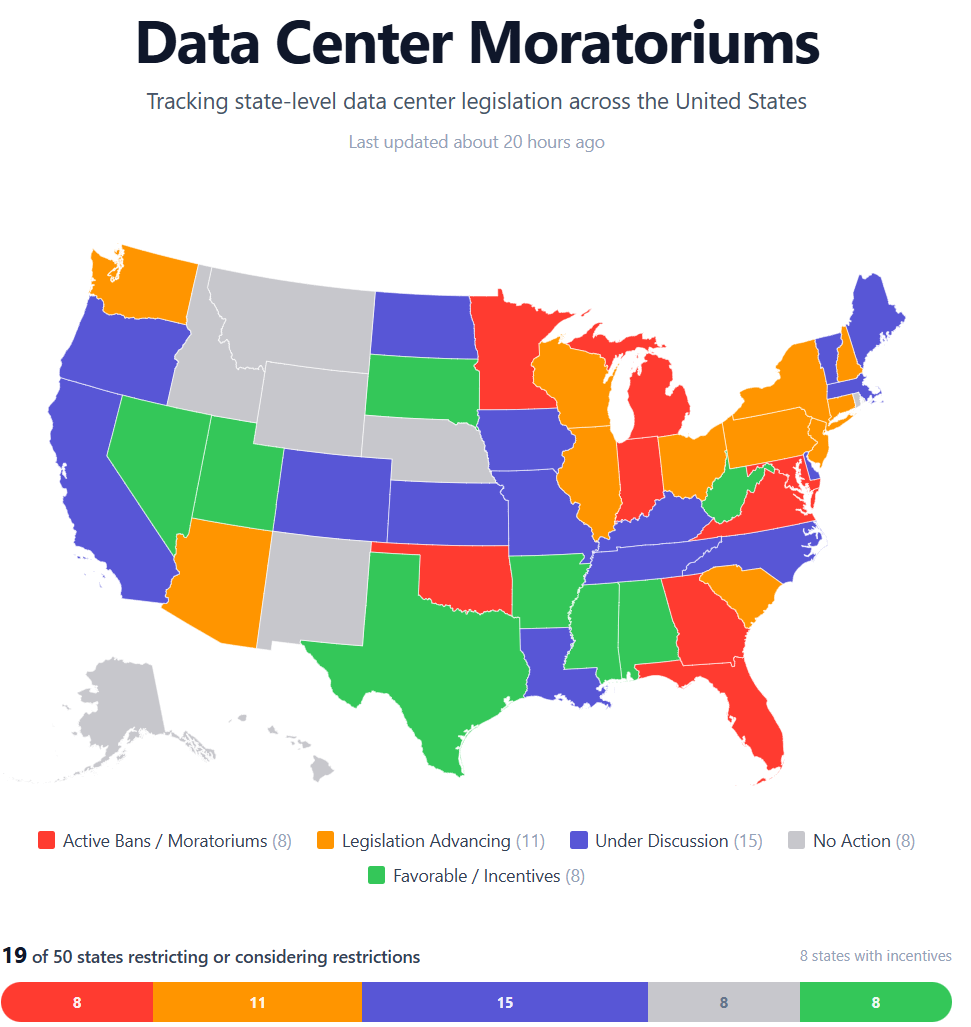
Some places are putting up a wet blanket. Lowell, Massachusetts passed a 360-day moratorium on new data-center construction and expansion. Charlotte, North Carolina approved a 150-day moratorium. Durham, North Carolina extended its data-center moratorium to 12 months. At the state level, NCSL is tracking proposed or passed moratorium activity in 14 states, including New York, Maine, Georgia, Michigan, Pennsylvania, South Carolina, Vermont, and Virginia.
Other places are letting out their inner John Gray and waving the bedsheet like madmen.
Louisiana is waving. The state passed Act 730, a sales and use tax exemption for data-center equipment and software, and its economic development team is openly marketing Louisiana for AI, cloud, and hyperscale sites. Meta is building a $10 billion AI data center in Richland Parish, Louisiana.
Mississippi is waving. AWS announced a $10 billion investment in Madison County, Mississippi. Compass Datacenters announced another $10 billion hyperscale campus in Lauderdale County, Mississippi.
Indiana is waving. AWS announced an $11 billion data-center investment in St. Joseph County, Indiana, and Indiana offers data-center sales and use tax exemptions for up to 50 years for the largest projects.
Wyoming is waving. Especially in Cheyenne, where Microsoft announced plans to buy roughly 3,200 acres to expand its data-center operations.
And of course, Texas is still waving. Per the Comptroller, Texas offers a sales-tax exemption for qualifying large data centers, and West Texas is now pairing AI campuses with dedicated power generation.
These places are not all “tech hubs”.
That may be why they are interesting.
Because the AI data-center trade may not be about finding the city with the most obvious ingredients. It may be about finding the city with the most organized hunger.
Austin’s leaders made a bet on electronics before the payoff was obvious. These states are making a bet on AI infrastructure before the payoff is understood.
You may think:
Maybe some of them are over-subsidizing low-job-count infrastructure.
Maybe some of the projects never become more than expensive boxes full of servers (that quickly depreciate, too).
Maybe the public backlash is right, and these are just power-hungry, water-guzzling industrial boxes being dressed up as the future.
Maybe.
That is also very close to how Austin could have thought about electronics manufacturing in the 1950s and 60s.
“Industry” did not sound glamorous then. It sounded like smokestacks, refineries, steel mills, and places Austin did not want to become. What Austin realized that others didn’t was that electronics was a different kind of manufacturing. Cleaner. More technical. More university-adjacent. More likely to compound into something bigger.
Not as obvious. As prescient.
Because here’s what’s happening in data center water and energy innovation:
Microsoft says its next-generation data center design, launched way-back-when in 2024, uses chip-level cooling and consumes zero water for cooling, avoiding more than 125 million liters of water per year per data center. Satya Nadella has gone even further, saying Microsoft’s newest AI data centers can use roughly the annual water of a single restaurant.
Nvidia is moving in the same direction. Its new DSX AI factory reference design uses closed-loop liquid cooling and dry coolers, which Nvidia says can reduce facility cooling water consumption from roughly 2.6 million gallons per megawatt per year to near zero in favorable climates. As Nvidia put it, the design has “no evaporative water cooling” outside of limited cases in some climates.
Amazon reiterated that it is pursuing SMRs (nuclear power) up to 960 MW in Washington and advancing more than 5 GW of new nuclear energy by 2039; its June 2026 sustainability piece frames carbon-free energy, grid strengthening, and community benefits as part of the AWS data-center strategy.
Meta announced agreements with Vistra, TerraPower, and Oklo to support up to 6.6 GW of nuclear energy projects for AI infrastructure.
Microsoft previously signed a 20-year power purchase agreement with Constellation to restart Three Mile Island Unit 1 as the Crane Clean Energy Center in Pennsylvania.
Google previously signed a deal with Kairos Power to bring up to 500 MW of advanced nuclear power online for U.S. grids, with the first deployment expected by 2030.
The old Austin story was a man in a field waving a bedsheet at Texas Instruments.
Today’s story is a city and state saying: here is the land, here are the utility options, here is the water plan, here is the tax exemption, here is the workforce, here is the local support, and here is why your project will not die in year three of permitting.
Real estate growth will ultimately be where AI demand is welcomed, translated, packaged, and made buildable.
That is what long-term investors should underwrite.
And if Austin is any guide, the places waving bedsheets today may look a lot smarter a few decades from now.
This essay grew out of a Build Order conversation. If you haven’t caught it yet, you can watch all our episodes on all your favorite platforms: Substack, YouTube, Spotify, Apple Podcasts, Pocket Casts, iHeartRadio, and Overcast.
Subscribe for more amazing Build Order content! And if you’re already a subscriber, THANK YOU! Please be a dear and share it, and you’ll be our favorite friend of the pod.
Comments
Nothing yet. Say the first thing.
Sign in to join the conversation.