
Lansing’s origin story feels appropriately chaotic for a city we found by accident.
It began as a planned settlement called Biddle City, allegedly pitched to New Yorkers with drawings that looked nothing like the swamp they arrived to find. Michigan later made this settlement of fewer than 20 people its state capital. In reply, critics called it a “howling wilderness.”
Nearly 180 years later, Lansing caught our attention for a different reason. Our capital city screen surfaced an unusual combination: Michigan State University, population growth, and little new construction. The more we dug, the more we found the kinds of ingredients we keep seeing in smaller, less-covered markets: existing infrastructure, specialized talent, and room for the megaprojects increasingly reshaping the American economy.
So, is Lansing simply a very affordable, unassuming Midwestern capital? Or are the pieces there for something more?
Most cheap cities aren’t actually cheap. They seem cheap because rents or home values are low, but once you adjust for the wages the discount disappears. It’s a currency conversion of sorts, not a deal.
Lansing is one of the few places where the numbers don’t cancel out.
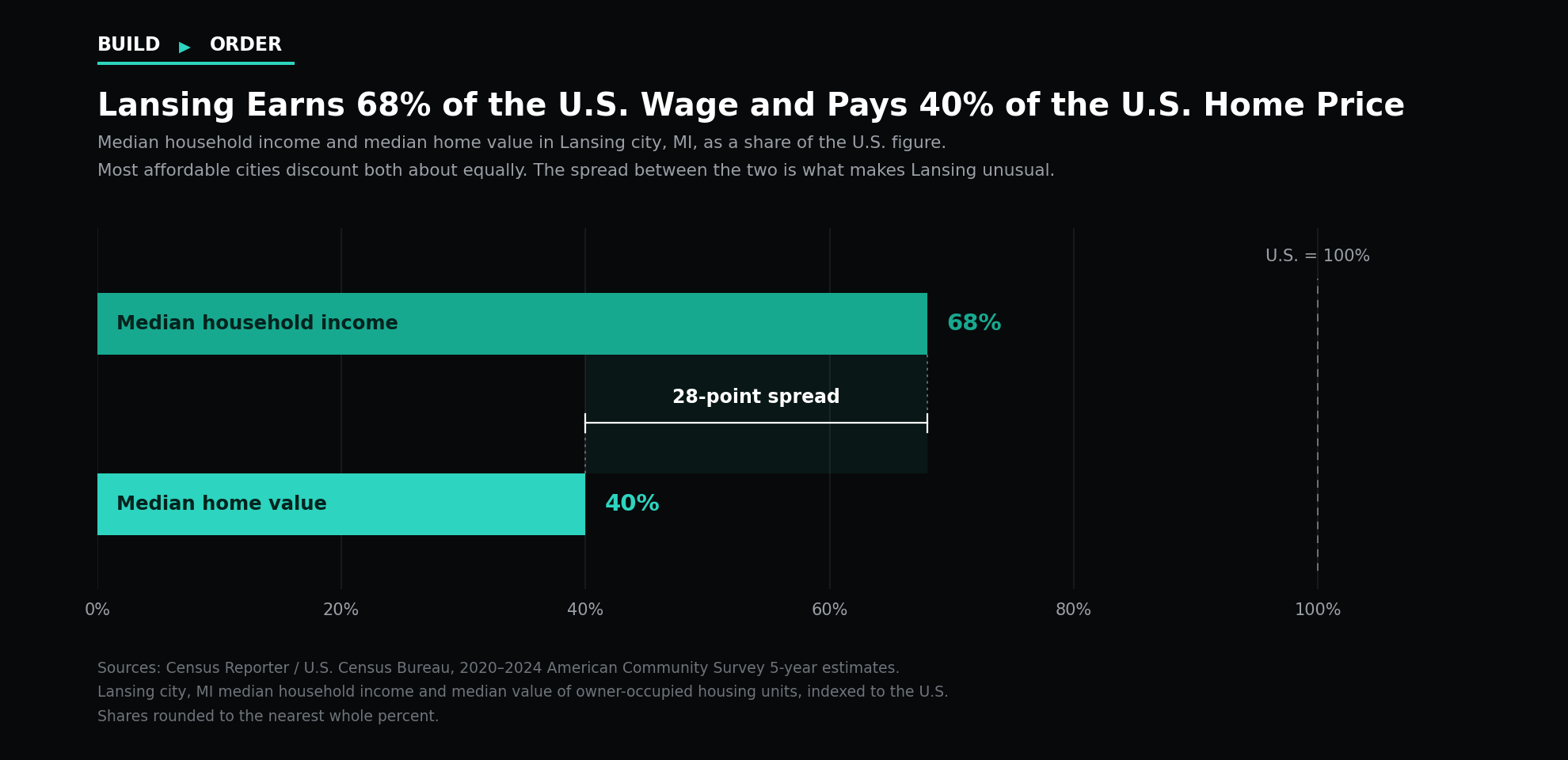
Median household income in the city runs about $55,400 against $81,600 nationally — 68 cents on the dollar, and the number that keeps Lansing off most lists. Median home value is $142,800 against $360,600 nationally. That’s 40 cents on the dollar. 28 points of spread between what you earn and what you pay to live there. Twenty-eight points!
Rent says the same thing. About $1,225 a month in the city as of August 2026, against Ann Arbor at $2,050, Grand Rapids at $1,600, and East Lansing — which shares a border — at roughly $1,750. This is the Lansing discount. RentCafe puts overall cost of living 8% below the national average.
And the cherry on top is the birth data. Births have outpaced deaths in Ingham County every year since 2021 — roughly 2,700 against 2,500. Small in absolute terms, unusual in kind. National fertility has been falling for a decade and cost is a large part of why. When a place is cheap enough that people can act on it, it seemingly shows up in birth records. At least, here in Lansing it has.
Median age is 34.5, about 5 years younger than the U.S. MSU’s 51,838 students keep depositing young graduates there every year, and whether the city keeps them is the only question that matters.
For now, affordability is a reason to stay rather than a reason to arrive. And the people of Lansing seem to know it.
This article is brought to you by Datacloud USA, the premier deal-making event bringing over 3,000 top decision makers across data centers, hyperscalers, energy, finance, and the public sector to Austin from September 2-3, 2026.
Join Lauren and Jen there by using code BUILDORDER10 for 10% off your pass.
We’ve established that Lansing has that affordability factor.
But being cheap only gets you so far. What else does Lansing have going for it?
Four things, and they tell you a lot about the kinds of businesses that might actually want to set up shop there.
The first: it’s the seat of the state government. In our Capital Cities episode, we discussed the benefits of being close to state decision-makers, funds, and all the people and services that surround them, especially for regulated industries. That’s true of any capital city, so we’ll give it a passing mention here.
Onto the second factor: Lansing’s automotive talent bench. The Oldsmobile, once the best-selling car in America, was produced in Lansing for over a hundred years. And while the plant has closed and the Oldsmobile has been relegated to mythic Americana status, General Motors remains one of the largest employers in the Lansing area. Manufacturing expertise is sticky: the plants may change, but the engineers, skilled trades, suppliers, and institutional know-how remain.
If you watched our Lansing episode, you’ll recall that we said “the Ultium plant” enough times to warrant a drinking game. This is the mega-$2.6B battery plant for electric vehicles — and joint venture between GM and LG Energy Solution — that was announced in Lansing in 2022. And the story has taken a few turns since then. In December 2024, General Motors announced it was selling its stake in the plant to LG, which was widely reported as part of an effort to cut back on its EV investments given lower-than-expected demand. Then, in March 2026, LG announced that they were going to make battery cells at the Lansing plant for Tesla’s Megapack 3 systems, alongside serving other EV customers.
This is a story — and an increasingly common one — of manufacturing capacity being repurposed to serve America’s enormous new demand for energy infrastructure, including for the AI build-out. But it also gets at the third advantage of building in Lansing and, arguably, Michigan more broadly: there’s still spare infrastructure capacity. Michigan has abundant fresh water resources across groundwater and the Great Lakes. There is strong highway connectivity to major Midwest and national freight corridors. And Michigan has been relatively friendly to megaprojects like data centers. Michigan is offering a long-term sales and use tax exemption to enterprise data centers that receive certification before 2030. That’s not to say that everyone in Lansing or Michigan is thrilled, or that energy concerns don’t exist.
But the picture is fairly rosy relative to other states.
The last factor, and arguably the most encouraging, is Michigan State University. It’s one of the largest schools in the U.S., already a national leader in supply-chain management, agriculture, and biosciences, and it’s made a few noteworthy investments this year. In February, they revealed a $50M commitment from the Leinweber Foundation to establish a Center for Engineering and Digital Innovation. Among other things, that means room for 1,000 additional engineering students. Then, in June, the MSU Research Foundation announced a new headquarters to open next summer with the idea of further seeding the innovation ecosystem. There are signs of life already: Red Cedar Ventures, a subsidiary of the MSU Research Foundation founded in 2014, has become one of the most active early-stage investors in the Midwest. Other capital city markets have broken out in part on the strength of their universities. It remains to be seen if Lansing can repeat this same success story.
Lansing isn’t a market we’d recommend everyone build in. But if what you’re building maps onto what the city already has — automotive and manufacturing talent, spare infrastructure capacity, and MSU’s research ecosystem — the rationale starts to look more interesting.
Read the vacancy numbers cold and Lansing looks like a landlord’s market. Multifamily occupancy at 94–97%. Industrial vacancy near 3%. Office at 11%, which in 2026 sounds brilliant. Retail at 8.1% with asking rents still climbing.
Nothing distressed in there. And yet, many would argue there’s nothing investable either.
Tight markets come in two kinds. In the first, demand outruns the ability to build. Think Austin’s water, Columbus’s power, an interconnection queue. That’s a real constraint, and you can underwrite rent growth against it. In the second, supply stopped and demand never showed up to test it.
Lansing is the second kind, and industrial proves it. Deliveries fell to 546,000 square feet from more than 3 million a year earlier. That earlier number was never a market; it was a single plant. Absorption ran 2.7 million square feet in a single half, almost all of it Ultium Cells moving in. Once they finished, absorption went negative and the pipeline emptied. Developers ran the math against $7.52 NNN and stopped.
Retail is the same story: vacancy up sharply, absorption flat at 1,500 square feet, landlords still pushing rent, and about $12.4 million in total sales volume at roughly $89 PSF. There are barely any trades from which to discover a price.
Which tells you how you’d have to underwrite it. In a constrained market you’re buying rent growth. In Lansing you’d be buying basis, and basis has to carry the return by itself, because nothing here supports a rent growth assumption you’d want to defend to an investment committee.
There’s still a catalyst hanging around Lansing though. LG’s Lansing plant, formerly Ultium, now sits under a $4.3 billion agreement to make LFP cells for Tesla’s Megapack 3, with dedicated production lines starting in 2027 and LEAP projecting 1,500-plus jobs. Underwrite that and you’re underwriting one tenant’s hiring plan on a three-year contract.
We’re still bullish on certain sub-asset classes like workforce and student housing bought rather than built, scattered-site single-family, existing multifamily at a going-in yield you’d accept flat for five years. At 94% occupancy with no pipeline, that works. Development? Not so much today.
That said, if the plant hits its numbers in 2027, the rent growth assumption gets defensible fast.
So where do we land?
For living, Lansing is a stay. The affordability is real, not just an artifact of lower wages, and the city offers a low cost of entry for a young capital anchored by a major university.
For building, Lansing is a start*.
*If you’re the right kind of builder. Lansing’s manufacturing talent, spare infrastructure capacity, state government, and MSU ecosystem create real advantages, but they’re advantages for specific businesses, not every business.
For investing, Lansing is a stay. Occupancy is tight, but demand hasn’t proven strong enough to justify much new development. We like existing housing at the right basis more than we like betting on rent growth.
This is ultimately the Lansing puzzle: the ingredients are there, but the catalyst hasn’t arrived. For now, it’s a city worth watching.
This essay grew out of a Build Order conversation. If you haven’t caught it yet, you can watch all our episodes on all your favorite platforms: Substack, YouTube, Spotify, Apple Podcasts, Pocket Casts, iHeartRadio, and Overcast.
Comments
Nothing yet. Say the first thing.
Sign in to join the conversation.