
Columbus may be over-invested relative to the city that exists today. But it’s still one of the Midwest’s better growth platforms.
Think of your dream city. It probably has a low cost of living. Major employers. A strong industrial base (hey, we like fast shipping!). A huge university. A decent restaurant scene. New data centers (well, maybe not everyone has this in their dream city…). And enough “next Austin” energy to make real estate investors start checking flights to Ohio. That’s Columbus.
Or so it seemed.
Should real estate investors give Columbus another look — if they haven’t invested already? Does the data actually support the thesis for individuals looking to move to Columbus? What about those deciding where to start their next business or build another HQ?
Using our Build Order framework: people, jobs, buildings, systems, and rules, we asked the only questions that really matter: Would we live there? Would we build there? Would we invest there? We answer each using a stop, start, stay framework.
Columbus is interesting because the live, build, and invest answers diverge. The city may be a start for residents, a start for physical-economy companies, and a stay for real estate investors who don’t have the right asset-class angle.
That is what makes it such a good first Build Order city. “Columbus is growing” is true. It is also not enough.
The live case for Columbus starts with affordability.
Columbus still offers something a lot of growth markets have lost: a plausible middle-class life. The metro has about 2.2 million people, a median age around 37, and average income around $82,000 — roughly in line with the U.S. overall. It is younger than average, but not in a “boomtown full of 24-year-olds and scooters” way. It is more like a steady, functional metro that still has room for normal people to live normal lives.
The housing math is the clearest advantage. Redfin shows the median home price in Columbus around $290,000, compared with about $436,000 nationally, and Zillow shows average rent around $1,500 as of this writing versus about $2,004 nationally. RentCafe also pegs Columbus’ cost of living at about 6% below the national average.
Columbus is also more functional than its car-oriented reputation suggests. One local broker we interviewed described Columbus as a “borough city”: you drive to German Village, Short North, Easton, Dublin, or wherever you are going, walk around there, and then drive home. Walkability is not the lifestyle. Drivability is.
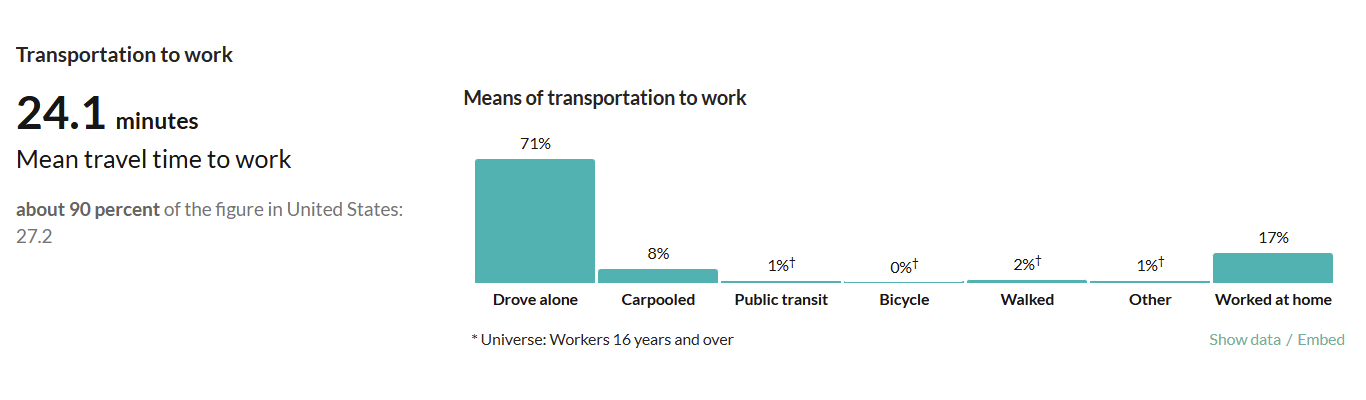
That said, the average commute is still shorter than the national average. Census Reporter shows the Columbus metro’s mean commute around 24 minutes, versus roughly 27 minutes nationally So yes, it is car-oriented. But at least for now, it is not car-broken.
Columbus also has a lot to offer from a broader cultural perspective, as evidenced by its demographics. Columbus has long had a reputation as a kind of American test kitchen — large enough to be meaningful, diverse enough to be commercially useful, and average enough that brands could test ideas there before rolling them out. For someone deciding whether to move there, that means there’s a decent chance you can find your people.
The migration data supports that story. The Columbus metro had 13.7% of residents move in over the last year, above the U.S. rate, which tells us this is not just a city people are from. It is increasingly a city people are choosing.
Now for the caution flags.
The biggest one is utilities. The data center boom is not just a business story. It’s possible that it becomes a household affordability story.
PJM, the region’s electricity wholesaler, had capacity prices increase from $28.92/MW-day in the 2024/2025 delivery year to $269.92/MW-day in 2025/2026 — roughly an 833% increase. That is the kind of number that makes Columbus residents understandably nervous, and more likely to protest in front of schools and other public establishments, as one of the residents we interviewed said. PJM’s later auction for 2026/2027 cleared at $329.17/MW-day.

But we don’t want to overstate the direct impact to residents. The new AEP Ohio data center tariff is specifically designed to prevent ordinary customers from being left holding the bag for speculative data center capacity. New large data center customers must pay for at least 85% of their contracted capacity for up to 12 years, even if they use less, and AEP also charges a load study fee of up to $100,000.
So the utility concern is real, but it is not as simple as “data centers arrive, your bill explodes.” The more precise concern is whether Columbus and Ohio can keep attracting energy-intensive projects without making residents feel like the infrastructure buildout is happening to them rather than for them.
Taxes are another watch item. Ohio’s state income tax is moving to a flat 2.75% rate on income over $26,050 in 2026. Columbus also has a 2.5% municipal income tax on residents’ income, with a credit for taxes paid to other municipalities up to 2.5%. So for someone comparing Columbus to Austin, Nashville, Miami, or other no-state-income-tax markets, the tax story is not nothing.
Still, taxes are only one part of the affordability equation. A higher local income tax can be offset pretty quickly if the housing costs one-third less and the commute is shorter.
So where do we land?
For living, Columbus is a start.
It is not perfect. It is car-oriented, has a questionable tax structure, and faces real questions around energy demand. But the core live thesis is strong with affordable housing, manageable commutes, and a broad enough demographic mix that a newcomer can probably find a group of friends, not just a lower mortgage payment.
Columbus may not be where you go to be discovered. But it may be where you go to discover that life can be easier.
Columbus makes a strong company-building case on three fronts: deep and diversified talent pools, uniquely connected infrastructure and land capacity, and a business-friendly incentives environment.
The keyword for Columbus’ industry base is diversification. No industry makes up more than 17% of overall employment. Major employers include insurance providers like Nationwide and retail giants like Bath & Body Works and Victoria’s Secret, both formerly part of L Brands, as well as large healthcare players like Cardinal Health, a key node in the U.S. medical supply chain. And while Columbus does not have the same historic uni-focus on manufacturing as other Midwestern cities, it has a strong bench of manufacturing talent. Among major market participants is Honda, whose North American manufacturing and engineering operations are located in nearby Marysville Importantly, Columbus is also home to Ohio State, one of the largest schools in the country with over 67,000 students enrolled for Fall 2025.
The result is a city with both resilience and optionality. Columbus has a diversified talent platform rather than a single-industry growth story, supported by a major university engine, and a growing draw as an attractive, relatively affordable place to live.
Next, consider the new industrial layer that’s behind the latest national interest in Columbus. Intel announced a more than $28 billion investment in its Ohio One campus in New Albany, just outside the city. The project has been delayed, with Intel’s timeline now stretching toward 2030 and 2031 for full completion. But even delayed, Central Ohio was selected for one of the largest semiconductor manufacturing bets in the country. Another important signal is Anduril. Arsenal-1, its large autonomous-systems manufacturing facility near Columbus, opened three months ahead of schedule in March 2026. It is expected to create more than 4,000 direct jobs and over $900 million in capital investment over ten years.
Why make these bets in Columbus?
One of the most important facets of Columbus’ pitch is geography. Columbus, and Ohio more generally, sits in the middle of the map with room to build. The region is connected to the rest of the country through I-70 and I-71, has ample greenfield space, and companies based there can reach 60% of the U.S. and Canadian populations within a one-day drive. It is also home to Rickenbacker International Airport, one of the world’s only cargo-focused airports receiving service from Asia, Europe, and the Middle East. Rickenbacker’s advantage lies in turning geography into speed, connecting global cargo flows to major American and Canadian population centers. Not coincidentally, Arsenal-1 is being developed on land adjacent to Rickenbacker.
If you are building a business that moves atoms, whether advanced manufacturing, retail and ecommerce, medical supply, or reshored supply chains, Columbus has infrastructure and logistics capacity on offer.
Columbus also has business-friendly state and local government when we consider the other side of the tax coin: incentives. Its secret weapon is JobsOhio, an economic development organization with an unusual operating and funding structure. JobsOhio is a private organization funded through the profits of a liquor enterprise — to which the state has awarded an exclusive 25-year franchise on the sale of spirits. Anduril and Intel have both benefited from either JobsOhio support or state and local infrastructure investment, but the incentive ecosystem is broader than large industrial recruitment. JobsOhio offers business incentives and growth loans to small businesses, workforce development grants and programs, and site and community development. Its Ohio Site Inventory Program (OSIP) pre-prepares and vets prime sites for large-scale development, reducing friction for industrial site selection.
So where do we land?
For building, Columbus is a start or stay depending on the type of business.
Some frontier-facing industries require a density of capital and specialized talent that Columbus does not yet offer. This is not the obvious place to start a cutting-edge AI company. But if your business moves atoms, is materially advantaged by exceptional national or global connectivity, requires manufacturing or logistics talent, or would benefit from a lower-cost second headquarters, Columbus is very compelling.
For businesses tied to the physical economy, Columbus may be one of the most practical places to build in the U.S.
The invest case for Columbus is where the hype and the data don’t exactly align.
The headline version is this: Columbus is growing, Intel is coming, Anduril is there, data centers are eating up power, people are moving in, and the Midwest is finally having its moment.
But real estate investors don’t care whether a city has a good story. We care whether demand, supply, timing, basis, and capital markets line up. In Columbus, the answer depends heavily on the asset class.
Multifamily is the warning label on the Columbus boom story. Demand is real, but supply has been heavy. Realist/CoStar shows vacancy near 9.8%, the highest level in more than 20 years, even though net absorption over the last 12 months was meaningfully above the historical average. Yes, people are moving to Columbus at a higher frequency, but when any market delivers more than double its historical average, you’re probably running into trouble. (The market delivered more than 9,000 units over the past year compared with a 10-year historical average below 4,000!)
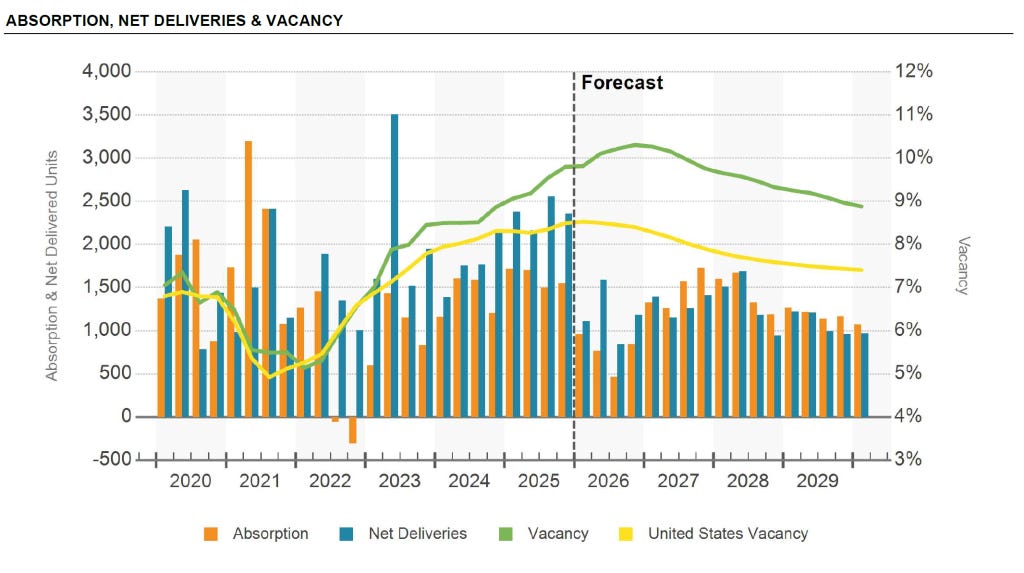
Other sources are less severe but point in the same direction. Yardi Matrix shows average asking rent around $1,355 and occupancy around 94.1%, down 50 basis points year-over-year. Marcus & Millichap expects more pressure in urban submarkets, especially Downtown-University and Far East Columbus near Reynoldsburg, while suburban submarkets remain tighter. Green Street expects deliveries to remain elevated and peak in 2027, which supports a more cautious view on multifamily.

So multifamily is not a clean “stop.” It is more like a “be very specific.” If you have a long hold period, the right basis, and the ability to absorb near-term softness, there may be an interesting entry point. But if the thesis is simply “Columbus is growing, therefore rents go up,” that is not enough.
Office is harder. Columbus has some positive absorption and select strong submarkets, but the broader office story still looks like the national office story: flight to quality, weak commodity space, and selective leasing. Colliers shows vacancy around 19.2%, with stronger rent performance in places like New Albany, Easton, Dublin, Arlington/Grandview, and the CBD. Medical office is more interesting, but generic office is not the clearest expression of the Columbus growth thesis.
Unless you have a conversion strategy, medical office angle, or very specific basis advantage, office is probably a stop.
Industrial makes the most sense for real estate investment in Columbus. Geography, logistics, reshoring, manufacturing, data centers, and population access all point in the same direction —> towards Columbus.
CBRE shows average asking industrial rent reaching $6.78 per square foot in Q1 2026, up 12.4% year-over-year and 17.5% over three years. Colliers reported the second-highest first-quarter absorption level in the past decade, with vacancy around 5.19%. The former Big Lots space alone added roughly one percentage point to market vacancy, which means the underlying market may be tighter than the headline suggests.

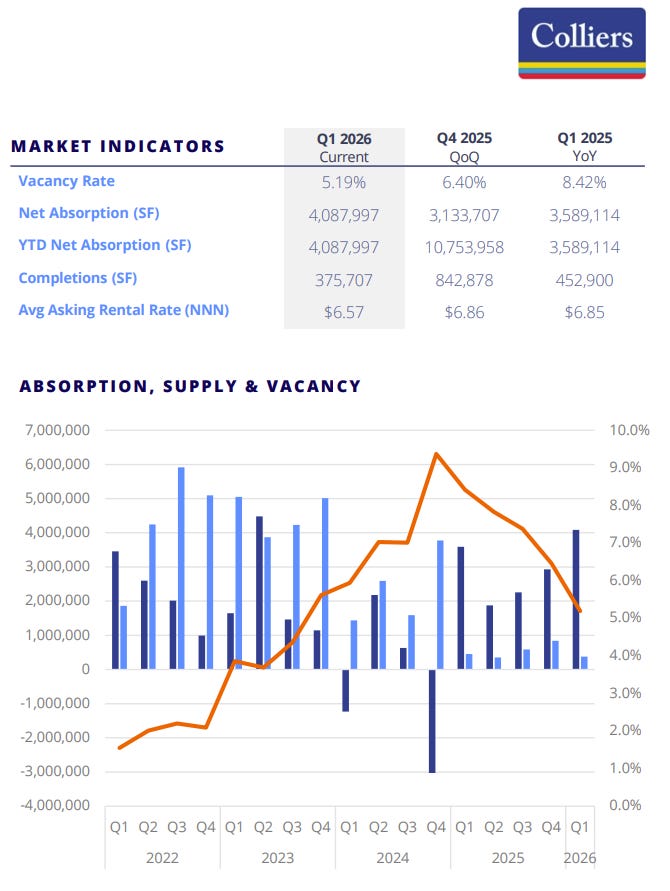
Data centers add another layer. Green Street notes that more than 80% of Ohio’s data center inventory is in the Columbus market, and Columbus posted more than 400 megawatts of new data center leases in 2025. That is a major infrastructure and industrial demand driver.
Industrial is definitely a start.
Retail is less exciting but probably healthier than people may initially think. Marcus & Millichap expects vacancy around 4.5%, about 200 basis points below the metro’s historical average, and average asking rent is expected to rise modestly to $16.08 per square foot — still the highest among major Ohio markets. Colliers does show recent vacancy pressure, including from Saks Fifth Avenue at Polaris and Esporta Fitness in Hilliard, but the broader picture is still steady.
Retail is a stay. Not because it is bad, but because it is more steady than explosive.
Single-family supports the live thesis more than the invest thesis. Columbus is still meaningfully cheaper than the national market, and that relative affordability is one of the city’s biggest advantages. But from an investor perspective, that does not automatically mean SFR, BTR, or even homebuyers will see returns. Rising prices, slower days on market, and local affordability constraints still matter.
So where do we land?
For investing, Columbus is a stay overall. Because the city story is real, but the investment story is asset-class specific.
Multifamily depends on basis and hold period.
Office is mostly a stop unless you have a very specific angle.
Industrial is a start.
Retail is a stay.
Single-family helps explain why people may move there, but it does not automatically create an investment opportunity.
Columbus is worth underwriting. But we do not recommend to point the ship west and just assume you’ll scream “land, ho!”
So where do we land?
For living, Columbus is a start.
It is still affordable enough, functional enough, and broad enough that a newcomer can probably build a real life there. That may sound like a modest compliment, but in a lot of American cities right now, “you can afford a house, get to work in under 30 minutes, and find people you like” is a pipe dream.
For building, Columbus is also a start*.
* because it is not the obvious place to build every company. If you are trying to build the next OpenAI, you probably still need a denser capital and talent network. But if your business moves atoms, relies on logistics, needs manufacturing talent, serves healthcare, defense, retail, infrastructure, or the physical economy more broadly, Columbus has a very compelling pitch.
For investing, Columbus is a stay.
Multifamily has demand, but also too much supply. Office has pockets, but not a broad-based thesis. Industrial is a start and retail is steady. But single-family doesn’t warrant an investment thesis.
And while industrial, and more specifically data centers, continue to contribute to Columbus’ rapid growth, we are wary of the potential impact of energy constraints on the multifamily and single family markets in the short term.
Columbus isn’t just hype. But the folks who treated it like a layup may have gotten ahead of themselves.
Columbus is worth underwriting.
Just don’t mistake spotting land for finding treasure.
This essay grew out of a Build Order conversation. If you haven’t caught it yet, you can watch all our episodes on all your favorite platforms: Substack, YouTube, Spotify, Apple Podcasts, Pocket Casts, iHeartRadio, and Overcast.
Subscribe for more amazing Build Order content! And if you’re already a subscriber, THANK YOU! Please be a dear and share it, and you’ll be our favorite friend of the pod.
Comments
Nothing yet. Say the first thing.
Sign in to join the conversation.