
Hey Friends🖐️,
What if I told you that your dream product idea can be validated with a bit of writing? I’ve often been asked how to start planning for a new physical device concept. By planning I mean the strategy, vision, and ideation before engineering gets involved.
Luckily, there’s a method to do this. While there are many guides on crafting such documentation for software, some of the best-selling hardware in recent years, such as Amazon Kindle and Google Nest, have used this mechanism as step 1 of their product development process.
Today we’ll talk about PRFAQs and cover:👇
What they are
Why they’re important
How to write PRs that excite
How to craft FAQs that gauge concept viability
Challenges
🤔Interested in learning 0-1 HW Product Management?
Our readers have been requesting a practical guide to taking a hardware idea from concept to mass market.
We’ll be covering principles including HW product sense, business feasibility, go to market planning, user desirability, and technical viability.
Our goal is to help beginners or even experienced product makers sharpen their craft. Drop your email below for access to initial modules and early bird pricing.
What is a PRFAQ
In Tony Fadell’s words (ex iPod, iPhone chief), a press release FAQ is a document drafted at the inception of a new product endeavor. It answers the what, why, and who.
It starts by working backward from the customer experience and provides a clear vision for the team.
It’s a guide that outlines a product’s target users, key features, and most importantly - the problems it solves.
It facilitates communication between product, marketing, design, and engineering.
A good PR creates excitement and helps the team prioritize development efforts.
PRs are among the most critical artifacts drafted by product managers. In some organizations, PRs are also considered business plans because they outline the strategy for making a successful product. They also contain FAQs that answer important questions on demographics, competitive market analysis, technology feasibility, operations, and financials.

How to Write PRs
Generally, PRFAQs should focus more on product vision than technical execution. They should bring a concept to life, create excitement, and inspire action. However, it’s also an iterative process and while there is no single format most PRs have the following elements:
Headline
This should be a clear, compelling statement that communicates your product’s core value.
Subtitle
An extension of the headline that adds exciting context, usually highlighting the key feature or a one-line summary of the product.
Summary paragraph
A 3-4 sentence overview of the product and opportunity, similar to an elevator pitch.
Assume that your audience doesn’t have time to read the entire PR. Hence this summary will probably be the most important part.
Body
This is the meat of the press release.
It establishes customer pain points with examples and data.
Introduces your solution, how it works, and why it’s important.
Use pictures and sub-sections to accentuate key features.
Company leader quote
Quote from a key executive that strategically reinforces the main value prop while adding credibility.
Customer quote
Humanize the situation and show a real-world use case that validates the problem and demonstrates how your product is meaningful.
Call to action
Next steps for customers such as where they can learn more, purchase, or engage with your product.
Tenets
These aren’t formally part of the press release but should be referenced in the doc.
Tenets are core values that guide decision-making in times of tension or ambiguity.

Example Press Releases

Customer and Stakeholder FAQs
FAQs are a list of questions that both customers and internal stakeholders will ask about the product. These are designed to anticipate concerns and mitigate risks. Although the FAQ section is the toughest to write, completing this saves time downstream in the product development process. Writing them upfront demonstrates a deep understanding of the business and is a mature product-building practice.
A sign of a good PRFAQ is that it makes the PM reconsider product ideas. It’s not uncommon for some teams to realize the idea just isn’t viable from a business or technical perspective. That’s a win. You just saved your organization a lot of capital and resources. It’s an even bigger win in hardware, with the cost of development exponentially increasing with each phase such as tooling, production lines, machinery, certification, and testing.
Customer FAQs
Are a set of questions that users may ask to understand the product during their purchase journey. Let’s walk through an example. Say we’re an audio company called SmartWave and are developing a new smart speaker. What are the immediate questions our customers will ask?
What is this product?
The SmartWave Speaker is your voice-controlled hub for an intelligent home. Enjoy high-fidelity audio while seamlessly controlling compatible smart devices, accessing information, setting reminders, and more through its advanced AI assistant. The speaker’s uniform design and powerful speaker system deliver a premium audio experience that integrates into any room.
What are the product’s key features and how do they work?
Crystal-Clear Sound: Enjoy premium audio quality for podcasts and more.
Effortless Smart Home Control: Seamlessly connect and manage your smart home devices with your voice.
Powerful AI Assistant: Get answers, check the weather, and much more – all hands-free.
Intuitive Touchscreen: Visualize information and access interactive features.
Privacy First: Easily control microphone access for your peace of mind.
How is this product different from the previous generation?
The SmartWave Speaker features enhanced sound quality with improved bass response, a first-ever touchscreen display for interactive feedback, and faster/accurate AI voice recognition that intuitively learns your routines.
Where can I buy the product?
Our speaker is available globally through our official website, amazon.com, and Walmart.
How will the product be priced?
The SmartWave speaker is available for $149.99 and also features a $4.99 monthly subscription for access to our ecosystem.
Is there a warranty?
Our products come with a 1-year warranty and free software updates.
A good reference of what to anticipate in customer FAQs can be found by looking at Amazon detail pages. They include product descriptions, features, pricing, and warranty info all in one spot.

Stakeholder FAQs
Are a set of questions from your development teams such as marketing, engineering, design, and legal to gain context into the new product concept. Anticipating these early is a good exercise to drive alignment and gauge feasibility.
What problem does the product solve?
Why are you building what you’re building?
Who are our target users?
Have 3-5 user personas.
List demographics, age ranges, income, spending habits, & needs.
Has customer demand been validated?
List all data points to confirm customers are interested in pursuing this product. Given this is the pre-prototype stage it is ok if the data is not perfect. However, it does have to be directionally indicative of trends.
Include feedback from surveys, interviews, reviews, and workshops.
Try to find tangential products to get concepts in people’s hands. Real-world usage feedback is key for hardware businesses.
What are the industry trends?
YoY growth, new technologies, consumer behavior, regulatory changes, and economic factors.
Is there a competitive analysis?
Make a table of 3-5 competitor products vs your product. List key features (HW, SW, app), customer ratings, pricing, differentiators, strengths, & weaknesses.
What is the financial analysis (FA)?
Is there business viability in pursuing this opportunity? Hardware product FAs are very nuanced so this will be covered in a later article. At a high level include:
Pricing strategy (one-time vs subscription).
Costs for BOM, tooling investments, non-recurring (NRE) engineering, certifications, shipping, tariffs, assembly, material attrition, & headcount.
Estimated returns, reverse logistics, discounts, & concessions.
Gross margins, net margins, profit-per-unit, Lifetime Value (LTV), & ROI timeline.
What is the value proposition?
What utility does it provide target users? What makes it unique versus alternatives?
What is our positioning?
How do we want our product to be viewed by users relative to competitors?
Positioning statements can be used to guide product communication and marketing.
Template: For [target users], who are frustrated with [existing solutions], our product is a [product type], that delivers [main value prop], unlike [competitor], we offer [additional unique features].
What is the operations plan?
Regions sold, SKUs, manufacturing, bundles, supply chain strategy, and distribution channels.
Is this Technically Feasible?
Engineering General
Engineering will become more involved in the PRD phase when requirements are further defined however early technical feedback in the PRFAQ phase is invaluable.
Look for conceptual insight and leverage demos, mockups, or prototypes wherever possible.
Electrical/Firmware
Include any high-level system architecture plans or block diagrams.
For the smart speaker example, you can have rough chipset discussions on processors, audio codecs, speaker modules, amplifiers, power type, and RF modules.

Mechanical/ID
Include feedback on items like weight, strength, materials, & manufacturability.
Add any early industrial design concepts.

App/Software
High-level discussions on experiences for setup, integrations, UI/UX, engagement, privacy, and security.
Challenges
Think of the main user experiences and talk to engineering about associated risks. Some examples of challenges with the smart speaker are brainstormed below:
SW/FW: Is our ML model efficient enough to fit on the device or will we need to access the cloud? How accurate is our model for voice recognition? What types of classification needs to be done?
HW/FW: To enable the AI assistant, does our chipset allow enough edge computing from a processing and memory POV to reduce latency? If not, how expensive are alternative chipsets?
Mechanical: Can our ID withstand thermal risks if users are based in Arizona or Texas? Can the weight of this device resist drop testing?
Electrical: If it’s battery-powered, how much will Wi-Fi degrade battery life? Should we switch to low-powered RF like Bluetooth for connectivity?


Finishing the PRFAQ
After all of the above is completed take the PRFAQ and share it with as many people. A good PRFAQ process drives discussions and has to be re-written. It’s okay if it gets beaten up. That’s the whole point.
Some More Thoughts
PRFAQs are not perfect. There are scenarios where they might not be the best for your product. The most common criticism is how long they take to write. Some PMs spend months researching and still have to revise several iterations based on each round of stakeholder feedback.
The counter to this is that they should take a while to write. PRFAQs are technically a business case and should be treated meticulously to validate a product’s feasibility. Doing the work upfront will save your team hours because a lot of questions will have to be answered anyway such as financials if doing pitch decks, use cases when drafting a PRD, or BOM constraints when defining the engineering spec.
A practical solution is writing a PRFAQ-lite. This is a hybrid document that is a concise version of typical PRFAQs. It balances speed and clarity by focusing only on priority FAQs. It can be used for quick feedback from stakeholders.
Personally, the most important outcome of a PRFAQ is that it inspires deep thinking. It forces us to critically test our assumptions and mitigate risk.
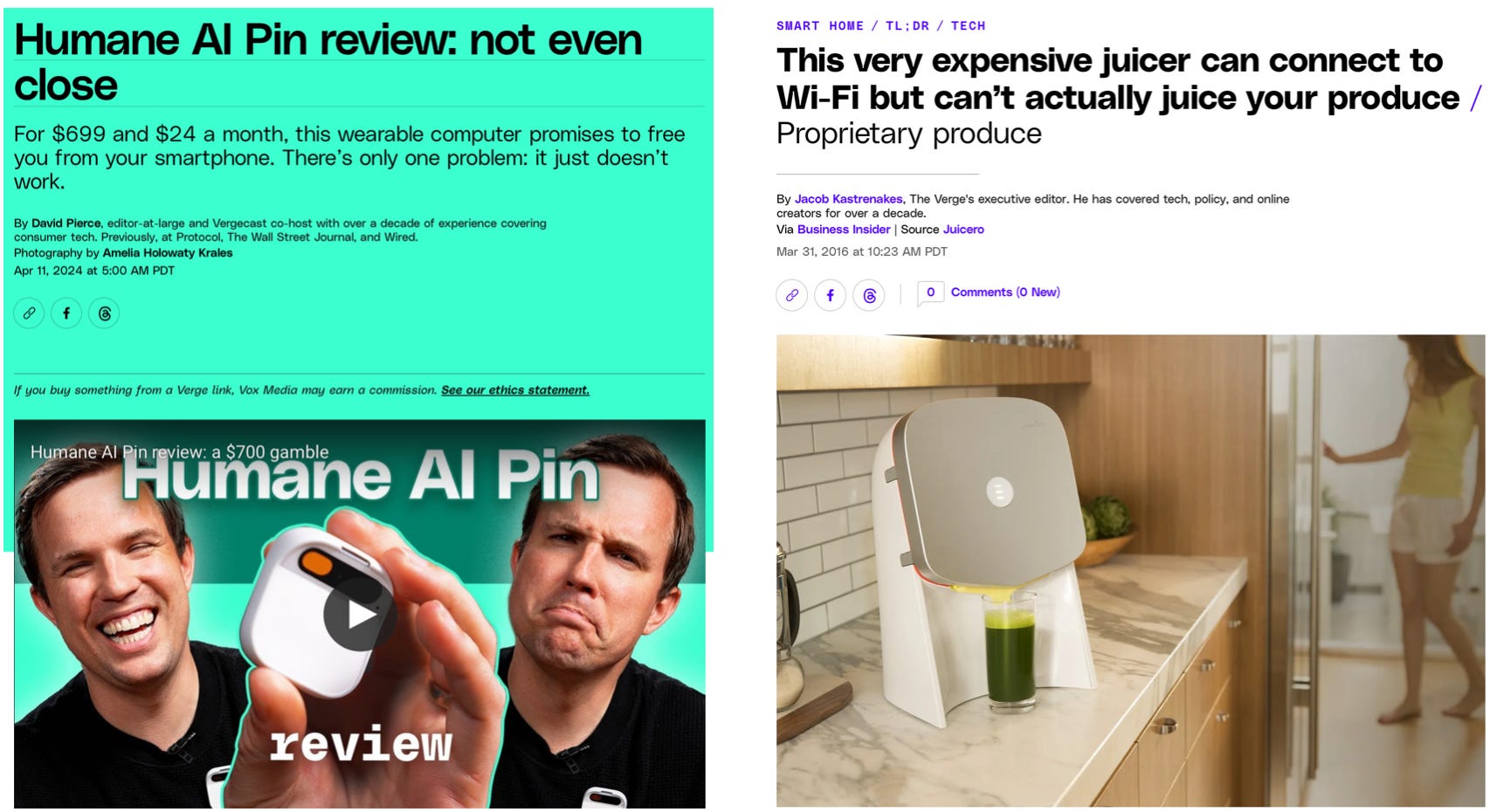
Building hardware is technically and financially complex, hence the work needs to be done upfront to gauge robustness. Sometimes I wonder if companies like Humane or Juicero wrote PRFAQs before selling such disappointing products.
Thanks for Reading
Make sure you check out some other articles:
If you enjoyed this, like and spread the word. If you have any questions on hardware PMing, product development, or careers let’s talk.
Comments
Nothing yet. Say the first thing.
Sign in to join the conversation.