
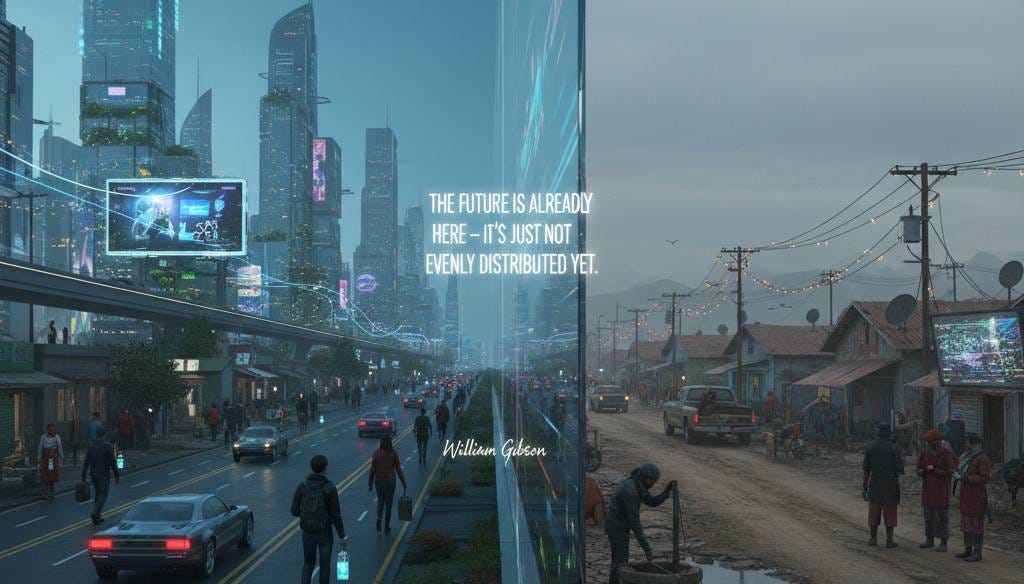
“The future is already here – it's just not evenly distributed.”
―William Gibson
William Gibson, a master of science fiction, observed that what we consider "the future" isn't a global phenomenon that arrives everywhere at once. Instead, it starts with a small group of early adopters, often in a specific location like Silicon Valley.
William Gibson was right about technology.
He was thinking about distribution of technology. Think fibre optic cables reaching some cities before others. Silicon Valley getting the latest gadgets while rural towns waited. The usual suspects of technological rollout.
But with AI, something different is happening. AI distribution was global and faster than any product in history. But, the uneven distribution Gibson imagined is showing itself in different ways.
It's not the usual suspects like geography, economics, or access to capital that determine who gets to live in tomorrow.
It’s willingness.
Think of it like this: There are two groups of people standing at the edge of a river. The first group sees the rushing water and immediately starts building reasons why they can't cross. Too cold. Too fast. What if there are rocks beneath the surface?
The second group? They're already wet.
AI tools have become that river. And the fascinating part isn't watching the early adopters splash around on their way to the other side. It's watching the IT professionals, the analytical thinkers, the ones who should know better, stand at the water's edge with their arms crossed.
They take a quick look. Dip a toe in. Declare it a toy. Then walk away, certain they've made the prudent choice.
But toys have a funny way of becoming tools. And tools have a funny way of becoming essential.
There are also the skeptics who eventually wade in but don't do it with joy. They do it with the grudging acceptance of someone who's realized the bridge they were waiting for isn't coming. They adapt because they have to, not because they want to.
These are the people to watch. They represent the people that are going to relate to both the innovators and the skeptics.
Everett Rogers mapped this decades ago coining it “diffusion of innovations”: innovators → early adopters → early majority → late majority → laggards.
This adoption curve still applies, but now it's playing out in real time, everywhere, simultaneously.
So why are the results so different?
Because when distribution becomes instant, psychology becomes everything.
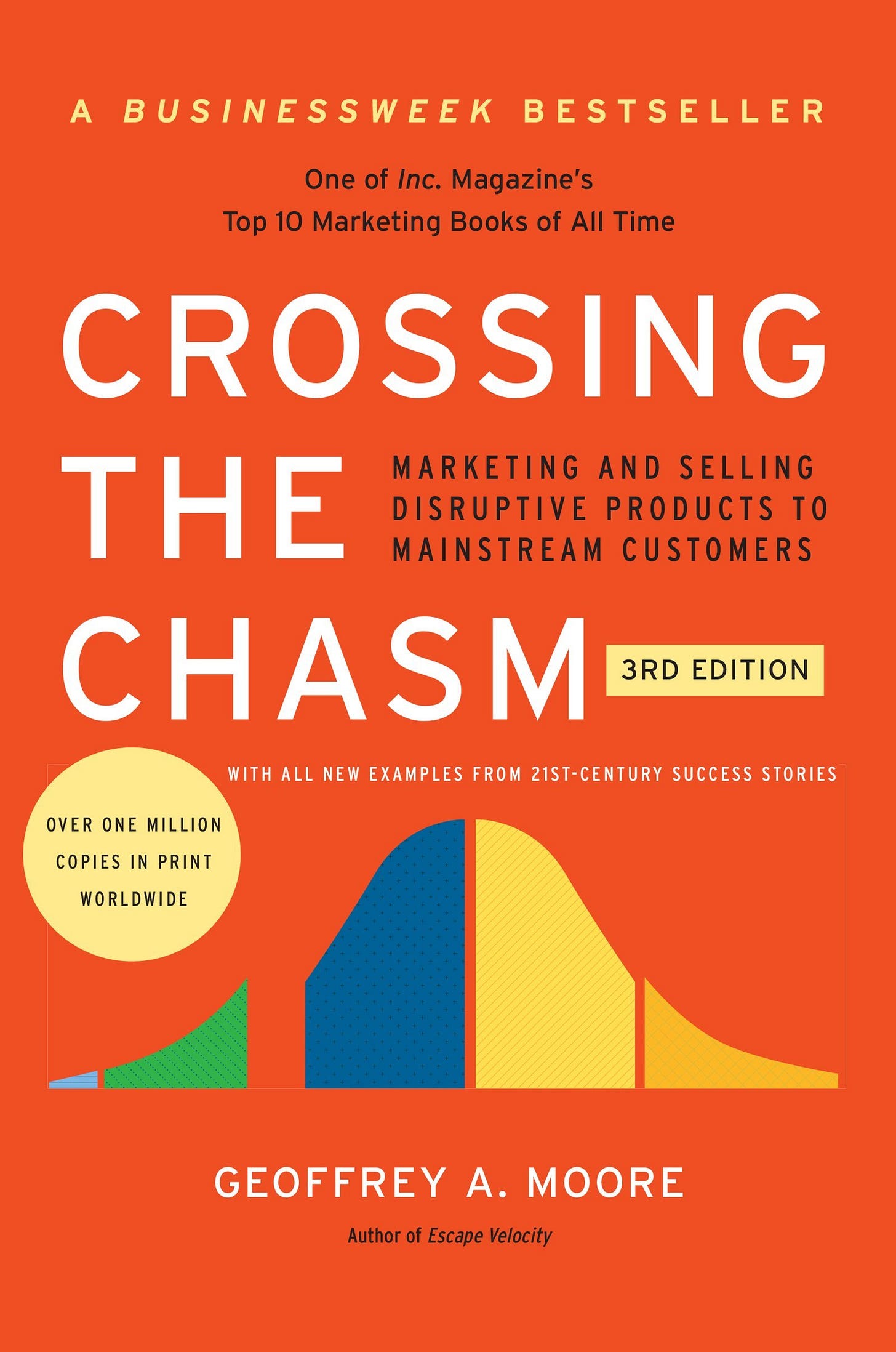
Geoffrey Moore writes about this in Crossing the Chasm, that deadly gap between early adopters and mainstream markets. "The single most important difference between early markets and mainstream markets is that the former are willing to take responsibility for piecing together the whole product, whereas the latter are not."
Early adopters will piece together incomplete solutions for competitive advantage.
The majority wants complete products with guarantees.
AI today is all pieces. Powerful ones, but still pieces.
The early adopters are busy assembling while the majority are waiting for someone else to do the assembly work.
What’s really happening is that the future is being defined by the willingness to look foolish while you figure things out. By choosing possibility over certainty.
People living in tomorrow aren’t necessarily smarter or more privileged. They’re just more willing to get uncomfortable.
So the question becomes: will you be standing on the shore, explaining why the water is too cold, or will you be on the other side, wondering what took everyone else so long?
Rivers don’t care about your reasons. But your future does, so dive in.
No posts
Comments
Nothing yet. Say the first thing.
Sign in to join the conversation.