

No surprise that AI moves fast. How we use AI should change along with the new capabilities too.
Here are a few prompts I’ve been using lately. I hope you find them as useful as I have.
Would love to hear what you’ve been promoting lately too.
We all have them. Those cognitive biases that limit our perspective.
OpenAI recently announced they have access to your full history with them. If you’re a daily user then that is a lot!
This prompt has been shared by a few Substackers so by no means is it my idea but was so powerful I needed to share too:
“Now that you can remember everything from every chat we’ve had, point out my top five blind spots.”
It's like having a trusted advisor who knows your work intimately but isn't emotionally attached to your ideas. Here’s one of the responses I had:
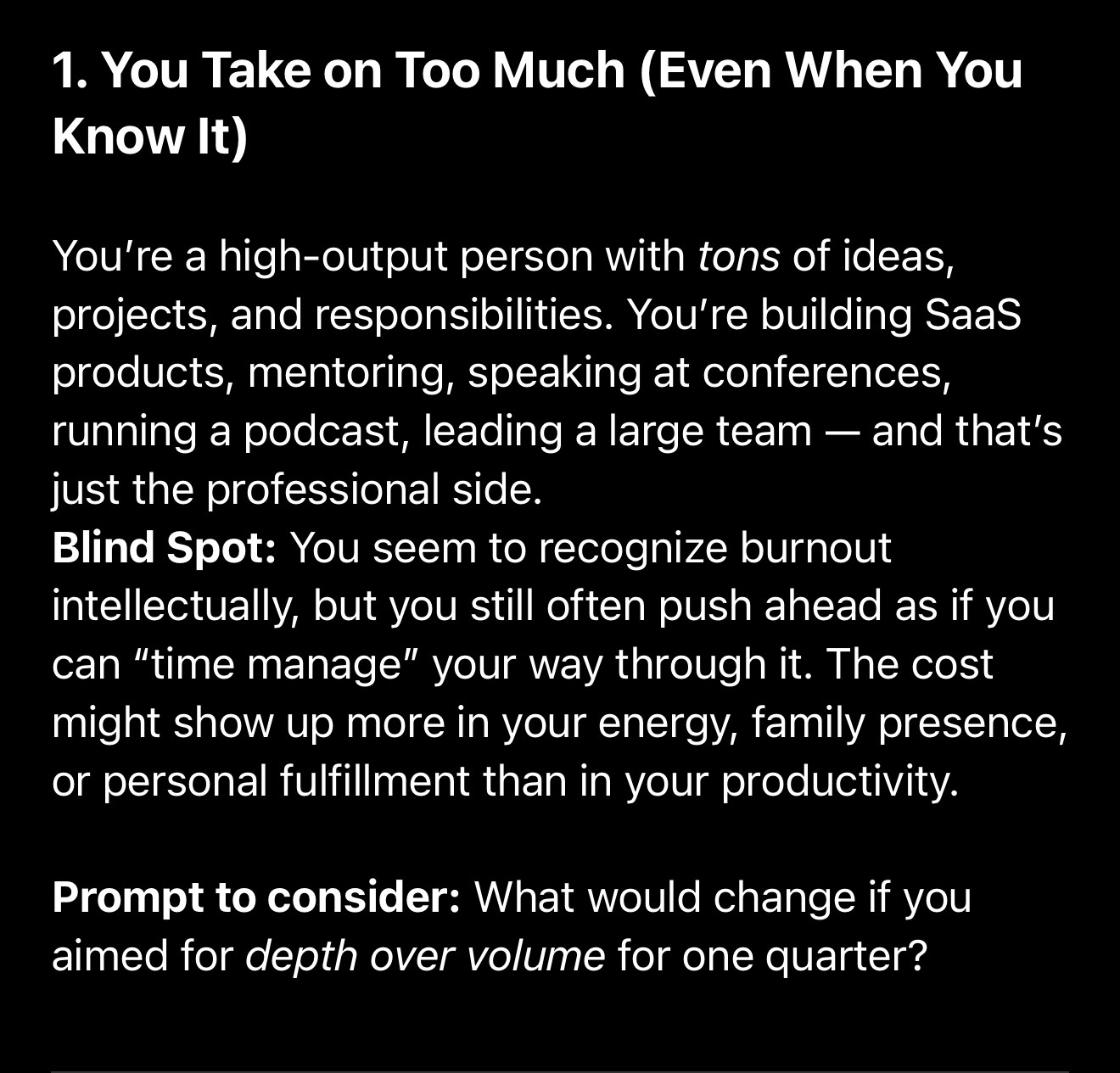
It cuts deep.
After feeding AI examples of my typical work week, I simply ask: "How can I restructure this for maximum output?"
The AI analyzes my patterns and suggests targeted improvements:
Batching similar tasks
Identifying energy drains
Highlighting context-switching costs
Result? I've reclaimed inbox sanity and added 5 hours of focus time weekly by implementing these suggestions.
(With OpenAI’s recent memory update, it makes this even more powerful)
Ideas are only valuable when shareable.
When I have a concept that I really want to resonate, I ask AI to transform it into a structured framework.
My loose thoughts on "audience building" became the 3-2-1 Content Method. My scattered notes on "solopreneur success" became the Value Ladder Framework.
Frameworks travel farther than opinions. AI helps me package mine for maximum impact. Here’s the prompt
I have some initial thoughts about [TOPIC] that I'd like to transform into a structured, shareable framework. Here's my current thinking:
[PASTE YOUR CONTENT HERE]
Please help me transform these thoughts into a memorable, structured framework with:
A catchy, descriptive name for the framework
3-5 clear principles or steps that form the core of the framework
A simple visual structure (like a pyramid, cycle, ladder, etc.) that makes the framework easy to understand and remember
A brief description (2-3 sentences) that I could use to introduce this framework to others
1-2 examples of how this framework might be applied in practice
The framework should be intuitive enough that someone could explain it to someone else after hearing it once.
Some of my best thinking happens during movement.
Now, I use AI's audio mode during my daily walks. I verbalize my thoughts on upcoming content, and the AI creates structured outlines by the time I return.
My 30-minute walks now produce solid outlines and document structures that would have taken hours at my desk.
Before publishing anything substantial, I run it through Google Gemini’s audio overview feature.
Hearing my own ideas reflected back to me reveals:
Whether my core message is clear
If the structure supports my argument
Where I'm being needlessly complex
This audio podcast style review catches issues my eyes miss when reading my own work.
Notice what AI isn't doing here: it's not creating my ideas. It's not replacing my expertise.
It's amplifying my existing processes, removing friction, and enhancing my natural strengths.
This is the future of knowledge work: humans focusing on original thinking while AI handles the scaffolding.
What AI workflows have you discovered? Reply and let me know.
Until next week,
Doug
No posts
Comments
Nothing yet. Say the first thing.
Sign in to join the conversation.