

Canadian Kayfabe
In professional wrestling, “kayfabe” refers to the practice of presenting scripted storylines as real — maintaining the fiction that the feuds are genuine, the outcomes uncertain, the stakes authentic. The audience knows, on some level, that it’s performance. But the performance has to be credible enough that everyone can allow themselves to pretend otherwise.
As cynical as this sounds, it might be a useful frame for thinking about what happened in Calgary on Friday.
Prime Minister Mark Carney and Alberta Premier Danielle Smith signed what they are calling an Implementation Agreement: Ottawa will fast-track a new one-million-barrel-a-day pipeline to the West Coast, designated as a project of national interest by October 1, with construction approval targeted for September 2027. In exchange, Alberta commits to a rising industrial carbon price — $115 per tonne in 2030, $130 by 2035, $140 by 2040 — plus investment in carbon capture and storage through the Pathways Alliance.
The agreement is real in the sense that it exists, has been signed, and contains specific dates and numbers. Whether it represents a genuine commitment by either party to achieve its stated goals is a different question. The incentive structure on both sides suggests the worrisome answer might be no.
Let’s start with Carney. He needs this deal for two reasons that have nothing to do with oil actually getting to the coast. First, he needs to neutralize Alberta separatism, which has gone from a fringe position to a live political threat. Second, he needs to demonstrate that a Liberal government can be pro-energy while also keeping faith with the pro-climate values that animated the party under Justin Trudeau, as well as Carney’s own pre-politics worldview.
There was always a certain elegance in the way the original MOU linked a pipeline with carbon pricing. In Ottawa’s framing: no carbon price, no pipeline. In Alberta’s framing: no pipeline, no carbon price. The two conditions locked together like a handshake, suggesting that both sides had finally found a structure that aligned their respective incentives toward the same goal.
But here’s the thing: if the pipeline never gets built, whether stalled by British Columbia, by Indigenous rights litigation, by the courts, or by the absence of a private proponent willing to underwrite the risk, Carney still wins. He can say he tried his best to bring Alberta’s energy to market with the powers the constitution gives him. He also gets to keep his left flank happy, which may not be the coalition that elected him, but which remains a sizeable part of his caucus and his cabinet. The deal gives him political cover in both directions at once.
As for Smith, she has secured a carbon price that is materially weaker than what independent analysts say Canada needs to meet its targets. The Canadian Climate Institute, which published an assessment of the original MOU in February, concluded that even a $130 per tonne credit price would not be sufficient to return Canada to a trajectory consistent with net zero by 2050. Their lead researcher noted pointedly that if the MOU is the starting point of the negotiation, and it is already weak on climate policy, it will only get weaker. Alberta’s industry estimates the deal saves producers roughly $250 billion by 2050 compared to what the federal government’s previous targets required.
That is a very substantial win for Smith, achieved without building a single kilometre of pipeline. And if the pipeline never gets built, Smith wins even bigger. She gets to tell Albertans that she made a good-faith deal and was betrayed, yet again, by a Liberal government in Ottawa that never really meant it, or a federal structure that makes it impossible. That is precisely the narrative that drives separatist sentiment, and it is one she can deploy at a moment of her choosing.
This is the game theory of what we might call Mutually Assured Kayfabe: Carney and Smith have designed an arrangement in which they each benefit from either outcome. If the pipeline gets built, both claim credit. If it doesn’t, each has a pre-scripted explanation that serves their political interests.
In a well-functioning political system, that kind of symmetrical heads-I-win, tails-you-lose incentive structure shouldn’t be available. Ideally, the incentives should do the opposite, driving opposing sides to an agreement neither side can afford to see fail.
What’s missing from Friday’s deal (conspicuously so, in Heather Exner-Pirot’s careful read) is the carbon credit price floor that was supposed to accompany the headline carbon benchmarks. It “will be initiated” in 2030, according to the agreement. What it will actually be set at remains unannounced. This is not a minor detail. It is precisely the mechanism through which the headline numbers translate, or don’t, into real investment incentives for emissions reduction. Its absence suggests it is still being negotiated, or that the number was too controversial to attach to a Friday afternoon announcement.
Canada has a growing tradition of landmark energy agreements: frameworks, MOUs, memoranda of intent, agreements in principle. What it has a much weaker tradition of is seeing them through, with one side or the other giving in at the slightest shift in political winds. The standard interpretation of all this is that Canada has a problem with execution.
But what if the real problem is not with governments being able to get things done, it is about them wanting to? The dark question facing Canadians about Friday’s deal isn’t whether this framework can lead to a pipeline. It is whether either party actually needs, or even wants, it to succeed.
— Andrew Potter
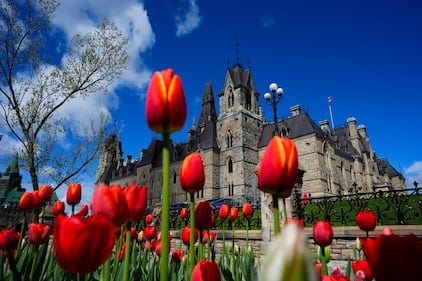
Tulip Fest!
The Canadian Tulip Festival traces its origins to World War II, when the Dutch royal family found refuge in Canada, and Princess Margriet was born in Ottawa. In gratitude, the Netherlands gifted 100,000 tulip bulbs to Canada in 1945, sparking a tradition that continues to this day as a symbol of peace and international friendship.
The festival itself was founded in 1953 by world-renowned photographer Malak Karsh and has grown into the world's largest tulip festival. This year it runs from May 8 to 18, 2026, at Commissioners Park in Ottawa, an 11-day celebration now in its 74th edition. Princess Margriet was even on hand last week to kick things off.
Emily Carr (1871–1945)

Born in Victoria, Emily Carr trained in San Francisco, London, and Paris before returning to paint the landscapes and Indigenous cultures of Canada’s Pacific Northwest. Largely ignored for decades, she gained recognition in 1927 when her work was exhibited alongside the Group of Seven at the National Gallery of Canada, cementing her place in the Canadian modernist tradition.
Carr’s mature work is defined by two great preoccupations: the spiritual vitality of the West Coast forest, rendered through swirling, energetic brushwork that transforms trees and sky into living forces; and the totem poles and villages of First Nations peoples, documented with a reverence few non-Indigenous artists of her era matched. She remains one of the foundational figures in Canadian art.
This week in Building Canada
May 16: The first successful hand transplant was performed by a team at the Toronto General Hospital on this day in 2002
May 19: James Gosling, creator of the Java programming language, was born in 1955.
May 20: The first referendum on Quebec sovereignty took place on this day in 1980, with the “No” side winning with almost 60 per cent of the vote.
May 21: On this day in 2015, Shopify completed its IPO on the TSX and NYSE — valuing the Ottawa-born e-commerce platform at $1.27 billion and heralding a new era of Canadian tech.
May 22: On this day in 1832, the first steamboat transited the newly opened Rideau Canal from Kingston to Bytown, inaugurating a commercial waterway that served the Ottawa Valley for a century.
Building Canada’s Entrepreneurial Economy
Canada's entrepreneurial economy is in serious decline. More businesses are closing than opening, founder emigration is accelerating, and 2025 marked the worst year for domestic VC fundraising since 2016.
In early May, Brice Scheschuk submitted a briefing to the House Finance Committee as part of pre-budget consultations for the 2026 federal budget, with suggestions for how to fix this problem. He proposes four structural fixes: shut down the sprawling federal innovation investing complex; mandate the Maple 8 pension funds to deploy $10B/year into Canadian venture for 20 years; eliminate capital gains tax on early-stage business investments and offset the cost by taxing primary residence gains above $750K for the wealthiest Canadians; and expand the Canada Small Business Financing Program into a genuine SBA equivalent with larger loan sizes and no forced personal guarantees.
Build Canada published Scheschuk’s briefing this week as part of our memo series, hoping to contribute to the broader public conversation on how Canada can compete for founders, investors, and capital.
Making the case for a United Canada
This past Monday, we were in Calgary with former Alberta premier Jason Kenney, Calgary Confederation MP Corey Hogan, and The Line co-founder Jen Gerson to talk Canadian unity, the Alberta separatism movement, and what we can do as a nation to promote Albertan prosperity.
Watch our full discussion here:
Build Canada + Toronto Tech Week
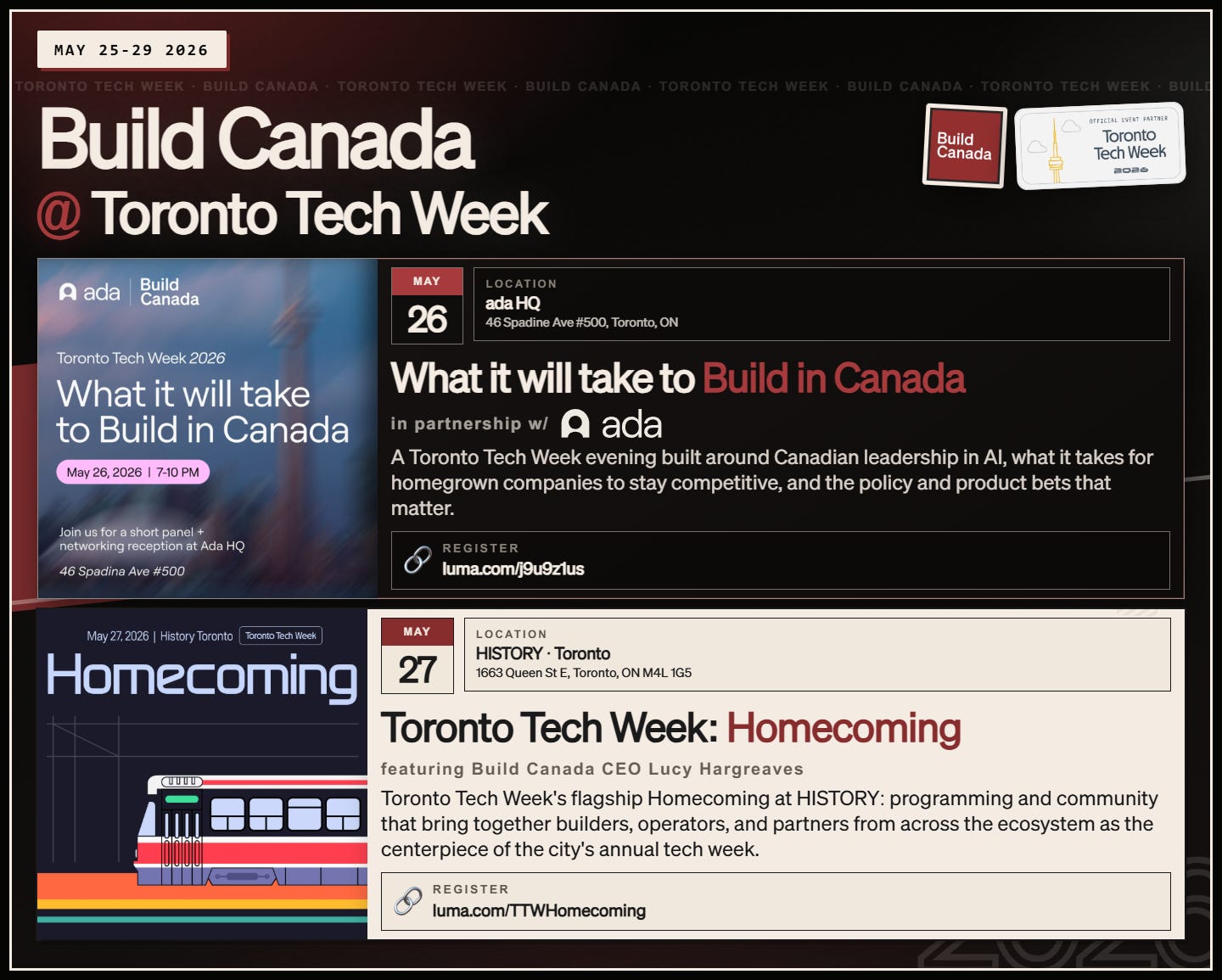
What it will take to Build in Canada
On May 26, we’ll be at ada’s HQ to discuss what it will take for Canadian companies to stay one step ahead & maintain its global leadership in the AI industry.. The event is currently sold out, but keep an eye on the official Luma page for a potential waitlist or last second spot openings.
Join our CEO Lucy Hargreaves, and titans of the Toronto tech sphere from Shopify, Neo Financial, Cohere, Uber, Google, and more at HISTORY for Toronto Tech Week’s Homecoming. Visit the official Luma page to sign up. Registration is extremely limited.
What else we’ve been reading
MDA Space has officially opened a new 185,000-square-foot satellite manufacturing facility in Montreal. And in Ottawa last week, the crew of Artemis II were greeted like returning heroes.
A bi-annual survey of investor sentiment across global markets ranked Canada as the country seen as most attractive to investment, ahead of Germany and the United States. But the head of TC Energy says Mexico is eating our lunch on pipelines.
There is a remarkable partisan age gap in Canada, with under 35s leaning Conservative and Boomers tilting strongly Liberal. Could it have anything to do with the bleak future the youth seem to be facing?
In Montreal, the city’s strippers are threatening to walk out during the F1 race weekend. And former Canadiens defenceman P.K. Subban has fulfilled his $10 million commitment to the Montreal Children’s Hospital.
Get weekly, no-fluff insights on building a more prosperous Canada. Tap “Subscribe” now and be first in line for next week’s brief. Then forward this email to one friend who cares as much as you do—let’s build together.
Thanks for reading! Subscribe for free to receive new posts and support my work.
Comments
Nothing yet. Say the first thing.
Sign in to join the conversation.