


You Are the Progress
By: Ronnen Harary
Excerpted from NO EXPERIENCE NECESSARY: Why Betting on Yourself in Your Twenties Is the Best Decision You’ll Ever Make by Ronnen Harary. Copyright © 2026 by Ronnen Harary. Published in the United States by Crown Currency, an imprint of the Crown Publishing Group a division of Penguin Random House LLC.
We all have certain skills we are gifted with when we come into this world, inborn abilities and personality traits that define who we are. What is your gift? It may take a while to figure out, but when you know, you just know, because you feel most like yourself whenever you’re doing it. You step out onto your school’s track for the first time, and you can run like a gazelle. You pick up a guitar for the first time, and it just feels natural in your hands. The chords and the progressions, it all makes sense.
You’ve still got a long way to go. You’ve got hours and hours of diligent practice ahead of you before you reach a technical mastery of whatever it is. But the positive feedback loop of enjoying it and wanting to do more of it happens almost right away. There’s no friction. It’s effortless. You know you’re using your gift when you can lose yourself in something and the whole idea of time falls away. You sit down to the task, and the next thing you know you look up and hours have gone by. You’re in the flow state. Your energy level peaks and stays high. You have the ability to channel ideas and influence people around you in a positive way because those people are now your mirror; they’re reflecting back to you the energy you’re putting out into the world. Simply put, it’s you when you’re being your most authentic self. Whatever that is for you, that’s your gift.
Sadly, some people never get the opportunity to identify their talents when they’re young. No one ever showed them the right door to open, so they don’t learn until later in life that what they love is travel or photography or cultivating a garden, and only then are they able to try to align their lives and careers with their gifts. Others of us are lucky enough to know in our bones from a young age what we’re meant to do, and whatever hardships I may have endured in my youth, in that respect I was one of the lucky ones. Thanks to my parents, I grew up immersed in the world of business and commerce. I saw what made it exciting. I saw that what made a good business thrive, more than anything, was people. Business, at the end of the day, is nothing more than humans interacting with other humans. How people organize themselves, interact, and collaborate— that’s what defines what any particular business is, and that’s what I loved about it.
I went into business knowing I wasn’t employable in most traditional fields because of my dysgraphia. I probably could have held a job in sales, and given my passion for real estate I might have been successful doing that, but for the most part I knew I’d need the freedom to do things my own way. I’d spent all of my high school and college years stuck at a desk, taking three hours to do work that the other kids could do in less than one, bending my brain to force it to work within the confines of how other people wanted it to work. It was excruciating. But from the day we started Spin Master, I did the opposite. I designed my day to work the way my brain worked, and it was liberating.
When I come into the office, I’m scheduled in meetings from the moment I arrive until the moment I leave. I never take lunch breaks. I’ve only gone on five business lunches in my life, and I mean that literally. I can count them on one hand. I never go out to restaurants, and I never sit at my desk and eat by myself. I’ve eaten every single lunch of my career in a meeting. Once I’m going, the meeting cadence is back-to- back-to-back-to-back-to-back-to-back, just this crazy flow of one meeting giving way to the next. Which works for me because of the way my brain functions. I don’t like to take notes, I don’t want to write memos or talk over Slack, and the way I assimilate information best isn’t through reading. It’s through face-to-face conversation and dialogue. So that’s how I’ve always structured my day.
The ideas and thoughts that I’d struggled to express on the page in school, now they were all free to come bursting out of my mind, ready to be implemented to help the business grow.
Controlling my environment at Spin Master also meant controlling who I was able to meet with and what information I was surrounded by. In a world with so many distractions, controlling the information that flows into your brain is critical to shaping decisions to move your business forward, and for me, having the ability to do that was a gift. The word that comes to mind is “idiosyncratic.” Given the idiosyncratic way my brain works, if I had been forced to spend my whole life working in a structure and on a schedule dictated by someone else, conforming to their culture and environment, I don’t think I ever would have achieved anything close to what I have now.
Like me, you know your own idiosyncrasies, the way you need to work in order to maximize the talents and gifts you’ve been given. Whatever culture you create will begin to take on characteristics of your personality, and you’ll be able to mold that institution to maximize your productivity, to amplify your strengths and surround yourself with people whose strengths make up for your weaknesses. (Because you will never be great at what you’re weak at; it doesn’t work that way.) The most important thing is to work in a way that matches who you truly are. There are tons of business books out there that will tell you a million different tips and tricks for the best way to succeed. But what none of those books have is an understanding of who you are. The truth is that there is no right way or wrong way to run your business. There is only what’s right for you. The results will back it up, and that will point the way forward.
Ultimately, the big question you have to ask yourself is not just Am I putting my talents to use? but Am I putting my talents to good use? Have I aligned the use of my gifts with my true purpose, with a goal that I find meaningful and worthwhile? The reality of this world is that you can be a very smart, very gifted individual who gets paid to use your talents for something you don’t believe in at all. You can do that and still achieve stellar results and attain great material success. On the surface, you may appear to have it all, and you may even tell yourself that you’re more than satisfied with the life you’ve led. But deep down you’ll know that’s not true. Your soul will know that it’s not properly aligned, and that frustration will manifest itself in unhealthy ways, whether it’s anxiety, boredom, procrastination, or something worse. You’ll end up creating workarounds to make yourself feel happy even though you’re not.
Your true purpose can be anything that excites you, anything that impels you forward. It’s a thing you believe needs to get done. Somewhere in the world, there’s a hole that has to be filled and you’re the one who’s meant to fill it. That could be something you need to do for yourself, for your community, or for the whole of society. It might be working with children or the elderly. It might be making music. It might be developing cutting- edge technology with AI.
There is literally no limit to your choices. When it comes to living a purposeful life, there are many different paths to take. Public service and the nonprofit sector both offer meaningful opportunities. But in my experience, starting a business is one of the most dynamic and powerful ways to go about it. Business is creativity in motion. It’s an expression of what you care about and how you want to see the world. When you start your own business, you begin to make the change you want to see on that very day. You decide what product or service you’re going to provide based on what you believe the world needs. You decide which customers you want to benefit from those products. You decide how you’re going to treat people, from the wages you’re willing to pay, the hours you expect people to keep, and the range of benefits you’re going to offer.
You decide how you want to treat the environment. You decide if you’re running a company that won’t tolerate financial kickbacks or sexual harassment. And if more businesses were created, there would be more diversity in the business world, fewer large corporations, and more real engines for innovation, which would create the most jobs and spark the most ideas for new business in the future. Simply put, when you start your own business, you’re not just protesting and petitioning for progress.
You are the progress.
Summer Merch
The highly requested merch shop is once again open! Looking to grab something for those summer days by the water? Head over to 🛒: shop.buildcanada.com
This week in Building Canada
July 18: The Selkirk Treaty was signed by Lord Selkirk and Indigenous leaders in 1817, making it the first treaty between settlers and First Nations in Western Canada, securing land along the Red and Assiniboine for the Red River Colony.
July 20: British Columbia joined Confederation, becoming Canada’s 6th province, on this day in 1871.
July 21, 1836: Canada’s first railway, the Champlain and Saint Lawrence Railroad, officially opened, running between La Prairie on the St. Lawrence and St-Jean on the Richelieu, financed by John Molson.
*July 22: Fur trader and explorer Alexander Mackenzie reached the Pacific Ocean, becoming the first European to cross North America north of Mexico, in 1793.
July 23: On this day in 1983, Air Canada Flight 143 ran out of fuel at 41,000 feet midway between Montreal and Edmonton, and the crew glided the Boeing 767 to an emergency landing at a former RCAF base in Gimli, Manitoba, with no serious injuries. The cause was crew mistaking pounds for kilograms, leaving the aircraft with only 45% of its required fuel during Canada’s metric transition.
July 24 On this day in 1874, Henry Woodward and Mathew Evans patented the electric lightbulb in Toronto, a Canadian breakthrough that Thomas Edison later bought and commercialized.
*“From Canada, by land…”
On July 22, 1793, on a rock face above an inlet drawing Pacific tidewater, a 29-year-old Scottish fur trader mixed vermilion pigment with melted bear grease and scrawled a message to posterity: “Alex Mackenzie, from Canada, by land, the twenty-second of July, one thousand seven hundred and ninety-three.” Then he turned around and went home.
It was the understatement of the century. Alexander Mackenzie had just become the first European to cross the North American continent north of Mexico, fully twelve years before Lewis and Clark set out to do the same thing with the full backing of the American state, an army detachment, and a presidential mandate. Mackenzie did it with nine men, his loyal dog, and a 25-foot canoe. He had missed George Vancouver’s survey ships, probing the same inlet from the sea, by a matter of weeks.
It was actually his second attempt at the crossing. In 1789 he had followed a great river northwest from Lake Athabasca, convinced it would deliver him to the Pacific. It delivered him to the Arctic Ocean instead. He called it the River Disappointment, but today it is known as the Mackenzie River.
Mackenzie was a partner in the North West Company, and his transcontinental crossing was, at bottom, a business trip as he searched for a viable trade route to the Pacific. That had the pattern of Canadian exploration for two centuries, as the men who mapped this country — La Vérendrye, Hearne, Thompson, Fraser — were not sent by kings or parliaments. They were sent by fur companies chasing beaver, and the commercial infrastructure they built did the work that armies did elsewhere. The web of posts, routes, and relationships with First Nation laid down by the Montreal traders and the Hudson’s Bay Company became the factual basis for British claims to the Northwest and, eventually, the territorial inheritance of the Dominion of Canada. Our border with the United States runs where it does in no small part because the fur trade got there first.
Mackenzie understood the stakes better than most. In 1801 he published his journals and called openly for a unified British commercial empire spanning the continent. London mostly ignored him, but the country he sketched was built anyway.
Paraskeva Clark (1898–1986)
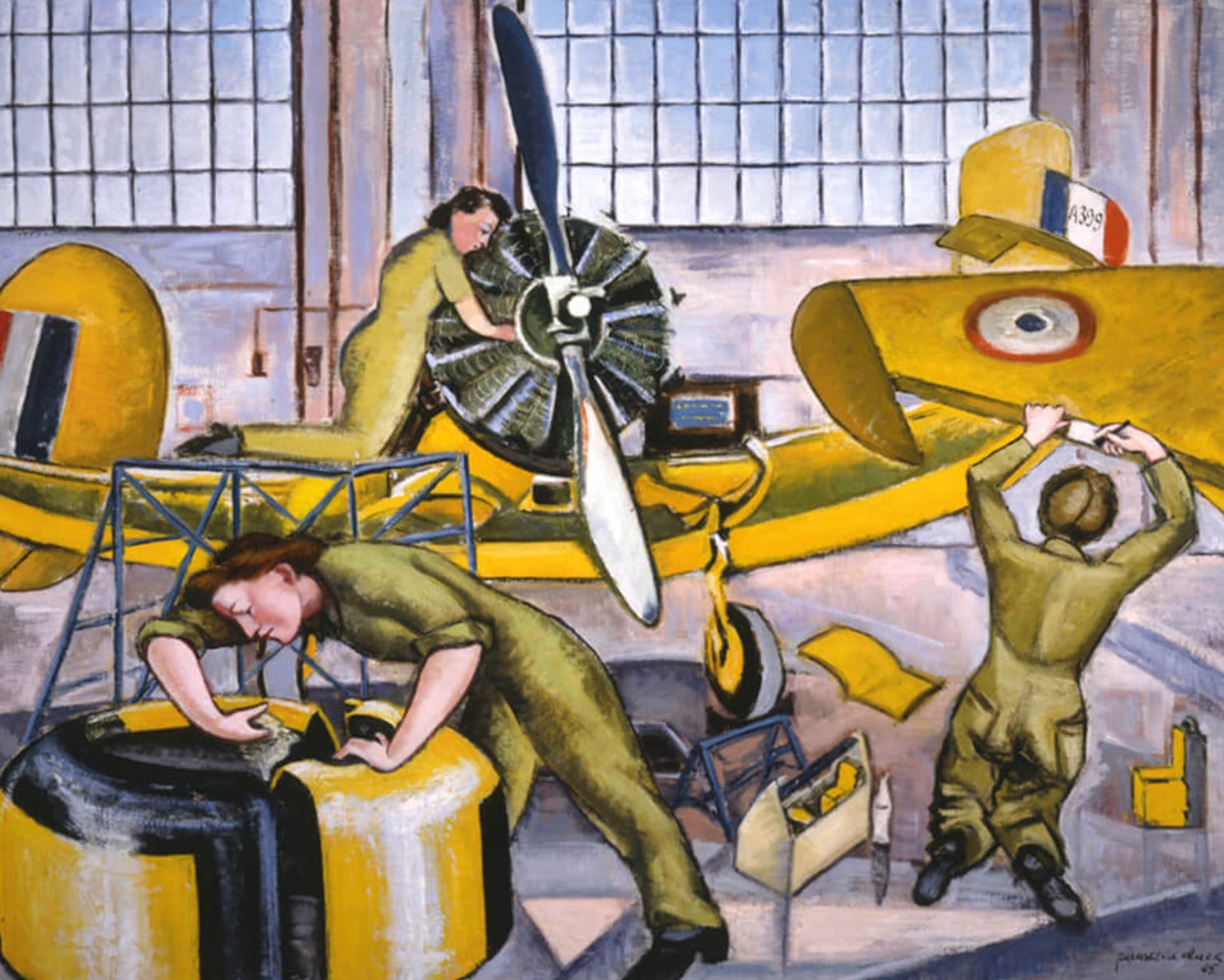
Paraskeva Clark was a Russian-born Canadian painter who brought revolutionary Petrograd to staid Toronto. Trained under Kuzma Petrov-Vodkin in St. Petersburg, she emigrated to Canada in 1931 and became the country's most outspoken advocate for socially engaged art, famously declaring that artists must "paint the moment." She was commissioned during the Second World War to document women's contributions to the war effort, and was a member of the Canadian Group of Painters.
What else we’ve been reading
A new survey finds Canadians overwhelmingly support growing the country’s space capabilities and developing launch infrastructure at home. And 53 per cent of Canadians continue to go out of their way to buy Canadian.
A report from the Fraser Institute found that I5 of the last 25 years, one or more provinces with higher living standards received equalization while a province with lower living standards did not. And writing for the MLI, economist Trevor Tombe has some thoughts on how to fix it.
Anthropic is putting $10 million into Canadian AI research. And Quebec and Alberta are working together to integrate AI into government.
Godin guitars has built a signature bass/six string double-neck guitar for indie darlings of the moment Angine de Poitrine.
Get weekly, no-fluff insights on building a more prosperous Canada. Tap “Subscribe” now and be first in line for next week’s brief. Then forward this email to one friend who cares as much as you do—let’s build together.
Comments
Nothing yet. Say the first thing.
Sign in to join the conversation.