

The NHL’s “second season” begins this weekend, with sixteen teams setting out on the long road to the Stanley Cup final. There are three Canadian teams in the playoffs this year: In the East, the Montreal Canadiens are taking on the Tampa Bay Lightning, while the Ottawa Senators are up against the Carolina Hurricanes. The sole Canadian team from the West is the Edmonton Oilers, who will have their hands full with the Anaheim Ducks. But in addition to the league’s leading scorer, Connor McDavid, the Oilers expect to have Leon Draisaitl back from injury and ready to start.
Care to make it interesting? Build Canada community member Owen Gartner has set up a playoffs Bracket Challenge; the winner gets a highly prized Build Canada quarter zip hoodie or T-shirt, depending on availability. You can sign up at this link; the password for the league is BuildCanada.

Mark Carney finally has the majority government he has been working toward for the past year. It was achieved in part through seats picked up in by-elections, but more importantly, through new MPs won not at the ballot box but in the backrooms, courted by who knows which means and what promises. The question for the prime minister, and indeed for the country, is if it is worth the cost.
On the face of it, the numbers are tidy. Three by-election wins on Monday night gave the Liberals their 172nd, 173rd, and 174th seats in a 343-seat House, which is enough to govern and legislate without opposition support, without tie-breaking votes, without negotiation of any kind. For a government that has spent a year navigating minority arithmetic while managing a trade war, a housing crisis, and a cratering economy, the relief must be considerable.
But the majority was not won on Monday. It was assembled over the preceding five months, through a series of floor-crossings — five MPs from two opposition parties, lured across in sequence — that has no precedent in Canadian political history.
CPC leader Pierre Poilievre has complained that Canadians voted for a minority Parliament, a constitutionally inaccurate claim for which he has drawn some mockery. As Andrew Coyne (and countless others) have noted, voters elect individual MPs in 343 separate contests, not a parliamentary configuration. “There was no space on the ballot to indicate whether one party should have a majority or not,” Coyne wrote, with considerable derision.
But you know what there was space for on the ballot? Party affiliation. On federal ballots, printed below every candidate’s name is their party. It wasn’t always this way: for the first century of Confederation, voters were expected to actually know who their candidates were and which party they represented. That was changed in 1970 partly to help voters keep track of who was running for whom. But also, it reflected the growing reality that most Canadians vote with party identification in mind.
This is why the spate of floor-crossings is not just corrosive, but of dubious democratic legitimacy as well.
Consider the logic offered by Marilyn Gladu, the most recent and certainly most jarring of the crossers. A decade-long Conservative MP, reliably to the right of her own party on everything from abortion to vaccine mandates, Gladu justified her defection in part by noting that ridings on the government side tend to receive more in federal spending. Maybe that’s true and maybe it isn’t. But to offer it openly as a reason for crossing the floor? If that’s the argument, you don’t have parliamentary democracy anymore. You have a patronage auction, and the bidding is open.
That is bad enough, but what makes this especially troubling is what it does to the opposition function itself. The premise of the Westminster system of government is not simply that one party wins and governs, while the other MPs sit on their hands. It is that the losers hold the winners to account — exposing wrongdoing, demanding answers, offering alternatives. An MP “stuck in opposition,” as too many commentators have condescendingly framed it, is not a figure to be mocked or pitied. They are performing an essential job. The moment opposition MPs start calculating that their constituents are better served by them joining the winning side than by holding it accountable, the whole system begins to eat itself.
Finally, there is the question that goes beyond what’s on the ballot, beyond Parliament, beyond Ottawa, to the central issue of Canadian political life, and that is national unity.
Canada is not, at the moment, a nation flush with civic confidence. Quebec sovereigntist sentiment, largely dormant for a decade, has been quietly reactivating. Western alienation, a permanent, low-grade fever in the Canadian body politic, is spiking. And the underlying feeling of populist disengagement, the conviction that the country is run by a permanent governing class for whom elections are largely a formality, is not a fringe sentiment.
Floor-crossing at this scale is exactly the kind of event that feeds that conviction. Not because it is illegal, and not even because it is necessarily dishonest or illegitimate in every individual case. It is because mass floor-crossing produces an outcome that runs contrary to what the previous election had settled: the Liberals had won a fragile and somewhat limited right to govern, but only by courting the support of members from at least one other party.
The thread running through all of this is not legality, but legitimacy, and the real constitutional illiteracy is treating them as equivalent. Not every majority government is created equal. A majority earned through a general election carries with it something a stitched-together parliamentary majority does not: a clarifying mandate, a visible public verdict, a shared understanding, however rough, of what the country chose and why. Elections are frustrating, expensive, and often ambiguous. But they have a legitimizing power that no amount of backroom negotiation or opaque deal-making can replicate.
Carney now has the votes to do pretty much whatever he wants. He has talked a huge game about building Canada, and one of the last excuses for not doing so is gone. But the hardest things his government will need to do – on energy infrastructure, defence procurement, interprovincial trade reform, the restructuring of an economy battered by a year of tariff war, and on and on – require more than votes, they require public trust in the institution making the call.
A fresh election, even one that returned a much larger Liberal majority than is currently in place, would be healthier for this country than what happened these past weeks. Mark Carney no longer needs to earn the support of other parties. But he should govern as if he did.
— Andrew Potter
This week’s memo takes on Canada’s federal public service. The workforce has reached a record high, yet outcomes have declined. Canada needs public service reform that delivers better services at lower cost.
Between 2015 and 2024-25, the federal workforce has grown by 110,000 employees. Personnel spending hit $71.4 billion, an increase of 80% over a decade. And only 16% of Canadians say they get good value from government services. Meanwhile, fewer than 0.5% of public servants are ever terminated for poor performance — twenty times less than the private sector.
Jean Chrétien balanced the budget in three years with a tough, outcomes-driven program review. We can do it again. Cut the federal workforce back to 2015 levels over four years. That would free up $15 billion annually, nearly a fifth of the 2025–26 deficit. Tie pay to performance so headcount savings aren’t eroded by rising per-employee costs. Go AI-first to improve government services’ productivity and efficiency. Publish performance metrics and targets for every federal department.
Read more here.
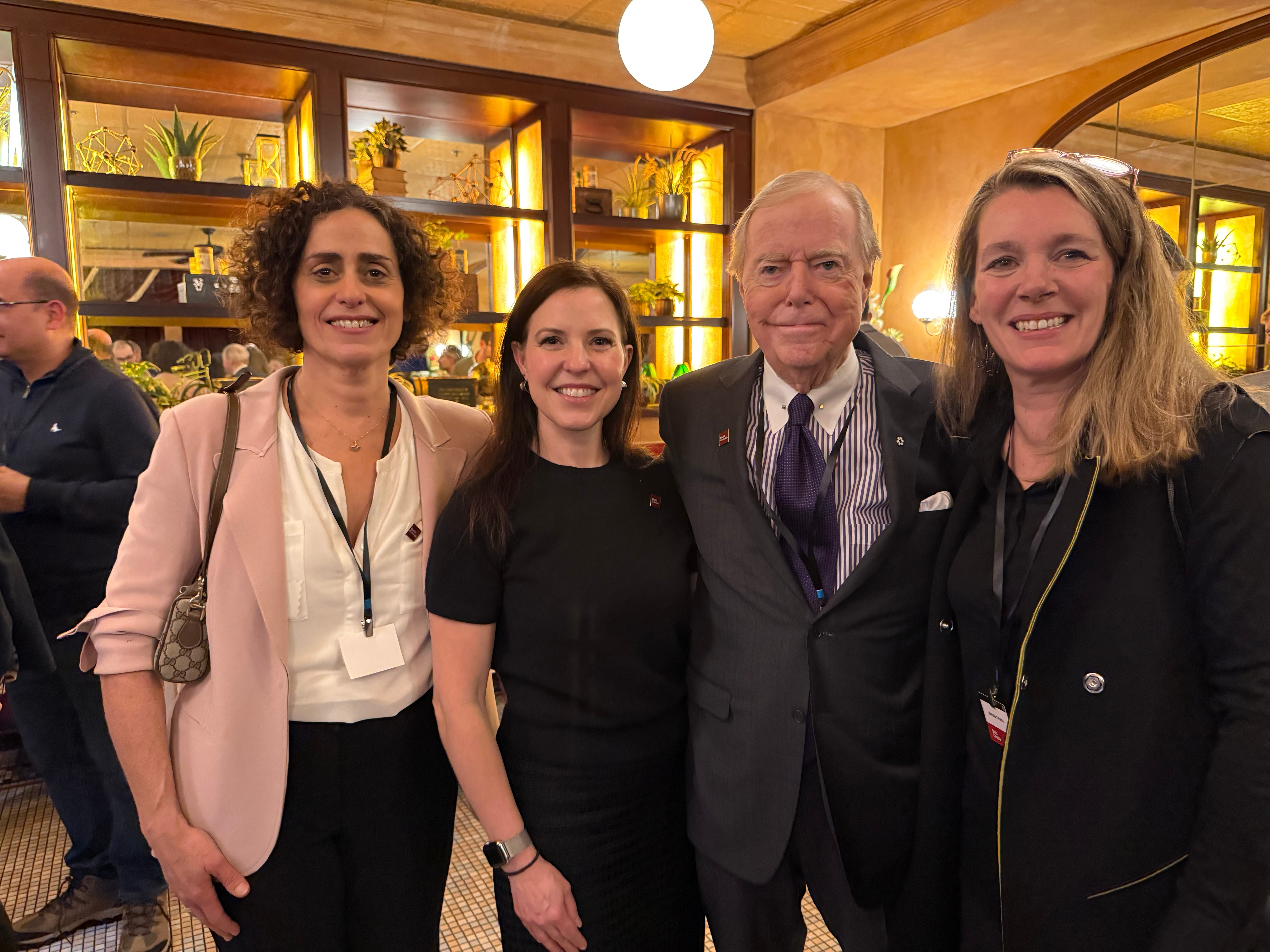
On Thursday, we hosted our Ottawa reception at the Metropolitain Brasserie Restaurant, where we held a fireside chat with Simon Hørup Eskildsen, founder of Turbopuffer — one of Canada’s fastest-growing companies — and brought together some of the country’s most ambitious builders, entrepreneurs, and policy leaders.


There is no trophy in sport quite like the Stanley Cup. Not because it is the oldest — though it is, predating the World Series, the FIFA World Cup, and every other major championship on earth — but because of what it represents: a continuous, unbroken thread of competition stretching back to the winter of 1893.
It was donated that year by Frederick Arthur Stanley, the 16th Earl of Derby and Governor General of Canada, who had watched the game take hold of the country with something between bemusement and genuine enthusiasm. He paid fifty dollars for a silver bowl (“a challenge cup,” he called it) to be awarded to the top hockey club in the Dominion. He never actually saw it presented. He returned to England before the first championship was decided, and was dead within a decade.
The Cup has outlasted him by more than a century. It has been stolen, lost, drop-kicked into the Rideau Canal, left in a ditch outside a gas station, and used to baptize at least two children. It has been carried into the dressing rooms of Montreal’s storied dynasty teams of the 1950s, into the raucous Edmonton crowds of the Gretzky era, and onto the ice in Tampa and Denver and Las Vegas. It travels with its own handlers, the so-called “Keepers of the Cup,” and every player on the winning team gets to spend a full day alone with it — a tradition with no equivalent in any other sport.
Up to 1,400 public servants will use Cohere’s North AI as part of the firm’s first major government deployment since it signed an agreement with Ottawa to test its tech. But is Cohere in merger talks with a German company?
Canadian defence companies are cooling their heels while federal procurement processes catch up to reality. Meanwhile, Toronto-based Kepler Communications has secured a $30.1M prime contract from the European Space Agency.
How much does Donald Trump hate Canada? The Globe and Mail has the details, in five handy charts.
Canadians are warming to the federal government since Mark Carney took over, according to a new Nanos poll. Though it’s up from a pretty low baseline in the Prairie provinces.
The federal government has announced the first-ever Canada Investment Summit in Toronto this September. It will “convene the world’s largest investors, including top CEOs, entrepreneurs, and prominent global business leaders,” and is focused on attracting new investment to the country.
Get weekly, no-fluff insights on building a more prosperous Canada. Tap “Subscribe” now and be first in line for next week’s brief. Then forward this email to one friend who cares as much as you do—let’s build together.
No posts
Comments
Nothing yet. Say the first thing.
Sign in to join the conversation.