
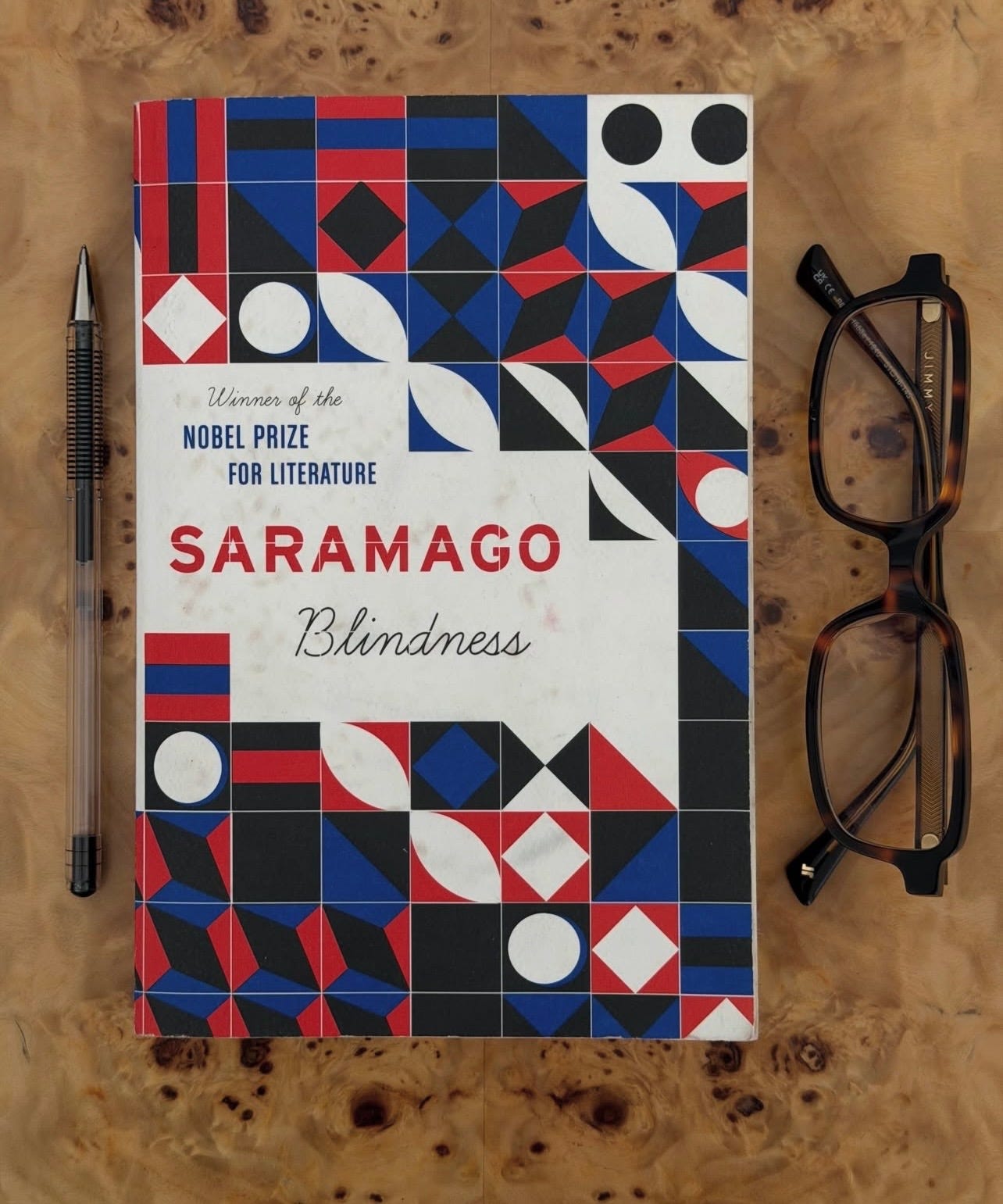
HELLO! I can’t believe it’s already nearing the end of July, the summer is flying by but I am back in London for a few weeks and so happy to be here.
This month’s book club choice, Blindness by José Saramago. I’ve never read anything by the Portuguese writer before, who has written over 40 books, and loved researching him and his very eventful personal life. I currently have about 60 pages of the book to go, and wow, it’s been a brutal read. I look forward to seeing some of you to discuss the book in person at Finks, Clissold Park on the 30th of July. I think there is going to be a lot to discuss here!
Thanks for reading Buffy's ! Subscribe for free to receive new posts and support my work.
About José Saramago
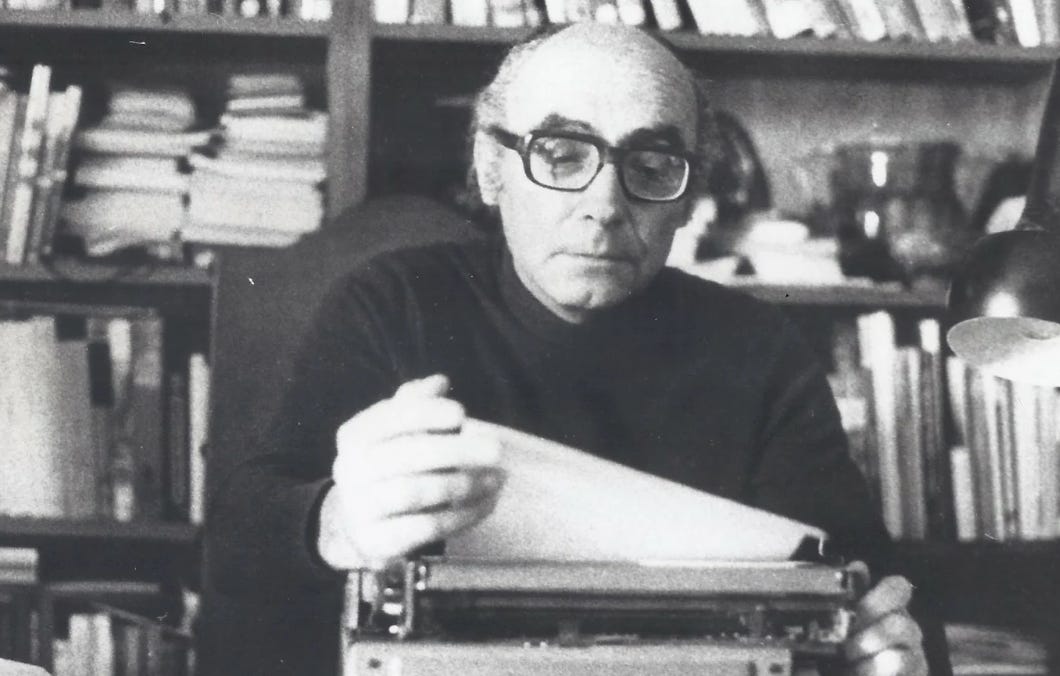
B. 1922, Portugal, d. 2010, Canary Islands, aged 87
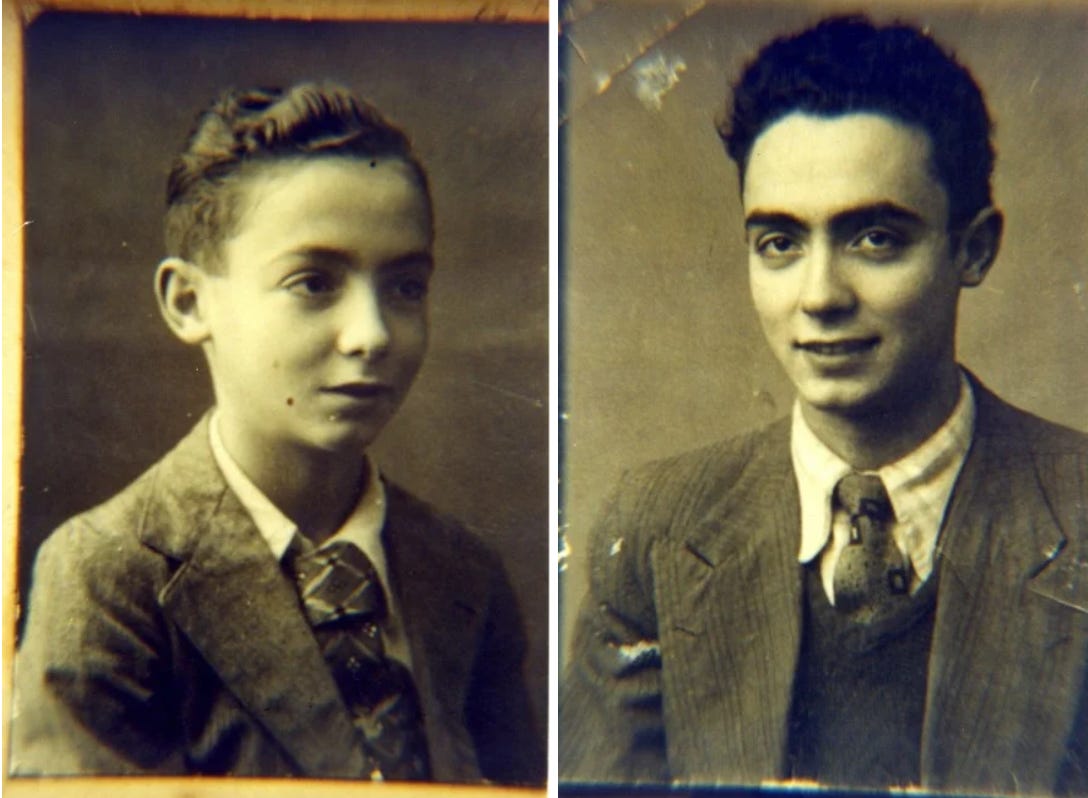
Born to a very poor peasant family in Azinhaga, Portugal, a small village 100km north of Lisbon.
Father was José de Sousa and mother was Maria da Piedade. He had an older brother called Francisco.
The surname Saramago is Portuguese for ‘wild radish’, and was an insulting nickname given to José’s father and mistakenly incorporated into his birth certificate
“saramago is a wild herbaceous plant, whose leaves in those times served at need as nourishment for the poor.”1
When Saramago was 2, his family moved to Lisbon where his father worked as a police officer, and his older brother died suddenly at the age of 4.
Saramago was a good student but his parents could not afford to keep him in grammar school, so moved him to a technical school aged 12.
He graduated as a lathe operator, a machine which cuts/sands, and then worked as a car mechanic for 2 years - began to read in his free time in the local library
On reading in the library: “And it was there, without help or advice, only guided by curiosity and the desire to learn, that my taste for reading developed and refined”2
Saramago begins working in the 1940s as a civil servant.
1960s - works for publishing company Estúdios Cor as an editor and translator.
Also works as a journalist during this period.
1998 - is awarded the Nobel Prize for Literature.
The committee noted Blindness as one of the novels that led to his election to the committee.
Describing himself as “the apprentice” in his Nobel Prize speech he said “The apprentice thought, ‘we are blind’, and he sat down and wrote Blindness to remind those who might read it that we pervert reason when we humiliate life, that human dignity is insulted every day by the powerful of our world, that the universal lie has replaced the plural truths, that man stopped respecting himself when he lost the respect due to his fellow-creatures.”
2007 - Saramago founds the Jose Saramago Foundation in Lisbon - works to defend the Universal Declaration of Human Rights, promote Portuguese culture and focus on environmentalism.
Pilar and Saramago’s Lanzarote home is also open to visitors.
2010 - dies from Leukemia at the age of 87.
Portugal declared two days of public mourning following his death.
His funeral in Lisbon was attended by more than 20,000 people.
Novels/published works - Saramago wrote over 40 books(!), so I’ve outlined a selection of more popular/significant works below
1947 - Saramago publishes his first novel, Land of Sin
1966 - publishes a poetry collection Possible Poems
1970 - publishes poetry collection Probably Joy
Published collections of his newspaper writings in 1971, 1973, 1973, and 1976
1974 - publishes first novel in nearly 30 years, Opinions That DL Had
1977 - novel Manual of Paintings and Calligraphy published
1978 - short story collection The Lives of Things published
1982 - publishes fourth novel Memorial do Covento, at the age of 60, which leads to him receiving widespread recognition for the first time (it was translated in 1988)
1995 - Blindness published
2004 - Seeing, a sequel to Blindness, published
2011 - Claraboia published posthumously following Saramago’s death - it had been written in the 1950s and stayed in the author’s archive since
2014 - Halberds, halberds, Shotguns, shotguns published posthumously, which Saramago began writing in 2010
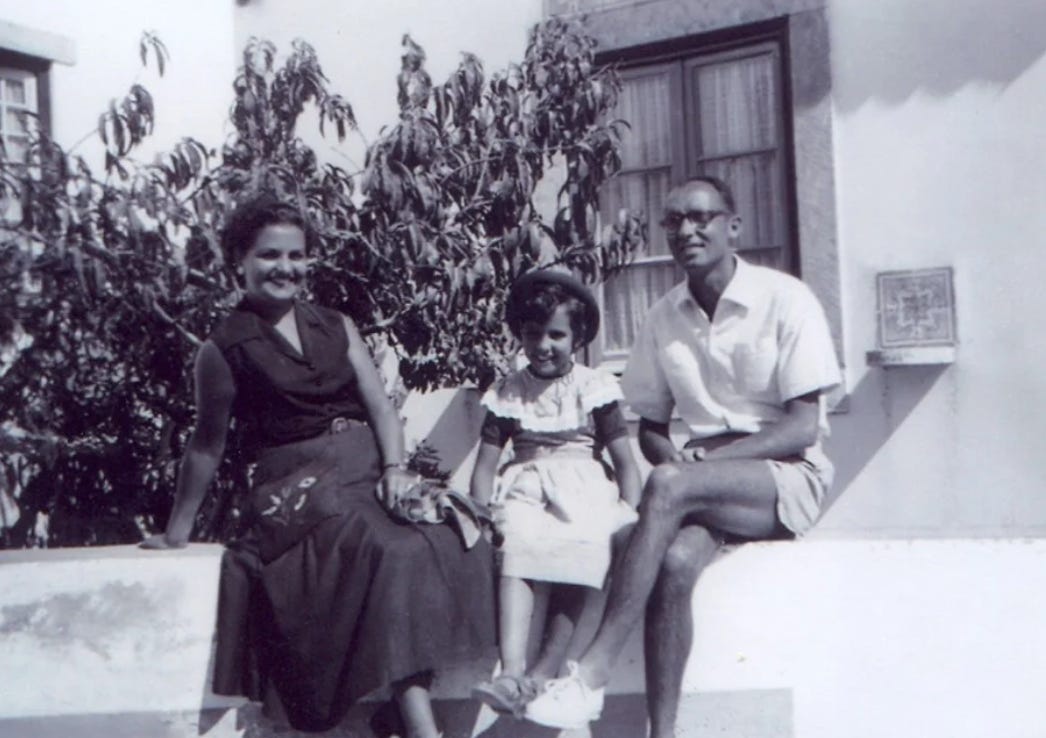
Personal life/relationships
1944 - marries typist and artist Ilda Reis.
They have one child, Violante, born 1947 - she is now 78 and a biologist.
The couple divorced in 1970.
Reis died in 1998, having become a successful engraving artist.
Begins an affair in the late 1960s with the writer Isabel da Nobrega, who he then had a 20 year relationship with.
Two of his books, O Ano da Morte de Ricardo Reis (1984), and Memorial do Convento (1985), were dedicated to her.
He later removed the dedications from subsequent editions after their relationship ended (I find this a hilariously petty decision!!)
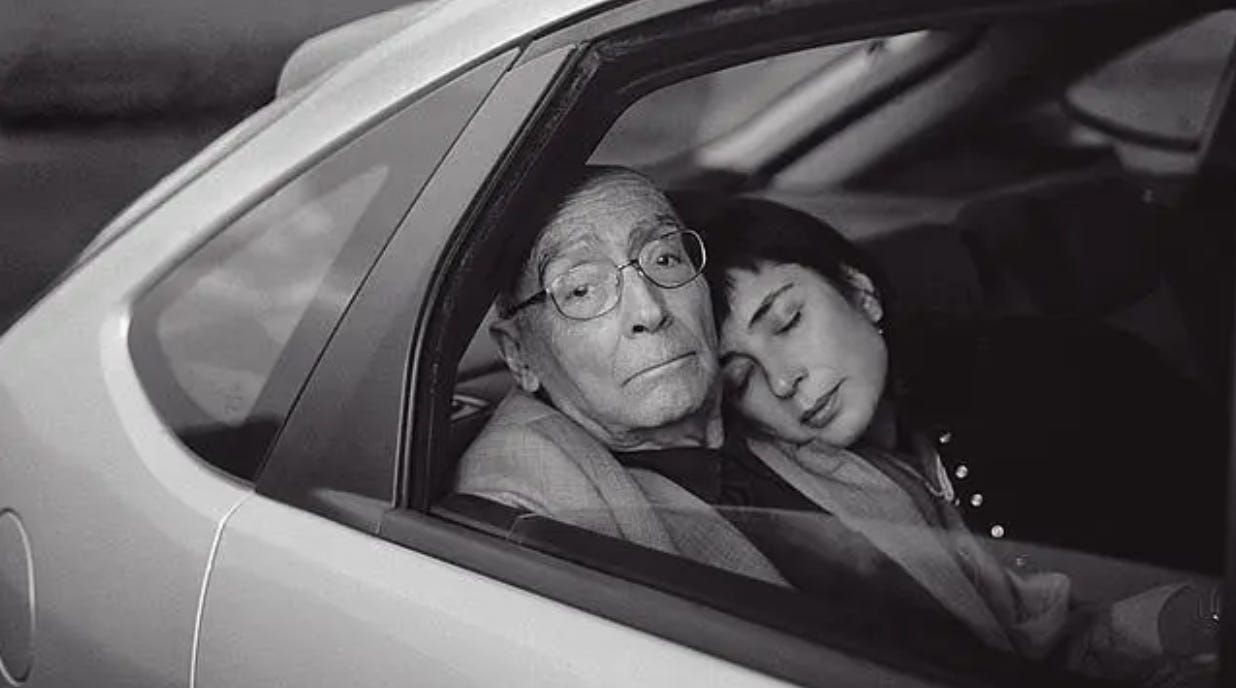
1986 - meets Spanish intellectual and journalist Pilar del Rio, who was 27 years younger than him, and immediately ends his 20 year relationship with da Nobrega.
Marry in 1988 and are together until his death in 2010.
Del Rio is the official translator of Saramago’s books into Spanish.
A 2011 documentary was made on their relationship - available to watch on Youtube.
Politics/views
Joined the Portuguese Communist Party in 1969 and was a member until his death.
Atheist. Was publicly criticised by the Catholic Church for the content of some of his books, particularly The Gospel According to Jesus Christ, where he uses humour and satire to describe God.
Portuguese government spoke out against this book and struck the writer’s name from nominees for the European Literature Prize.
The Vatican City criticised Saramago’s choice as Nobel Prize winner for Literature.
Writing style
Writes in long sentences, sometimes over a page, and uses full stops sparingly.
Experimental - his works often refer to his previous works.
Described his daily writing routine in 2009: “I write two pages. And then I read and read and read”.
About Blindness
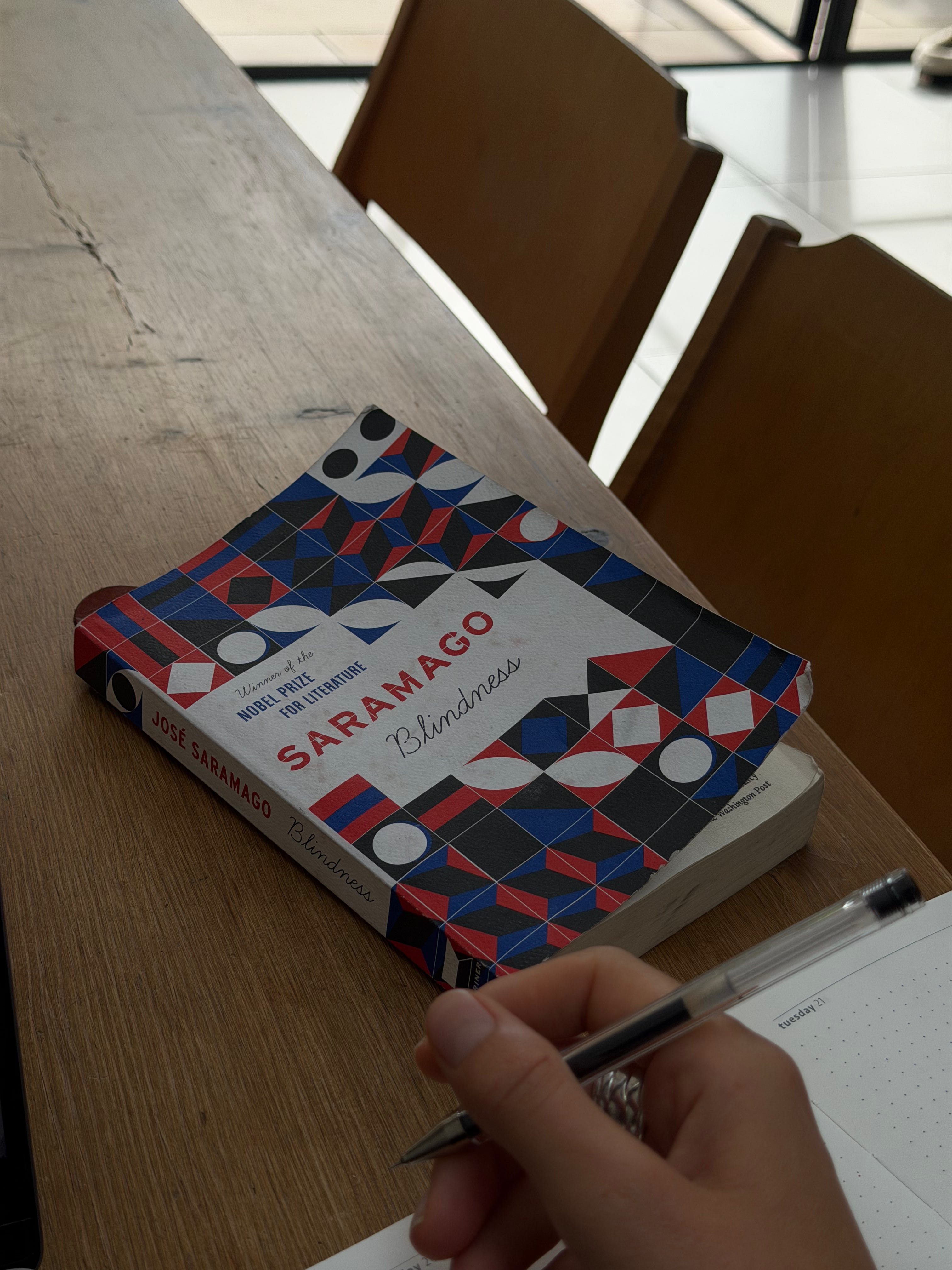
Published in 1995.
Translated to English in 1997 by Giovanni Pontiero.
The book centres on an unexplained mass epidemic of blindness afflicting nearly everyone in a nonspecific city, and follows multiple unnamed characters as they navigate the social breakdown that swiftly follows.
The city is never identified but there are some hints that it is somewhere in Portugal - the main character is shown eating chouriço, a spicy sausage, and some dialogue in the untranslated original book employs the familiar “tu” second-person singular verb form, which is unique to Portuguese spoken in Portugal.
Characters
The Doctor’s wife - the only character who does not lose her sight
The Doctor - an ophthalmologist
The Girl with dark glasses
The old man with the black eye patch
The dog of tears
The boy with the squint
The car thief
The first blind man
The first blind man’s wife
The man with the gun
The blind accountant
Style
The book completely abandons the use of proper nouns, instead referring to characters simply by some unique characteristic.
Contains many long passages in which commas take the place of full stops, quotation marks, semicolons, and colons.
Sequel
Saramago wrote a sequel, Seeing, published in 2004 - features many of the same characters but with a more realistic/positive solutions posed at the end.
Still from the 2008 film adaptation of Blindness. Film adaptation
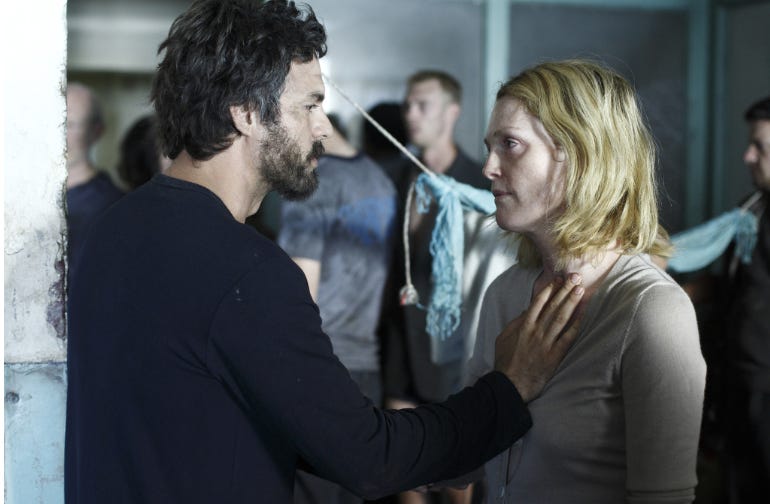
Adapted into a film in 2008 with Mark Ruffalo as the doctor and Julianne Moore as the doctor’s wife.
Saramago did not initially want to sell the film rights, saying “I always resisted because it’s a violent book about social degradation, rape, and I didn’t want it to fall into the wrong hands.”
He refused to sell the rights to Whoopi Goldberg and Gael Garcia Bernal.
The screenwriter Don McKellar visited Saramago at his home in the Canary Islands and spent two days convincing him to sell him the rights.
Saramago’s conditions for sale were that the film should be set in a country that would not be recognizable to audiences, and that the Dog of Tears should be a big dog.
Brazilian director Fernando Meirelles directed, and decided to do an English adaptation to appeal to a wider international audience.
Cast and crew, which included 700 extras, were all taught to simulate blindness.
At a private screening of the film, Saramago said “Fernando, I am as happy to have seen this movie as I was the day I finished the book.”.
The film was critically well received but led to protests from the blind community who worried people would believe all blind people behaved in a ruthless, uncivilized way.
Saramago responded explaining that in the book blindness is an allegory, a “blindness of rationality” - he said “stupidity doesn’t choose between the blind and the non-blind”
Further reading
Other articles, videos, and podcasts I listened to whilst reading and researching the book.
Jose Saramago, a life of resistance, BBC doc from 2002, 29 minutes
Jose Saramago’s House-Museum in Lanzarote, tour of Saramago’s house museum
Entrevista a José Saramago (1ª parte ) Portuguese interview with Saramago
José e Pilar - Documentário - 2011 doc on Jose and Pilar’s relationship, 2 hours (unfortunately in Portuguese!)
José Saramago Foundation - website of the Saramago foundation
José Saramago – Biographical - NobelPrize.org - Jose’s biography in his own words
New ways of seeing | José Saramago | The Guardian - on Blindness, 2008
Paris Review - José Saramago, The Art of Fiction No. 155, 1998
José Saramago, the Unexpected Fantasist, New York Times, 2007
Still a street-fighting man | José Saramago | The Guardian, 2006 - his first interview with an English newspaper
On Blindness:
Analysis of José Saramago’s Blindness – Literary Theory and Criticism
Have You Read This? Podcast, 2024
Upcoming Events/News
We announced our biggest Buffy’s event last month, the Buffy’s Summer Fair. Gathering ten independent publishers, the fair will take place at London’s Ladbroke Hall on Saturday, July 25th. I made videos highlighting each of the publishers which will be at the fair, and these will be posted over on the Buffy’s Instagram over the next few weeks.
We were able to add a few more tickets, so there is a limited number available here.
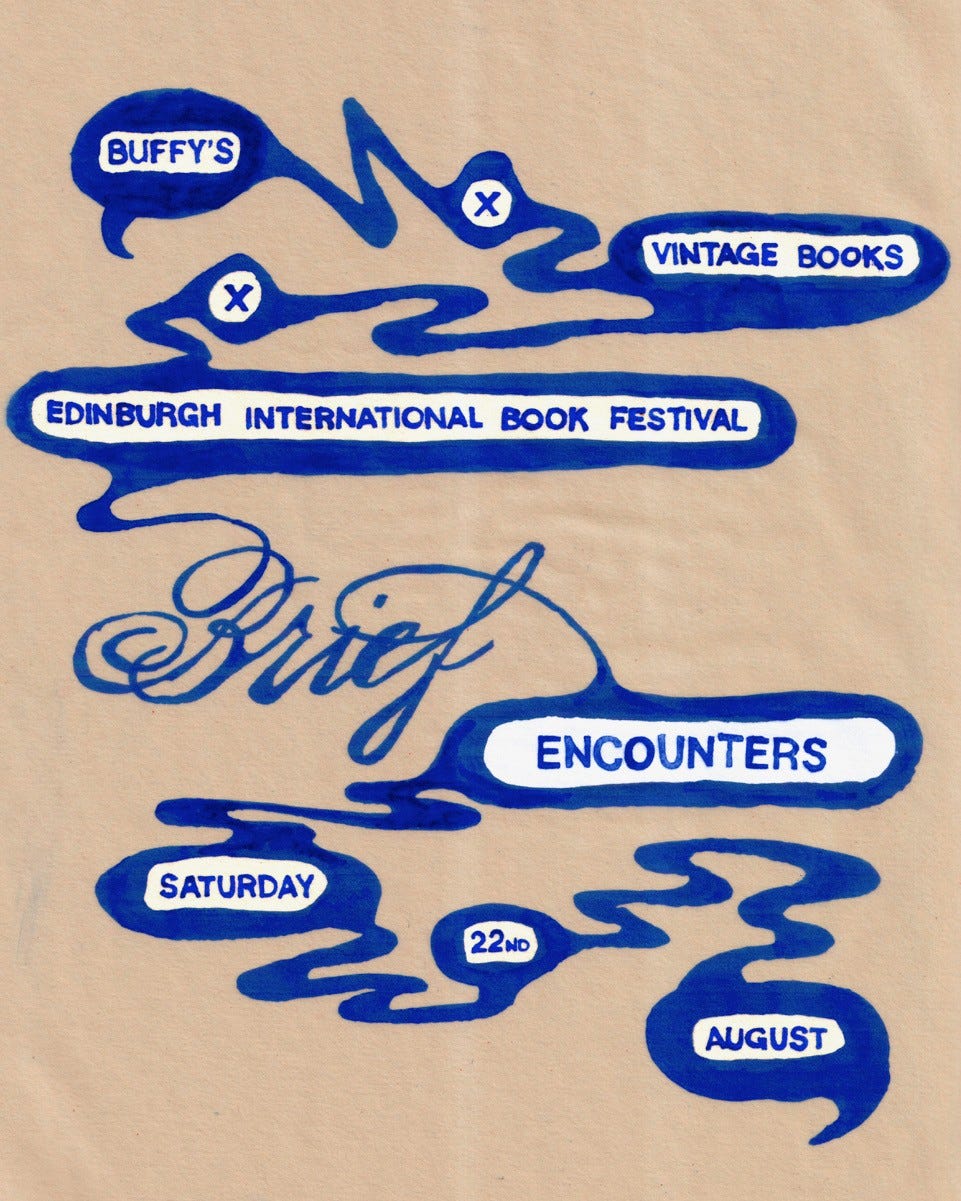
We are returning to the Edinburgh International Book Festival for the second year in a row. This time with an even bigger event, in collaboration with Penguin Vintage.
Join us on Saturday August 22nd, from 6-8pm, at this special Edinburgh event to sip, socialise, and compare TBR lists with other discerning book lovers in celebration of Vintage Classic’s Brief Encounters collection. Enjoy a drink on us as Vintage’s ‘Bibliotherapists’ pair you with the perfect short novel for your taste – whether that’s an Edith Wharton ghost story or a lesser-known gem by Virginia Woolf – which you’ll take home with you.
Tickets available to buy here.
Thanks for reading Buffy's ! This post is public so feel free to share it.
Additional research by Agnes Perotto-Wills.
Comments
Nothing yet. Say the first thing.
Sign in to join the conversation.