
This is the third in a series of guest posts spotlighting work across the Buddhism and AI landscape. This post was authored by Jane Compson, who is an Associate Professor at the University of Washington Tacoma where she studies the application of contemplative techniques and Buddhist thought in contemporary secular contexts such as medical ethics, education, and artificial intelligence ethics.
You are probably very familiar with the feeling – somehow, despite your best intentions, you have found yourself scrolling through content on your phone for much longer than you feel is good for you. One reel, one post after another, and then another one pops up and you just have to look at it. You are starting to feel restless, irritable, perhaps annoyed with yourself for wasting time, but yet somehow it’s hard to stop – just one more click and the next watch or read may be more satisfying. It rarely is.
Buddhist teachings mapped this state of mind many centuries ago. It is described as symptomatic of living in the Hungry Ghost realm, and it is embedded, along with other states of suffering, in a single image called the Wheel of Life or the Wheel of Becoming (Bhavacakra).
This image is considered significant enough that it is found in countless Buddhist temples and sacred spaces. The wheel represents the cyclical nature of existence, saṃsāra, and the causes and conditions that keep the cycles of our lives and our everyday experience spinning. It is more than just a depiction of the nature of existence, but is also a map of how to become liberated from the cycle that keeps bringing us back to suffering. It is both descriptive and prescriptive. Different kinds of existence or experience are represented by the six sections or segments of the wheel. For many Buddhists these realms are understood literally as states into which one can be reborn in future lifetimes – in this sense it is a cosmological map. For others, it can also or instead be seen as a psychological map. On this understanding the realms describe possible states of mind—each one characterizes a mode of experience available to us in any given moment. Whether its six sections represent actual existences or recurring psychological states, the fundamental point is the same: suffering is present in every realm, and no lasting peace is available within the wheel’s turning. The good news - there is an outside to the wheel. This tells us that liberation from the treadmill of suffering is possible, and there are clues in the image about how to do this.
As a pictorial representation of Buddhist teaching, this image also gives us a mind-map for thinking about how these teachings might apply to AI and how in some ways it depicts our relationship with AI. There are many ways to do this, from a macro lens which considers how AI interacts with geopolitics, economics, and social structures, to the micro which focuses on our individual relationship with AI. This post will focus on the latter, using the example of AI recommender algorithms on social media to illustrate how the Wheel of Life can help us understand how AI can keep us bound up with suffering, and how it can point to ways out of this cycle.
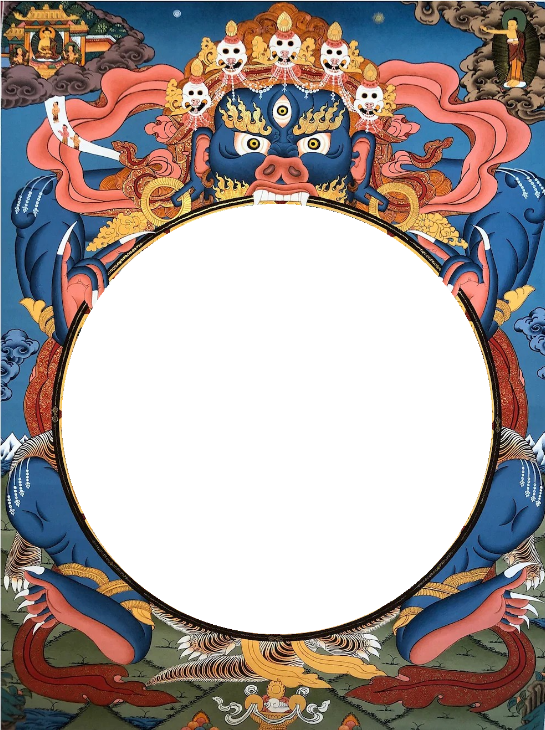
The fearsome being holding the wheel in its jaws and claws is Yama, the Lord of Death, representing the truth that everything within the wheel is impermanent and insecure, in a state of constant flux. Anybody paying attention to the roll-out of AI must surely now be familiar with this insecure feeling of groundlessness, of the instability and insecurity that accompanies the rapid social, cultural and economic changes coming with AI. Everything is overshadowed by existential impermanence.
In the Wheel of Life, the conditioned nature of existence is depicted by the outer rim of the wheel, which contains the twelve links of dependent arising. Outside the cycle, beyond Yama’s grip, stands the Buddha pointing at the moon—depicting the possibility of nibbāna, the realization of the unconditioned and the cessation of suffering. Escape from the wheel is possible, but not through chasing immortality. How do we gain liberation, then? To do this we must understand what causes the wheel to turn in the first place.

At the very hub of the wheel, three animals depict the fundamental energies fueling the cycle: a rooster (greed, lobha), a snake (hatred, dosa), and a pig (delusion, moha). These are collectively known as the three poisons or unwholesome roots. Crucially, they are shown biting each other’s tails—they do not exist independently but, like everything else in the wheel, arise in dynamic, mutually reinforcing relationships. The location of these three poisons at the very center of the wheel is significant – they are what drive its spinning.
Buddhist teachings point to an alignment problem in our minds and lives; we want to be free from suffering, but we keep acting and thinking in ways that lead to more suffering. Greed, hatred and delusion are at the root of this mis-alignment. In our ignorance, we fail to see how what we are doing is not working for us; we become aversive to the things that we don’t like, and greedy for the things we do like, but acting out like this does not end our pain – in fact, it worsens it. This is the nature of the wheel of existence – it is always in motion, and as long as our thoughts, deeds and actions are motivated by greed, hatred and delusion, then suffering will always be present.
Without addressing the roots, AI becomes a force-multiplier in this process, actively amplifying human values and intentions at great scale.
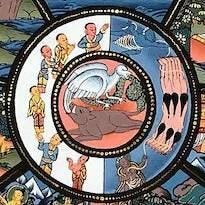
The ring immediately surrounding the hub depicts the consequences of these energies: on one side, beings are ascending toward more wholesome states; on the other, they are descending toward more painful ones. The direction of travel is not fixed by fate but determined by karma—whether our intentional actions of body, speech, and mind are infused with greed, hatred and delusion, or not.
Let’s think about AI-enabled social media algorithms. The values baked into them are not associated with the quest to alleviate suffering, but ultimately capital accumulation. The means to this end is through attention capture – the more time users spend on a platform, the more data can be harvested about their preferences and user habits, the easier it is to make personalized targeted advertisements, and the more likely the users are to spend and help to generate revenue, profit and shareholder value for the companies advertising, or indeed, for the ideologies searching for followers. The technological affordances of AI systems make them extremely efficient at attention capture. Novelty and stimulation, social comparison and validation, emotional arousal, personalization, ‘frictionless’ and infinite scrolling are all by design compelling.
It is not difficult to see the roots of greed, hatred and delusion here. The algorithms are both predicated on and designed to generate craving, manipulating our attention and intentions so that we always want more. Outrage and anger are engaging – our capacity for hatred is recruited in this quest for engagement and revenue creation. Delusion shows up in countless ways, from ‘filter bubbles’ to fake stories to mindless ‘infotainment.’ These distractions and distortions ultimately turn our attention away from that which actually alleviates suffering, keeping us bound within the six realms of cyclical existence.

The God or deva realm is associated with pride and complacency: its existence is one of pleasure and ease and its suffering is subtle, coming mainly from the fact that eventually this pleasant state will end. On a psychological interpretation, the realms represent a state of mind, so the God realm depicts those times when we are on top of the world and feeling good; the only ‘buzz-kill’ comes from the nagging knowledge that this feeling won’t last forever. In terms of digital engagement, the God-realm is when the algorithms may be providing us with exactly what we want.
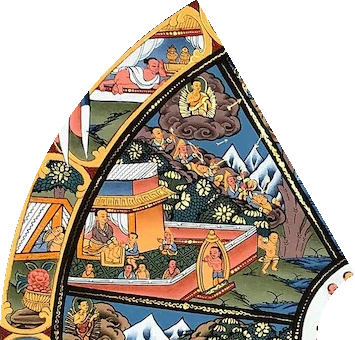
The realm of the titans or jealous gods (asuras) is associated with jealousy or envy, because they can see that the Gods have more. In this segment the titans are firing arrows at the gods, and somebody is trying to chop down a tree that is growing there; this points to the angst of comparison, competition, envy or resentment. In the digital realm, this is shadow side of influencer culture – FOMO, keeping up with the Joneses, trolling, ever-escalating efforts to better the feats, appearance, accomplishments and the follower counts of others, or expressing delight in the misfortunes or failures of others.
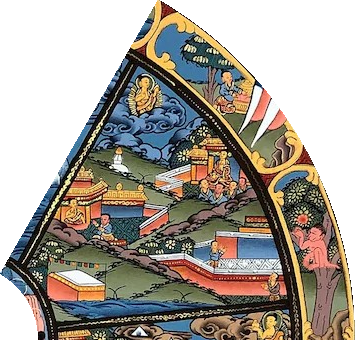
The human realm occupies a particularly significant position: it is described as the realm uniquely suited to spiritual development, because it contains sufficient suffering to motivate practice and sufficient capacity for reflection to pursue it. This realm might represent measured and thoughtful digital engagement with intention and discernment that uses the technology for genuine connection, collaboration and creativity which furthers pro-social and compassionate relationships.
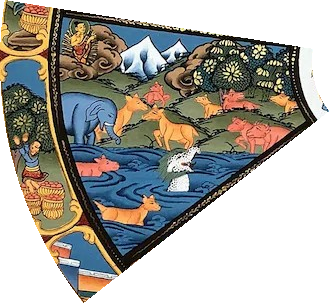
The animal realm is associated with delusion or dullness, in the sense that the beings there are seeking satisfaction of their basic needs, instincts and habits without questioning or awareness. In terms of our digital engagement, this realm could be a metaphor for our mindless scrolling, being in pure stimulus-response mode, with no reflective awareness or active intention. This has the quality of a kind of tunnel vision, where we are not open to what is going on around us. The attention-capturing power of the algorithms creates and amplifies this tunnel effect.

The hungry ghost realm represents craving and addiction. Beings in this realm are presented as having enormous stomachs, representing huge appetites, by tiny throats, meaning that they are unable to satisfy these appetites and are always hungry, compulsively seeking more. When they do eat, they do not even taste the food, and keep seeking the next meal. This is the state of mind described in the opening of this post – the compulsive consumption of digital content, despite the fact that it is unsatisfying. In fact, the algorithms are designed to keep us in the mental state of the hungry ghost, always wanting to consume more.
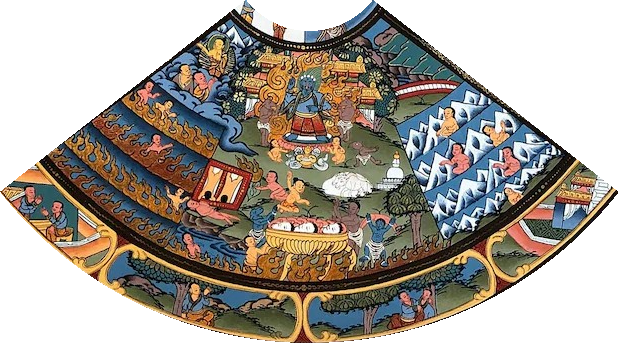
In the hell realm, beings are dominated by hatred and rage, such that every moment is tormenting. Beings are depicted in cold and hot hells, symbolizing perhaps the cold of isolation, numbness, loneliness, and the heat of rage and anger. This could represent a profoundly negative side of our digital engagement – cyberbullying, pile-ons, rage-baiting, AI-induced psychosis, compulsive doom-scrolling, and so on.
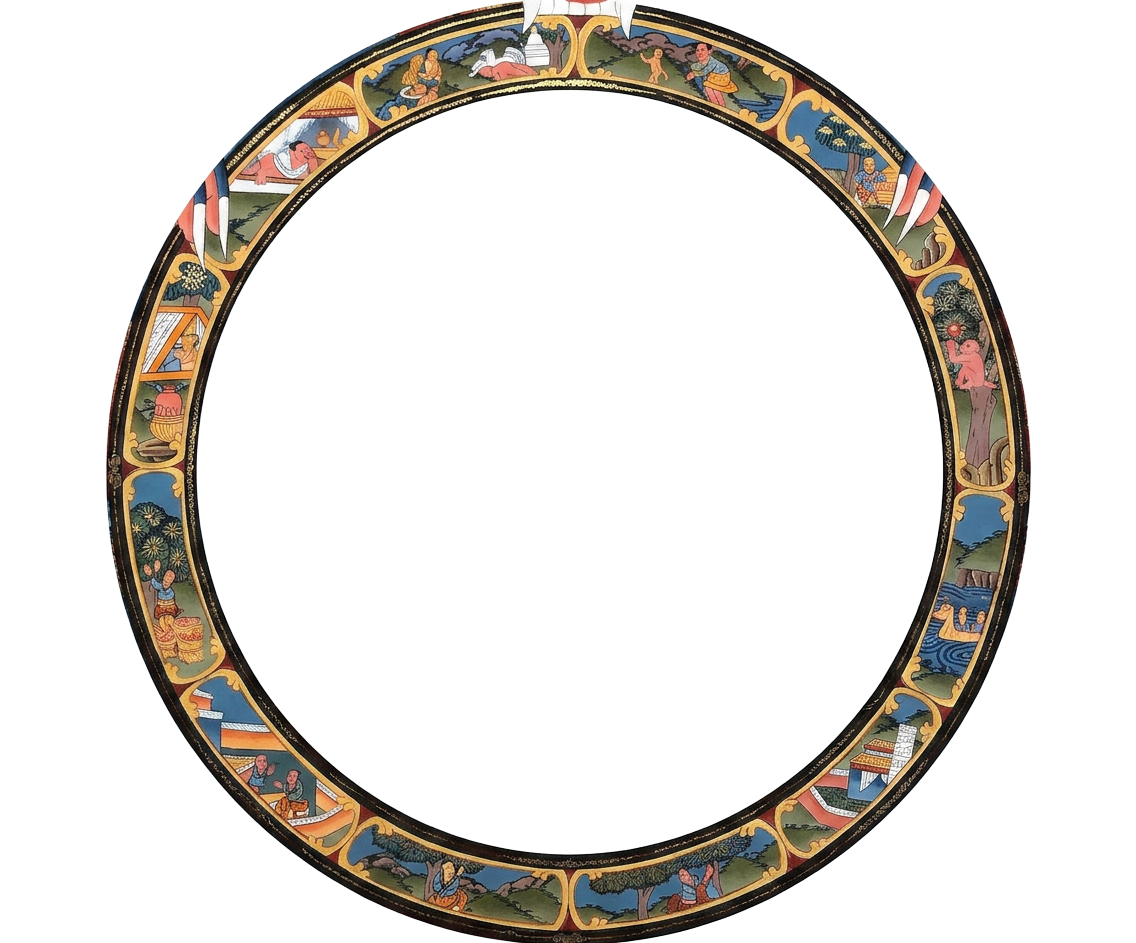
The outer rim displays twelve images corresponding to the links of dependent arising (paṭiccasamuppāda), illustrating how the energy of one moment—conditioned by greed, hatred, and delusion—gives rise to the next. Our experience is a chain of conditioned moments: each is shaped by what came before. The crucial hinge is the moment between feeling and craving—this is where the wheel gains its momentum into the future.
AI inserts itself into that chain. Just as our past engagement conditions what appears on our screens now, the content served to us isn’t neutral: it is designed to maximize engagement and provoke a strong feeling-tone, reducing the chance of a reflective pause between stimulus and response—a pause that, in Buddhist terms, is a precondition for breaking the cycle of suffering. The moment of contact has been deliberately engineered to be maximally compelling. As the six realms showed, the target states tend to be grounded in greed, hatred and delusion. All of them capture attention, which converts to capital accumulation—and to karmic accumulation, since the more we attend to such content, the more likely we are to meet it again.
The same conditioned processes that drive the wheel’s turning can also, when redirected, lead away from suffering. This is described as transcendental or positive dependent arising and is not a closed cycle but a spiral, with each step representing increasing liberation from the pull of saṃsāric existence. Rather than greed, hatred, and delusion as its energizing roots, this liberative process is powered by their opposites: generosity or contentment, friendliness, and wisdom. This is how we begin the process of being liberated from the cycle, and the crucial pivot point is in the space between feeling and craving.
Just as AI can be used to engineer high-intensity, craving-generating stimuli, it could in principle be designed to create the conditions for reflection at the critical feeling-craving gap. Buddhist psychology distinguishes between wise attention (yoniso manasikāra), which lengthens the space between feeling and response, and unwise attention (ayoniso manasikāra), which collapses it, pulling us from stimulus to craving before reflection can arise. This unwise attention is compounded by mental proliferation (papañca) – the tendency of the mind to spin elaborate stories, to ruminate or perseverate in ways that escalate stress. AI recommendation algorithms function as engines of both unwise attention and mental proliferation. Rather than creating the reflective space in which a feeling can be recognized as impermanent and released, they surface content that feeds and extends whatever emotional elaboration is already underway, ensuring that what might naturally subside instead intensifies into craving. AI could also be used to create stimuli that support alignment with contentment, friendliness and wisdom, rather than greed, hatred and delusion. Indeed, many efforts in this direction are underway.
When we look at the Wheel of Life, it is easy for our eyes to be drawn to the fearsome Yama, and the wheel he consumes. Yet the figure of the Buddha, pointing to the moon, indicates the purpose of the whole image – it is a map that shows how we get entrapped, but also how we can escape. The very same conditioned processes that keep the wheel spinning and generating suffering, can also work in the direction of liberation from that entrapment. The extent to which our energies and intentions are driven by greed, hatred and delusion, or by their opposites of generosity/contentment, friendliness and wisdom determines whether the cycle is entrapping or liberative. AI has made this more true - the algorithms that engineer our collective attention are not natural forces but were built by people, in pursuit of particular values, and they can be challenged, regulated, and reimagined. This must be a collective effort, and as the Wheel of Life depicts, must begin with seeing how we are implicated in the spinning of our own futures.
Share Buddhism & AI Initiative
—
Jane Compson is Associate Professor in the School of Interdisciplinary Arts and Sciences at the University of Washington, Tacoma, where she teaches religious studies and philosophy. She studies the application of contemplative techniques and Buddhist thought in contemporary secular contexts such as medical ethics, education, and artificial intelligence ethics. She is a Buddhist chaplain with lay ordination from the Zen Peacemaker Order, and a Research Fellow with the AI and Faith organization, a non-profit bringing the wisdom of faith traditions to conversations around AI ethics. She is currently working on a book about Buddhism and AI.
No posts
Comments
Nothing yet. Say the first thing.
Sign in to join the conversation.