

You know that moment when your partner does not reply for a few hours, and suddenly your mind starts questioning the entire relationship?
Not because something has actually happened.
But because your mind starts filling the silence with possibilities.
Did I say something wrong?
Are they upset with me?
Are they pulling away?
Am I too much? Or not enough?
This is one of the quieter forms of relationship anxiety.
It often does not begin with a real problem.
It begins with the story we create around an ordinary moment.

Sam and Lily have been together for two years.
They are good together. They laugh often, communicate well, and talk about their future.
Nothing is wrong.
But notice what happens during one ordinary evening.
4:12 PM
Lily: “Heading into a meeting, talk later?”
Sam: “Okay, good luck ❤️”
7:45 PM
No reply.
8:10 PM
Sam thinks she’s probably busy.
But opens Instagram anyway and sees that Lily was active 12 minutes ago.
The mind immediately reacts:
Wait. She was online. Why didn’t she text me?
8:27 PM
Sam feels a tightness in their chest.
Did I say something weird earlier?
Is she pulling away?
Am I too much?
Or not enough?
8:40 PM
Sam types:
“Is everything okay with us?”
…then deletes it.
Then types:
“You good?”
…then deletes that too.
On the outside, nothing is happening.
On the inside, it feels like everything is happening.
Later, Lily calls, cheerful but tired.
“Sorry, the meeting went on forever. What’s up?”
Sam says, “All good.”
But Sam does not feel all good.
There is relief, but also embarrassment.
Why did I spiral so quickly?
Why did I assume the worst?
Why could I not just stay calm?
And sometimes, that unspoken fear later comes out as irritation, distance, silence, or a completely unrelated argument.
The fight may look like it is about one small comment.
But often, it began much earlier with the meaning the mind gave to the silence.
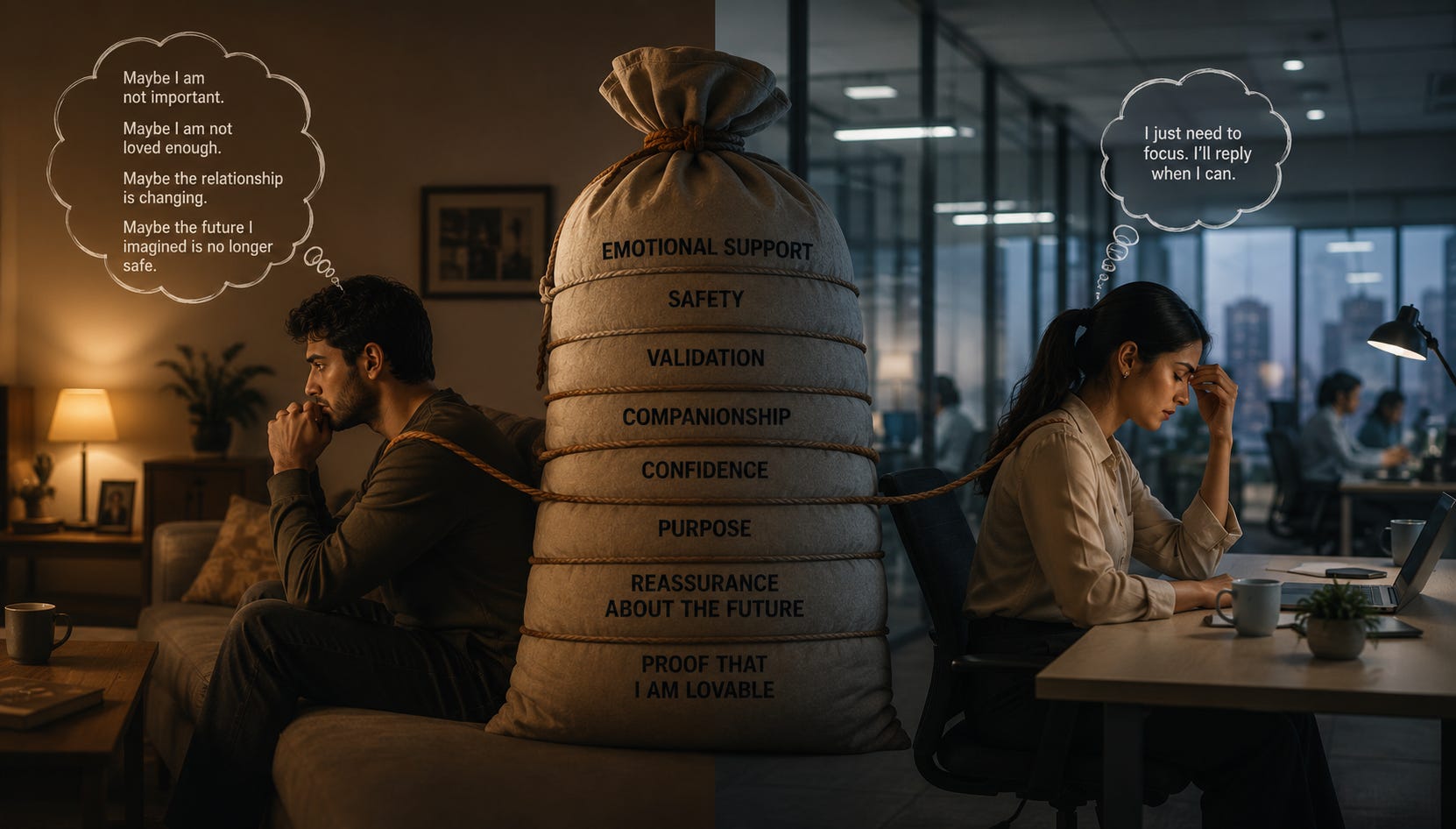
Sometimes relationship anxiety is not irrational.
It is overloaded.
Without realising it, we may expect one person to become our main source of:
emotional support
safety
validation
companionship
confidence
purpose
reassurance about the future
proof that we are lovable
Then a delayed reply is no longer just a delayed reply.
It can begin to feel like:
Maybe I am not important.
Maybe I am not loved enough.
Maybe the relationship is changing.
Maybe the future I imagined is no longer safe.
That is a lot of emotional weight for one message to carry.
The fear is not always about what your partner did.
Sometimes it is about the job you have unknowingly given the relationship.

This may sound strange, but many people are more familiar with tension than peace.
If you have spent years expecting disappointment, rejection, distance, or emotional unpredictability, calm may not immediately feel safe.
When things are going well, the mind may start asking:
What if this does not last?
What if I relax and then get hurt?
What if I am missing a warning sign?
So the mind stays alert.
It watches tone, timing, punctuation, facial expressions, and online activity.
It tries to prepare for pain before pain arrives.
This does not mean you enjoy overthinking.
It may simply mean that some part of you believes:
If I stay alert, I will be protected.
But constantly preparing for heartbreak can also stop you from fully experiencing love.

Relationship anxiety is not always created by one major event.
Sometimes it is strengthened by small daily habits.
You may find yourself:
checking when they were last online
reading meaning into one-word replies
analysing emojis, punctuation, or tone
counting who called or texted first
silently keeping score of who cares more
trying to appear calm, attractive, interesting, or “easy” at all times
hiding your real needs because you are afraid of being too much
None of these may look dramatic from the outside.
But together, they can make the relationship feel less like a shared space and more like a daily evaluation.
When love starts feeling like a test, anxiety becomes the preparation.

The next time you feel yourself spiralling, try this before sending the message, withdrawing, or starting an argument.
Instead of asking:
“What is wrong with this situation?”
Ask:
“What am I expecting this moment to prove?”
Perhaps you are expecting one reply to prove that you matter.
Perhaps you are expecting your partner’s mood to confirm that the relationship is safe.
Perhaps you are expecting one evening together to remove your loneliness.
Perhaps you are expecting their attention to prove that you are lovable.
Try saying:
“I may be asking this one moment to carry more than it can.”
That does not dismiss your feelings.
It simply helps you understand why the moment feels so intense.
Take 30 seconds and write down two things.
The fact: What actually happened?
The story: What has your mind added?
For example:
Fact: They have not replied for two hours.
Story: They are losing interest in me.
Fact: They sounded tired on the phone.
Story: They are unhappy with me.
Fact: They changed the plan.
Story: I am no longer important to them.
Your story may need a conversation later.
But it is not automatically a fact.
Ask yourself:
“If I reacted only to what I know, instead of what I fear, what would I do differently?”
You are not forcing yourself to think positively.
You are simply allowing reality to become clearer before fear takes over.
Think of one thing you are asking the relationship to carry completely.
Then move a small part of that need outward or back toward yourself.
If your partner is your only source of emotional support, share one small concern with a trusted friend, journal, counsellor, or community.
If the relationship has become your main source of meaning, do one thing this week that matters to you independently learn, create, help someone, move your body, or spend time with yourself.
If you are waiting for your partner to confirm your worth, complete this sentence each day:
“I mattered today because…”
Let the answer come from something you handled, offered, learned, created, or became.
Not only from how someone responded to you.
This does not mean loving your partner less.
It means allowing the relationship to support your life without asking it to carry your entire identity.
Let the relationship be a pillar.
Not the entire building.
The safer you begin to feel within yourself, the less every pause, delayed reply, or change in tone will feel like a threat.

So, my beautiful beings, tell me in the comments:
Which job are you ready to stop asking your relationship to carry your worth, your peace, or your entire sense of belonging?
With love,
Dr Monika Singh Shubhaa
No posts
Comments
Nothing yet. Say the first thing.
Sign in to join the conversation.