
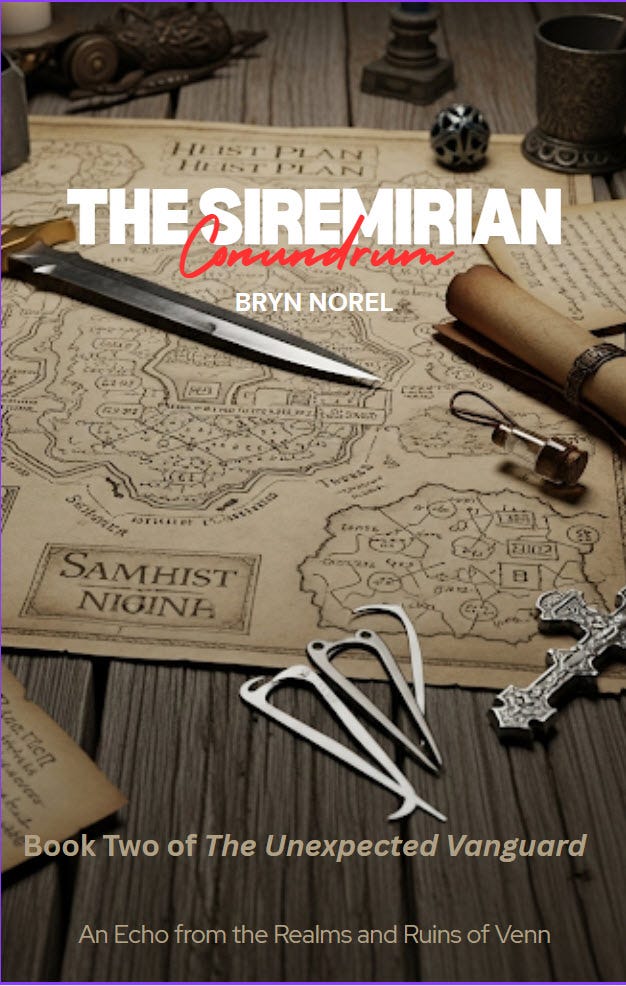
The Unexpected Vanguard: A Tactical Epic Fantasy trilogy for fans of The Lies of Locke Lamora and Six of Crows. In Book 2 - The Siremirian Conundrum, A found family of unremarkables is forced into a high-stakes game of cat-and-mouse after unwittingly stealing a powerful meteorite from an evil and powerful mark.
The Siremirian Conundrum is a serialized novel. If you’re new here, go back and read Book 1 - The Glimmerstone Enigma, first!
[View the Table of Contents for The Siremirian Conundrum]
As the shadows of the Glimmerstones pushed east in the fading daylight, the group gathered around the fire, sharing a meal of provisions. The occasional crackle and hiss of the flames served as a backdrop for long stretches of silence until Segwyn spoke up.
“Hey, I forgot to congratulate you!” he said to Lunish. “For defeating the familiar all by yourself – I heard it was an epic aerial battle!”
Lost in thought, her gaze fixed on the fire’s dancing embers, the gnome returned to the moment. “What? Oh, thanks.”
The ranger didn’t let it go. “Hard to believe it was only a few nights ago we sat around this same fire, trying to convince you to think differently about combat, and here you are, the first one of us to take down a demon single-handedly.”
Lunish’s cheeks flushed. “It was only the familiar. The little bastard didn’t even attack me.”
Whydah swiped an errant spark away from her face before cocking her head towards Glynfir at the mention of the tiny servant demon. “Speaking of him, will he remember seeing us and blab about it to the Red Queen when she conjures him up again?”
The wizard shook his head. “Not at all. Because a familiar is a magical conjuring in the form of a creature, it doesn’t have any persistent memory from one summoning to the next.”
Whydah nodded in acknowledgement. “And it can’t voluntarily communicate with its master either, right?”
“Correct,” the wizard confirmed. “The caster can initiate mental communication, and the familiar can respond, but it can’t start the conversation. Also, I can see through the eyes of my familiar if we are close enough.”
“So, if he ever sees us, we have to make sure to take him out, or the lich will know what he knows?” Bird verified.
“Yes, to a degree,” Glynfir replied, one finger tapping his chin in concentration. “The familiar’s intelligence also limits its ability to communicate.” The wizard paused, his eyes widening before turning to Lunish. “That reminds me, did we share the news about the Red Queen’s true nature with Snuggles?”
The druid shook her head. “I can’t, yet. I already messaged her today. But it’s a good question. What do we want to tell the Hub about what we learned and what we’re doing next?”
“Can anyone think of a reason not to tell them that the Red Queen is a lich?” Segwyn asked.
Tsuta shook his head. “I think it only helps. We know they aren’t part of this Crimson Dominion–Snuggles was the one who told us about it. In my opinion, the more people who know a lich is calling the shots, the better.”
“I agree,” Glynfir nodded. The wizard stood, brushing flecks of ash from his robes before extending his hands towards the fire’s warmth. “What I just can’t fathom, as a wizard myself, is what would make someone decide that giving up everything you are as a person, including your sanity, is a good trade for immortality and the pursuit of power, especially when it involves exploiting or hurting others.”
Tsuta grunted a hollow chuckle through closed lips before speaking. “You have to understand, Mustache, that anyone with designs on becoming a lich isn’t like you.” The monk thumbed the points of the medallion around his neck, causing it to glint in the firelight. “My holy training would insist there is a fundamental spiritual corruption at play, as well as a human perspective that is very different from yours.”
The wizard was skeptical. “That sounds more divine than psychological.”
“It’s definitely a bit of both,” Tsuta countered. “No one ever considers themselves the villain in their version of the story,” he said matter-of-factly. “Because if they did, they’d arrive at your very logical conclusion. Narcissism, delusion, call it what you want, but every person choosing ‘lich’…,” he made accompanying air quotes with his fingers, “…inherently believes they’re superior to others and that achieving their desired outcome is more important than the lives of anyone who may be harmed in the process.” He paused, sliding a hand over his bald head. “In their mind, they’re entitled to it. The end is all that matters; the means of getting there…” he waved his hand dismissively, “…immaterial. To them, the villain is anyone standing in the way of realizing their ambition. That’s the psychological dimension.”
“Where does the divine come in, and what about the insanity?” Whydah probed.
The bald monk shrugged. “Their arrogance is so great, I think they honestly believe they can defeat it, that it won’t happen to them because they’re too powerful, but it’s an immutable law of nature. You can’t cheat mortality without corrupting your soul. That’s the divine element, which, in turn, drives insanity. Remember, while it’s obvious to everyone else they’re the villain, in their mind, they’re the hero.”
He raised his arms in a gesture to the heavens. “Only they are capable of ruling effectively, only they can bring peace, and so on and so on. When you start with a big helping of raw power, entitlement, arrogance, and an inherent superiority complex, then add soul corruption and insanity to the potion…” Tsuta pressed his lips in a tight line, raising his palms.
“It sounds like we agree on telling the Hub that a lich is running the Crimson Dominion,” Bird summarized. “The biggest threat to any secret organization is exposure, but we also need a way to recognize them. So far, all we have is the name.”
“No, we have more than that,” the wizard said thoughtfully. “We have the symbol.”
“What symbol?” Whydah asked.
Seeing confusion on the faces around the fire, Glynfir took a deep breath. “On our last mission before coming here, we were tasked with confirming the details of Commander Duvall’s will, over in Chagrothlond.”
“Yes, you told us that already.” Segwyn’s tone urged the wizard’s storytelling forward.
“We were also asked to identify any strange symbols present on the document,” Glynfir continued, “which we did.” He turned to Lunish. “Didn’t she later confirm that symbol was associated with the Crimson Dominion?”
The druid cocked her head, her eyes narrow as she reflected. “I don’t think she ever actually said that, but it’s a reasonable inference under the circumstances.”
“What was the symbol?” Tsuta asked from across the fire.
Glynfir picked up a stick. “It was a line with a circle below it, like this.” He scrawled the symbol into the dirt next to the fire, as the others rose for a look.
Iskvold let out a sharp intake of breath, and her body went stiff.
“What is it?” Whydah placed her palm on her friend’s back, peeking around the drow’s rigid form to see the drawing.
Iskvold’s face contorted as she inhaled deeply, preparing to speak before reluctantly letting it out in silence. The others watched the firelight reflections dance against her obsidian skin until finally, words tumbled from her lips. “Do you remember I told you that I only have flashes,” she cleared her throat, “from my childhood life before the abbey, and my mother?”
“Of course I do,” Whydah reassured her.
The drow took a half step back. “In one of those flashes, I’m in a cave, or some other dark space, but it was natural, definitely not a house.” Her gaze was distant while her hands gestured wildly, trying to keep up with the images in her mind. “It was a gathering of some kind, and that symbol,” she pointed at the ground next to Glynfir, “was on a battle standard, black on red.”
“Do you remember anything else? Was your mother there?” Whydah coaxed as the others looked on in silence.
The drow closed her eyes, bowing her head. “I was very young…she must have been, but the only other thing I recall was the whole group repeating something in response to the main speaker’s words. I remember because I was learning Common and was surprised that I understood what they were saying.”
The bard’s words were soothing. “What was it? What were they saying?”
Iskvold hesitated, eyes still squeezed shut. “I think it was ‘From above, we serve. ’” Her eyes snapped open, and she shook her head. “That’s all I’ve got.”
Bird looked at Whydah. “We’ve seen that symbol before as well. Remember the two gentlemen we separated from their wealth back in Preeble? The tattoos?”
The halfling’s face lit up in recollection. “Green Hat and Red Beard!” She took in the confused looks as a need for further explanation. “Two guys we robbed at a pub had that symbol tattooed on the backs of their necks.” She pointed emphatically toward Glynfir’s illustration. “They weren’t even trying to hide it! They were also carrying swords, which you don’t see much in small towns, and were unusually flush with coin.” Her voice trailed off, and her hand instinctively rose to the pendant tucked under her jerkin. Pulling it out, she held it up into the firelight. The crystal sparkled with flashes of color across the spectrum.
“They had this too!”
Letting the pendant fall back against her chest, Whydah stepped away from the fire, returning with her pack. Plopping herself down, cross-legged, she dropped the necklace onto the ground in front of her before pulling out a pearl and an owl feather.
Recognizing material components when he saw them, Glynfir rose, circling the firepit to stand behind her. “What are you casting?”
“Identify. I’m so dense! I don’t know why I didn’t check right away,” Whydah muttered, pink arcane energy dancing from her fingertips as she started reciting the words of the incantation. She closed her eyes as her voice trailed off. Her left hand, clutching the necklace, pulsed with a bright pink flash, then the shadows of firelight returned.
“Well?” the wizard asked impatiently.
Whydah’s eyes flew open, landing on Bird, accompanied by a wide grin. “Oh, it’s magic, alright! Just give me a minute to make sense of it in my head.” Her brow furrowed, the smile ebbing from her face. “It allows the wearer to cast Suggestion three times per day, but it comes at a cost…”
“What’s Suggestion?” Iskvold asked before Bird spoke over her.
“What’s the cost?”
The halfling held their questions at bay with two raised hands before turning to Iskvold.
“It’s a basic charm spell that allows the caster to suggest something to a target, and they have to do it.” Pivoting to Bird, she added. “There is an inherently evil residue on it. I’m not quite sure how to explain it, but if someone good uses it, it will slightly diminish their ability to do what they do best temporarily.”
“I don’t know what that means…” Bird said flatly.
Whydah pursed her lips in thought. “So, if you used it, you might be a little noisier than usual, or a bit clumsier. For me, my pitch might be just a bit off for a while, my music less inspirational.” She frowned, not quite satisfied with her explanation. “It’s different for each person, and there’s something else. It’s some kind of key.” She paused. “No… not a key, more like a token. It grants the wearer passage, but not through a door, more like into a place or an area.”
The chirp of insects and the constant rush of the Shand filled the silence for several long moments as all eyes fixed on the dancing flames, digesting the recent revelations.
“What she saw,” Segwyn pointed to Iskvold, “sounds like a typical cult—secret gathering, chanting.” He waggled his index finger between Glynfir and Whydah. “But what you two are describing is much more widespread…even mainstream—tattoos, contract notations.”
“What I saw was almost twenty years ago.” Iskvold reminded him.
The ranger nodded in response. “My point is they’ve grown, evolved, somehow appealing to a much larger audience of followers.”
Lunish rose abruptly, stepping to the makeshift woodpile. Palming and launching a small log into the fire harder than necessary sent a shower of sparks into the air, causing everyone to lean back momentarily. “What I don’t understand is why anyone would knowingly support and assist a lich, one of the most evil, self-serving creatures imaginable. Are they stupid?”
Bird snorted. “That’s one of the things I love about you, my gnomish friend, you see the world in such simple terms–good and evil, right and wrong, black and white.” The tabby shot her a wide grin. “As someone who lives their life in the grey areas in-between, I find your outlook very refreshing.” He casually picked up a twig, tossing it toward the recently added log. “In my experience, followers are drawn to a cause that screams evil to most of us, for one of three reasons.” He nodded in her direction. “Ignorance is unquestionably one. They either don’t understand the outcomes they’re pursuing or have been misled into believing them to be nobler than they truly are. I have some sympathy for them. They’re no different than the marks in a grift.”
“What are the others?” Glynfir asked.
“Self-interest and thinly veiled malice,” Bird responded flatly. “Some don’t believe in the ideas at all, but exploit the cause, and its contingent of ignorant followers to further their own goals,” he shrugged, “be it money, power, or influence.”
“What’s the malice group all about?” Lunish prompted.
“They’re driven by a hatred bubbling just below the surface, usually grounded in fear…fear of other races, fear of magic, fear of change. They convince themselves that the cause, however repulsive, is the only way to protect themselves from those fears. They masquerade as good people, but their virtue is only skin deep.”
“At least these are mortal motivations we can relate to, instead of the pure evil of demons,” Segwyn added. “The better we understand the Crimson Dominion, the greater our chances of success.”
“Precisely.” Bird confirmed, jabbing one clawed finger in his direction. “In fact, another of Teffel’s rules might offer just the guidance we need.”
Whydah straightened, a frown on her face. “Which one?”
Bird smiled. “Rule six—‘While a pauper can trust the man guarding his fortunes, a prince mistakenly believes the same.’”
Whydah’s expression didn’t change. “That one’s about the difference between a poor man, whose closed fist is his security, and the rich man believing he can rely on vaults, locks, and bankers, all of which can be indirectly compromised.” She shrugged, spreading her hands wide. “We’re not chasing loot here.”
“No,” Bird agreed, “But the vulnerability is the same. Teffel is saying the prince can be had because he’s forced to put his trust in things outside his direct control.” He paused, his flicking tail rustling back and forth in the grass. “If she rules by fear, likely favoring loyalty over intelligence, and relies on ignorant, self-interested, malicious people…” The tabby wiggled his eyebrows, his smile widening into a grin as he left the sentence unfinished. “Since we can’t go straight at her, we’ll go through the Dominion to discover her secrets.” He fixed his gaze on Whydah. “And this time…I know exactly who we’re stealing from!”
Thanks for reading The Siremirian Conundrum! Subscribe for free to receive new chapters of The Unexpected Vanguard serial directly to your inbox and support my work.
Writing The Unexpected Vanguard Trilogy began as an experiment while I was between jobs, and has turned into a labor of love and many late nights. My goal is to keep the entire series free to read in serial format.
However, if you would rather not wait for the weekly serial releases, prefer a complete EPUB or PDF version of my novels for your e-reader, or want to show your support with a donation, [Purchase full files of The Glimmerstone Enigma and The Siremirian Conundrum at Buy Me a Coffee].
Comments
Nothing yet. Say the first thing.
Sign in to join the conversation.