

“[We] should engage in active listening of those adversely affected by the decisions of the past which have created historic inadequacies as well as address current issues which further disparate outcomes. Through an open and frank dialogue … it is my hope that the [City Council] can … address present and past inequities by providing equal access and opportunity for the citizens of Jacksonville.” -— Tommy Hazouri - Creating “Safer Together” - September 2020
In recent blogs, I’ve advocated the creation of a citywide consortium bringing together organizations involved in the work of racial reconciliation, racial justice and racial healing in Jacksonville.
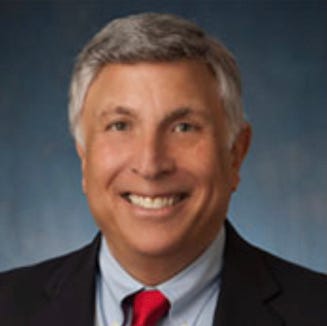
The vacuum on the City Council left by the heartbreaking death of Tommy Hazouri — called by many “a man of the people” -— has placed this need in sharp perspective.
An uprush of activities resulting from the protests following the murder of George Floyd opened a window for addressing the historic racial disparities that continue to plague our city and our nation.
Recent efforts by Council President Hazouri added impetus to these efforts in Jacksonville.
Thanks to him, more than $3 million in proposed legislative programs now stands before the City Council, funds that have the potential to correct decades of neglect of predominately-Black neighborhoods. This is in addition to the $1 million in private funding to United Way of Northeast Florida and to 904WARD, and $10 million in city and federal funds to reduce health care disparities.
A collective agenda for progress
More than 35 Jacksonville organizations are involved in the work of racial reconciliation and racial justice --- a significant commitment by hundreds of talented, committed people.
Among these initiatives, recent moves at the City Council have strengthened my belief that a citywide campaign and a collective agenda for progress are crucial in the coming days and months.
The racial divide in our city means that thousands of our residents have no idea of the devastating conditions in some predominately-Black neighborhoods, and the daily stresses for Black people at all socioeconomic levels. We need to bring people together to learn, share and commune at deep personal levels.
Honoring Tommy Hazouri
The death Tommy Hazouri has intensified the role of the City Council in these efforts.
While legislation to name the Council Chambers in his honor has drawn attention, it will say much more about our city when racial equity leaders came together in a citywide collaboration to support his work. Given predictable resistance among some City Council Members, such a collaboration will be critical in pressing for legislative changes he initiated and advocated.
It’s telling that Hazouri initiated these Council actions following his first surgery and accelerated the process between his return to the Council and his final days.
There are currently four initiatives on the City Council docket, two of which Hazouri initiated and all of which he supported.
The Social Justice and Community Investment Special Committee
Safer Together
The Task Force on Civil Rights History
The Special Committee on Jacksonville Small & Emerging Business (JSEB)
Here’s a rundown of the four initiatives and their potential:
The Social Justice and Community Investment Special Committee
This committee was created by Hazouri in June of 2020. He set up the committee as a legislative clearinghouse “to establish programs and policies which serve to eradicate systemic bias as well as honor the unfulfilled promises of consolidation.”
The Committee introduced or sponsored legislation and supported funding priorities in excess of $2.85 million to advance community investment in predominately Black neighborhoods. This widely-ranging agenda has the potential of righting many of the wrongs cast upon predominately-Black neighborhoods over many decades.
Some of its legislative proposals have been adopted; many remain on the Council agenda. It is co-Chaired by Council Members Brenda Priestly Jackson and Matt Carlucci.
The SJCIC held 18 meetings involving diverse participants from across the city. It also held one-on-one meetings to address specific issues in employment, education and mentorship, infrastructure, neighborhood blight and parks, healthcare access, mental health and wellness and children’s services.
Legislation supported or initiated by the committee includes, for example, $225,000 for “Quench the Violence,” a program focused on “high risk zip codes” to put justice-involved 18-25 year olds on a new path through life; the $200,000 “Brentwood Blight” program; a $300,000 program to restore the historic Stanton Building in Lavilla. These are few of the 19 projects that would go a long way to uplift predominately-Black areas of our city.
In creating this committee, Hazouri acknowledged the historic betrayal of Jacksonville’s Black neighborhoods, from Reconstruction through Consolidation.
“The committee should engage in active listening of those adversely affected by the decisions of the past which has created historic inadequacies as well as to address current issues which further disparate outcomes. Through an open and frank dialogue … it is my hope that the committee can leverage the momentum spurred by current events [The George Floyd murder and protests] and work with community representatives, stakeholders, and community organizations … to address present and past inequities by providing equal access and opportunity for the citizens of Jacksonville.”
“Safer Together”
This committee was created by Hazouri in September of 2020. Its mandate was to conduct “a series of workshops on community policing, policies, procedures and budgeting.” Its co-Chairs are Council Members Joyce Morgan and Michael Boylan. Last week, the committee presented its Final Report recommending legislation that would create major shifts in the relationship between the Jacksonville Sheriff’s Office and communities of color.
“Safer Together” involved leadership from the JSO and other city leaders to hold 8 public meetings --- listening sessions that attracted a wide range of community input and resulted in a 51-page report. Its recommendations --- called “suggestions” --- imply shifts in budget priorities from enforcement to community-based programs.
These suggestions include mental health awareness training, mental health co-responders on police calls, implicit bias mitigation training, strengthened crisis communication, community-based approaches, and revisions in complaint procedures. One controversial suggestion is a proposal to reconsider the creation of a Citizen Review Board.
Work on this project was led by the local consultants from All Things Diverse and its founder, Dr. Tammy Hodo. All Things Diverse is one of the 35+ organizations active in racial reconciliation work. For other leaders to surround Dr. Hodo and her team in a spirit of mutual support, unity and collaboration would be a powerful signal to our city and to the Council — and a wonderful way to honor the memory of Tommy Hazouri.
The Task Force on Civil Rights History,
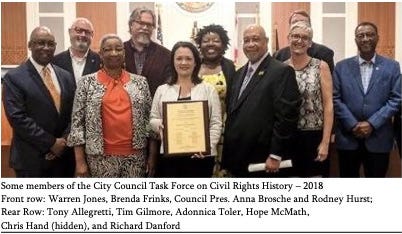
This committee was formed in 2018 by then Council President Anna Brosche. It was chaired by Council Members JuCoby Pittman and Warren Jones and consisted of an impressive group of community volunteers. Many of its recommendations remain unfulfilled; they offer a comprehensive agenda for progress in understanding and honoring the racial history of Jacksonville.
Its recommendations include creation of a National Civil Rights Museum (a project picked up by Drs. Rudy Jamison and Chris Janson and Civil Rights icon Rodney Hurst as part of their National Civil Rights Conference next February).
The Special Committee on Jacksonville Small & Emerging Business (JSEB)
The committee is chaired by Council member Ju’Coby Pittman, supported by Members Garrett Dennis and Terrence Freeman.
Its mandate includes “legislative improvements or programs supported by … disparity studies, and applicable federal and state law.” The work includes a review of racial disparities in contracts to entrepreneurs of color. Our history of white business domination in city contracting is a barrier to the development of a stable Black middle-class in Jacksonville. The committee is due to report recommendations in July of next year.
The work of this committee is vital. The most recent disparity study was completed in 2013. Black entrepreneurs are shown to be virtually absent from major contracts. It’s possible the committee will conduct a new survey of racial disparities to assess the “race neutral” philosophy in place since 2004. That’s when Mayor John Peyton terminated the city’s set-aside program. An early study indicated a significant decline in contracts going to Black entrepreneurs due to the “race neutral” policy.
Major shifts are possible
Taken together, the body of legislative recommendations and activities launched or supported by Tommy Hazouri has the potential to create major shifts in our city.
We are in a period that feels very much like post-Reconstruction. Gains stemming from the Civil Rights Movement of the 60s and 70s are in jeopardy --- voting rights gains, education gains, econcomc gains, political gains. (See my prior blog: “The Illusion of Racial Progress.”)
Jacksonville’s history makes it clear that promises of a more equitable city remain unfulfilled. To change that historic pattern, we need to create a new consensus.
Over the last 24 years, my partner, Shirley, and I have worked with thousands of Jacksonville citizens in workshops and seminars. Our strategy was small groups on a massive scale. We’ve found people sorely uninformed about each other and out of contact with their fellow residents. As a result, we lack a consensus on moving forward.
However, once people have an opportunity to understand the truths of our history and the depth of our current disparities, there’s a willingness among many whites to support needed changes
In the words of my friend and colleague, Attorney Gregory Redmond, when we engage in depth we will discover “the heartbeat of our multicultural city” — our spiritual core and our true cultural identity.
A consortium of organizations involved in the work of racial equity can lead this effort and help our city to reveal the imbedded goodwill in our personal and neighborhood relations — the essential kindness in the hearts of most Jacksonville residents.
A New Era of Enlightenment
Tommy Hazouri shared this optimism. His long political career had its ups and downs. A friend who knew him well described him lovingly as “a consummate politician.” He added that his love for our city and his passion for how people are treated was always clear, perhaps stemming from early mistreatment when told he was not welcome in Jacksonville politics because of his ethnicity.
Council Member Brenda Priestly Jackson described the opportunity of her Committee created by Hazouri: “What we are focused on is eradicating the vestiges of systemic and institutional bias, which really reflects … maybe racism and social inequity in Jacksonville.”
Councilwoman Joyce Morgan said of the “Safer Together” committee.“I think that we're on the verge of doing something that we have certainly needed to do for a very long time here in Jacksonville.”
Hazouri agreed. "We have the opportunity to be one of the best councils in decades, especially if we start addressing some of the issues that have been left behind for so long.
“I believe that we are entering a new era of enlightenment for our city. We can all be proud of what we're going to do, and what will have been done,” he said.
Hazouri and other Council Members set a high bar. Will the rest of us step and support their efforts? Organizational leaders have an opportunity to set personal and organizational egos aside and embody a collective spirit of collaboration and create a shining future for our increasingly multicultural city?
A personal note
My appeal for collaboration among leaders of organizations working in the vineyards of racial reconciliation comes from an ancient place in my bones, my psyche, my lineage.
I’ve written in previous posts that Shirley and I were asked to come here 24 years ago by a group of local citizens to work on improving race relations. We sought to bring our years of experience working race relations nationally and internationally to bear on this city of 1 million people.
That project grew into a commitment. We discovered kindred spirits, wonderful people sincerely dedicated to healing wounds from our city’s racial history. We remained; and we have made Jacksonville our home because we now understand that we were called to be here. Jacksonville was always, in a deep sense, our “home.”
Some of our work was with the City’s Human Rights Commission and its Study Circles Initiative led by heroic leader Charlene Taylor Hill. That work happened at Jacksonville City Hall --- 117 West Duval Street.
Just two years ago, I discovered that my great grandfather, Noah Rollins, also worked at 117 West Duval Street --- as a waiter at the St. James Hotel. The St. James was an elegant establishment for wealthy white vacationers that, ironically, was located on the very same plot of land as the current City Hall —- 117 West Duval St. I trod the same turf as my great grandfather had trod more than a century before.
I also discovered that Noah Rollins and his mother and father, Susan and Charles Rollins --- my great great grandparents --- were all born slaves in Tallahassee. Their land is still occupied by Rollins descendants.
We did not know of this ancestral family connection when were drawn to come here. The synchronicity of these connections continues to keep us here.
We are now retired. We will continue to work closely with the Jacksonville Community Remembrance Project of 904WARD, mainly as a way of honoring my ancestral family. Noah left Jacksonville during the period of racial terror lynchings to live in the safety of Boston, where I was born two generations later.
I can best honor my slave ancestors — and the energy and rituals that saw them through slavery, Reconstruction and the violence of post-Reconstruction —- by drawing on their humility, dedication and right action in their world. The Rollins family became leaders of social justice in Tallahassee in the 1800s.
To my colleagues in the racial equity movement in Jacksonville:
Humility, dedication and right action now calls for us as volunteers, professionals and stewards to surrender personal and institutional ego and come together in service of a greater cause. Thousands of Jacksonville residents are waiting for us — trusting us —- to do so.
We can best honor Tommy Hazouri by adopting the new spirit of enlightenment of which he spoke. Our charge is right action offered with humility and dedication. Together, let’s make Jacksonville a model of racial healing and racial equity.
Next Blog: Oct. 1st
No posts
Comments
Nothing yet. Say the first thing.
Sign in to join the conversation.