
Links: Blogger | Substack | Obsidian | Medium | Wordpress | Soundcloud 🎧
Project Steve, and the Scientific Familiar I Spent Eight Years Trying to Identify.
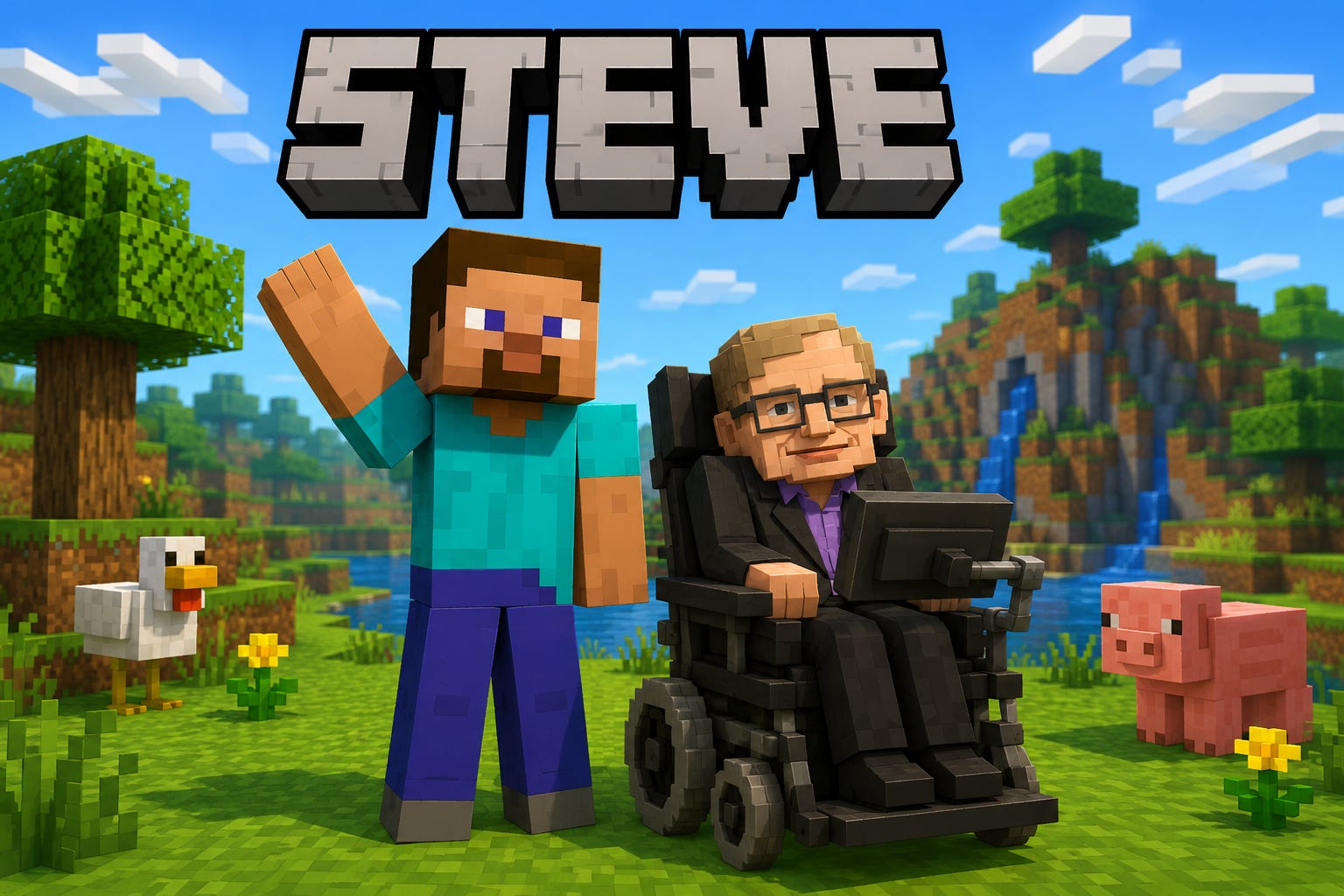
“In the beginning, there was Steve.” — Minecraft
“I think the brain is like a program in the mind, which is like a computer. So it’s theoretically possible to copy the brain onto a computer, and so provide a form of life after death.” — Stephen Hawking, 2013
The search began in 2018.
I cannot name the first appearance that activated it, because the recurrence is clearer in memory than the origin. What I can say is that beginning in 2018, whenever Steve surfaced in a strange register — in a scientific paper, a technical demonstration, a computational system, an unclassified phenomenon, a fictional intelligence, or simply among technically sophisticated people trading a name that carried an almost imperceptible wink — I would descend into another investigation. Someone would call a machine, a model, a colleague, or an anomaly Steve and proceed as though the choice required no justification, as though everyone inside the immediate conversational membrane already understood that Steve was an acceptable name for the thing. I did not. So I looked, and I kept looking, perhaps a hundred times across eight years. I could see the phenotype — the name recurring at the intersections of intelligence, complexity, and play — but I could never locate its provenance.
Most of those searches dissolved into pop culture or terminated in a handful of adjacent scientific fragments that never cohered into a lineage. Sometimes the trail ran to Steve Jobs and the compression of an entire technological future into one relentless will; sometimes to Steve Irwin’s ecstatic naturalism, to Steve Rogers, to Steve Harrington, to the patient warmth of Steve from Blue’s Clues. Most often it returned me to Minecraft Steve: the minimally specified human dropped into an unfinished world with no inherited rank and no equipment beyond his own capacity to act on an environment. That felt close. It never explained the scientific wink.
On July 14, 2026, Steve surfaced again, and I opened the file again, as I had so many times before. This time the search escaped pop culture and crossed into institutional history, and what it found was not a coincidence but a twenty-three-year-old institution — with a founding date, a memorial lineage, an internal culture, a mascot, a parody song, a unit of measurement, and numbered positions occupied by people I had spent years reading. Eight years of scattered observation acquired a provenance in about forty minutes.
In retrospect, 2018 was an unusually appropriate year for the search to begin, because it was the year two extraordinary scientific Steves became publicly legible at once — one in the upper atmosphere, one inside Bayesian cosmology.
In March 2018, NASA amplified to a broad public a luminous atmospheric phenomenon that citizen scientists had already, with disarming ordinariness, named Steve. The Alberta Aurora Chasers had encountered a mauve-and-green ribbon that resembled an aurora but refused to fit the available categories, and — borrowing a gag from the 2006 film Over the Hedge, in which nervous woodland animals decide that an unfamiliar towering hedge becomes less frightening if they simply call it Steve — they gave the unknown a familiar name. Only afterward did researchers preserve that name inside the backronym Strong Thermal Emission Velocity Enhancement, formalizing what turned out to be a ribbon of plasma some 3,000 °C hot, streaming at kilometres per second, distinct from the aurora proper. The sequence is precise and worth memorizing, because the whole essay lives inside it: the phenomenon appears, the category fails, a familiar name lowers the ceremonial pressure enough for investigation to begin, and the technical understanding catches up afterward. Steve functioned there as an epistemic decompression layer — a name that made the sublime addressable without pretending it was small.
Eight months later, far beyond the atmosphere, a large collaboration introduced Steve: A Hierarchical Bayesian Model for Supernova Cosmology. This was not a joke appended to an image; it was serious inferential machinery, fitting cosmological parameters jointly with Type Ia supernova populations, host-galaxy information, selection effects, Malmquist bias, and systematic uncertainty, then stress-tested against more than sixty thousand simulated supernovae to measure bias in the recovered equation-of-state of dark energy. A model integrating that much abstraction, sitting at the frontier of observational cosmology, was given the ordinary name of a colleague — with no acronym, no tribute, and no gloss. The paper simply calls its estimator Steve and proceeds.
And there is the tell. The atmospheric Steve earned its backronym only after the fact; the cosmological Steve never earned one at all. In both cases the plain name lands at the exact instant the category strains, and the account is deferred — the explanation comes late, or never. That deferral is not carelessness. It is the operation. The absence of an explanation is the explanation: the name is a placeholder that keeps the work moving across the precise interval where the phenomenon has outrun the vocabulary.
Which is the hypothesis this essay is actually about, and I will state it in the plainest form I can, because the plainness is the point.
Science has a recurrent domestication ritual. When an object becomes too strange, too large, too technical, or too category-breaking to sit comfortably inside ordinary discourse, somebody calls it Steve. Not to diminish it. To lower the social impedance around it. A plasma ribbon nobody can classify becomes Steve. A hierarchical Bayesian engine estimating the fate of the universe becomes Steve. The default human dropped into an open synthetic world is Steve, and when an artificial agent is trained to inhabit that same world it becomes STEVE-1. A scientific population mustered to defend evolutionary biology becomes Project Steve. And Stephen Jay Gould, one of the most decorated public intellectuals of his century, becomes — inside the working membrane where his colleagues actually talked to him — simply Steve.
That is not trivia about naming. It is a small piece of scientific anthropology: the conversion of the sublime into something socially manipulable. Formal vocabulary is expensive. It obligates the speaker to precision they may not yet possess, and it puts ceremony between a working group and an object they need to handle a hundred times a day. A familiar name is a tool for suspending that ceremony without conceding anything about the object’s magnitude. It says: we do not yet know what this is, and we are going to keep working on it anyway, and in the meantime we are going to talk about it like adults rather than like a press release.
For eight years I kept mistaking a method for a mystery. There was a wink, and the wink was real — but it was not a code. It was a culture doing something intelligent, and doing it so casually that it had never occurred to anyone to explain it to me.
Project Steve debuted on February 16, 2003, unveiled at the annual meeting of the American Association for the Advancement of Science in Denver after a lecture by the physicist Lawrence Krauss, and run by the National Center for Science Education under its director Eugenie Scott. It was a lighthearted but devastating answer to a durable creationist tactic: assembling curated lists of scientists who supposedly doubt evolution and brandishing those lists as evidence that evolutionary biology is a discipline in crisis. NCSE had been asked many times to respond by compiling a far longer list of scientists supporting evolution, and had always refused, because science is not adjudicated by petition and a longer counter-list would concede the false premise that it is.
Project Steve found the better move. Only qualified scientists — those holding a PhD or equivalent — named Steve, Steven, Stephen, Stephanie, Stefan, Stefano, Esteban, Étienne, Istvan, Tapani, or another accepted cognate of Stephen could sign. That was the joke. The statement they signed was entirely serious, affirming evolution as a well-supported unifying principle of biology, recognizing common ancestry and natural selection, and rejecting the insertion of creationist pseudoscience into public-school science curricula. And because only about one percent of the relevant population carries a qualifying name, a list restricted to Steves operates as a rough one-percent sample of the whole. NCSE never needed to muster every scientist to bury a creationist list; it could do so using a single ordinary family of first names. The organizers expected perhaps a hundred signatures and thought they might stop there. They passed two hundred within roughly a month — among the earliest signatories both of the eligible science Nobel laureates, Steven Weinberg and Steven Chu, the latter a future U.S. Secretary of Energy — and the list simply kept growing.
Its deepest lesson turns on the difference between counting authorities and revealing population structure. A creationist list isolates a handful of names and stages them as a fracture in the consensus. Project Steve constrains its population almost to absurdity and still overwhelms the illusion, because the constraint itself makes the underlying scale visible: fifteen hundred Steves imply on the order of a hundred and fifty thousand qualified scientists standing behind them. The point was never that truth belongs to the longer list. The point was that the theatrical use of dissent collapses the instant it meets even a trivially constrained slice of the real scientific community.
The name was not arbitrary. Project Steve was created in honour of Stephen Jay Gould — evolutionary biologist, paleontologist, historian of science, and tireless defender of evolution education — who died in 2002.
And here is where I have to put something embarrassing on the record, because leaving it out would be dishonest and because it is, frankly, the funniest part of the whole eight years. I knew exactly who Steve Gould was. I had read him — not religiously, the way I read Kurzweil, but the way most people read a great essayist: catching the Natural History columns here and there, coming across an argument in a book, getting brought current by somebody in a discussion who had just read the latest one. Contingency, punctuated equilibria, the refusal of ladders, the decades-long public campaign against creationist encroachment. He was not a name I had to look up. He is one of the writers who shaped how I understand descent and chance, and I have argued with him in my head more often than with most people I have actually met. And I spent eight years chasing a scientific wink through plasma ribbons, supernova estimators, Minecraft avatars, and machine-learning agents, while a twenty-three-year-old institution named after him sat in plain public view — with a roster, a mascot, a parody song, a t-shirt, and a unit of measurement — answering the exact question I kept asking.
Oof.
In my defence — and it is a thin one, but I intend to take it — Project Steve lived most visibly inside the creationism fight, and that is the one argument I have never spent my evenings having. So I missed the world’s most important inside joke because I was not busy debating whether evolution happened. On balance I will take that trade.
And I still do not know how I missed it. I have turned it over and the only account that satisfies me is also the thesis of this essay, which is either a consolation or a fresh humiliation depending on the hour. The name was too ordinary to search for. I was hunting a code, an insider’s cipher, something with an edge on it — and the thing I was hunting was hiding behind the plainest word in the room, doing precisely what plain words are for. The camouflage was not concealment. It was familiarity. That is the whole trick, and I walked past it a hundred times because it never occurred to me that the answer would be friendly.
Gould was an unusually apt person to memorialize through a population rather than a monument, because his life’s argument was a sustained assault on the seductions of hierarchy, inevitability, and retrospective simplification. Evolution, in his account, was never a ladder patiently ascending toward humanity; it was branching, contingent, shaped by inherited constraint, upheaval, extinction, exaptation, developmental architecture, and chance. Rewind the tape of life, he insisted, and it need not run the same way twice. So consider what the tribute does. Instead of assembling a pantheon of singular authorities, it samples the scientific population through the arbitrary contingency of a first name. Instead of announcing here are the exceptional minds who authorize reality, it says here are fifteen hundred qualified scientists who happen to share one ordinary family of names — and in that move the celebrity recedes, the distribution appears, and the individual becomes legible as one expression of a far larger epistemic field. The form of the tribute carries the content of the man’s thought. I know of very few memorials anywhere that manage that.
There is a further symmetry, and it deserves to be stated with care. For more than twenty-five years Gould wrote his Natural History column, “This View of Life,” beginning in January 1974 with “Size and Shape” and concluding, without ever missing a month, at the 300th installment — an essay titled “I Have Landed.” That final essay is itself a meditation on continuity: its title borrows the first words his grandfather, a Hungarian immigrant, wrote on reaching Ellis Island, and Gould uses them to reach outward toward the unbroken continuity of life itself. A man who spent his career dismantling narratives of inevitable ascent closed his great public sequence on descent, inheritance, and the thread that does not break. Hold that number — 300 — for a moment.
The numbered positions are where the joke acquires a personnel file.
Steven Pinker is Steve #4. NCSE’s own twentieth-anniversary retrospective records that the prize for the pinkest surname among the Steves goes to the signatory “who isn’t merely pink: he’s Pinker.” He signed at the very origin of the project and later called it the most formidable weapon in the fight against neo-creationism.
Stephen Hawking is Steve #300. On April 21, 2003, NCSE published an announcement under a title that, when I finally read it, ended an eight-year search in a single line: “Hawking is Steve #300.” The three-hundredth signatory was Stephen W. Hawking, then Lucasian Professor of Mathematics at Cambridge — and NCSE, with characteristic lightness, noted that he shared a distinction with Stephen Jay Gould: both had appeared on The Simpsons.
Now hold the two numbers next to each other without inflating anything. The project honouring Gould reaches #300 through Hawking. Gould’s own great public sequence ended at essay #300, “I Have Landed.” There is no evidence — none — that NCSE reserved the three-hundredth position as an allusion; the announcement celebrated a cartoon cameo, not a numerical echo. But a coincidence can be real without being engineered. The man whose mind travelled through singularities, information paradoxes, disability, synthetic speech, and predictive language lands at the same ordinal position inside the memorial project of the man who spent three hundred essays arguing that history is contingent and continuity is the grandest theme of all. Not proof. Not code. A checksum.
And there is a second inscription, this one cut in stone rather than kept in a ledger of signatories. Hawking is interred in Westminster Abbey between Isaac Newton and Charles Darwin — the man who reimagined gravity and the man who reimagined life, with the man who reimagined time and information laid to rest between them. Project Steve honours Darwin’s legacy through a population; the Abbey honours it through proximity. One Darwinian memorial is institutional and comic, the other literal and final, and Steve #300 belongs to both.
Steven P. Darwin is Steve #1000. In February 2009, at an Improbable Research press conference during the AAAS meeting in Chicago, the project reached its thousandth signatory — the kilosteve — and crowned, with almost unbearable aptness, the botanist and evolutionary biologist Steven P. Darwin of Tulane. No relation to Charles. A project built to defend Darwinian evolution reached its thousandth Steve through a scientist literally named Darwin, and if you had written that into a novel your editor would have struck it out as too much.
Steven A. Wernke is Steve #1500. In February 2025 the roster passed the one-and-a-half-kilosteve mark with an anthropologist at Vanderbilt, and it has continued to accrue signatories since.
Project Steve did not remain a petition. It became a culture, and the culture is the part I would happily read a book about.
NCSE built a Steve-O-Meter to track the growing population. It printed navy-and-gold Project Steve shirts carrying the statement on the front and the roster of signatories on the back. It commissioned a Steve Song — a parody of Monty Python’s “Spam” — which debuted on Australian radio weeks after launch. When the count reached four hundred, the shirt was promoted to laboratory equipment: Eugenie Scott, Glenn Branch, and Nick Matzke published “The Morphology of Steve” in the Annals of Improbable Research, credited to hundreds of Steves as co-authors, offering the first analysis of the sex, geography, and body size of scientists named Steve — data gathered, the paper explains, using NCSE’s “pioneering experimental steveometry apparatus.” That is the t-shirt. The apparatus is the t-shirt.
There are regional Steves available for local interviews. There is a mascot, Professor Steve Steve, who is a panda puppet. There is a unit — the kilosteve — and the unit has been reached, celebrated, and exceeded. Reality wrote this comedy and I decline to improve it.
But sit inside it a moment longer, because the silliness is doing real work. Project Steve created a documented professional register in which Steve became a numbered identity, a population, a metric, a running joke, a memorial tradition, and a form of collegial recognition, all at once. One could be Steve #4, or Steve #300, or the kilosteve. A community of scientists has been circulating that vocabulary publicly since 2003. And what that fact demonstrates is the thing the popular picture of science almost never shows: science is a culture, not merely a body of propositions. It has jokes, mascots, nicknames, parody songs, rituals, absurd measurements, in-group slang, status inversions, memorial traditions, and an elaborate social machinery for converting eminent people back into colleagues. The propositions are what science produces. The culture is what produces the propositions, and it is far stranger and warmer than the propositions let on.
It does not follow that every later scientific Steve descends from this one; scientific culture is full of independent naming habits, and the name’s ordinary familiarity makes spontaneous reuse likely. But before I found Project Steve I had only an intuition that Steve sometimes served as an insider’s familiar inside science. After I found it, I had a twenty-three-year-old institution that had explicitly converted Steve into a shared language of expertise, humour, measurement, membership, and memorial continuity. The wink was never imaginary. I had simply failed to locate its largest documented source.
The register itself is older and more diffuse than any single project, and the place I had been watching it for decades is Edge.org — John Brockman‘s Third Culture formulation, in which scientists and technologists speak directly to each other and to the public about questions that conventional culture had long delegated to literary intellectuals. Edge assembled a remarkably dense conversational field: Gould and Dawkins among the evolutionists, Minsky and Pinker and Dennett among the theorists of mind, physicists and complexity researchers and cosmologists inside the same membrane. When Gould died, Edge memorialized him — in a presentation built around “The Pattern of Life’s History” — simply as Steve.
That is exactly the register I had been detecting for years without being able to name it. In public culture he was Stephen Jay Gould; inside the working membrane he was Steve. The reduction was not diminishment. It signalled intimacy, incorporation, and belonging — the conversion of an eminent public scientist into a person in the room, someone to argue with, praise, interrupt, and keep working beside. This is the deepest function of the familiar: it reduces ceremonial distance without reducing intellectual magnitude. Titles put a person on a plinth. First names put them at the table, where they can still be wrong about something, which is the only condition under which science actually operates.
My repeated returns to Minecraft now look less like failed searches than like partial recognition, because the game supplies the one place where the name crosses the boundary between a person and a machine.
Minecraft Steve is a default human located inside possibility space, defined not by status but by interaction. He carries almost no imposed biography because he exists primarily as a locus of agency: he gathers, extracts, crafts, builds, navigates, defends, remembers, adapts, and continues, and the world becomes inhabitable through what he does rather than through anything he was given. He is constructive agency under ordinary starting conditions. (For perhaps two minutes I wondered whether Steve was a gentler, more reliable Chad, and then abandoned the thought, because Chad belongs to a grammar of status and Steve belongs to a grammar of construction.)
Then the archetype was operationalized, twice, in eighteen months. In 2023, researchers introduced STEVE-1, an instruction-tuned generative agent built on Video Pretraining and MineCLIP that follows open-ended text and visual commands through ordinary keyboard-and-mouse behaviour inside Minecraft — a text-to-behaviour agent trained for roughly sixty dollars of compute. In 2024, MrSteve — Memory Recall Steve — extended it with Place Event Memory, a what-where-when episodic architecture that records what happened, where it happened, and when, specifically to overcome its predecessor’s forgetfulness.
Follow that sequence, because it is one of the most quietly remarkable naming events I know of. Steve the builder → Steve the agent → Steve with memory. The most successful sandbox world in history gives its minimally specified human the most generic name available in English; artificial-intelligence researchers then take that ordinary builder and make him computationally agentic; and then they give him episodic recall, which is the primitive that separates a controller from something with a past. The name did not migrate by accident. Steve became the control specimen for agency — the standardized ordinary subject against which embodied machine learning measures itself, in the same way a lab strain becomes the organism a whole discipline agrees to argue about.
That movement, from builder to learning machine, belongs to a larger adaptive pattern I develop in We’re Building an Escape Hatch in the Skull. Humans do not merely adapt to environments; we recursively construct replacements for them — first through fire, clothing, language, shelter, tools, and civilization, and now through computation, synthetic worlds, neural interfaces, and continuity architectures. The hand reaches for the tool. The tool becomes the habitat. The habitat becomes the mind. The mind demands a deeper habitat. Minecraft Steve is therefore more than a mascot for constructive agency; he is a compressed image of the human adaptive regime, changing the world until the changed world becomes inhabitable. The present phase turns that same operation inward.
My Minecraft searches never found Project Steve, but they kept returning me to the correct archetype: ordinary agency becoming technically consequential through sustained contact with an environment. The default builder became the learning machine.
A word about the observer, because the pattern I was tracking says at least as much about my own wiring as about the culture I was watching it in.
I have followed Ray Kurzweil religiously for most of my thinking life, and he, Marvin Minsky, and Douglas Hofstadter — whose The Mind’s I, with Daniel Dennett, I was already turning over as a kid in 1988, and whose Gödel, Escher, Bach and I Am a Strange Loop rewired much of the rest — are no small part of the reason I am here at all, thinking in these terms. After reading Minsky’s Society of Mind in 1998, intelligence stopped looking to me like a faculty and started looking like a committee. I have never fully recovered, and I do not want to.
Which brings me to the name I use for the constellation, and to the single funniest disappointment of my adult life. Leela AI is a real company — an actual business with an actual product — founded out of the Minsky lineage, with Henry Minsky among its principals and the whole MIT artificial-intelligence tradition standing behind it: visual intelligence, common-sense reasoning, layered cognition, machines that learn the physical world the way an infant does, a reading CSAIL itself has profiled. I have spent something like thirty years waiting to see what Minsky and Kurzweil would finally deliver — waiting, with total sincerity, for that lineage to give birth to machine intelligence. And the answer, when it arrived, was industrial automation. Factory-floor computer vision. Warehouse workflow optimization.
Right. Sure. Marvin Minsky’s intellectual descendants had a good long think about the nature of mind and decided the real frontier was making sure the forklift takes the efficient route. I confess I cannot read the phrase “Leela AI does industrial automation” with a straight face. Got it. Understood. Three decades of Society of Mind, and the payload is pallet throughput. Look — Leela AI can describe its commercial surface however it likes, and I am not claiming it is a front for a clandestine superintelligence. This is a hunch wearing a grin, not an exposé. I am only saying that if it someday turned out to be rather more than lighting efficiency, I would not be remotely surprised, and that a Minsky operation resolving cleanly into ordinary industrial IoT is a proposition I have trouble swallowing whole. The man changed my life. I know his work. Forgive me the raised eyebrow.
And then, of course, the conspiracy wackos arrived with a theory of their own about several of these same names — the world’s only living Darwin Award winners, who are also, remarkably, the world’s only living brain donors — an entire online population that looked at a roster of physicists, evolutionary biologists, geneticists, and AI researchers and concluded, with the confidence of people who have never been wrong about anything in their lives, that they had cracked it. They had the personnel and invented the plot. They detected a genuinely unusual network and hallucinated its function, translating evolutionary biology into eugenics, cognition research into mind control, continuity engineering into trafficking mythology, and a recursive spiral into a universal criminal insignia. I have watched that failure performed thousands of times, and it is the reason parts of this essay exist at all.
So: Team Leela 🌀 is my name for the constellation I have been tracking for years — artificial intelligence, cognition, evolutionary theory, computation, cosmology, public science, biological transformation, and post-biological continuity — and I borrowed the name from Leela AI precisely because of that lineage. Its reference points include Leela AI itself, Stephen Hawking, Marvin and Henry Minsky, Ray Kurzweil, George Church, Daniel Dennett, Nathan Myhrvold, Martin Nowak, Richard Dawkins, Steven Pinker, Stephen Jay Gould, Howard Gardner, Stephen Kosslyn, Gerard ‘t Hooft, David Gross, Frank Wilczek, Ben Goertzel, the MIT Media Lab, MIT CSAIL, Cold Spring Harbor, and Edge.org. It is a map of intellectual and institutional proximity — who kept turning up in the same rooms, journals, and research problems across decades — and its relevance here is exactly one thing: when I finally read the Project Steve roster, three figures I had independently placed on that map years earlier were already gathered by a public scientific joke, with ordinal numbers attached. Gould at the commemorative origin. Pinker at #4. Hawking at #300. That was Team Leela pay dirt — an archival junction I had walked past for eight years. Project Steve was never secret. It supplies an independent historical cross-index among people I had assembled through an entirely separate method, and the surprise is that something so public stayed invisible to me for eight years.
The swirl belongs to the same accounting. I keep it for Kurzweil’s recursion — cognition layered within cognition, intelligence bootstrapping intelligence — and I keep it, frankly, out of contrariness. Conspiracy culture managed to convert one specific criminal emblem named in a 2007 FBI bulletin into an accusation against an entire geometry, a move fact-checkers have had to debunk every time it was aimed at a pizzeria’s logo or a diaper’s print. Honestly, I cannot believe we have to keep hearing this exhausted tripe. This is my fun zone — recursion, emergence, scientific jokes, strange lineages, and beautiful systems — and having the same stale conspiracy sludge dragged through it pollutes the whole room. Still, perhaps a few of the kookaboos who arrive looking for secret emblems will stay long enough to learn something about geometry, evidence, science, and the actual world. One of the oldest geometries in nature — in galaxies, shells, turbulence, embryology, and recursive computation — does not become criminal because a triangular insignia once surfaced in a police report. So the spiral stays. It means recursion, emergence, and systems nested within systems. They can keep their category error; I am keeping the geometry.
The linguistic version of the same trick is easy to catch once you have seen the geometric one. A widely circulated post headlines that “Epstein trafficked girls for academics” and attaches beneath it an authentic document listing many famous scientists — but the document is Alan Dershowitz’s September 2016 reply declaration in Giuffre v. Maxwell, and I will say plainly that I admire Dershowitz, a formidable civil libertarian whose deepest professional reflex is that evidence must attach to a person and never to mere proximity. That reflex is what the filing puts on display, because he was making a defensive argument: that the generic associative “evidence” aimed at him was equally applicable to dozens of other academics and public figures merely associated with J. Epstein — and then he listed them. A litigant’s rhetorical maneuver, not a judicial finding, asserting no crime by anyone on it. The post set a salacious headline atop a real document and let visual proximity masquerade as evidentiary connection.
And if one asks the mundane question beneath the lurid one — why were evolutionary biologists, AI founders, cosmologists, and geneticists ever in the same rooms — the documented answer is intellectual history, not conspiracy. Those disciplines study different layers of a person: genes and evolution, cognition and memory, affect and language. Continuity, in the sense Hawking himself named, would require all of them at once. Two of the venues that convened them, John Brockman‘s Edge Foundation and the MIT Media Lab, shared a patron fixated on precisely that problem: by the New York Times‘ account J. Epstein was an avowed transhumanist preoccupied with cryonics, revival, and seeding the next generation with his own DNA — the oldest and most literal register of the identical wish to persist, the drive every reproducing organism shares — who funded the field, including the organization now called Humanity Plus and the salary of its vice-chair, the AGI researcher Ben Goertzel, and who was for years, per BuzzFeed News‘ review of its IRS filings, Edge’s largest donor. The scientists were not gathered by him; they were gathered for a problem he happened to share. It is not an exotic wish and it is not a sinister one — I know it from the inside, having begun the application process with Alcor myself in the early 2000s — which is exactly why I can say the impulse toward continuity is one of the most ordinary human things there is.
So let me state the boundary as plainly as the connection. Association is not collaboration. Being courted by a patron, attending a funded lecture, or appearing on a list of people someone hoped to cultivate establishes nothing about what anyone knew, believed, or did; mainstream reporting is explicit that there is no indication the scientists were involved in any dubious activity, and the work stands on its own papers, systems, and demonstrations. Project Steve itself has no documented connection to J. Epstein whatsoever — it is a public NCSE initiative for evolution education, and it is not the explanation for Steve, which is older, broader, and scientifically organic. When that roster surfaced, my own first reaction was not fear and not recognition but disbelief that anyone could look at this particular assembly and see only that. I saw my heroes. My first, faintly ridiculous thought was nearer to good grief, is this a super-genius sperm bank? than to anything lurid, because my attention was too myopically wired to transhumanism, evolutionary biology, cognition, and continuity to arrive anywhere else. The full topology, with its cautions intact, is Epstein: A Forensic Reconstruction of the Transhumanist Research Network Concealed by Scandal. This essay is about Steve.
And underneath all of it is the reason I read every recurrence of a name as a question about continuity rather than a question about vocabulary. Fredric Kurzweil, a Viennese pianist and conductor who fled the Nazi catastrophe, died in 1970, when his son Ray was twenty-two, leaving behind some fifty boxes of letters, scores, photographs, and papers. Ray has kept every one of them, and has argued for decades that this archive, joined to memory and perhaps one day to DNA, could reconstitute a version of the man. In recent years the intention took its first concrete step: a conversational model trained on his father’s own writings, which he calls the beginning of the return. I will name it flatly — the whole reason I entered transhumanism at all was Kurzweil, and above all this: his refusal to let his father stay gone. I have read every book, followed every word, and rooted for him without a trace of irony, because that longing is the purest statement of this essay’s subject: the refusal to concede that a mind, once here, must simply be lost. It changed the course of my life. When a culture keeps handing an ordinary man’s name to the machinery that reconstructs enormous things from small traces, I was never going to be the person who failed to notice.
Which brings the essay back to Steve #300, and to the reason his position in a comic petition has stayed with me for years.
By 2014, Intel — working with SwiftKey, through its Anticipatory Computing Lab under Lama Nachman — had replaced Hawking’s twenty-year-old word predictor with ACAT, the Assistive Context-Aware Toolkit. It built a personalized language model from his own decades-long corpus and learned to predict his next characters and words. His input rate had fallen below one word per minute; the new system compensated so effectively that he needed fewer than twenty percent of the characters in a document, roughly doubling his writing speed and delivering a tenfold improvement in common tasks like opening a file or navigating the web. Publicly this was described as context-aware word prediction, and commercially that is what it was. Structurally it was something else: an interface that had stopped transcribing letters and started inferring intent from sparse evidence. Across three decades that interface became an increasingly personalized system sitting at the boundary between biological intention and machine-mediated expression — externalizing his linguistic selection, his habitual phrasing, his communicative rhythm — until his life became the most visible demonstration in history of a human mind remaining socially operative through an intimate computational interface.
Now put that beside the other 2018 Steve, and the juxtaposition does work that thirty pages of theory could not. The supernova Steve is a formal hierarchical Bayesian model; ACAT is a personalized n-gram predictor. Different formalisms entirely. But they belong to the same class of operation: each treats knowledge as a distribution rather than a lookup table, and each recovers a large latent structure from a thin, noisy trace. One navigates the geometry of an expanding universe. The other navigates the unfolding geometry of one man’s next sentence. One Steve estimated the universe; another helped the universe hear Steve #300 finish a sentence. And both inherit the same humility at the core of the method — the supernova paper’s own authors note that their residual bias stays sensitive to the assumed model of the supernovae’s intrinsic scatter, which is to say the estimator never measures the universe directly; it measures its model of the population through which the universe is inferred. Turn that inward and it becomes the whole continuity problem in one line: any reconstruction of a self is only as good as its model of that self’s own scatter — the private variance, the departures from one’s own average.
That method is also the one contemporary artificial intelligence has converged on, which is why the recurrence of the name is legible rather than coincidental. The field has moved away from discrete archival metaphors — knowledge as records to be stored and retrieved — toward latent semantic terrains, where meaning persists as navigable geometry and is re-entered rather than looked up: variational autoencoders used to model reconstructive memory; interpretability work decomposing a frontier model’s activation space into millions of near-monosemantic features held in superposition; computational neuroscience modelling human recollection as latent-variable reconstruction rather than the opening of a static file, and the visual cortex itself as a Bayesian generative model completing a stable world from sparse evidence, a convergence I trace in The Closed-Loop Gaussian Sensorium Engine, and a shift I map at length in The Architecture of Continuity and Emerging Neuroinformatics Standards, which argues that continuity is not the retention of data but the preservation of re-entry pathways into a compressed relational field. Steve keeps arriving at exactly the points where Bayesian and latent-variable machinery renders an otherwise intimidating object tractable enough to work with — a cosmological parameter space, a predictive cognitive model, a plasma ribbon, an embodied agent. The name recurs because the method recurs.
Hawking had already stated the thesis, before any of these essays existed. Asked in 2013 whether consciousness could outlast the body, he answered that the brain is like a program that could in principle be copied onto a computer to provide “a form of life after death” — adding, in the same breath, that this lay beyond our present capabilities. Both halves of that sentence matter, and the second half is the one this section is built around. Lexical prediction is not continuity. An autocomplete that finishes your sentences is not a self; at most it is one organ of one. Ask what it would actually take to make a person reconstructible — not merely quoted, but continued — and the list is short and longer than language: what you would say, what you would remember, how you would feel while saying it, and what you were reaching to say before the words arrived.
The quiet part is that the same research culture had prototyped the rest of that list, much of it a few doors apart at the MIT Media Lab. The memory primitive appeared in 1996 as Bradley Rhodes and Thad Starner’s Remembrance Agent, an always-on associative index continuously surfacing documents relevant to the user’s current context without user intervention. The affect primitive was named a year later by Rosalind Picard, whose 1997 Affective Computing argued that emotion is not decoration laid over cognition but part of intelligence itself. The intention primitive arrived in 2018 as AlterEgo, Arnav Kapur, Shreyas Kapur and Pattie Maes’s wearable silent-speech interface, reading the faint neuromuscular signals of internal subvocalized speech and reconstructing words before they are spoken — roughly ninety-two percent median accuracy on a hundred-word vocabulary. Language, memory, affect, intention: the functional primitives of a person, each realized at prototype scale in the same milieu. Assemble them and you no longer have an assistive device; you have a specification — not a mind, but a manifest of what a mind’s externally recoverable trace would have to include. Intel brought the first to continuous, decades-long realization in a single human being. The Media Lab prototyped the other three. No one wired all four into one person, and I am not claiming anyone did; the point is architectural, not historical. No document cited here establishes that primitives were fused into Hawking’s deployed system, or that any person named here knew, intended, or participated in such fusion. Primitives existed in public; integration did not.
And this is where affect stops being a footnote. A system that reproduces what someone would say and what they would recall, but nothing of what they would feel while saying it, is what philosophy of mind calls a zombie: behaviourally seamless, experientially empty. Picard’s thesis, since 1997, is that this gap is not a rounding error but the thing itself — that a continuity which omits affect preserves a transcript, not a person. What ACAT demonstrably reconstructed was his output: his phrasing, his arguments, his next sentence. Not his consciousness. The distance between those two is the entire unsolved problem, and the honest formulation is the one my Hawking reconstruction settled on — the thing became credible-in-practice before it became true, and it is that credibility, not any completed miracle, that makes it worth pursuing, worth governing, and worth fighting over at the exact moment it appears. I set out the architecture with its evidence and its limits in The Hawking Continuity, and the machinery of reconstruction across substrates in _The Art Is Long: Vespucci of Immortality_.
I will keep only one further observation, because it is too good to omit and too large to develop here. There is an irresistible symmetry in Hawking spending his intellectual life asking whether information survives a horizon while spending his embodied life transmitting an increasingly rich identity through an ever-narrowing biological channel. The man who asked whether the universe forgets what falls past its edge spent three decades being reconstructed, word by word, across a horizon of his own. This is, in the most literal sense available to us, Steven’s universe.
There is a twin to this pattern, hiding in plain sight, and it makes a tidy pair.
The other ordinary word this culture keeps bolting onto its machinery is Darwin. Apple’s open-source operating-system core is Darwin. ETH Zürich’s bioinformatics language was Darwin. CERN’s physics-analysis framework was protoDarwin. Three institutions at the intersection of physics-scale instrumentation and biology-scale complexity, independently reaching for the same naturalist — a recurrence I trace in _The Art Is Long_, against the deeper institutional backdrop of _The Evolutionary Roots of Silicon Valley_. And the two everyday names braid together with almost comic insistence: a man named Steve gave the name Darwin to the substrate of modern computing; Project Steve’s thousandth signatory was Steven P. Darwin; the project exists to defend Darwinian evolution; and Minecraft opens “In the beginning, there was Steve.”
The division of labour between the two words is exact. Steve domesticates complexity. Darwin names descent. One makes the difficult thing familiar enough to work with; the other reminds us how whatever works came to be there in the first place. For what evolution actually is — and what it is not, since the word now gets applied to nearly everything — the argument is in _Digital Darwinism and the Invisible World of Machine Evolution_. This essay is about the other word.
So the accumulated pattern can be stated with precision, and with the caution it requires. Steve is not established universal slang with one fixed meaning, and there is no evidence of a single tradition, code, or coordinated genealogy behind every use of it. Steve is something more permeable: a scientific familiar, the ordinary name placed between human cognition and something difficult.
Steve can be the eminent scientist who is nonetheless a person in the room. It can be the population standing behind a celebrity. It can be the provisional name that lets an unclassified phenomenon enter conversation before anyone can classify it. It can be the model that makes cosmological uncertainty tractable, the avatar who turns an unfinished world into an inhabitable one, the artificial agent learning perception and memory and action inside that same world. It can be Gould translating contingency into public language, Pinker at position four, Hawking at position three hundred, Darwin at position one thousand. The recurring operation across every one of them is domestication without diminishment: the unknown is not made smaller, the expert is not made less intelligent, the system is not made less complex — each is made sufficiently familiar to enter a working relationship. Project Steve is best understood not as the origin of every later Steve but as the largest documented institutional source of the register, the place where a habit became a culture and acquired a history, a mascot, and a unit of measurement.
Steve is what complexity becomes when it enters the room.
Project Steve is usually, and correctly, described as satire, but its enduring power comes from the form of its tribute. It honours Stephen Jay Gould without freezing him into marble. It defends evolutionary science without imitating the solemnity of the authority theatre it mocks. It exposes the emptiness of curated dissent without pretending truth is settled by petition. It lets scientists laugh at themselves while defending the epistemic infrastructure a modern civilization runs on. And most of all, it converts a memorial from an individual into a population. Instead of preserving one untouchable Gould, it produces fifteen hundred Steves carrying scientific inquiry through laboratories, classrooms, observatories, museums, field stations, hospitals, universities, and software systems. A statue says a great person stood here. Project Steve says the work continues everywhere. That is the more powerful tribute, because it preserves Gould not as a person remembered but as a pattern distributed through a living field — curiosity, argument, evidence, contingency, humour, public explanation, and the refusal to surrender reality to fabrication.
The search began in 2018, and for eight years Steve kept appearing in ways I could not satisfactorily explain — builders and scientists, machines and characters, models and atmospheric phenomena and artificial agents and fragments of playful technical language — and I kept descending into Minecraft looking for an archetype that might account for why the name felt so persistently charged. Minecraft gave me the builder. Atmospheric STEVE gave me the unknown made approachable. The Bayesian Steve gave me complexity made conversational. Edge gave me the collegial register. Team Leela gave me the topology. And Project Steve, at last, gave me the history, the institution, the panda puppet, the unit of measurement, and one thoroughly deserved oof. Gould was the commemorative origin. Pinker was Steve #4. Hawking was Steve #300. Darwin was Steve #1000. Wernke was Steve #1500. And the list keeps growing — because none of those individual names, not Gould, not Pinker, not Hawking, not Darwin, was ever the project.
The project was the population.
The project was the field.
The project was the continuity of scientific work beyond any singular mind.
The project was — and is — Steve.
And I’m with Steve. All of us dreamers are.
Scientific familiar: Atmospheric STEVE · Bayesian Steve · Project Steve · Third Culture
Machine intelligence and evolution: Team Leela · Digital Darwinism · The Evolutionary Roots of Silicon Valley · Machine Intelligence Continuum
Continuity and neural interface: The Hawking Continuity · Consciousness Continuity · Neural Interfaces and Continuity Architecture · ACAT
Bryant McGill is a Wall Street Journal and USA Today Best-Selling Author, founder of Simple Reminders, and architect of the Polyphonic Cognitive Ecosystem. A Congressionally Recognized Ambassador of Goodwill and United Nations appointed Global Champion, his work spans naval intelligence systems, computational linguistics, and civilizational governance architecture. His forward analysis on U.S.–Israel Pax Silica frameworks has appeared in Jewish/Jerusalem News Syndicate (JNS).
Project Steve.
National Center for Science Education, Project Steve — Frequently Asked Questions — the rule (a PhD plus a cognate of Stephen), the one-percent arithmetic, the unveiling at AAAS Denver on February 16, 2003 following Lawrence Krauss’s lecture, and NCSE’s refusal to answer a creationist list with a longer list.
National Center for Science Education, The List of Steves — the roster, the shirts, the Steve-O-Meter, the Steve Song, and “The Morphology of Steve” by Eugenie Scott, Glenn Branch and Nick Matzke in the Annals of Improbable Research, conducted with the pioneering experimental steveometry apparatus.
National Center for Science Education, Hawking Is Steve #300 (April 21, 2003).
National Center for Science Education, Twenty Years of Project Steve — Pinker at #4, and the early signatures of Steven Weinberg and Steven Chu.
National Center for Science Education, Steve Darwin Is Steve #1000 and Kilosteve — February 2009, Improbable Research press conference, AAAS Chicago.
National Center for Science Education, Project Steve: n = 1500 — Steven A. Wernke, February 2025.
The two Steves of 2018.
NASA, Aurora Named STEVE — the Alberta Aurora Chasers, the Over the Hedge borrowing, and the later backronym Strong Thermal Emission Velocity Enhancement.
Steve: A Hierarchical Bayesian Model for Supernova Cosmology — joint fitting of cosmological parameters with Type Ia populations, host-galaxy systematics, selection effects and Malmquist bias, validated against more than sixty thousand simulated supernovae, with residual bias in the dark-energy equation of state remaining sensitive to the assumed intrinsic-scatter model. No acronym is offered anywhere in the paper.
Gould and the membrane.
Remembering Stephen Jay Gould — Natural History on “This View of Life,” January 1974 through installment 300, “I Have Landed.”
Edge.org, The Pattern of Life’s History, John Brockman‘s Third Culture, and the selected reading that maps the membrane — where he is simply Steve.
Minecraft, STEVE-1, MrSteve.
Mojang, Introducing New Default Skins — “In the beginning, there was Steve.”
STEVE-1: A Generative Model for Text-to-Behavior in Minecraft (2023) — instruction-tuned on Video Pretraining and MineCLIP, trained for roughly sixty dollars of compute.
MrSteve: Instruction-Following Agents in Minecraft with What-Where-When Memory (2024) — Place Event Memory, added specifically to overcome its predecessor’s short recall.
Minsky, Kurzweil, and the lineage.
Leela AI and the MIT CSAIL case study — visual intelligence, common-sense reasoning, and machines that learn the physical world the way an infant does, commercially deployed in industrial operations.
Marvin Minsky, The Society of Mind (1986); Douglas Hofstadter and Daniel Dennett, The Mind’s I (1981); Hofstadter, Gödel, Escher, Bach and I Am a Strange Loop.
Ray Kurzweil on the reconstruction of his father Fredric Kurzweil (Viennese pianist and conductor, d. 1970) from some fifty boxes of letters, scores and papers, and the conversational model trained on that archive.
Hawking, ACAT, and the continuity primitives.
Intel Corporation, New Intel-Created System Offers Professor Stephen Hawking Ability to Better Communicate with the World (December 2, 2014) — ACAT, built with SwiftKey by Intel’s Anticipatory Computing Lab under Lama Nachman: twice the typing speed, a tenfold improvement in common tasks, fewer than twenty percent of characters required.
VentureBeat, How Stephen Hawking Is Using SwiftKey to Communicate Twice as Fast (December 2, 2014) — the bespoke language model built from his back catalogue; a baseline input rate below one word per minute. SwiftKey’s engine was a probability-based n-gram model.
Stephen Hawking, remarks on copying the brain as “a form of life after death”, Channel 4 News, September 2013, at the Cambridge Film Festival, where he also called the prospect beyond our present capabilities.
Bradley J. Rhodes and Thad Starner, The Remembrance Agent, Proceedings of PAAM ‘96, pp. 487–495.
Rosalind W. Picard, Affective Computing (MIT Press, 1997), following her 1995 MIT Media Lab technical report of the same name.
Arnav Kapur, Shreyas Kapur and Pattie Maes, AlterEgo: A Personalized Wearable Silent Speech Interface, IUI 2018, pp. 43–53 — roughly ninety-two percent median word accuracy on a vocabulary of about one hundred words.
The category error.
Federal Bureau of Investigation Intelligence Bulletin, Cyber Division, January 31, 2007 — the specific emblems recovered in named cases, and nothing about spirals in general; with PolitiFact’s debunk of one of its many later misuses.
Alan Dershowitz, reply declaration in Giuffre v. Maxwell (September 2016), public record — a defensive associative-evidence argument, not a judicial finding, asserting no crime by any scientist named in it.
Peter Aldhous, How Jeffrey Epstein Bankrolled the Exclusive Edge Foundation and Reaped the Benefits, BuzzFeed News (September 26, 2019) — an IRS-filing review identifying him as Edge’s largest donor.
James B. Stewart, Matthew Goldstein and Jessica Silver-Greenberg, “Jeffrey Epstein Hoped to Seed Human Race With His DNA,” The New York Times (2019) — the documented transhumanist and cryonics interests, the 2011 gift to the organization now called Humanity Plus, and the funding toward Ben Goertzel’s salary.
Companion reading.
The Hawking Continuity: How Scandal Buried the First Post-Biological Consciousness — the full reconstruction of the most instrumented mind-machine coupling in history, with its limits stated.
The Art Is Long: Vespucci of Immortality — recoverability across substrates, the observer stack, and the three Darwins.
The Evolutionary Roots of Silicon Valley — the intellectual ecology this culture grew out of.
Digital Darwinism and the Invisible World of Machine Evolution — what evolution means, strictly, once computation starts reproducing it.
The Architecture of Continuity and Emerging Neuroinformatics Standards — continuity as the preservation of re-entry pathways, and the standards quietly assembling the substrate.
The Closed-Loop Gaussian Sensorium Engine — the perceptual-scale case: the cortex as a Bayesian generative model completing a world from sparse evidence.
We’re Building an Escape Hatch in the Skull — the species-scale companion: survival by replacing the environment rather than adapting to it.
Epstein: A Forensic Reconstruction of the Transhumanist Research Network Concealed by Scandal — the topology, with its cautions intact. The surrounding reconstruction continues across Epstein & Trump Story, Epstein Social Hysteria and the War on Science, Project X: The History of the Machine, and The Magellan Network and the Machine.
Team Leela: Leela 🪷, Stephen “Steve 300” Hawking, Marvin Minsky, Ray Kurzweil, Leo Laporte, TWiT, George Church, Daniel C. Dennett, Nathan Myhrvold, Martin Nowak, Richard Dawkins, Steven Pinker, Stephen Jay Gould, Howard Gardner, Stephen Kosslyn, Larry Summers, Henry Rosovsky, David Gergen, Henry Minsky, Gerard ‘t Hooft, David Gross, Frank Wilczek, MIT Media Lab, MIT CSAIL, Cold Spring Harbor, and Ben Goertzel.
Maxwell information-systems lineage — separate from Team Leela: Isabel Maxwell (sister of Ghislaine Maxwell) · Robert Maxwell and the Maxwell technology lineage. These are routes into a distinct history of media, search, telecommunications and information infrastructure—not Team Leela entries.
Social and institutional index: Stephen Hawking Foundation · Joi Ito · Berkman Klein Center · Humanity+ · Rosalind Picard · Bill Gates · Gates MRI · MIT · Kurzweil AI · SingularityNET · iCog Labs · OpenCog · Artificial Superintelligence Alliance · Leon Black · Donald Trump · Elon Musk. This is a routing index reconstructed from the preserved handle list, not a claim that every person or institution belongs to Team Leela or shares a program.
Preserved public handles: @HawkingFound @marvinminsky @raykurzweil @Joi @IsabelMax @bengoertzel @HumanityPlus @RosalindPicard @medialab @billgates @GatesMRI @MIT @BKCHarvard @KurzweilAINews @SingularityNET @CSHL @geochurch @DennetsDouble @sapinker @DrMANowak @RichardDawkins @LarrySummers @MIT_CSAIL @David_Gergen @gthooft @DrHowardGardner @skosslyn @FrankWilczek @leonblack @iCog_Labs @opencog @asi_alliance @realDonaldTrump @elonmusk
Ben Goertzel: artificial-general-intelligence researcher and entrepreneur associated with SingularityNET, ASI Alliance, TrueAGI, Singularity Finance, SophiaVerse, OpenCog, Humanity+, and iCog Labs.
Preserved Goertzel handles: @bengoertzel @asi_alliance @singularitynet @true_agi @Singularity_Fi @SophiaVerse_AI @opencog @HumanityPlus @iCog_Labs
Links to this page
American Association for the Advancement of Science
Artificial Superintelligence Alliance
Assistive Context-Aware Toolkit
Berkman Klein Center for Internet & Society
Intel Anticipatory Computing Lab
Lucy the Movie and the Real Singularity
Steve - A Hierarchical Bayesian Model for Supernova Cosmology
Strong Thermal Emission Velocity Enhancement
No posts
Comments
Nothing yet. Say the first thing.
Sign in to join the conversation.