
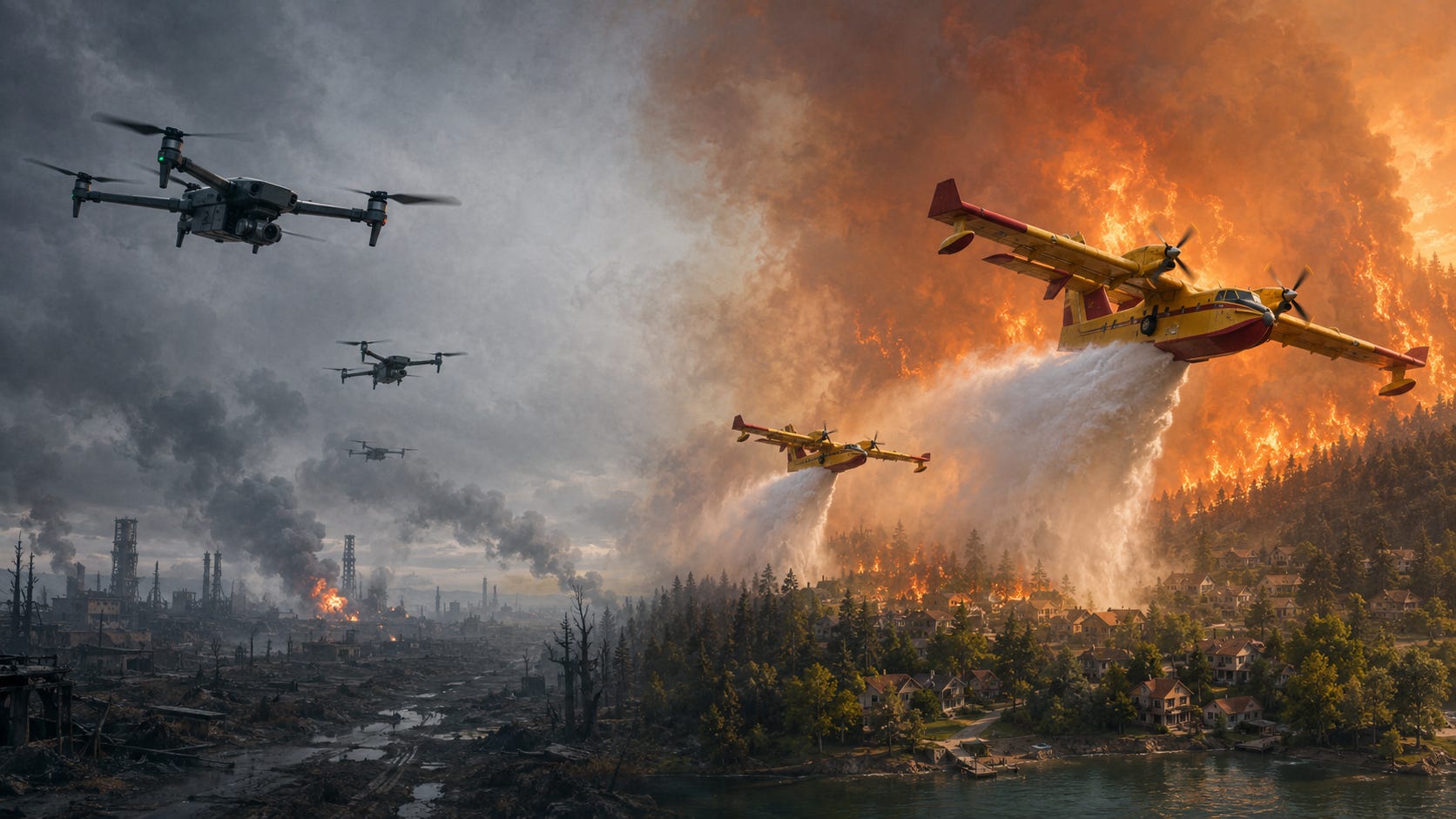
Western governments have promised to support Ukraine “for as long as it takes.”
At home, their wildfire policy appears to operate according to a different timetable:
For as long as it burns.
Weapons are ordered in anticipation of the next offensive. Loans are arranged before the next Ukrainian budget crisis. Sanctions are prepared before the effects of the previous sanctions have been assessed.
Wildfire resources arrive after ignition. Aircraft are repositioned after communities are threatened. Emergency capacity is enlarged after citizens have been evacuated and smoke has reached the cities.
Apparently, governments understand preparedness perfectly well.
They simply practise it more enthusiastically abroad.
Russia launched its full-scale invasion of Ukraine in February 2022. Ukraine had—and continues to have—the right to defend itself.
That does not exempt the governments financing the war from explaining what their money is expected to accomplish.
Canada has committed more than $25.5 billion in military, financial, humanitarian and other assistance to Ukraine. Yet Ottawa has never clearly identified the attainable political objective of that commitment.
Is Canada still financing the military restoration of Ukraine’s 1991 borders, including Crimea? Is the objective to recover only the territory occupied since 2022? Prevent further Russian advances? Preserve a viable Ukrainian state? Strengthen Ukraine’s negotiating position? Or sustain the war until circumstances somehow supply an answer?
These are not different descriptions of the same policy. They are different objectives requiring different amounts of money, equipment, manpower and time.
Nor has Ottawa demonstrated the causal path from another Canadian commitment to a better attainable outcome.
Canadian assistance must impose identifiable costs upon Russia. Those costs must change Russian military or political behaviour. That change must improve Ukraine’s probable settlement. And the improvement must justify the financial, military and escalation risks assumed by Canada.
Without that chain, Ottawa is measuring expenditure rather than achievement.
A weapons shipment is an event. A sanctions package is an event. A drone strike is an event. A ministerial visit is an event.
Victory—or movement toward a tolerable settlement—is a direction.
The Government of Canada reports the events and avoids measuring the direction.
Even its accounting has been confused. One National Defence page reported $6.5 billion in Canadian military assistance since 2022, while another government release reported $8.5 billion. Whatever explains that discrepancy, citizens should not have to reverse-engineer federal announcements to discover which $2 billion is real.
“For as long as it takes” is not a strategy. It defines neither the destination nor the stopping rule.
And it does not operate in a financial vacuum.
Every open-ended commitment abroad is also a decision about what will not receive the same money, procurement priority, personnel or political urgency at home.
That brings us to the second question, now visible through the smoke:
What might those resources have protected here?
Canada’s wildfire seasons are not unforeseen emergencies.
Governments know when the danger increases. They possess weather forecasts, historical burn records, satellite surveillance, fuel assessments and models of drought and lightning activity. They know which communities have limited evacuation routes. They know that remote northern and Indigenous communities are especially difficult to protect and evacuate.
The federal government says that 2025 was Canada’s second-worst wildfire season on record. It also acknowledges that Canadian Armed Forces involvement in domestic disaster response has roughly doubled every five years since 2010.
That is not an unexpected interruption.
It is a documented trend.
Yet Canada entered the 2026 fire season only beginning to establish a national aerial surge capacity.
Ottawa announced $316.7 million over five years for the Canadian Interagency Forest Fire Centre to lease and deploy ten additional firefighting aircraft. It also committed $108 million over three years to renew a civilian emergency-workforce program and $55.4 million over four years to renew the national public-alerting system.
These are welcome investments.
They also reveal the scale of the political choice.
Canada’s total Ukraine commitment is approximately 80 times the entire five-year federal aerial-firefighting program. Even using Ottawa’s lower $6.5-billion figure, military assistance alone is more than 20 times the cost of leasing those ten aircraft for five years.
That does not mean every dollar committed to Ukraine could—or should—have been spent on water bombers. Some assistance consists of loans, transferred military inventory, humanitarian relief and commitments extending over several years. Wildfire management is also divided among federal, provincial, territorial and local governments.
But jurisdiction does not extinguish opportunity cost.
Money is not the only scarce resource. Governments also allocate procurement attention, industrial capacity, trained personnel, airlift, communications systems, political effort and the willingness to act quickly.
For Ukraine, fiscal restraint became flexible. Procurement was accelerated. Production lines were expanded. Public borrowing was treated as necessary. Ministers competed to announce the next commitment.
At home, scarcity returned from its diplomatic vacation.
Budgets were limited. Aircraft were expensive. Personnel took time to train. Responsibility belonged to another level of government. Long-term programs required further study.
The state was capable of urgency.
It chose where to apply it.
There is another way to measure this opportunity cost.
Ottawa’s five-year program to lease ten additional firefighting aircraft may improve short-term capacity. But leasing aircraft is emergency administration.
Expanding Canada’s ability to manufacture them would be industrial strategy.
De Havilland Canada is producing the DHC-515, the world’s only purpose-built amphibious firefighting aircraft. The company possesses the design, specialized knowledge, production experience and largely Canadian supply chain needed to serve a market whose demand is no longer speculative.
The danger is already here. Communities are evacuating. Existing fleets are aging. Fire seasons are lengthening. Several countries increasingly require the same limited aircraft at the same time.
If wildfire were merely another market, even an economist could say with a straight face that the market is smoking hot.
European governments understood this. Croatia, Spain, Italy, Greece, Portugal and France collectively secured the first 22 DHC-515s in the opening production run. Manitoba, Ontario and Alberta subsequently placed orders of their own.
Foreign governments did not merely purchase Canadian water bombers.
They recognized the strategic value of Canadian technology before Canada developed a national strategy to expand it.
A serious industrial policy would do more than place a few additional provincial orders. It would help De Havilland accelerate production, expand its supplier network, train engineers and skilled tradespeople, preserve specialized knowledge and establish a Canadian-controlled aerial reserve.
The resulting aircraft could protect Canadian communities while generating export, leasing, maintenance and training revenue for decades.
That expenditure would leave something behind: factories, tooling, intellectual property, experienced workers, supplier networks and aircraft capable of serving for generations.
Military matériel sent abroad is consumed.
Industrial capacity compounds.
The contrast extends beyond assistance to Ukraine.
Canada is committing tens of billions of dollars to foreign-designed military platforms whose principal capabilities will not arrive until the next decade.
The first F-35s assigned to Canadian pilot training are being delivered to Arizona. The first aircraft intended for operations in Canada is scheduled to arrive in 2028, while full operational capability is not expected until 2032–34.
Canada’s proposed German-designed submarines lie even further in the future, with the first potentially arriving in 2033.
Both programs may eventually prove necessary. A serious country must defend its territory and cannot prepare only for threats that have already materialized.
But Ottawa is purchasing extraordinarily expensive platforms for wars that might occur, against adversaries whose capabilities will continue to evolve, using technologies and doctrines that may change before the equipment becomes fully operational.
Ukraine has already demonstrated how rapidly that transformation can happen. Relatively inexpensive drones, autonomous systems and electronic warfare have changed reconnaissance, targeting, logistics, armoured warfare and battlefield survivability.
Platforms once regarded as dominant can become vulnerable—or even obsolete—before conventional procurement systems finish delivering them.
By the time all the F-35s arrive, or the first new submarine surfaces to fight a war that may never come, the equipment—or the kind of war it was designed to fight—may have changed profoundly.
Wildfire requires no comparable act of imagination.
The forests are burning now.
The technology required to fight them is neither experimental nor awaiting some distant breakthrough. Canada already builds it. International customers already want it.
The demand is not projected.
It is backlogged.
This is not an argument for cancelling every fighter and submarine and filling the Arctic with water bombers. A serious country must prepare for more than one threat.
The issue is the allocation of urgency.
Ottawa treats a possible war in the 2030s as justification for enormous expenditure today. It treats fires burning Canadian territory today as seasonal emergencies to be managed through leasing, interprovincial borrowing and incremental programs.
One procurement anticipates the future.
The other is already late.
Canada has already demonstrated how easily a world-class domestic aircraft can be weakened when infrastructure, procurement and industrial policy operate as unrelated bureaucratic kingdoms.
In 2013, Porter Airlines conditionally ordered 12 Bombardier CS100 aircraft, with options for another 18. The order depended upon permitting jets and extending the runway at Billy Bishop Toronto City Airport.
Ottawa refused to reopen the airport’s tripartite agreement. The proposed expansion died, and with it went a potential order for as many as 30 Canadian-designed aircraft.
That decision did not single-handedly cause Bombardier to surrender control of the C Series. The program also faced high development costs, heavy debt, production difficulties, slow early sales and an aggressive trade challenge from Boeing.
But losing a highly visible Canadian customer removed precisely the domestic support a new Canadian aircraft needed.
Airbus acquired majority control of the program in 2018. Bombardier surrendered its remaining interest in 2020. The aircraft survives successfully as the Airbus A220 and remains assembled in Quebec—but control of the program no longer rests with the Canadian company that created it.
The lesson is not that governments should approve every airport expansion or rescue every struggling corporation.
It is that aviation policy, infrastructure, procurement and industrial development cannot be treated as separate subjects merely because different departments have separate stationery.
A government cannot proclaim its devotion to Canadian innovation while denying Canadian technology the domestic conditions required to succeed.
The same danger now confronts De Havilland.
If Canada fails to support production growth, supplier development, workforce training and sustained domestic orders, the specialized knowledge underlying the DHC-515 could eventually shrink, migrate or fall under foreign control.
Canada would then perform its customary industrial ritual: celebrate the product’s Canadian origins while purchasing it from somebody else.
Federal and provincial governments cannot argue that large-scale industrial intervention is beyond their means.
The Parliamentary Budget Officer estimated total federal and provincial support for the Northvolt, Volkswagen and Stellantis-LGES battery projects at $43.6 billion between 2022–23 and 2032–33, including announced and unannounced costs.
Those governments were prepared to wager extraordinary sums on foreign-controlled battery production, uncertain electric-vehicle demand and an industrial strategy substantially shaped by American subsidy policy.
Meanwhile, Canada already possesses a Canadian-controlled aerospace manufacturer producing a proven aircraft for a market driven by an observable, immediate and growing public need.
The argument is not that every battery investment must fail.
It is that Ottawa and the provinces were willing to assume enormous commercial and political risks to attract industries selected as fashionable while behaving like nervous bookkeepers toward a Canadian industry whose customers are already waiting.
We are subsidizing industries politicians predict we may need, purchasing foreign military technology we may receive in the 2030s and financing matériel consumed in a distant war.
At the same time, we are underinvesting in a Canadian aircraft, a Canadian workforce and a Canadian supply chain confronting a danger already burning across the country.
We do not need to invent this industry.
We need to recognize the one sitting in front of us.
Canada is buying foreign-designed fighters and submarines for wars that may come, in forms that may change before the equipment arrives. Foreign governments, meanwhile, have secured the first 22 aircraft from a Canadian production line to fight a danger already upon us.
Europe understood the market signal.
Canada smelled smoke and commissioned another program.
Europe’s recognition of the DHC-515’s value reflects a larger problem.
Wildfires in France and Spain have displaced hundreds of thousands of people and forced both countries to draw upon aircraft and firefighters available through the European Union Civil Protection Mechanism.
Mutual assistance is sensible. No country should maintain unlimited idle capacity for every conceivable emergency.
But mutual aid rests upon an assumption: several participating countries will not require the same resources at the same time.
That assumption becomes increasingly fragile when heat, drought and fire danger affect large regions simultaneously.
France cannot reliably lend aircraft to Spain while France is burning. Spain cannot reinforce Portugal if its own crews are fully committed. A continental reserve is useful only if it remains a reserve during a continental emergency.
Europe found the financial and political capacity to create vast multiyear facilities for Ukraine. It should be capable of creating a permanent civil-protection fleet, strategically placed across the continent, with standardized aircraft, trained crews, maintenance facilities and authority to deploy before national resources are exhausted.
Instead, foreseeable fire seasons are still treated as a succession of national surprises.
The smoke, being less respectful of sovereignty than Brussels, declines to remain inside the appropriate jurisdiction.
The United States requires a more careful comparison.
America has committed vastly greater resources to Ukraine, but it also possesses much greater domestic wildfire capacity than Canada or individual European countries. It maintains large federal, state, local and contracted firefighting organizations, extensive aviation resources and substantial forest-management programs.
Its failure is therefore not simply an absence of capability.
It is the continued imbalance between suppression after ignition and risk reduction before it.
The United States Forest Service says fuel-reduction projects generate substantial returns through avoided damage. Its research also indicates that fire-informed fuel treatments and forest management can produce benefits several times greater than their cost.
Those conclusions make prevention sound almost embarrassingly rational.
Fuel reduction, prescribed burning, firebreaks, resilient electrical systems, improved evacuation routes, remote detection and community hardening will not eliminate wildfire. Nothing will.
They can reduce the probability that an ignition becomes a catastrophe.
Yet prevention remains politically less attractive than emergency response. A fire that never destroys a community produces no dramatic press conference. There are no grateful evacuees to photograph, no aircraft passing heroically through walls of smoke and no minister announcing that every possible resource has now been mobilized.
Preparedness is punished by its own success. When it works, the disaster does not occur and politicians cannot claim credit for defeating it.
War spending has the opposite political advantage.
Every setback can be used to justify further expenditure. If weapons fail to alter the balance, more sophisticated weapons are required. If sanctions fail to change Russian policy, another sanctions package demonstrates resolve. If Ukraine’s position deteriorates, the deterioration becomes evidence that assistance must increase.
Failure does not trigger reassessment.
It becomes the next funding request.
The argument is not that Western support for Ukraine caused the wildfires.
It is not that redirecting every dollar would have prevented every evacuation.
And it is certainly not that Ukrainian lives matter less than Canadian, European or American lives.
The argument is that governments repeatedly claimed the fiscal capacity, industrial flexibility and political urgency necessary to confront danger abroad while describing domestic preparedness as constrained by scarcity.
A serious wildfire strategy could have built:
permanent national and continental aerial reserves;
greater Canadian production of purpose-built firefighting aircraft;
year-round crews rather than seasonal improvisation;
trained civilian emergency reserves;
larger fuel-reduction and prescribed-burning programs;
satellite, drone and ground-based early-detection networks;
firebreaks and defensible zones around vulnerable communities;
hardened electrical and communications infrastructure;
reliable evacuation routes for remote communities;
stockpiled pumps, hoses, protective equipment and mobile shelters;
agreements allowing aircraft and crews to cross jurisdictions before local capacity is exhausted;
Indigenous-led land-management and emergency-response capability; and
stable funding for prevention rather than emergency appropriations after disaster.
Some of this is finally being done.
That is not evidence that the criticism was misplaced.
It is evidence that the need was real.
The proper question is not how much money was announced after several catastrophic seasons. It is what capacity existed before the smoke arrived, what was operational when it was needed and whether that capacity is growing faster than the threat.
Citizens do not need another ceremonial promise that governments will “spare no expense.”
They need an account.
What do we have now?
How many aircraft, trained crews, evacuation teams and deployable emergency personnel are operational—not ordered, proposed or awaiting delivery?
What is coming in?
Which new aircraft and capabilities are funded, contracted and scheduled? When will they become available?
What is leaving?
How many aircraft are unavailable because of age, maintenance or competing deployments? How many experienced personnel are retiring or leaving seasonal work?
Which direction are we moving?
Is national capacity growing faster than the number, duration and geographic overlap of serious fires?
What needs to change?
Do we need a permanent national fleet, expanded Canadian production, more prescribed burning, improved forest management, different building standards, hardened utilities or a larger emergency workforce?
How much time do we have?
Can the present system withstand several provinces—or several European countries—requiring major assistance simultaneously?
These are elementary questions.
Governments bury them beneath announcements because announcements describe intention, while answers reveal capacity.
Supporting Ukraine’s survival can be defended.
Humanitarian assistance can be defended.
Helping Ukraine negotiate from the strongest realistically attainable position can be defended.
What cannot be defended is treating a distant war as an unlimited strategic obligation while predictable dangers at home are managed through limited programs, fragmented jurisdictions and emergency improvisation.
Ukraine’s destruction would not be remedied by allowing Canadian, European or American communities to become less secure. Compassion for Ukrainians does not require governments to neglect their first responsibility to the citizens who elected and financed them.
Nor should the comparison be reduced to an accounting trick in which every artillery shell becomes a theoretical fire truck.
The deeper opportunity cost is political and industrial.
Western governments gave the war priority, urgency and permission to exceed ordinary restraints. Wildfire preparedness received programs, pilot projects and promises of coordination.
Canada went further. It subsidized foreign-controlled battery production, committed enormous sums to foreign-designed military platforms arriving in the next decade and financed matériel for an open-ended war—while failing to make a Canadian firefighting aircraft and its Canadian supply chain a central national priority.
One approach spends money.
The other builds capacity.
The question is not whether every fire could have been stopped.
It is whether governments that found hundreds of billions for a war without a defined conclusion could have acted substantially sooner to prepare for dangers they knew were coming—and whether Canada could have turned that preparation into productive national investment.
“For as long as it takes” was never merely a promise to Ukraine.
It was a claim upon money, equipment, personnel, industrial capacity and political attention that could not be used elsewhere.
Now the cost of that choice is drifting over our cities, closing our roads and forcing citizens from their homes.
The weapons were treated as urgent before they were ordered.
The foreign fighters and submarines are treated as urgent years before they arrive.
The wildfires became urgent only after they began to burn.
That is not an absence of resources.
It is a declaration of priorities.
No posts
Comments
Nothing yet. Say the first thing.
Sign in to join the conversation.